
Case Background
The matter arose out of a long-running dispute between a tenant (the petitioner) and the landlord’s side (opposite party no. 2) over a shop and house premises in Patna.
According to the record, the petitioner claimed to be a tenant of the premises under an agreement made by the late mother of opposite party no. 2. The existence of a tenancy document in favour of the petitioner was not disputed, though its authenticity was challenged by opposite party no. 2.
Serious disputes followed. The petitioner lodged an FIR alleging that opposite party no. 2 and others had broken open his lock and removed stock of shoes worth Rs. 3–4 lakhs from the rented premises. That criminal case ended in the conviction of opposite party no. 2 and others.
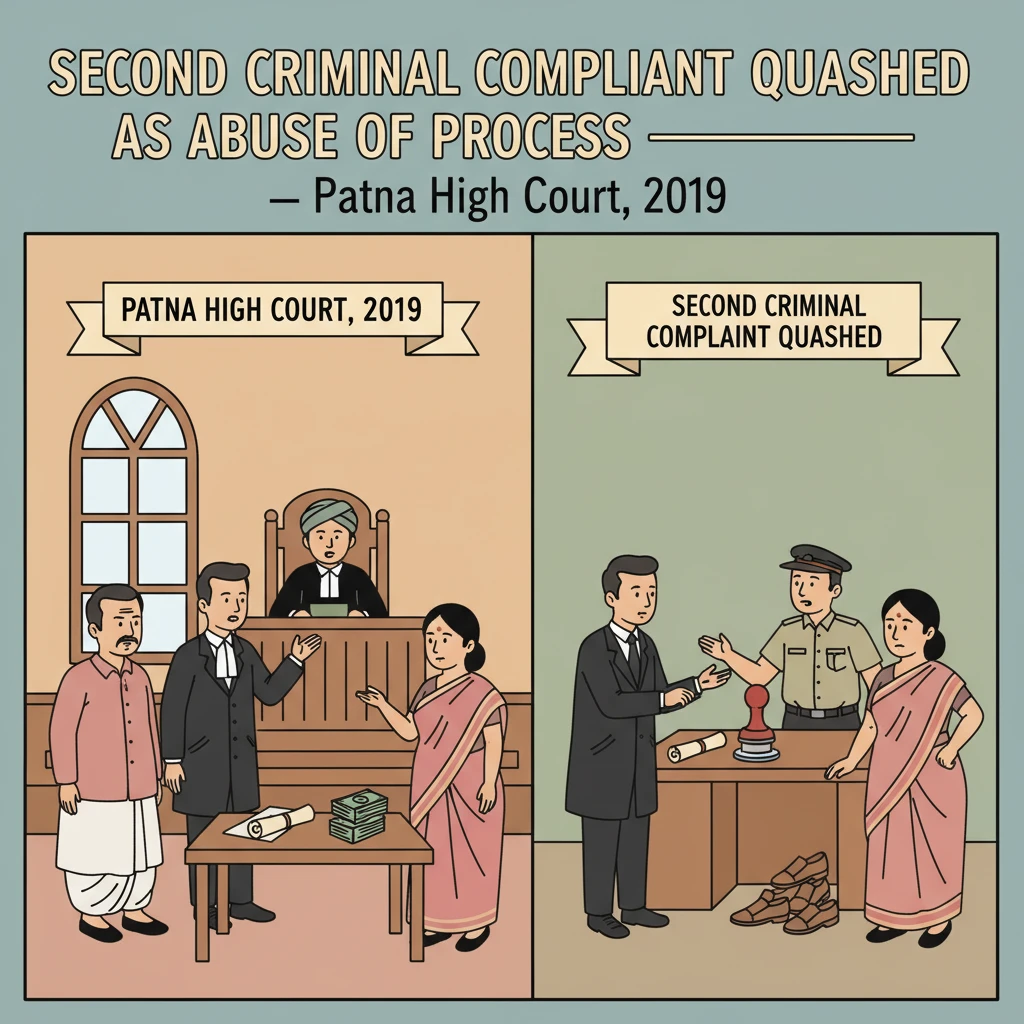
Opposite party no. 2 also started criminal proceedings against the petitioner. He first filed Complaint Case No. 1542(C) of 2013. When that complaint was sent to the police, it led to Kotwali P.S. Case No. 271 of 2013. After investigation, the police gave a clean chit to the petitioner and other co-accused and recommended action against opposite party no. 2 under Sections 182 and 211 of the Indian Penal Code for lodging a false case. That prosecution also ended in conviction of opposite party no. 2 and others under those sections.
Not satisfied, opposite party no. 2 filed a Protest-cum-Complaint Case No. 4518(C) of 2013 when the police did not send up the petitioner for trial. The Magistrate granted him about six months’ time and several opportunities to produce witnesses. When he failed to do so, that complaint was dismissed on 03.06.2014.
After this dismissal, opposite party no. 2 again filed a fresh Complaint Case No. 28282(C) of 2014 on 25.07.2014. This time, he alleged that on 01.05.2013 at 9:00 p.m. the petitioner and two others entered his shop, snatched Rs. 8,000 and a gold chain, and that there had earlier been misbehaviour with his wife on 19.04.2013 regarding keeping the petitioner’s goods in his house.
On 10.08.2015, the Judicial Magistrate, 1st Class, Patna, found a prima facie case under Sections 379, 323 and 385 of the Indian Penal Code and issued process against the petitioner and others in Complaint Case No. 28282(C) of 2014.
The petitioner approached the Patna High Court under Section 482 of the Code of Criminal Procedure, 1973, seeking quashing of the order dated 10.08.2015, the entire complaint case and all subsequent proceedings.
What the Court Examined and Decided
The Patna High Court, through Hon’ble Mr. Justice Ahsanuddin Amanullah, heard the petitioner, the State, and opposite party no. 2. The central questions were whether this fresh complaint was legally maintainable and whether continuing the criminal case would amount to abuse of the Court’s process.
The petitioner argued that the 2014 complaint was a “counter blast” and a repeat of earlier allegations already rejected by the police and the Court. He pointed out:
- His own FIR about theft of shoes from the rented premises had led to conviction of opposite party no. 2 and others.
- Opposite party no. 2’s Complaint Case No. 1542(C) of 2013 had been investigated through Kotwali P.S. Case No. 271 of 2013, found totally false, and ultimately resulted in conviction of opposite party no. 2 under Sections 182 and 211 of the IPC.
- When the police did not send up the petitioner for trial, opposite party no. 2 filed Protest-cum-Complaint Case No. 4518(C) of 2013, but failed for six months to produce witnesses, leading to dismissal of that complaint on 03.06.2014.
- Only after this dismissal, a fresh Complaint Case No. 28282(C) of 2014 was filed with identical allegations, merely to harass the petitioner and put pressure on him to vacate the tenanted premises.
The petitioner relied on the Supreme Court decision in Surender Kaushik v. State of U.P. (2013) 5 SCC 148, particularly paragraph 24, which holds that a further complaint on the same facts by the same complainant against the same accused is not permissible once a case has already been registered and investigated.
He also relied on the landmark judgment in State of Haryana v. Bhajan Lal, 1992 Supp (1) SCC 335, especially category 7 of paragraph 102. That category allows quashing where a criminal proceeding is manifestly attended with mala fide or is maliciously instituted with an ulterior motive for wreaking vengeance.
Further, the petitioner cited State of Karnataka v. L. Muniswamy, (1977) 2 SCC 699, where the Supreme Court held that the High Court can use its inherent powers to quash criminal proceedings that have become tools of harassment or persecution.
Lastly, he referred to Anand Kumar Mohatta v. State (Govt. of NCT of Delhi), 2019 (1) PLJR (SC) 215, to show that the High Court can still exercise its powers under Section 482 CrPC even after a charge-sheet is filed or charges are framed.
The State’s counsel stated that the Magistrate had taken cognizance after examining the complaint and witness statements. However, when the Court directly asked how a second complaint based on the same facts between the same parties was maintainable in light of Surender Kaushik, the State fairly admitted that the law favoured the petitioner.
Opposite party no. 2 maintained that he was the real victim. He said the petitioner and others had misbehaved with his wife and tried to forcibly keep their goods in his house, for which he had first lodged a Sanha with the local police. When no action followed, he filed complaints. He claimed the police investigation was faulty because his witnesses were not examined. He stressed that in the fresh complaint he had mentioned a specific incident of 01.05.2013, whereas in the earlier complaint the period of occurrence was from 09.04.2013 “till date,” arguing that the two causes of action were different.
He candidly admitted that, due to wrong legal advice, he had filed a fresh complaint instead of a restoration application for Complaint Case No. 4518(C) of 2013. He also pointed out that, since filing of the quashing petition, charges had been framed and some witnesses cross-examined.
The Court considered the admitted sequence of events and concluded that opposite party no. 2 was repeatedly trying to pursue an issue in which he had already failed twice—before the police and before the Court. Both the petitioner’s FIR and the police case arising out of opposite party no. 2’s first complaint had ended in convictions against opposite party no. 2 and others.
On these facts, the Court held that the 2014 complaint was “totally not maintainable, both in law as well as on facts.” It stressed that the Magistrate had earlier granted more than reasonable opportunity to opposite party no. 2 to produce witnesses in Complaint Case No. 4518(C) of 2013. After his failure and the dismissal of that case, he filed a fresh complaint without explaining his earlier default.
The Court observed that a person cannot take advantage of his own gross negligence. Allowing someone to file a fresh complaint every time an earlier complaint is dismissed because of his own inaction would create “legal chaos” and would clearly be an abuse of the process of the Court.
Relying on Surender Kaushik, the Court held that a second complaint on the same facts by the same complainant against the same accused is not permissible. Here, the situation was even worse: the facts were identical, parties were the same, and the second complaint was by the same complainant.
On the factual allegations, the Court found that the story of the petitioner entering the shop at 9:00 p.m. on 01.05.2013 and snatching Rs. 8,000 and a gold chain “cannot be said to be believable” and appeared “cosmetic,” seemingly introduced only to give a criminal colour to the dispute.
Similarly, the allegation that on 19.04.2013 the petitioner and others had tried to forcibly keep goods in the house of opposite party no. 2, resisted by his wife, did not sit well with the admitted existence of a tenancy document in favour of the petitioner. If the petitioner was a tenant, there would be no occasion for him to use force simply to keep his goods in the tenanted premises.
The Court underlined that, although the authenticity of the tenancy document was disputed, it had not been set aside by any court. Until such time, law requires that such a document can only be undone, quashed, or declared void by a competent civil court. Therefore, the Court noted that the real dispute between the parties was “basically civil in nature,” relating to the tenancy of the petitioner in the house/shop.
Applying category 7 of Bhajan Lal, and the principles in L. Muniswamy, the Court held that the present criminal proceedings were manifestly attended with mala fide and had been instituted with an ulterior motive to wreak vengeance and harass the petitioner.
On the argument that charges had already been framed and some witnesses examined, the Court answered by citing Anand Kumar Mohatta. It affirmed that the High Court’s inherent powers under Section 482 CrPC can be used at any stage of criminal proceedings to prevent abuse of process or secure the ends of justice. The stage of the case does not bar the Court from quashing proceedings where warranted.
In conclusion, the Court found that the complaint of opposite party no. 2 lacked bona fides and had been filed for oblique reasons. It therefore exercised its inherent power under Section 482 CrPC to quash the entire criminal proceedings.
The Criminal Miscellaneous application No. 8734 of 2016 was allowed. The entire criminal proceeding arising out of Complaint Case No. 28282(C) of 2014, pending before the Judicial Magistrate, 1st Class, Patna, including the order taking cognizance dated 10.08.2015 and all subsequent orders, stood quashed.
Why This Judgment Matters
This Patna High Court judgment is important for people facing repeated or motivated criminal complaints arising from tenancy or property disputes. It shows that criminal law cannot be used again and again to pressurise the other side when earlier attempts have failed.
The Court makes it clear that:
- A second complaint on the same facts, by the same complainant, against the same accused, is not allowed.
- A person cannot avoid the consequences of his own default in an earlier case by simply filing a new complaint.
- Where the main dispute is civil—like over tenancy or possession—criminal law should not be misused as a weapon of harassment.
- The High Court can step in under Section 482 CrPC at any stage, even after charges are framed, to stop such abuse of process.
For ordinary tenants and small shopkeepers, this judgment offers reassurance that the courts will not permit repeated, false criminal cases just to drive them out or settle scores.
Legal Issues and Answers
Issue: Can a complainant file a fresh criminal complaint on the same and identical facts, between the same parties, after an earlier complaint has been dismissed and related proceedings have already resulted in conviction against him?
Answer: No. The Patna High Court held, following Surender Kaushik, that a second complaint on the same facts by the same complainant against the same accused is not maintainable, and such conduct amounts to abuse of process.
Issue: Can the High Court exercise its powers under Section 482 CrPC to quash criminal proceedings even after cognizance has been taken, charges framed, and some witnesses examined?
Answer: Yes. Relying on Anand Kumar Mohatta and other precedents, the Court held that Section 482 can be invoked at any stage to prevent abuse of the process of any court or to secure the ends of justice.
Issue: Whether the criminal complaint in this case, based on allegations of snatching money and a gold chain and misbehaviour regarding keeping goods, should be allowed to continue?
Answer: No. The Court found the allegations inherently improbable and cosmetic, noted that the underlying dispute was civil (tenancy), and held that the proceedings were mala fide and intended to harass the petitioner; hence, they were quashed.
Cases Cited by the Court
- Surender Kaushik v. State of U.P., (2013) 5 SCC 148.
- State of Haryana v. Bhajan Lal, 1992 Supp (1) SCC 335.
- State of Karnataka v. L. Muniswamy, (1977) 2 SCC 699.
- Anand Kumar Mohatta v. State (Govt. of NCT of Delhi), 2019 (1) PLJR (SC) 215.
Case Details
Case Number: Criminal Miscellaneous No. 8734 of 2016, arising out of Complaint Case No. 28282(C) of 2014.
Case Title: Sabiul Haque @ Saviul Haque @ Sabih-ul-Haque v. The State of Bihar & Aftab Alam.
Coram: Hon’ble Mr. Justice Ahsanuddin Amanullah.
Date of Judgment: 12-04-2019.
Citation: 2019 (2) PLJR 1141.
Advocates:
- For the petitioner: Mr. Rana Vikram Singh, Advocate.
- For opposite party no. 2: Mr. Aaruni Singh and Mr. Sandeep Kumar Gautam, Advocates.
- For the State: Mr. Jharkhandi Upadhyay, APP I/C and Mr. S. Dayal, APP.
Nature of the case: Petition under Section 482 of the Code of Criminal Procedure, 1973, seeking quashing of an order taking cognizance and the entire criminal proceedings arising from a private complaint.
Link to Judgment: Patna High Court official judgment link
If you found this explanation helpful and wish to stay informed about
how legal developments may affect your rights in Bihar,
you may consider following Samvida Law Associates for more updates.







