
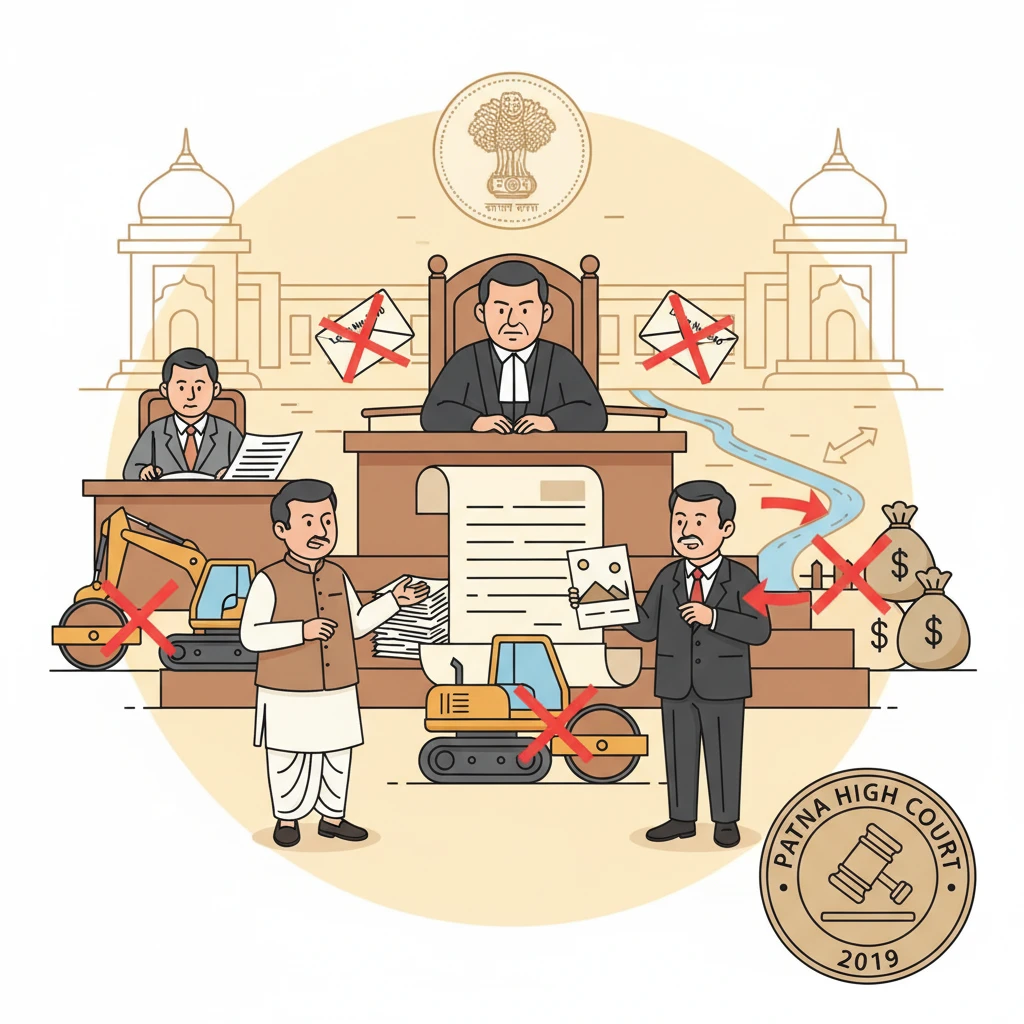
He wanted extra compensation for idle machinery, loss of profit, and contractual compensation.
The Court refused to interfere with the Arbitration Tribunal’s findings.
The revision was dismissed and the Tribunal’s award remains in force.
Case Background
The dispute arose out of a public works contract executed by the petitioner with the Water Resources Department of the State of Bihar. The work related to a government project, and the Bihar Public Works Contracts Disputes Arbitration Tribunal was the forum agreed for resolving disputes under such contracts.
The petitioner claimed that, while executing the work, serious delay occurred because land required for the project was not made available in time. According to him, this delay was due to land acquisition proceedings and not due to any fault on his part.
Because of this delay, the contractor approached the Bihar Public Works Contracts Disputes Arbitration Tribunal in Reference Case No. 74 of 2012. He raised several monetary claims against the State and its officers connected with the Water Resources Department.
On 27.11.2014, the Tribunal passed its award. It partly allowed the contractor’s claim by granting escalation of price and extra lead charges for carriage of construction materials, along with interest. However, it refused to grant three substantial claims raised as Relief Nos. 3, 4 and 5.
The contractor then filed Civil Revision No. 23 of 2015 before the Patna High Court under its supervisory jurisdiction. He asked the High Court to interfere with the Tribunal’s award to the limited extent of the three rejected heads of claim.
What the Court Examined and Decided
Justice Birendra Kumar heard the civil revision on 22.02.2019. Both sides were represented by counsel. The Court focused on whether there was any legal basis to interfere with the arbitration award in respect of three denied claims.
The three rejected reliefs were clearly set out in the judgment. First, Relief No. 3 sought to set aside departmental letters No. 340 dated 15.06.2012 and No. 476 dated 11.08.2012, and to award a sum of Rs. 3,39,78,968/-. This amount represented expenditure allegedly incurred between 25.05.2010 and 15.04.2012 towards idle machinery, that is, tools and plants which could not be used because of non-availability of land.
Second, Relief No. 4 claimed Rs. 3,47,31,597/- as loss of opportunity to earn profit elsewhere. The basis of this claim, as recorded by the Court, was that the petitioner had spent more than three years on the project due to alleged lapses on the part of the respondents.
Third, Relief No. 5 sought compensation of Rs. 41,85,528/- under clause 2(A) of the contract. All three reliefs were described by the Court as interconnected, arising out of the same core grievance: delay in making land available for the project because of ongoing land acquisition proceedings.
The petitioner’s counsel advanced a key argument. He submitted that the notice inviting tender (NIT) formed part of the contract and that item No. 6 of the NIT specifically stated that the land for the work was available. On this basis, counsel argued that a later contractual clause, numbered 6.3.7, could not be used to deny compensation for delay caused by non-availability of land.
Clause 6.3.7, which was reproduced in the judgment, stated that it might take the department some time to obtain possession of land through normal land acquisition procedures, and that the department would not be liable for any damage or compensation due to delay in start or suspension of work on account of delay in getting possession of land or change in alignment.
The petitioner’s counsel contended that this clause should not bar compensation in the present case because the NIT itself had declared that the land was already available. He argued that contractors bid relying on the NIT, and that once the department declared availability of land, it could not later rely on clause 6.3.7 to escape liability for delay.
To support this submission, the petitioner relied heavily on an earlier judgment of the Patna High Court in Civil Revision No. 19 of 2014, M/s. Anil Sharma vs. The State of Bihar and Others, decided on 15.09.2017. That matter also involved the same petitioner and the same department but under a different contract.
The earlier Single Judge Bench had examined similar contractual clauses. In paragraphs 11 to 13 of that decision, quoted extensively in the present judgment, the Court had held that where the NIT clearly stated that the site was available and did not disclose that the land was under acquisition, a contractor could not be expected to assume that the site itself might not be available.
In that earlier case, the Court found that clause 6.3.7 did not absolve the department because the NIT had never mentioned that the land was in acquisition proceedings. The Court had also observed that inspection clauses, which treat bidders as having full knowledge of the site whether inspected or not, relate to nature and conditions of the site rather than non-availability of the land itself.
On that reasoning, in Civil Revision No. 19 of 2014, the Court had held that the Tribunal erred in relying on clause 6.3.7 to reject the contractor’s claim, and it had remitted the matter back to the Tribunal for reconsideration.
In the present civil revision, the petitioner tried to extend that reasoning. He urged that, since the clauses and circumstances were similar, the Tribunal’s rejection of his three claims in Reference Case No. 74 of 2012 should also be set aside, or at least reconsidered.
The State’s counsel opposed the revision. He anchored his argument not on the detailed facts of the contract but on the limited scope of judicial review of arbitral awards. According to him, decisions of the Supreme Court had repeatedly clarified that High Courts cannot act like appellate courts over arbitration tribunals.
The State’s counsel pointed out that a “catena of decisions” of the Supreme Court restricted interference with arbitration awards. He also submitted that these Supreme Court judgments had not been brought to the notice of the Single Judge who had decided Civil Revision No. 19 of 2014, implying that the earlier ruling could not control the outcome here when higher binding precedent on the scope of review was now being specifically cited.
The Patna High Court then referred to the Supreme Court judgment in M/s. Rabindra Kumar Gupta vs. Union of India, reported in 2010 (1) PLJR SC 145. Paragraphs 13 to 18 of that judgment were reproduced in detail. Those passages discussed earlier Supreme Court decisions, such as State of Rajasthan vs. Puri Construction Co. Ltd., Municipal Corporation of Delhi vs. Jagan Nath Ashok Kumar, Arosan Enterprises Ltd. vs. Union of India, ONGC vs. SAW Pipes Ltd., Kwality Manufacturing Corporation vs. Central Warehousing Corporation, Madhya Pradesh Housing Board vs. Progressive Writers and Publishers, and Ispat Engineering & Foundry Works vs. Steel Authority of India.
The common principle running through those authorities, as highlighted in the Patna High Court’s judgment, is that an arbitrator is the final judge on facts and, to a large extent, on interpretation of the contract. Courts cannot re-appraise evidence, re-evaluate findings, or substitute their own view if the arbitrator’s view is a possible one based on the material available.
The Supreme Court had clarified that courts may interfere only in narrow situations: where there is total perversity in the award, where it is based on a patently wrong proposition of law, where there is an error apparent on the face of the record, or where the arbitrator has acted beyond jurisdiction or in a manner contrary to the reference.
Relying on these binding principles, Justice Birendra Kumar concluded that the High Court, while exercising supervisory jurisdiction over an arbitral award, cannot go into disputed questions of fact. Nor can it re-appreciate the Tribunal’s findings on the evidence or interpret the contract differently merely because another view is possible.
The judgment records that the Tribunal had already considered the material and exercised its judgment in allowing some claims (escalation and extra lead with interest) and rejecting others (idle machinery, loss of profit, and clause 2(A) compensation). The High Court held that it could not simply replace the Tribunal’s view with its own, even in light of the earlier Civil Revision decision.
Ultimately, the Court held that there was “no merit in this revision application.” On that basis, Civil Revision No. 23 of 2015 was dismissed. The Tribunal’s award dated 27.11.2014 thus remains operative in the form it was originally passed, including the rejection of Relief Nos. 3, 4 and 5.
Why This Judgment Matters
This decision reinforces for contractors and government departments alike that once a dispute goes to the Bihar Public Works Contracts Disputes Arbitration Tribunal, its factual findings carry great weight.
Even if a contractor feels that important amounts like idle machinery charges or loss of profit have been wrongly denied, the Patna High Court will intervene only in very rare situations. The Court will not re-calculate figures, re-weigh evidence, or reinterpret contractual clauses if the Tribunal’s view is a reasonably possible one.
For government works contractors, this means that the main battle is before the Arbitration Tribunal itself. Evidence, site conditions, and contractual interpretation must be fully presented at that stage. Later attempts to reopen such matters through civil revision are likely to fail unless there is a clear legal error or perversity.
For departments, the judgment confirms that arbitration awards in their favour are unlikely to be disturbed merely because contractors rely on different readings of the same contract. The focus will remain on whether the Tribunal acted within its jurisdiction and followed the law, not on whether some other view might also have been taken.
Legal Issues and Answers
Issue: Can the Patna High Court, in a civil revision, re-examine the Bihar Public Works Contracts Disputes Arbitration Tribunal’s refusal to grant claims for idle machinery, loss of profit, and contractual compensation where those findings are based on the Tribunal’s appreciation of facts and contract clauses?
Answer: No. Relying on Supreme Court precedent, the Court held that it cannot go into disputed questions of fact, re-appreciate evidence, or substitute its own view for that of the Tribunal. As there was no perversity or jurisdictional error shown, the revision had no merit and was dismissed.
Cases Cited by the Court
- M/s. Rabindra Kumar Gupta vs. Union of India, 2010 (1) PLJR SC 145 (extracts from paragraphs 13–18 reproduced, referring to multiple Supreme Court decisions on limits of interference with arbitral awards).
- Within that judgment, the Supreme Court discussed and relied upon:
- State of Rajasthan vs. Puri Construction Co. Ltd. & Others, (1994) 6 SCC 485
- Sudarsan Trading Co. vs. Government of Kerala, 1989 India Law SC 463
- Municipal Corporation of Delhi vs. Jagan Nath Ashok Kumar, (1987) 4 SCC 497
- Arosan Enterprises Ltd. vs. Union of India, (1999) 9 SCC 449
- Oil & Natural Gas Corporation Ltd. vs. SAW Pipes Ltd.
- M/s. Kwality Manufacturing Corporation vs. Central Warehousing Corporation
- Madhya Pradesh Housing Board vs. Progressive Writers and Publishers, (2009) 5 SCC
- Ispat Engineering & Foundry Works vs. Steel Authority of India, (2001) 6 SCC 347
- The Patna High Court also noted its own earlier decision in Civil Revision No. 19 of 2014, M/s. Anil Sharma vs. The State of Bihar and Others, disposed of on 15.09.2017.
Case Details
Case Number: Civil Revision No. 23 of 2015
Case Title: M/s Anil Sharma vs. The State of Bihar and Others
Coram: Hon’ble Mr. Justice Birendra Kumar
Citation: 2019 (3) PLJR 203
Date of Judgment: 22.02.2019
Advocates:
- For the Petitioner: Mr. Sandip Shahi, Mr. Manish Sahay, Advocates
- For the Respondents (State of Bihar and officials of Water Resources Department): Mr. Kameshwar Pd. Gupta, GP 10; Mr. Binod Kumar, AC to GP 10
Nature of the Case: Civil revision challenging an award of the Bihar Public Works Contracts Disputes Arbitration Tribunal in Reference Case No. 74 of 2012 concerning a public works contract.
Link to Judgment: Patna High Court Judgment in Civil Revision No. 23 of 2015
If you found this explanation helpful and wish to stay informed about
how legal developments may affect your rights in Bihar,
you may consider following Samvida Law Associates for more updates.







