

Case Background
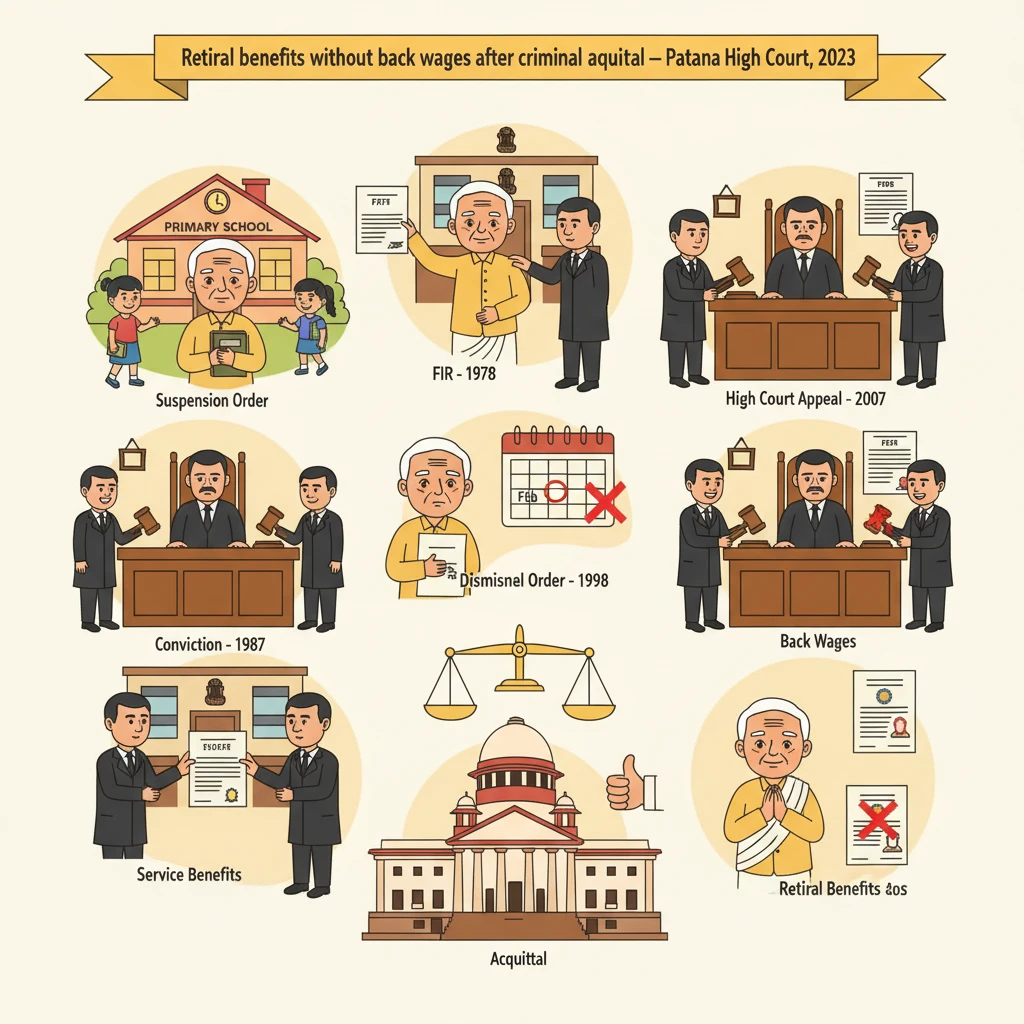
The appellant was a government primary school teacher. He joined service on 21.06.1971 at a primary school in Dumrawan, Aghoura, in the then district of Shahabad.
On 22.05.1978, an FIR being Mohania P.S. Case No. 8 of 1978 was lodged against him and others for the offence under Section 302 of the Indian Penal Code. Because of this criminal case, he was suspended from service on 29.05.1978.
After trial, the 4th Additional Sessions Judge, Rohtas at Sasaram, by judgment dated 18.12.1987 in Sessions Trial No. 1467 of 1979, convicted the appellant and others under Sections 302 read with 34 of the Indian Penal Code. The appellant then filed Criminal Appeal No. 28 of 1988 before the Patna High Court challenging his conviction and sentence.
While this criminal appeal was pending, the education authorities dismissed him from service by orders dated 12.06.1998 and 29.06.1998. The dismissal was based only on his conviction in the murder case. No departmental inquiry was held against him for any misconduct.
The appellant challenged the dismissal by filing C.W.J.C. No. 1974 of 1999 before a learned Single Judge of the Patna High Court. That writ petition was disposed of on 25.04.2000. The judgment notes that, if he had not been dismissed, he would have superannuated from service on 28.02.2003.
Meanwhile, on 24.08.2007, the Patna High Court dismissed Criminal Appeal No. 28 of 1988 and confirmed his conviction and sentence. The appellant then approached the Hon’ble Supreme Court by filing Criminal Appeal Nos. 493-494 of 2008.
By order dated 16.02.2017, the Supreme Court set aside his conviction and sentence and acquitted him. The Supreme Court observed that over-implication was not ruled out, that he had not been given any particular role in the assault on the deceased, and therefore he was entitled to benefit of doubt.
After this acquittal, the appellant submitted a representation dated 24.07.2017, followed by another similar representation, before the authorities. He requested full back wages and all terminal benefits on the basis of his acquittal. As the authorities did not respond, he filed Civil Writ Jurisdiction Case No. 13042 of 2018 before the Patna High Court.
The learned Single Judge dismissed the writ petition by order dated 27.02.2020. Aggrieved, the appellant filed the present Letters Patent Appeal No. 322 of 2020. During the pendency of these proceedings, the appellant died and the appeal is now being pursued by his widow.
What the Court Examined and Decided
The Division Bench, speaking through Hon’ble Mr. Justice Vipul M. Pancholi, examined whether the appellant, a government teacher dismissed on account of criminal conviction, was entitled to reinstatement, back wages, and retiral benefits after his subsequent acquittal by the Supreme Court.
The appellant’s counsel argued that the only ground for dismissal in 1998 was the trial court’s conviction for an offence under Section 302/34 IPC. No independent departmental inquiry was held. Once the Supreme Court had set aside the conviction on 16.02.2017 and acquitted him, the foundation of the dismissal order had vanished.
Therefore, according to the appellant, the authorities were bound to treat him as if he had never been convicted and should have granted him full back wages and all post-retiral benefits. Since he had already superannuated on 28.02.2003, the relief was essentially for financial benefits. His counsel also pointed out that his widow was now prosecuting the matter after his death.
On the other hand, the State contended that the appellant had actually worked for only about seven years. From 1978 onwards he was under suspension, and then after conviction in 1987 he remained out of effective service and was formally dismissed in 1998. By the time of his superannuation in 2003, his conviction still stood confirmed by the High Court’s 2007 judgment.
The State further pointed out that the Supreme Court’s acquittal was based on benefit of doubt. They emphasized that the order of acquittal came in 2017, long after he had reached the age of retirement, and hence there was no question of reinstatement.
They also urged that since he had not worked from 1978 onwards and particularly from his dismissal in 1998 till superannuation in 2003, he could not claim back wages. The learned Single Judge had already clarified that, if he had completed the qualifying service required for pension before the dismissal, the authorities could consider his case for pensionary or other post-retiral benefits, and the dismissal order would not block that. On this basis, the State requested dismissal of the appeal.
The Division Bench carefully considered the factual sequence: appointment in 1971; FIR in 1978 followed by suspension; conviction in 1987; dismissal in 1998; dismissal of criminal appeal by the High Court in 2007; acquittal by the Supreme Court in 2017; and superannuation date of 28.02.2003. It also noted that no departmental inquiry had been conducted; the only reason for dismissal was the criminal conviction.
The Court then examined a line of Supreme Court judgments cited by the appellant’s counsel to understand the law on the effect of an acquittal on employment consequences.
First, in Divisional Controller, Karnataka State Road Transport Corporation v. M.G. Vittal Rao, the Supreme Court had explained that reinstatement on acquittal normally arises where dismissal was based on criminal conviction under Article 311(2) second proviso (a) or similar rules. However, if an independent departmental enquiry has been held, an acquittal in the criminal case does not automatically wipe out the departmental findings because the standards of proof are different.
Second, in Deputy Inspector General of Police v. S. Samuthiram, the Supreme Court reiterated that mere acquittal in a criminal trial does not by itself lead to exoneration in disciplinary proceedings, especially where the punishment was not based solely on conviction.
Third, in Ranchhodji Chaturji Thakore v. Superintendent Engineer, Gujarat Electricity Board, the Supreme Court considered whether an employee, whose service was terminated due to criminal conviction and who was later acquitted, was entitled to back wages. The Court held that each case has to be examined on its own facts. An employee who had involved himself in a crime and was unable to render service due to conviction and jail incarceration was not entitled to back wages, though reinstatement might be ordered.
Fourth, in Union of India v. Jaipal Singh, the Supreme Court endorsed Ranchhodji. It held that when an employee gets involved in a criminal case as a citizen, and the department is not responsible for the prosecution, the employer cannot be faulted for keeping him out of service during conviction. The department is within its rights to deny back wages for the period when it could not avail his services. However, back wages from the date of acquittal might be granted.
Fifth, in Allahabad Bank v. Krishan Pal Singh, the Supreme Court once again underlined that reinstatement with full back wages is not automatic even where termination is found procedurally flawed. Considering that the employee in that case had worked only about six years and had already superannuated, the Court replaced reinstatement and full back wages with lump sum monetary compensation.
Using these authorities, the Patna High Court drew a distinction between two aspects: the legality of the dismissal order and the claim for back wages.
On the first aspect, the Court noted that the dismissal order was based “simply relying upon” the trial court’s conviction under Section 302 IPC. No departmental inquiry was undertaken into any misconduct or illegality. When the Supreme Court ultimately set aside that conviction in 2017 and acquitted the appellant, the very basis for the dismissal disappeared.
On these facts, the Bench held that the usual debate about whether the acquittal was “honourable” or only by benefit of doubt did not really arise. Since there was no independent departmental proceeding, and only the conviction had led to dismissal, the fall of the conviction meant the dismissal could not stand.
Accordingly, the Court concluded that the dismissal order had to be quashed and set aside.
On the second aspect, the Court considered whether back wages could be awarded. It stressed that the appellant had not worked from the date of dismissal on 29.06.1998 up to his superannuation on 28.02.2003. The acquittal came much later in 2017. Relying on the Supreme Court precedents, the Court held that an employer cannot be made liable to pay wages for a period during which the employee did not actually render service and the employer could not use his services because of a subsisting conviction.
The Bench accepted that in some cases back wages from the date of acquittal have been granted. But here, by the time of acquittal, the appellant had already crossed the age of superannuation and, further, had died during the present proceedings. Therefore, questions of reinstatement or post-acquittal salary did not practically arise. The Court, therefore, refused to grant back wages for any period.
Balancing these factors, the Division Bench set aside the learned Single Judge’s order to the extent it had upheld the dismissal. It held that the appellant (and now his widow) would be entitled to all retiral benefits flowing from his service, but not to back wages.
In effect, the service record would stand without the stigma of dismissal, enabling calculation of pension and other terminal dues, if otherwise admissible under applicable rules, but without payment of salary for the years he did not work after dismissal.
Why This Judgment Matters
This judgment is important for government employees in Bihar who are dismissed solely because of a criminal conviction and later acquitted.
The Patna High Court has clarified that where dismissal is based only on conviction, and no departmental enquiry is held, an acquittal by a higher court can wipe out the foundation of the dismissal. In such situations, the dismissal order can be quashed, allowing the employee or his family to claim retiral benefits.
At the same time, the Court has reinforced that back wages are not a natural or automatic consequence of acquittal. When an employee has not worked for many years due to a subsisting conviction and has already retired by the time he is acquitted, the employer cannot be forced to pay salary for that period.
The judgment thus strikes a balance. It protects the right of an acquitted employee or his dependents to receive pension and other retirement dues, yet shields the government from having to bear salary costs for years of non-service. For families of deceased or retired employees who faced long criminal cases, this decision offers a significant route to secure financial support through retiral benefits.
Legal Issues and Answers
- Issue: After a government teacher’s conviction in a murder case is set aside by the Supreme Court, can a dismissal order passed only on the basis of that conviction survive, especially when no departmental inquiry was held?
Answer: No. Since the dismissal was founded solely on the criminal conviction, once the conviction was set aside and the teacher was acquitted, the basis of the dismissal disappeared and the Patna High Court quashed the dismissal order. - Issue: Is the teacher (or his legal heirs) entitled to back wages for the period between dismissal and superannuation after such acquittal?
Answer: No. Because the teacher did not work from 29.06.1998 till his superannuation on 28.02.2003, and the acquittal came only in 2017, the Court held that back wages could not be awarded for the period when no service was actually rendered. - Issue: What financial benefits flow to the teacher’s estate after quashing of the dismissal order in these circumstances?
Answer: The teacher is entitled to all retiral benefits, such as pensionary and post-retiral dues admissible under the rules, but specifically excluding back wages.
Cases Cited by the Court
- Divisional Controller, Karnataka State Road Transport Corporation v. M.G. Vittal Rao, (2012) 1 SCC 442
- Deputy Inspector General of Police and Another v. S. Samuthiram, (2013) 1 SCC 598
- Ranchhodji Chaturji Thakore v. Superintendent Engineer, Gujarat Electricity Board, Himmatnagar (Gujarat) and Another, (1996) 11 SCC 603
- Union of India and Others v. Jaipal Singh, (2004) 1 SCC 121
- Allahabad Bank and Others v. Krishan Pal Singh, 2021 SCC OnLine SC 751
Case Details
Case Number: Letters Patent Appeal No. 322 of 2020 in Civil Writ Jurisdiction Case No. 13042 of 2018
Case Title: Bhagwan Ram v. The State of Bihar & Others
Citation: 2024 (1) PLJR 267
Coram: Hon’ble Mr. Justice Vipul M. Pancholi and Hon’ble Mr. Justice Rudra Prakash Mishra
Date of Judgment: 19.12.2023
Advocates:
- For the Appellant: Mr. Kumar Brijnandan, Advocate; Dr. Pratyush Kumar, Advocate
- For the Respondents: Mr. Priyadarshi Matri Sharan, AC to AAG-15
Nature of the Case: Letters Patent Appeal against dismissal of a writ petition seeking retiral benefits and back wages following acquittal from criminal charges.
Link to Judgment: Patna High Court Judgment – LPA No. 322 of 2020
If you found this explanation helpful and wish to stay informed about
how legal developments may affect your rights in Bihar,
you may consider following Samvida Law Associates for more updates.







