
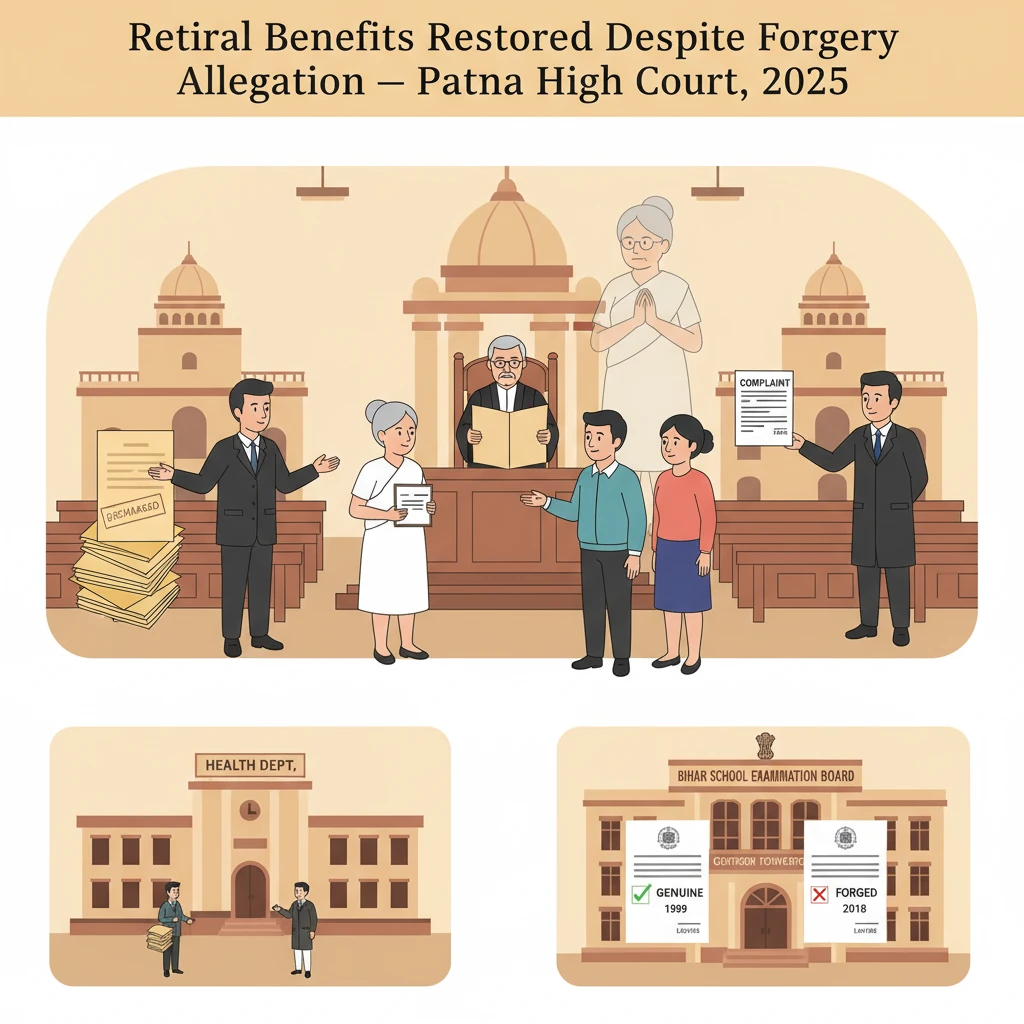
Case Background
The original petitioner was appointed as an Auxiliary Nurse Midwife (ANM) on 30.05.1986 and posted at the Primary Health Centre, Chenari, in the district of Rohtas, Bihar. She served in the Health Department for about 34 years.
She superannuated from service on 30.04.2020 from the Primary Health Centre, Shiv Nagar, Sasaram. After retirement, she was not granted her retiral benefits, including pension and some pending salary. Due to this, she filed the present writ petition before the Patna High Court seeking directions for release of all post-retirement dues.
During the pendency of the writ petition, the original petitioner died on 11.04.2024. Her legal heirs were then substituted as petitioners by order dated 27.08.2024 passed in I.A. No. 1 of 2024. For convenience, the Court continued to refer to the deceased employee as “the petitioner”.
What the Court Examined and Decided
The core dispute before the Patna High Court was whether the petitioner’s retiral benefits could be denied on the ground that her matriculation certificate was allegedly forged, especially when she had already retired and later died, and when earlier verification had found her certificate to be genuine.
Earlier Criminal Case and Verification in Favour of the Petitioner
While the petitioner was working as an ANM, a complaint was filed in 1988 alleging that her matriculation certificate was fake and fabricated. Based on this, Chenari P.S. Case No. 68 of 1988 (G.R. Case No. 1755/1988) was registered for offences under Sections 420, 467, 468 and 479 of the Indian Penal Code.
During investigation in that criminal case, the Bihar School Examination Board (the Board) was requested to verify her certificate. The Joint Secretary (Vigilance) of the Board, through letter No. 2523 dated 15.05.1989, informed the Investigating Officer that, upon verification, the petitioner’s matriculation certificate was found to be genuine.
Thereafter, the criminal court, finding no evidence collected during investigation to support the allegations, discharged the petitioner by order dated 20.02.1991 under Section 239 of the Code of Criminal Procedure. On the strength of this, the Civil Surgeon-cum-Chief Medical Officer issued Memo No. 2049 dated 03.08.1991, allowing her to resume duties. She continued to work without interruption and without any departmental proceeding against her and was ultimately allowed to retire on 30.04.2020 without objection.
Fresh Complaint in 2018 and New Adverse Report
Almost three decades later, on 04.09.2018, one Dharmendra Kumar Singh lodged a fresh complaint alleging that the petitioner’s matriculation certificate was forged and fabricated. The complaint led to a new departmental enquiry at the Health Department level.
This time, the petitioner’s matriculation documents were verified at the level of the Deputy Secretary of the Bihar School Examination Board. Through letter No. 4383 dated 20.11.2018, it was communicated that the enclosed marksheet bearing Roll Code 4321 and Roll No. 288 did not bear the name and address of any candidate in the Board’s records.
Acting on this adverse report, the Civil Surgeon-cum-Chief Medical Officer, Rohtas, sought guidelines from the Director-in-Chief, Health Services, Bihar, vide Memo No. 461 dated 15.02.2019. The petitioner’s salary was suspended, and she was directed to appear personally with documents before the Chief Medical Officer, Rohtas, on 10.08.2019. A show cause notice was also issued to her, which she replied to.
However, before any full-fledged and concluded departmental proceeding could be completed, the petitioner superannuated on 30.04.2020. Later, relying on the new adverse report of the Board, the authorities treated her appointment as forged and void ab initio and withheld her entire retiral benefits, taking support from the Supreme Court decision in State of Bihar & Ors. vs. Devendra Sharma [(2020) 15 SCC 466].
Court’s Scrutiny of Conflicting Board Reports
The Court carefully examined the two contrasting reports of the Bihar School Examination Board:
First, the 1989 report of the Joint Secretary (Vigilance) in letter No. 2523 dated 15.05.1989 categorically stated that, after proper verification, the petitioner’s certificate was genuine. Based on this, the criminal court had discharged her, and the department had allowed her to continue in service.
Second, the 2018 report of the Deputy Secretary (Vigilance) in Memo No. 4383 dated 20.11.2018, which stated that the marksheet details did not match any candidate in the Board’s records.
The Court noted that neither the State nor the Board had challenged the order of discharge in the criminal case. Nor did the authorities bother to reconcile or verify the earlier favourable 1989 report of the Board while acting on the later 2018 report. The Court found this change in stand of the Board’s officers to be “quite surprising” and held that the genuineness of the earlier report could not be wiped out casually without any verification.
Effect of Discharge and Absence of Departmental Enquiry
The State argued that since the petitioner had not been acquitted after a full trial but only discharged due to lack of material, the discharge order was not binding on the department. The Court acknowledged the general principle that acquittal in a criminal case does not automatically negate departmental action and that departmental proceedings can continue even after criminal acquittal, as explained in cases such as State of Rajasthan & Ors. vs. Heem Singh, (2021) 12 SCC 569.
However, the Court emphasized that in this case there had been no departmental proceeding at any stage when the earlier complaint was made. The order of discharge in the criminal case remained unchallenged. For almost 30 years, the petitioner served uninterruptedly and was allowed to retire.
The Court further referred to Supreme Court decisions like Capt. M. Paul Anthony vs. Bharat Gold Mines Ltd. & Ors., (1999) 3 SCC 679; G.M. Tank vs. State of Gujarat & Ors., (2006) 5 SCC 446; and Ram Lal vs. State of Rajasthan & Ors., (2024) 1 SCC 175, to underline that when the charges and evidence in the criminal case and departmental proceedings are the same, and the prosecution fails, courts in judicial review can grant relief if maintaining the departmental findings would be unjust or oppressive.
Requirement of Proper Enquiry in Alleged Forged Appointment
The Court stressed that even when there is an allegation of forged appointment, proper proceedings with full opportunity of defence are mandatory. Reference was made to Punjab State Electricity Board & Ors. vs. Leela Singh, (2007) 12 SCC 146, where the Supreme Court held that an allegation of fraud in obtaining appointment by a forged certificate must be proved through a duly constituted departmental enquiry, and that services cannot be terminated solely on the basis of a Board’s opinion.
Here, the Court found a direct conflict between the 1989 and 2018 reports of the Board. Despite this, the authorities treated the appointment as forged in a “hot-haste manner” without conducting a full, fair enquiry or giving the petitioner a proper chance to defend herself.
Impact of Petitioner’s Retirement and Death
The Court also placed weight on the fact that the petitioner had joined service in 1986, worked for more than 33 years, retired on 30.04.2020 and died on 11.04.2024. In such a situation, the Court held that there was no question of now sending the matter back for a departmental enquiry, as the petitioner herself was no longer alive to defend against the charge of forgery.
The Court reiterated that judicial or departmental proceedings against an employee abate on death because the employer-employee relationship ends. The defence available in such proceedings is personal to the employee; legal heirs cannot step into the shoes of the deceased to defend alleged misconduct. Therefore, no order can be passed withholding retirement benefits or outstanding dues unless the charge of forgery has already been proved in a full-fledged departmental enquiry or on the basis of impeccable, undisputed documents.
In this case, there were two conflicting Board reports, and no concluded departmental enquiry had ever been held.
Distinguishing the Devendra Sharma Case
The State relied heavily on State of Bihar & Ors. vs. Devendra Sharma, where large-scale illegal appointments in the Health Department had been set aside. The Patna High Court distinguished that case on facts.
In Devendra Sharma, one officer had made mass unauthorized appointments—about 6000 appointments against 2250 sanctioned posts, with 3750 persons occupying non-existent vacancies. A five-member committee was constituted, public notices were issued, candidates appeared, and the committee concluded that those appointments were vitiated from inception, leading to termination orders.
In the present case, there was no such independent committee, no similar large-scale bungling, and no termination or forfeiture order passed on the basis of a detailed and fair enquiry. Hence, the Court held that the reliance on Devendra Sharma was misplaced.
Final Directions of the Court
Having found the action of the respondents illegal and unsustainable, the Court held that the denial of retiral benefits on mere suspicion of forgery, without a proper and completed enquiry and especially after the petitioner’s death, was wholly unjustified.
The Court directed the concerned authorities to:
- Extend all consequential retiral benefits to the petitioner’s legal heirs.
- Pay the salary for the period during which the petitioner had discharged her duties.
- Pay pension up to the date of her death on 11.04.2024.
These directions were to be complied with preferably within 12 weeks from the date of receipt or production of a copy of the judgment. The writ petition was accordingly allowed.
Why This Judgment Matters
This judgment is important for government employees and their families who face sudden allegations of fake certificates late in service or after retirement. The Patna High Court has made it clear that benefits earned over a career cannot be stopped merely on the basis of a later adverse report, without a proper, fair enquiry.
The decision also protects the rights of legal heirs. When an employee dies, the department cannot continue or start disciplinary proceedings through the back door by freezing retiral benefits without proved misconduct. Allegations of forgery are serious and stigmatic, and the Court has insisted on strict adherence to fair procedure.
For authorities, this judgment is a reminder that earlier official findings and criminal court orders cannot be brushed aside casually. Conflicting departmental or Board reports must be carefully examined, and employees must be given a full opportunity to defend themselves before such drastic actions as denial of pension are taken.
Legal Issues and Answers
- Issue: Can retiral benefits and pension of a retired government employee be withheld solely on the basis of a later adverse verification of an educational certificate, without a completed departmental enquiry, especially after the employee’s death?
Answer: No. The Court held that in the absence of a full-fledged departmental enquiry proving forgery, and in the face of conflicting verification reports and an unchallenged criminal discharge, the State could not deny retiral benefits. After the employee’s death, proceedings effectively abate and benefits cannot be withheld on mere suspicion. - Issue: Does an unchallenged order of discharge in a criminal case and an earlier favourable verification report have relevance when the department later treats the appointment as forged based on a subsequent adverse report?
Answer: Yes. The Court held that the earlier favourable Board report and the discharge order could not be ignored casually. Without reconciling these and without conducting a proper enquiry, the authorities’ conclusion that the appointment was forged was unsustainable. - Issue: Is the Supreme Court’s decision in State of Bihar & Ors. vs. Devendra Sharma applicable to justify withholding retiral benefits in such a case?
Answer: No. The Court distinguished Devendra Sharma as a case of mass illegal appointments decided on the basis of an independent committee’s detailed investigation. In the present case, there was no such process and no valid foundation to apply that precedent.
Cases Cited by the Court
- State of Bihar & Ors. vs. Devendra Sharma, (2020) 15 SCC 466
- State of Rajasthan & Ors. vs. Heem Singh, (2021) 12 SCC 569
- Capt. M. Paul Anthony vs. Bharat Gold Mines Ltd. & Ors., (1999) 3 SCC 679
- G.M. Tank vs. State of Gujarat & Ors., (2006) 5 SCC 446
- Ram Lal vs. State of Rajasthan & Ors., (2024) 1 SCC 175
- Punjab State Electricity Board & Ors. vs. Leela Singh, (2007) 12 SCC 146
- LPA No. 568 of 2013, The State of Bihar & Ors. vs. Meera Sinha and analogous cases (Division Bench of Patna High Court)
Case Details
Case Number: Civil Writ Jurisdiction Case No. 12084 of 2021
Case Title: Manisha Kumari & Ors. vs. The State of Bihar & Ors.
Coram: Hon’ble Mr. Justice Harish Kumar
Date of Judgment: 01.05.2025
Citation: 2025(3) PLJR 89
Advocates:
- For the Petitioners: Ms. Vagisha Pragya Vacaknavi, Advocate; Ms. Prerna Anand, Advocate
- For the Respondents/State: Ms. S. D. Yadav, AAG 9; Mr. Anil Kumar Verma, AC to AAG 9
Nature of the Case: Writ petition (civil) seeking direction for payment of retiral benefits and salary, arising out of alleged forged educational certificate and consequent withholding of post-retirement dues.
Link to Judgment: https://patnahighcourt.gov.in/viewjudgment/MTUjMTIwODQjMjAyMSMxI04=-N–am1–hfgU3ujUA=
If you found this explanation helpful and wish to stay informed about
how legal developments may affect your rights in Bihar,
you may consider following Samvida Law Associates for more updates.







