
Case Background
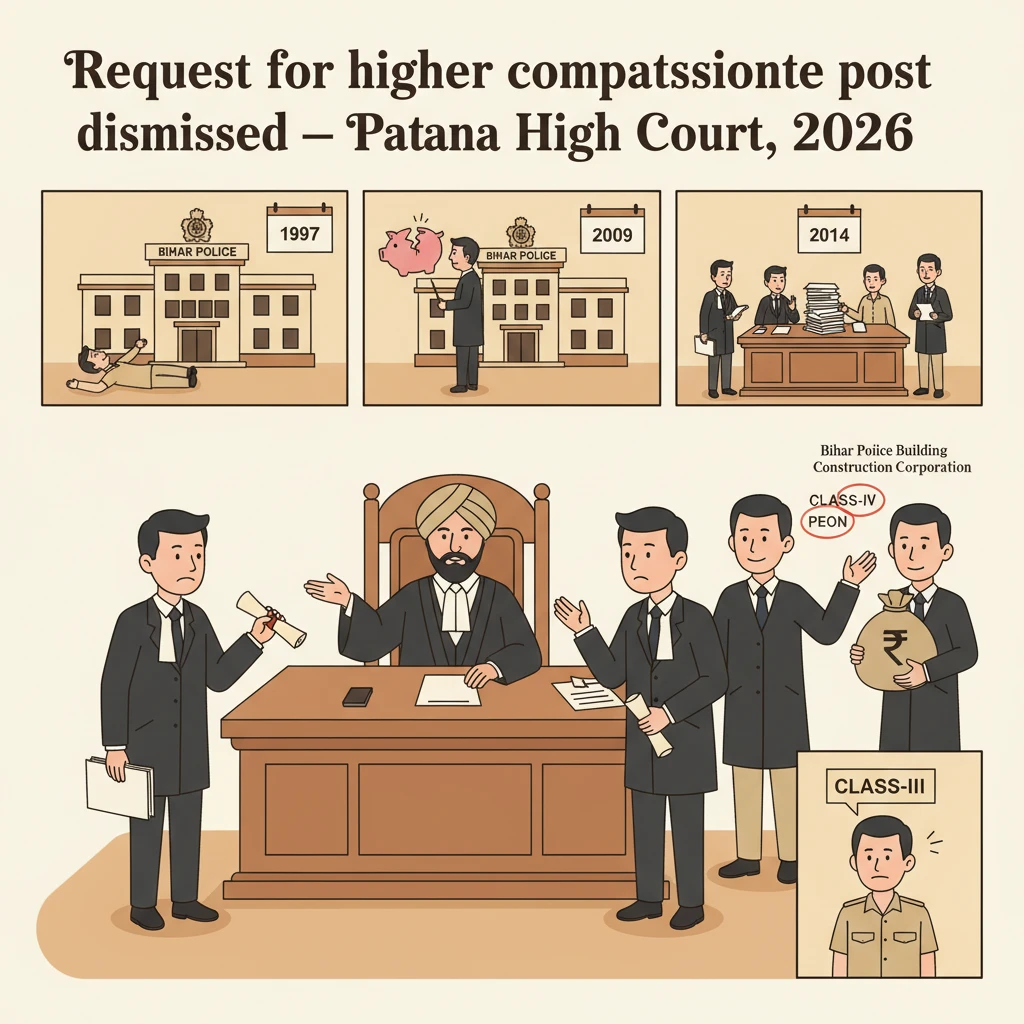
The petitioner’s father was an employee of the Bihar Police Building Construction Corporation. He died in harness on 4.9.1997.
After his father’s death, the petitioner applied for compassionate appointment. According to the judgment, his application was filed in 2009. At that time, the Corporation’s financial condition was very poor, and no compassionate appointments were being made.
In 2014, the financial condition of the Corporation improved. A committee was then constituted under the chairmanship of the Chief Engineer of the Corporation to review pending applications for compassionate appointment.
On 2.12.2015, by office order no. 365 of 2015, 17 applicants, including the petitioner, were appointed on compassionate grounds as Class-IV employees on the post of orderly/peon. The petitioner joined this Class-IV post and started discharging his duties.
After joining, in 2017 the petitioner approached the Patna High Court under its civil writ jurisdiction (CWJC No. 1316 of 2017). He asked the Court to direct the Corporation to appoint him instead on a Class-III post, relying on his higher educational qualification.
What the Court Examined and Decided
The petition before the Patna High Court sought a writ directing the Bihar Police Building Construction Corporation and its officers to consider and appoint the petitioner to a Class-III cadre/post instead of the Class-IV post already given to him on compassionate grounds after his father’s death.
The petitioner’s specific plea was that, at the time of his application for compassionate appointment, he held a Ph.D. degree. He relied on office order no. 109 of 2015 dated 30.1.2015, and argued that in view of this office order and his higher qualification, he should have been appointed to a Class-III post rather than a Class-IV post.
On the other hand, the Corporation, through its counsel, opposed the claim. It pointed out that the petitioner’s father had died in harness on 4.9.1997 and that the petitioner’s application for compassionate appointment was filed only in 2009. Due to the poor financial condition of the Corporation during that period, no compassionate appointments were made until the situation improved.
The Corporation’s counsel further submitted that the petitioner had no right to insist on appointment to any particular post or class of post, and certainly no right to insist on appointment to a higher post. According to the respondents, once a compassionate appointment had been offered and the petitioner had accepted and joined, the right stood exhausted.
Justice Partha Sarthy recorded that the key factual aspects were not in dispute. The father’s death in 1997, the filing of the application in 2009, and the appointment of the petitioner in 2015 as a Class-IV orderly/peon were all accepted facts. It was also undisputed that the petitioner had joined the Class-IV post and worked on it, and that he approached the Court only in 2017 seeking upgradation to a Class-III post.
To decide whether such a claim for a higher post could be allowed, the Court examined the law on compassionate appointments as laid down by the Supreme Court of India.
First, the Court relied on the decision of the Supreme Court in Director of Town Panchayat and Others v. M. Jayabal and Another; 2025 SCC OnLine SC 2794. The Patna High Court reproduced at length the passages dealing with claims for higher posts after a compassionate appointment has already been accepted.
In Jayabal, the Supreme Court noted that after the death of an employee, dependent family members are offered appointment on compassionate grounds as per the existing policy. Once such an appointment is offered and accepted, the immediate financial crisis of the family is addressed. The Supreme Court then framed the issue of whether such a dependent could later seek a higher post.
The Supreme Court clarified that the law is well-settled: once a dependent family member has exercised the option and joined a post on compassionate grounds, no second option is available to seek appointment to a higher post on compassionate grounds. It referred to the earlier case of State of Rajasthan v. Umrao Singh, where the dependent had initially accepted a lower post (LDC) after the death of his father who was a Sub-Inspector, and then later claimed appointment as Sub-Inspector. The Supreme Court had rejected that claim, warning against a situation of “endless compassion”.
The key principle repeated in Jayabal and quoted in the judgment is that once the right for consideration of compassionate appointment is consummated by accepting an offered post, no further compassionate consideration can arise. Dependants cannot use compassionate employment as a ladder to climb up in service merely because they possess higher educational qualifications.
Next, the Patna High Court relied on another Supreme Court judgment, State of U.P. and Others v. Premlata; (2022) 1 SCC 30. In this decision, the Supreme Court restated the object of compassionate appointment. It described such appointments as an exception to the general rule of recruitment. They are aimed at helping families of employees who die in harness and leave their dependents in penury and without any means of livelihood.
The Supreme Court in Premlata emphasised that the whole object of granting compassionate employment is to allow the family to tide over a sudden financial crisis, not to give the dependent a particular post or the same post as held by the deceased employee. Appointment is to provide a source of livelihood, not a right to a higher status.
The Supreme Court had also interpreted the term “suitable post” under the Dying-in-Harness Rules, 1974. The Division Bench of the High Court in that case had held that “suitable post” meant any post matching the educational qualification of the candidate. The Supreme Court disagreed and held that “suitable post” must be viewed with reference to the status or post held by the deceased employee and not merely the qualification of the dependent. Otherwise, there would be no distinction between compassionate appointment and regular recruitment.
In particular, the Supreme Court pointed out that if a deceased employee had held a Class-IV post, his dependent could not insist on a Class-I or Class-II post on compassionate grounds simply because he or she met the educational qualifications for such higher posts. That would defeat the core humanitarian objective of the scheme.
Applying these principles, the Patna High Court turned back to the petitioner’s case. The Court noted that the petitioner had already been appointed on a Class-IV post in 2015 and had joined and started working. His claim for reconsideration and appointment to a Class-III post was made only later, by filing the writ petition in 2017.
In light of the law declared by the Supreme Court in Jayabal and Premlata, the Court held that there was no merit in the petitioner’s plea. Once he had accepted the Class-IV appointment on compassionate grounds, his right to compassionate consideration had been fully exercised and exhausted. There was no legal basis for reopening his case or directing the Corporation to appoint him to a higher, Class-III post on compassionate grounds.
The Court therefore dismissed the writ application. No further directions were issued to the respondents, and the petitioner’s existing Class-IV appointment remained as originally granted.
Why This Judgment Matters
This judgment is important for families of deceased employees and for government or public sector employers handling compassionate appointments in Bihar.
The Patna High Court, following the Supreme Court, has made it clear that a dependent cannot first accept a compassionate appointment on a lower post and then later demand a higher post simply because of higher educational qualifications or later policy changes.
For dependents, this means that the choice made at the time of compassionate appointment is final. Once a post is accepted and joined, courts are unlikely to entertain later claims for upgradation on compassionate grounds.
For employers like public corporations and departments, the ruling confirms that they are not legally bound to upgrade posts or re-appoint a dependent once a compassionate appointment has been made in accordance with the applicable policy and existing vacancies.
Legal Issues and Answers
Issue: Can a dependent who has already accepted and joined a Class-IV post on compassionate grounds later seek appointment to a higher, Class-III post on compassionate grounds, relying on higher educational qualifications and a later office order?
Answer: No. The Patna High Court held that once the right to compassionate appointment has been exercised and the dependent has joined the post offered, no further or second consideration for a higher post on compassionate grounds can arise.
Cases Cited by the Court
- Director of Town Panchayat and Others v. M. Jayabal and Another; 2025 SCC OnLine SC 2794.
- State of U.P. and Others v. Premlata; (2022) 1 SCC 30.
Case Details
Case Number: Civil Writ Jurisdiction Case No. 1316 of 2017
Case Title: Abhishek Kumar v. The Bihar Police Building Construction Corporation and Others
Court: High Court of Judicature at Patna
Coram: Hon’ble Mr. Justice Partha Sarthy
Date of Judgment: 05-01-2026
Citation: 2026 (1) PLJR 598
Nature of the Case: Writ petition seeking direction for appointment to a Class-III post on compassionate grounds in place of a Class-IV appointment already granted.
Advocates: For the Petitioner – Mr. Sanjay Kumar, Advocate. For the Respondents – Mr. Prasoon Sinha, Sr. Advocate; Mr. Prabhat Kumar, Advocate.
Link to Judgment: Read full judgment on Patna High Court website
If you found this explanation helpful and wish to stay informed about
how legal developments may affect your rights in Bihar,
you may consider following Samvida Law Associates for more updates.







