

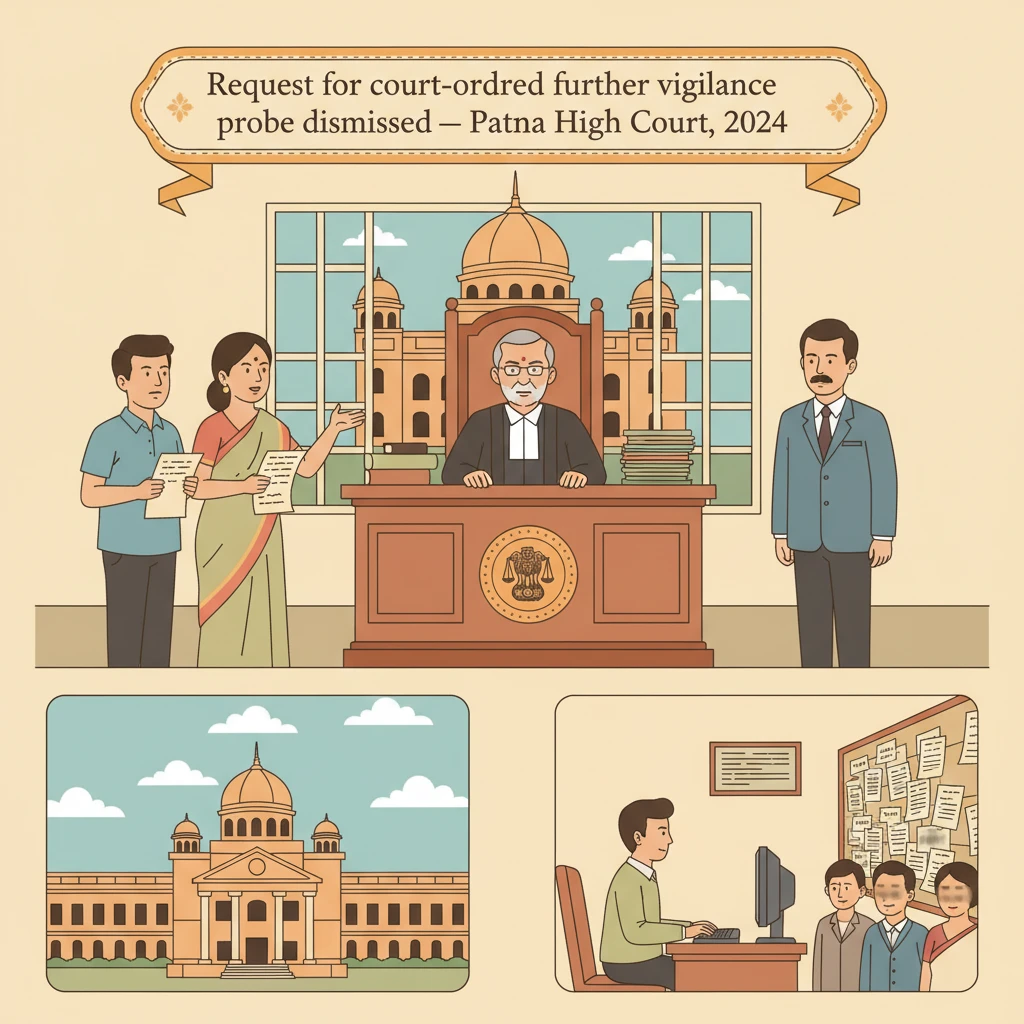
Case Background
The case arises from recruitment to 29 posts of Lecturers in Bhagalpur University advertised in 1997. The petitioner, Madhu Sharma, said she took part in the selection process, cleared the written examination, and faced the interview.
Her grievance is that despite success in these stages, she was not appointed as Lecturer against the advertised vacancies. She alleges that instead of limiting appointments to 29 posts, the Bihar State University Service Commission prepared a huge panel of about 1100 “successful” candidates.
According to her, these 1100 candidates were later adjusted, from time to time, against vacancies arising in colleges of other universities, without any fresh advertisement. She claims this led to large-scale corruption involving Vice-Chancellors of various universities, bureaucrats, political personalities and even the then Chancellor.
On the recommendation of the Chancellor, the Vigilance Investigation Bureau (VIB) registered Vigilance P.S. Case No. 1 of 2004. After investigation, VIB filed a charge-sheet before the Special Judge, Vigilance, at Patna against certain persons.
The petitioner alleges that this vigilance investigation was perfunctory and incomplete. She says that many “very important personalities” and their close associates, who were allegedly involved in the illegal appointments, were not even investigated.
After the charge-sheet was filed, the petitioner and another person, Mithlesh Kumar, moved an application before the Special Judge, Vigilance, under Section 173(8) of the Code of Criminal Procedure, 1973 (Cr.P.C.), seeking further investigation.
On 6 July 2022, the Special Judge, Vigilance, Patna rejected their application. The Special Judge held that the petitioner had no locus standi to seek further investigation as she was not the informant in Vigilance P.S. Case No. 1 of 2004.
The petitioner then approached the Patna High Court in Criminal Writ Jurisdiction Case No. 288 of 2023. She asked the High Court to quash the Special Judge’s order dated 6 July 2022 and to direct the Vigilance Investigation Bureau to conduct further investigation in light of her allegations.
What the Court Examined and Decided
The matter came before Hon’ble Mr. Justice Bibek Chaudhuri of the Patna High Court. The core question was whether the petitioner, as an unsuccessful candidate in the lecturer recruitment process, could demand further investigation into the vigilance case under Section 173(8) Cr.P.C.
The petitioner’s counsel made elaborate submissions. He argued that the vigilance investigation was incomplete and biased, and that many influential persons were deliberately left out. He relied on several Supreme Court decisions to argue that any person interested in a criminal case could move the court for further investigation.
On the other hand, the State and the Vigilance Bureau supported the Special Judge’s order. They explained that Vigilance P.S. Case No. 1 of 2004 was started on the direction of the then Governor of Bihar, acting as Chancellor of the universities. On that basis, a suo motu FIR was lodged and VIB conducted investigation.
After completing investigation, VIB filed a charge-sheet before the Special Judge, Vigilance. At the stage of acceptance of the charge-sheet, the petitioner and another person filed their application under Section 173(8) Cr.P.C. The Vigilance Bureau argued that since the petitioner was not the original informant, her application under Section 173(8) Cr.P.C. was not maintainable.
The High Court then examined Section 173 Cr.P.C. in detail. The judgment reproduces the entire provision and focuses especially on sub-sections (2) and (8).
Justice Bibek Chaudhuri clarified that once investigation is completed, the officer in charge of the police station must submit a report to the Magistrate empowered to take cognizance. This report under Section 173(2) is commonly known as the “final form” or “final report”.
The Court pointed out that this final report can be of two kinds. One, it may state that there is prima facie evidence and that charges are established against the accused persons. Two, it may state that no evidence could be collected and allegations are not established.
Under Section 173(2)(ii), the police officer must inform the person who first gave the information about the offence—the informant—about the action taken. In other words, when a final report is filed, it is the informant who is formally notified.
The Court explained that, especially in cases where the final report says that allegations are not proved, the informant has a recognised right. After receiving notice, the informant may file an application objecting to the final report and may pray for further investigation. On such an application, the Magistrate or Special Judge may order further investigation.
The Court further clarified that under Section 173(8) Cr.P.C., the police themselves are not barred from conducting further investigation even after filing a charge-sheet. If new oral or documentary evidence comes to light, the officer in charge may undertake further investigation and file a supplementary report before the Magistrate.
Importantly, this statutory power of further investigation under Section 173(8) does not require a prior formal order of the court. However, if the investigating agency seeks the court’s permission or if the court itself finds investigation tainted or incomplete, the court can direct further investigation.
Turning to the petitioner’s argument, her counsel contended that anyone interested in the outcome of a criminal case, not only the informant, could apply for further investigation under Section 173(8). To support this, he relied upon the Supreme Court decisions in:
(i) Azija Begum v. State of Maharashtra and another, (2012) 3 SCC 126;
(ii) Hasanbhai Valibhai Qureshi v. State of Gujarat and others, (2004) 5 SCC 347;
(iii) Kishan Lal v. Dharmendra Bafna and another, (2009) 7 SCC 685; and
(iv) Subramanian Swamy v. Director, CBI and another, (2014) 8 SCC 682.
The High Court analysed these judgments. Regarding Azija Begum, it noted that the Supreme Court there held that every citizen has a right to get his or her complaint properly investigated, and that fair investigation is part of Article 14’s guarantee of equal protection of laws and access to justice.
However, the High Court pointed out a key distinction: in Azija Begum, the appellant seeking further investigation was herself the informant. In the present case, the petitioner was not the informant in Vigilance P.S. Case No. 1 of 2004. Therefore, the ratio of Azija Begum did not apply to her situation.
On Hasanbhai Valibhai Qureshi, the Patna High Court observed that the Supreme Court had emphasised that further investigation may be conducted even after the court has taken cognizance and that possible delay of trial is not by itself a ground to reject further investigation. But the decision did not say that any person other than the informant may demand further investigation.
Similarly, in Kishan Lal, the appellant was again the informant. There, the Supreme Court explained situations in which the investigating officer or the courts may order further investigation—such as when new facts come to light or when earlier investigation is found to be tainted or unfair.
The High Court also referred to Subramanian Swamy, where the same principle regarding further investigation was reiterated. But none of these judgments said that a third party, who is neither the informant nor the accused, can insist on further investigation by moving an application under Section 173(8) Cr.P.C.
On this basis, Justice Bibek Chaudhuri concluded that the petitioner, simply as an unsuccessful candidate for Lecturer, was not a “competent person” to challenge the charge-sheet or to seek further investigation. The Court therefore found no illegality or material irregularity in the Special Judge’s order dated 6 July 2022 rejecting her application.
However, the Court did not ignore the petitioner’s grievance. It posed an important question: would the petitioner be left completely remediless in raising her concerns about improper investigation and alleged corruption?
To address this, the Court reverted to Section 173(8) Cr.P.C. It stressed that this provision itself allows the officer in charge of the police station, on receipt of fresh evidence, to conduct further investigation and to file a supplementary charge-sheet against persons not previously charge-sheeted.
The petitioner had complained that the Vigilance Investigation Bureau had not considered the documents she filed along with the writ petition. These documents, according to her, showed further irregularities and involvement of additional persons.
To balance her grievance with the legal position on locus standi, the Court devised a middle path. It disposed of the writ petition with a specific liberty to the petitioner: she may submit the very documents annexed to the writ petition before the Investigating Officer of VIB.
The Court directed that the Investigating Officer must then consider whether those documents disclose “fresh evidence” within the meaning of Section 173(8). If they amount to fresh evidence, the Investigating Authority would be at liberty to undertake further investigation and to file supplementary charge-sheet against any additional persons, as appropriate.
The Court also noted that in the existing charge-sheet, the Investigating Officer had already indicated his liberty to file a supplementary charge-sheet on receipt of fresh evidence. This reinforced that the statutory route for further investigation remains open, but it must be triggered by the police, not by a non-informant applicant via Section 173(8) before the trial court.
Finally, considering that Vigilance P.S. Case No. 1 of 2004 had been pending “for petty long time”, the High Court directed the learned Special Judge, Vigilance, Patna, to take proper steps for completion of the trial and disposal of the case.
With these observations and directions, the writ petition was disposed of. The Special Judge’s order stood confirmed, but the petitioner retained the practical option of placing her materials before the vigilance authorities for possible further action.
Why This Judgment Matters
This judgment is significant for candidates and citizens who feel that a criminal investigation into a recruitment scam or corruption case has been incomplete. The Patna High Court has clarified that not everyone can directly ask the trial court for further investigation under Section 173(8) Cr.P.C.
Only the informant, the police themselves, or the court on its own can move or order further investigation in a pending criminal case. A disappointed candidate or any other third party cannot demand it as a matter of right through a formal application under Section 173(8) before the trial court.
At the same time, the judgment shows that such persons are not entirely without remedy. They can still provide documents or information to the investigating agency. If those materials constitute fresh evidence, the police can legally reopen investigation and file a supplementary charge-sheet.
For ongoing vigilance cases in Bihar, especially those related to alleged irregularities in university appointments, the ruling reinforces two points: trials in old vigilance cases must be completed without further delay, and any expansion of investigation must follow the statutory framework of Section 173 Cr.P.C., respecting the role of the informant and the investigating agency.
Legal Issues and Answers
- Issue: Can a person who is not the informant in a vigilance FIR file an application before the Special Judge under Section 173(8) Cr.P.C. seeking further investigation?
Answer: No. The Patna High Court held that a third party, such as an unsuccessful candidate in a recruitment process, is not a competent person to challenge the charge-sheet or seek further investigation under Section 173(8) Cr.P.C. before the trial court. - Issue: If such a person has documents suggesting further irregularities, is there any way for those materials to be considered?
Answer: Yes. The Court allowed the petitioner to submit her documents to the Investigating Officer, who must examine whether they amount to fresh evidence. If they do, the Investigating Authority is at liberty to conduct further investigation and file a supplementary charge-sheet under Section 173(8) Cr.P.C. - Issue: What is the duty of the trial court in long-pending vigilance cases after filing of charge-sheet?
Answer: The Special Judge must take appropriate steps to ensure early completion of trial and disposal of the case, especially where the matter has been pending for a long period.
Cases Cited by the Court
- Azija Begum v. State of Maharashtra & Anr., (2012) 3 SCC 126
- Hasanbhai Valibhai Qureshi v. State of Gujarat & Ors., (2004) 5 SCC 347
- Kishan Lal v. Dharmendra Bafna & Anr., (2009) 7 SCC 685
- Subramanian Swamy v. Director, CBI & Anr., (2014) 8 SCC 682
Case Details
Case Number: Criminal Writ Jurisdiction Case No. 288 of 2023; arising out of Vigilance P.S. Case No. 1 of 2004 (Special Case No. 01 of 2004)
Case Title: Madhu Sharma v. The State of Bihar & Ors.
Citation: 2024 (2) PLJR 618
Coram: Hon’ble Mr. Justice Bibek Chaudhuri
Date of Judgment: 19-04-2024
Court: High Court of Judicature at Patna, Criminal Writ Jurisdiction
Advocates:
- For the Petitioner: Mr. Jagannath Singh, Advocate; Mr. Rakesh Kumar, Advocate; Mr. Deepak Kumar, Advocate; Mr. Md. Ghulam Mustafa, Advocate; Mr. Bhargava Pandey, Advocate
- For the State: Mr. Suman Kumar Jha, AC to AAG 3
- For the Vigilance: Smt. Archana Palkar Khopde, Advocate
Nature of the Case: Criminal writ petition challenging an order of the Special Judge, Vigilance, Patna, rejecting an application under Section 173(8) Cr.P.C. and seeking direction for further investigation in Vigilance P.S. Case No. 1 of 2004.
Link to Judgment: Click here to access the full judgment of the Patna High Court
If you found this explanation helpful and wish to stay informed about
how legal developments may affect your rights in Bihar,
you may consider following Samvida Law Associates for more updates.







