

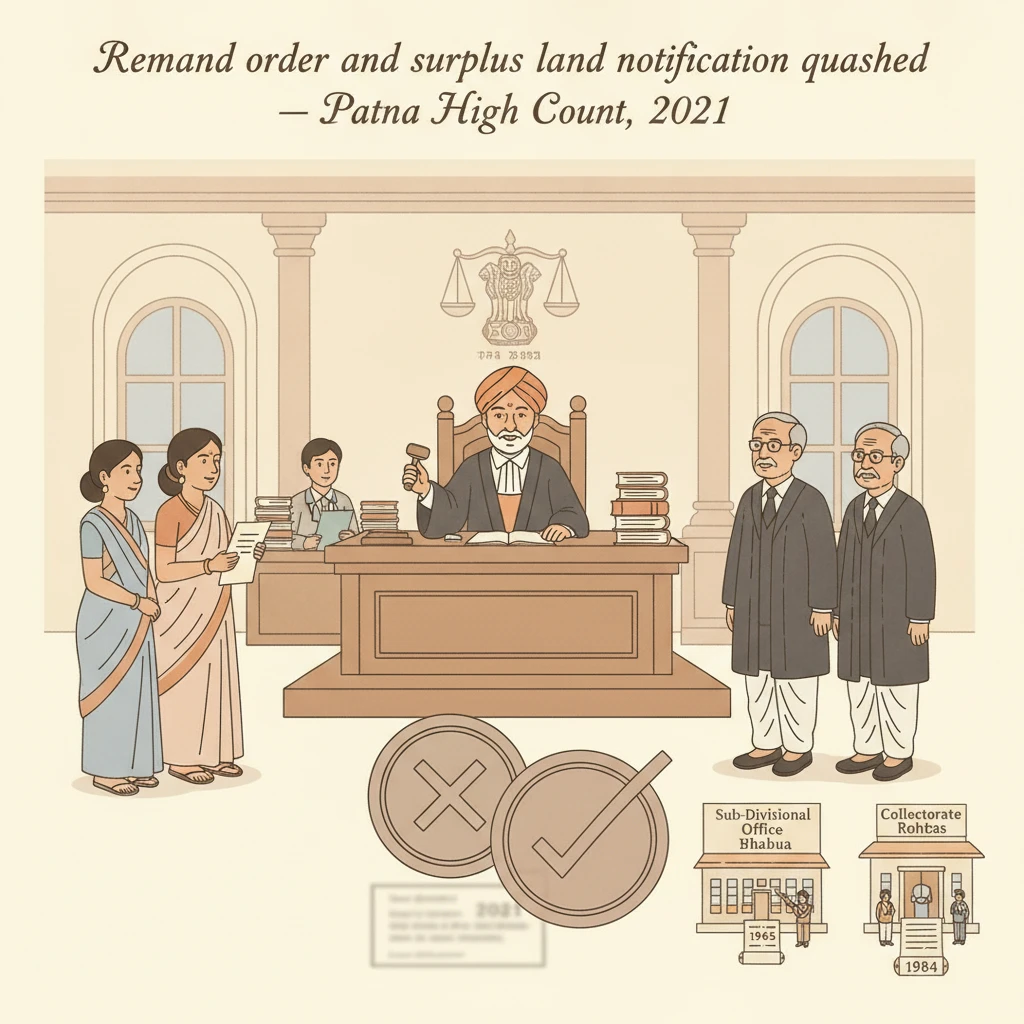
Case Background
This case arises out of a long-running land ceiling proceeding under the Bihar Land Ceiling Act, 1961.
Land Ceiling Case no. 102/1965 was started against one Jang Bahadur Rai, the land holder and uncle of the petitioners. In that proceeding, he was shown to hold 214.22½ acres of Class III land. The verification report recorded six adult family members and mentioned transfers of land by gift and sale.
The Sub-Divisional Officer, Bhabua granted four units to the land holder. This allowed him to keep 100 acres of land and 114.22½ acres was held surplus.
The land holder then filed Ceiling Appeal no. 8/1984 before the Collector, Rohtas. The Collector rejected the appeal on 10.2.1984.
Against this, the land holder went in Revision Case no. 104/1984 before the Board of Revenue. On 13.8.1985, the Board allowed the revision and sent the matter back to the Collector for fresh decision in accordance with law. The file was then placed before the Additional Collector, Rohtas.
When the matter came back, the present petitioners appeared before the Additional Collector and filed objections. They stated that 19.84 acres had been gifted to petitioner no. 1 by two registered gift deeds dated 16.1.1962 and 18.4.1963 by her father and grandfather. These lands related to particular plot and khata numbers mentioned in the judgment.
They further stated that 6.02 acres of land in specified plots of khata no. 109 had been gifted to petitioner no. 2 by her father by registered deed dated 18.4.1963. According to them, after these gifts, they took possession, mutation was done, jamabandi was created and they were paying rent to the government.
Alongside their objections, the land holder himself objected that 3.30 acres had been gifted to Ramgarh College and 8.25 acres had been transferred to Prahlad Rai much before the Act came into force.
By order dated 8.3.1988, the Additional Collector rejected the objections of the present petitioners but allowed the land holder’s objections regarding Ramgarh College and Prahlad Rai. He finally declared 88.23 acres of the land holder’s land as surplus.
Against this, two revisions were filed before the Board of Revenue, Patna. The land holder filed Revision Case no. 77/1988 and the present petitioners filed Revision Case no. 109/1988.
On 30.4.1989, the Additional Member, Board of Revenue decided both revisions. He dismissed the land holder’s Revision Case no. 77/1988. He allowed the petitioners’ Revision Case no. 109/1988 and directed the authorities to exclude the petitioners’ land from the ceiling proceeding, holding that the land had been validly transferred to them under the law then in force. It was also held that the land sold to the petitioners had been rightly not excluded from the ceiling proceeding.
That order dated 30.4.1989 was not challenged by the State or anyone else before any higher forum. On this basis, the petitioners pleaded that the issue of validity of the gifts and exclusion of their land from the ceiling case had reached finality.
Acting on the order in their favour, the petitioners applied before the Additional Collector, Rohtas, asking for exclusion of their land in terms of the Board of Revenue’s order dated 30.4.1989. However, the Collector, Rohtas, instead issued District Gazette Notification no. 95 dated 23.6.1993, showing 88.23 acres of land as surplus, which included the petitioners’ land. This was communicated to them by notice dated 30.8.1993.
The petitioners treated this as a clear violation of the Board of Revenue’s final order and alleged that the Collector had acted in insubordination.
They challenged the Gazette Notification by filing Revision Case no. 17/1994 before the Board of Revenue, Bihar, Patna. That revision was dismissed in default on 17.5.1995. The petitioners then filed a restoration application on 23.2.1996 along with an application for condonation of delay on 22.4.1996.
These restoration and limitation applications were heard by the Additional Member, Board of Revenue. Arguments concluded and order was reserved on 20.5.1996.
According to the petitioners, only the restoration and limitation applications were heard, not the revision itself on merits. They say that after 20.5.1996, they repeatedly enquired and were told that the order was still reserved.
In June 2000, they came to know that the Additional Member, Board of Revenue had actually passed final order dated 31.5.1996 in Revision Case no. 17/1994. By this order, he remanded Land Ceiling Case no. 102/1965 to the trial court for fresh order after making inquiry about the age of the petitioners so as to verify the legality of the earlier gifts.
Feeling aggrieved, the petitioners filed the present writ petition in the Patna High Court. They sought quashing of the order dated 31.5.1996 in Revision Case no. 17/1994 and quashing of District Gazette Notification no. 95 dated 23.6.1993.
What the Court Examined and Decided
Justice Satyavrat Verma of the Patna High Court heard counsel for the petitioners, for the State of Bihar and for certain alleged “parcha” holders who had moved to intervene.
On the side of the petitioners, their main stand was that the Board of Revenue’s earlier order dated 30.4.1989 in Revision Case no. 109/1988 had already settled the matter. In that order, the Board had clearly:
(a) accepted that the gifts in favour of the petitioners were valid and made under the law then in force; and
(b) directed that their land should be excluded from the ceiling proceeding.
That order had never been challenged. Therefore, the finding that their land stood excluded from the ceiling case had attained finality. Once a competent authority has finally decided an issue, it cannot be reopened by the same authority without statutory power.
The petitioners also argued that the order dated 31.5.1996 was passed behind their back. They said only the restoration and limitation applications were argued. The revision itself was not heard on merits. Yet, a final order remanding the case for fresh inquiry about their age and validity of the gifts was passed. This, according to them, violated the principles of natural justice because they were not given a full hearing on the revision.
A further and central plank of their argument was that by passing the order dated 31.5.1996, the Additional Member, Board of Revenue had in effect “reviewed” his own earlier order dated 30.4.1989. Under law, a quasi-judicial authority like the Board of Revenue can review its own order only if such power is explicitly given in the statute. The Bihar Land Ceiling Act, 1961 contains no provision for review. Hence, the Board had no jurisdiction to revisit its earlier final order.
In support of this proposition, learned counsel relied on the Supreme Court’s decision in Dr. Smt. Kuntesh Gupta v. Management of Hindu Kanya Mahavidyalaya, Sitapur (U.P.) and others, AIR 1987 SC 2186. In that case, the Supreme Court clearly held that a quasi-judicial authority cannot review its own order unless the power of review is expressly given by the statute under which it acts.
During the writ proceedings, an intervention application was filed on behalf of alleged parcha holders, who claimed that parchas (land allotment documents) had been issued in their favour regarding parts of the surplus land. They sought to be added as parties and to contest the petitioners’ case.
Senior counsel for the parcha holders submitted that their application had not yet been allowed and requested that it should now be allowed so they could contest the case.
Counsel for the petitioners opposed this. He argued that the rights of parcha holders depended entirely on the fate of the writ petition. If the writ petition was allowed, they would have no rights over the land claimed by the petitioners. If the writ was dismissed, their claimed rights would automatically revive. Therefore, he said, they were not necessary parties to this writ.
The High Court agreed with the petitioners’ counsel and rejected the intervention application. The Court held that, for the present writ, the parcha holders were not necessary parties because their rights simply followed the final result of the case.
The Court also noted a significant procedural fact: although the writ petition had been admitted on 8.11.2000, the State of Bihar had not filed any counter affidavit even by the time of final hearing. No pleadings of the petitioners in the writ petition had been specifically denied or rebutted.
In law, when pleadings are not denied, the doctrine of “non-traverse” applies. This means that if a party does not specifically deny an allegation, it is treated as admitted. Applying this doctrine, the Court treated the petitioners’ factual assertions as admitted in absence of any counter from the State.
After hearing the parties, the Court reached a considered conclusion on the legality of the 31.5.1996 order in Revision Case no. 17/1994.
The Court held that the Additional Member, Board of Revenue had no jurisdiction to pass a fresh order dealing with the petitioners’ land when his earlier order dated 30.4.1989 in Revision Case no. 109/1988 had already become final and binding in absence of any challenge.
By remanding the matter in 1996 to inquire into the petitioners’ age and to reassess whether the earlier gift deeds were in accordance with law, the Board was in effect reopening and reviewing its own final findings from 1989. This was beyond its powers because the Bihar Land Ceiling Act, 1961 does not provide for any power of review.
Relying on the law declared by the Supreme Court in Smt. Kuntesh Gupta, the High Court reiterated that a quasi-judicial authority cannot review its own order unless the statute clearly grants such power. Since no such power exists in the Bihar Land Ceiling Act, the Board’s 1996 order was without jurisdiction.
On this reasoning, the High Court quashed the order dated 31.5.1996 in Revision Case no. 17/1994.
Once that order was set aside, the Gazette Notification no. 95 dated 23.6.1993 also could not survive, because it too went against the earlier final order of 30.4.1989 and treated the petitioners’ land as surplus.
Accordingly, the Court also quashed the District Gazette Notification no. 95 dated 23.6.1993.
The Court directed the Collector, Rohtas to immediately exclude the petitioners’ land from Land Ceiling Case no. 102/1965 and then issue a fresh district gazette notification in accordance with law.
With these directions, the writ application was allowed.
Why This Judgment Matters
This judgment has practical importance for land holders and family members whose lands are involved in land ceiling proceedings in Bihar.
First, it confirms that once a competent authority like the Board of Revenue has given a final order about who owns certain land and whether it should be included in ceiling proceedings, that issue cannot be reopened by the same authority unless law specifically allows review.
Second, it protects people who have received land through valid registered gift deeds or transfers made before the land ceiling law came into force, when such transfers have already been accepted as valid by higher authorities.
Third, it sends a clear message to district officials, such as Collectors, that they must strictly comply with final orders of superior revenue authorities and cannot ignore them while publishing surplus land notifications.
Finally, it shows that if the State does not file a counter affidavit to deny the facts stated in a writ petition, the Court may treat those facts as admitted and decide the case on that basis.
Legal Issues and Answers
-
Issue: Could the Additional Member, Board of Revenue, in 1996 reopen and remand the land ceiling case concerning the petitioners’ land after his own earlier 1989 order had already finally upheld the validity of the gifts and directed exclusion of their land from the ceiling proceeding?
Answer: No. The Patna High Court held that the 1996 order was beyond jurisdiction and amounted to an impermissible review, since the Bihar Land Ceiling Act, 1961 does not confer any power of review on the Board of Revenue. -
Issue: Whether District Gazette Notification no. 95 dated 23.6.1993, which treated the petitioners’ land as surplus, could stand in view of the final 1989 order of the Board of Revenue?
Answer: No. Once the 1996 order was quashed, the Gazette Notification was also quashed, and the Collector was directed to exclude the petitioners’ land from Ceiling Case no. 102/1965 and issue a fresh notification. -
Issue: Were the alleged parcha holders necessary parties to the writ petition challenging the Board of Revenue’s and Collector’s actions?
Answer: No. The Court held that the rights of parcha holders were dependent on the final outcome of the case, so they were not necessary parties. Their intervention application was rejected.
Cases Cited by the Court
- Dr. Smt. Kuntesh Gupta v. Management of Hindu Kanya Mahavidyalaya, Sitapur (U.P.) and others, AIR 1987 SC 2186.
Case Details
Case Number: Civil Writ Jurisdiction Case No. 11112 of 2000
Case Title: Pushspa Rai @ Pushpa Kumari and another v. The State of Bihar and others
Citation: 2022(1) PLJR 229
Court: High Court of Judicature at Patna
Coram: Hon’ble Mr. Justice Satyavrat Verma
Date of Judgment: 09-12-2021
Advocates:
- For the Petitioners: Mr. Jitendra Kishore Verma, Advocate
- For the Respondents (State): Mr. Mukund Mohan Jha, AC to GP 27
- For the Intervenors (Parcha holders): Mr. Ramakant Sharma, Senior Advocate
Nature of the Case: Writ petition under civil writ jurisdiction challenging an order of the Additional Member, Board of Revenue and a District Gazette surplus land notification arising out of a land ceiling proceeding.
Statute Involved: Bihar Land Ceiling Act, 1961
Link to Judgment: Click here to read the full judgment of the Patna High Court
If you found this explanation helpful and wish to stay informed about
how legal developments may affect your rights in Bihar,
you may consider following Samvida Law Associates for more updates.







