

Case Background
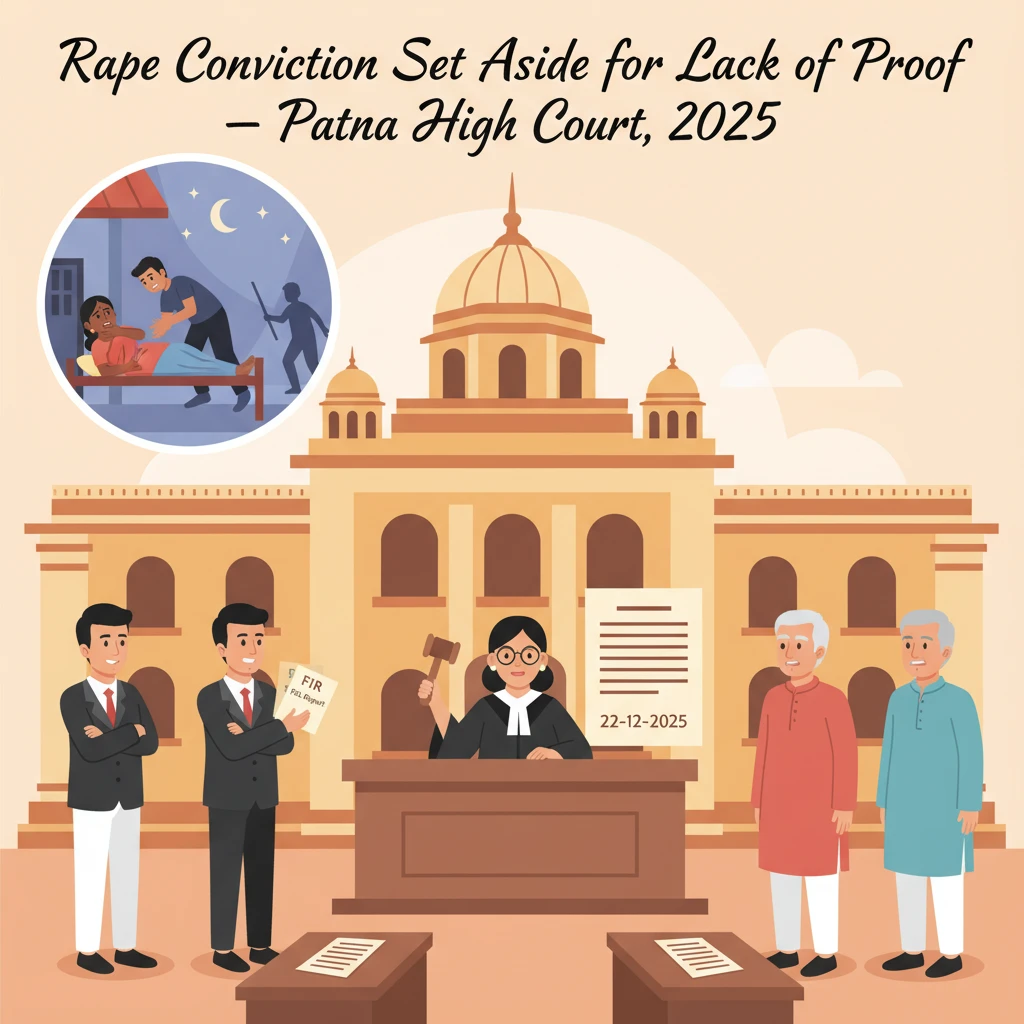
This case arose from an incident alleged to have taken place in the night of 24/25‑02‑1996 at about 1:00 A.M. in a village in District Darbhanga. The informant stated that she was sleeping on the verandah of her house while her daughter was sleeping inside.
According to her statement, the appellant came there, gagged her mouth and forcibly committed sexual intercourse with her. She claimed that there was a scuffle, she received injuries on both legs, and on hearing her muffled cries her daughter woke up and raised an alarm. On this alarm, two villagers, Yogendra Yadav and Madan Yadav, allegedly reached the spot, after which the appellant fled.
On the basis of this statement, Singhwara P.S. Case No. 15 of 1996 was registered under Section 376 of the Indian Penal Code. After investigation, the police submitted charge‑sheet under Sections 341, 323, 324 and 376 IPC against the appellant.
The case was committed to the Court of Sessions. The learned Additional Sessions Judge, FTC‑II, Darbhanga, framed charges under Sections 323, 341 and 376 IPC. The appellant pleaded not guilty and claimed trial.
The prosecution examined six witnesses and proved some documents, including the fardbeyan, medical examination report of the victim, and a forensic science laboratory (FSL) report. The defence examined one witness, the husband of the informant.
By judgment of conviction dated 10.02.2005 and order of sentence dated 11.02.2005 in Sessions Trial No. 186/1997, the trial court convicted the appellant under Section 376 IPC, but acquitted him of the charges under Sections 323 and 341 IPC. He was sentenced to rigorous imprisonment for seven years.
The appellant was taken into custody, but by order dated 21.03.2006, a learned Single Judge of the Patna High Court released him on bail during the pendency of this appeal. When the appeal came up for final hearing and no lawyer appeared for the appellant, the High Court appointed Mr. Purnendu Keshav as Amicus Curiae on 29.11.2025 to assist the Court.
What the Court Examined and Decided
Hon’ble Mr. Justice Arun Kumar Jha of the Patna High Court examined whether the prosecution had proved the charge of rape beyond reasonable doubt and whether the trial court’s judgment suffered from infirmities.
The Amicus Curiae argued that the conviction was bad in law and on facts. He highlighted contradictions in the prosecution evidence, lack of independent support, the hostile witnesses, the non‑supportive medical evidence, and previous family disputes suggesting a possible false implication.
The State, through the learned APP, opposed the appeal and supported the trial court judgment, claiming that the case had been proved beyond reasonable doubt.
The High Court carefully reviewed the depositions of all witnesses and the documentary exhibits. It noted that P.W.1 Yogendra Yadav and P.W.2 Madan Yadav, who were supposed to be the independent witnesses reaching the spot on hearing the alarm, did not support the prosecution and were declared hostile. No helpful material could be elicited from them in cross‑examination.
P.W.3, the daughter of the informant, and P.W.4, the informant herself, supported the prosecution version. P.W.5 was only a formal witness who proved the fardbeyan. P.W.6, Dr. V.C.S. Verma, conducted the medical examination.
The Court noted that, because the independent witnesses had turned hostile, the entire case substantially rested on the evidence of P.W.3 and P.W.4, with some support, if any, from the doctor’s evidence.
P.W.3 stated in general that the incident had taken place about six years prior to her deposition, without giving a specific date. She said that on hearing the alarm she saw the appellant committing a “wrong act” with her mother, and that villagers including Yogendra and Madan came to the spot.
In cross‑examination, P.W.3 admitted that:
- Her parents had an estranged relationship and there was a case under Section 125 Cr.P.C. between them.
- Her mother had previous enmity with the father of the appellant, and two cases were already pending between them even before this incident.
- The houses of her uncle and her mother were in the same courtyard, and at the time of occurrence, her uncle, the appellant’s mother, his two sisters and his brother were all present in their house.
- She stated that the appellant continued the “wrong act” with her mother for 10‑15 minutes.
P.W.4, the informant, in her examination‑in‑chief, repeated that the appellant committed rape on her while she was sleeping on the verandah and that villagers came when her daughter raised an alarm. She spoke about the seizure of her petticoat and her medical examination at DMCH.
However, in cross‑examination P.W.4 admitted several facts which the Court found important:
- She had filed a case against her husband which had concluded.
- She first said her son was staying with her, but later said he was not present at the time of the incident.
- She stated that the appellant was more than sixty years old.
- She acknowledged having prior disputes with the appellant and said they had previously had two altercations.
- She stated that the appellant committed rape on her for only 2‑3 minutes and that he was with her only for that period.
- She claimed that villagers including Yogendra Yadav and Madan Yadav came and caught hold of the appellant and that he was tied with a rope, but then he fled.
The Court found that there were clear contradictions between P.W.3 and P.W.4 on the duration of the alleged assault. P.W.3 mentioned 10‑15 minutes, while P.W.4 limited it to 2‑3 minutes. The Court also noted their admitted prior enmity and family disputes.
The evidence of P.W.6, the doctor, was examined in detail. He found only two injuries on the informant: one abrasion near the right elbow joint and two linear scratches or abrasions on the back of the left leg and right forearm. He clearly stated that the injuries were 3‑5 days old and caused by hard and blunt as well as pointed objects.
Regarding sexual assault, the doctor testified that vaginal swab and aspirates were taken, but under microscopic examination no spermatozoa, motile or non‑motile, were found. He concluded that there was no positive evidence indicating recent commission of forcible sexual intercourse.
The High Court observed that this medical evidence did not support the informant’s claim that she suffered injuries in her private part and that her petticoat was stained with blood. In fact, no injury was found on her private part, and the minor abrasions on limb areas were of older origin than the alleged date of the incident.
The Court also took note that although an FSL report (Exhibit 3) regarding seized material was produced, the investigating officer who had seized the material and sent it for examination was not examined. Therefore, the material object itself was not properly proved in evidence, reducing the evidentiary value of the forensic report.
On the defence side, D.W.1, the husband of the informant and uncle of the appellant, deposed that all of them lived in the same courtyard but in different rooms. He categorically denied that any such incident had ever taken place in his house between 20th and 28th February 1996. He stated that the appellant never committed rape on his wife and that any dispute between his wife and the appellant was due to her refusal to give him meals, for which the appellant had scolded her. He also stated that he had transferred 15 kathas of land to his wife for her maintenance.
The High Court found that the trial court had practically ignored this defence evidence, even though it was not coming in isolation. The estranged relationship between husband and wife, the prior litigations, and the admitted enmity between the informant and the appellant’s family all appeared in the cross‑examination of P.W.3 and P.W.4, thereby giving some corroboration to the defence version that there was a background of family dispute and a possibility of false implication.
The Court further noted that the trial court had acquitted the appellant of the charges under Sections 323 and 341 IPC. Since the alleged injuries were linked to the supposed struggle during the assault, this acquittal indicated that the trial court itself was not convinced about the use of force in the manner described by the informant.
Taking all these aspects together, the High Court held that this was not an “open and shut” case. With independent witnesses turning hostile, contradictions between the two key witnesses, medical evidence not supporting recent forcible intercourse, non‑examination of the investigating officer, and the background of deep family disputes, the prosecution case remained under a “shadow of doubt”.
The legal standard in criminal cases is proof beyond reasonable doubt. The Court concluded that this standard had not been met. Therefore, the conviction under Section 376 IPC, based largely on shaky and uncorroborated testimony, could not be sustained.
Consequently, by judgment dated 22‑12‑2025, the Patna High Court set aside the judgment of conviction dated 10.02.2005 and the order of sentence dated 11.02.2005. The appellant was acquitted of the charge by giving him the benefit of doubt. As he was already on bail, he was discharged from the liability of his bail bonds. The appeal was allowed, and the lower court records were directed to be sent back.
Why This Judgment Matters
This judgment shows how the Patna High Court insists that a person can be convicted for a serious offence like rape only when the evidence is clear and reliable.
Where there are serious contradictions, lack of independent support, and medical evidence does not match the story, the Court will not uphold a conviction. This is true even in sensitive offences, because criminal law requires proof beyond reasonable doubt.
For villagers and families facing long‑standing disputes, the case also underlines that courts will look carefully at the background of enmity. If witnesses are closely interested and there is a history of quarrels, their statements will be examined with extra care.
At the same time, survivors of sexual violence should note that medical evidence and timely, consistent statements strengthen their case. Delays or contradictions can weaken the prosecution and may lead to an acquittal even if an offence has actually occurred.
Legal Issues and Answers
Issue: Did the prosecution prove beyond reasonable doubt that the appellant committed rape under Section 376 IPC?
Answer: No. The Patna High Court found contradictions in the key testimonies, lack of supporting independent evidence, medical evidence not indicating recent forcible intercourse, non‑examination of the investigating officer, and a background of family disputes. These factors created reasonable doubt, so the conviction was set aside and the appellant was acquitted.
Cases Cited by the Court
The judgment records that the Amicus Curiae relied on the Supreme Court decisions in Rai Sandeep @ Deepu vs. State of NCT of Delhi (Criminal Appeal No. 2486 of 2009) and Krishan Kumar Malik vs. State of Haryana (Criminal Appeal No. 1252 of 2011) to argue about the need for “sterling quality” evidence in rape cases and the effect of prosecution lapses. The Patna High Court discussed these submissions while evaluating the quality of evidence in the present case.
Case Details
Case Number: Criminal Appeal (SJ) No. 141 of 2005
Case Title: Kari Yadav vs. The State of Bihar
Citation: 2026 (2) PLJR 60
Coram: Hon’ble Mr. Justice Arun Kumar Jha
Advocates:
For the Appellant: Mr. Purnendu Keshav, Amicus Curiae
For the State: Mr. A.M.P. Mehta, APP
Nature of the Case: Criminal appeal against conviction and sentence under Section 376 IPC arising from Sessions Trial No. 186 of 1997, decided by the Additional Sessions Judge, FTC‑II, Darbhanga.
Link to Judgment: Patna High Court official judgment link
If you found this explanation helpful and wish to stay informed about
how legal developments may affect your rights in Bihar,
you may consider following Samvida Law Associates for more updates.







