

Case Background
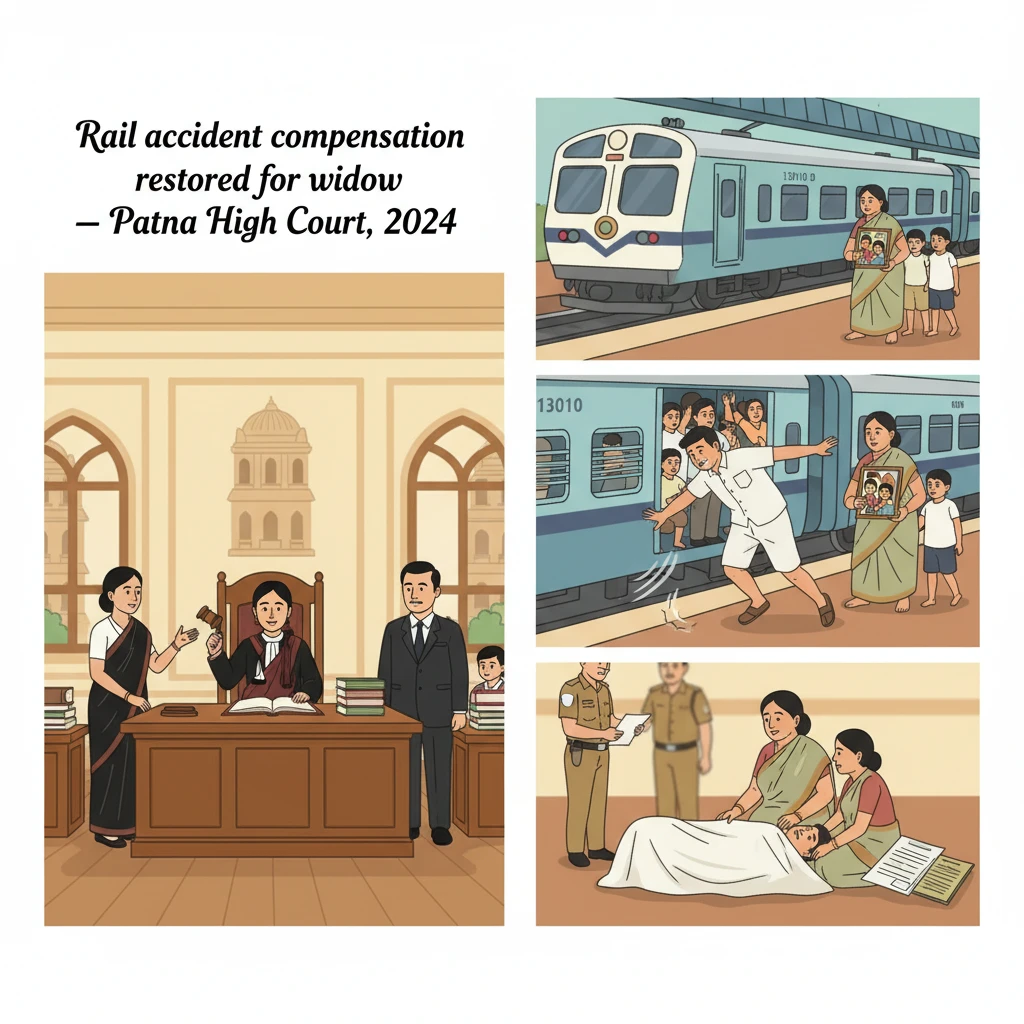
The case arises from a tragic incident on the night of 19 July 2012 at Anugrah Narayan Road Railway Station in Bihar.
The deceased, Sanjay Kumar, had a journey-cum-reservation ticket to travel from Anugrah Narayan Road to Howrah Junction by Dehradun–Howrah Express (Train No. 13010 D). His wife, two minor children and his wife’s elder sister were also travelling with him.
The reservation ticket remained in waiting list and was not confirmed. Because of this, the deceased decided to travel in the general compartment, which was, as the judgment records, “over crowded as usual”.
According to the wife’s account, she, the children and her sister somehow managed to board the crowded general coach. At that time the train started moving with a sudden heavy jolt. While the deceased was boarding, he lost his balance, fell from the moving train and died on the spot due to the injuries suffered in this fall.
The applicant and her sister raised alarm. Some passengers pulled the alarm chain, but the train did not stop. They then got down and managed to reach the place where the deceased had fallen.
Before the family reached, the Station Master on duty at Anugrah Narayan Road Railway Station issued a memo at 21:40 hours on 19 July 2012 regarding the death of an unknown passenger. On the basis of this memo, U.D. Case No. 30 of 2012 was registered at Sonenagar Government Railway Police Station (GRPS).
The dead body was initially recorded as that of an unknown person. Later, the relatives identified the deceased. The inquest report was prepared on the next day, 20 July 2012, as the occurrence had taken place at night. After inquiry, the GRPS submitted a final report stating that this was a case of accidental death due to fall from the train.
The deceased left behind his wife (the applicant), a minor son, a minor daughter and his widowed mother as surviving dependants. His father had predeceased him.
The widow filed Claim Application No. OA 00255 of 2012 before the Railway Claims Tribunal, Patna, seeking compensation of Rs. 4,00,000 with 12% interest from the date of filing till realization.
What the Court Examined and Decided
The Union of India, through the General Manager, East Central Railway, Hajipur, appeared before the Tribunal and filed a written statement.
The Railways mainly argued that the deceased was not a bona fide passenger of the train. They also stated that the applicant had no cause of action, that the injury did not fall under Section 123(c) of the Railways Act, 1989, and that the claim was barred by principles like estoppel, waiver and acquiescence. They demanded strict proof through documents and eye-witnesses.
However, the Railways did not produce any oral or documentary evidence in support of their defence before the Tribunal.
The applicant supported her case by filing an affidavit in evidence. She repeated the sequence of events: waiting ticket not confirmed, decision to travel in general compartment, sudden movement of train while boarding, loss of balance and fall from moving train resulting in instant death.
She further stated that GRPS, Sonenagar, registered U.D. Case No. 30 of 2012 on the basis of the station memo and, after inquiry, filed a final report confirming accidental death due to fall from the train.
In cross-examination, she confirmed that she was present at the time of occurrence at Anugrah Narayan Road Railway Station and firmly denied the suggestion that her husband died while crossing the railway track.
To corroborate her version, the applicant produced ten documents marked Exhibits A/1 to A/10:
- GRP memo dated 20.07.2012 in U.D. Case No. 30 of 2012
- Inquest report dated 20.07.2012
- Challan for sending the dead body for examination
- Copy of reserved train ticket
- Photocopy of police papers
- Final report dated 20.07.2012 in U.D. Case No. 30 of 2012
- Post-mortem report of the deceased
- Death certificate of the deceased
- Dependency certificate
- Voter ID card of the applicant
Despite this material, the Railway Claims Tribunal, by judgment dated 29 June 2016, rejected the claim. The Tribunal held that the applicant had failed to prove that Sanjay Kumar died in the accident of 19 July 2012.
Aggrieved, the widow filed Miscellaneous Appeal No. 1062 of 2016 under Section 23 of the Railway Claims Tribunal Act, 1987 before the Patna High Court.
Before the High Court, counsel for the appellant argued that the Tribunal had failed to properly appreciate the documentary evidence, especially the death certificate. He pointed out that the death certificate carried the date as 20 July 2012 because it was prepared on the basis of the inquest report date, not the date of occurrence. This minor discrepancy, he submitted, could not justify discarding the whole set of consistent documents and testimony which showed that the incident occurred on 19 July 2012.
Counsel for the Railways supported the Tribunal’s order and maintained that the appellant had not proved her case and that the appeal deserved dismissal.
The Patna High Court narrowed the controversy to a single question: whether the Tribunal was justified in denying compensation on the ground that the appellant had failed to prove that her husband died due to an untoward incident on 19 July 2012.
The Court carefully examined the inquest report (Exhibit A/2), post-mortem report (Exhibit A/7) and final report (Exhibit A/6) in U.D. Case No. 30 of 2012. Reading these documents together, the Court found that they clearly showed that Sanjay Kumar died after falling from the train while boarding at Anugrah Narayan Road Railway Station.
The Court held that the incident could not be doubted merely because of the date discrepancy of 20 July 2012 appearing in some documents instead of 19 July 2012. The applicant had filed her affidavit stating the relevant facts and had therefore discharged her initial burden. On the other hand, the Railways had produced no evidence at all in rebuttal.
To support its reasoning, the Court referred to earlier case law.
First, it cited its own decision in Rubi Kunwar vs. Union of India, reported in 2014 (3) PLJR 127. In that case, it was held that Section 124-A read with Section 123(c) of the Railways Act is a beneficial piece of legislation, and that a death within railway premises is presumed to be due to an “untoward incident” unless the Railways prove otherwise through evidence.
The Court also relied on the Supreme Court decision in Union of India vs. Prabhakaran Vijay Kumar & Ors., (2008) 9 SCC 527, which similarly described the compensation provision in the Railways Act as beneficial in nature.
The High Court then referred to Union of India vs. Rina Devi, (2019) 3 SCC 572. According to this judgment, once a claimant shows that a person was a bona fide passenger and that an untoward incident occurred, the burden shifts to the Railways. In the present case, the Court found that this initial burden had been discharged by the appellant through her affidavit and supporting documents. Since the Railways did not rebut this, the onus remained undischarged.
The Court further referred to Union of India vs. Radha Yadav, (2019) 3 SCC 410, where the Supreme Court held that, once the deceased is found to be a bona fide passenger who dies in an untoward incident, compensation must be awarded on the principle of strict liability.
Again relying on Rina Devi, the High Court clarified that death or injury while boarding or de-boarding a train is an “untoward incident” giving a right to compensation. Such cases do not fall within the exceptions under the proviso to Section 124-A merely because there might be some negligence on the part of the victim.
The Court also considered the amendment to the Railway Accidents and Untoward Incidents (Compensation) Rules, 1990, which came into effect from 1 January 2017. Referring to Rina Devi, Radha Yadav, Union of India vs. Dilip & Ors. (2019 SCC OnLine SC 2119) and Kamukayi & Ors. vs. Union of India & Ors. (2023 SCC OnLine SC 642), the Court reiterated that compensation should be calculated so that the claimant receives whichever is higher: the amount applicable on the date of accident with reasonable interest, or the amount prescribed as on the date of award.
On these findings, the Court concluded that the Tribunal’s reasons and the Railways’ stand could not be sustained. The claimant had proved that the deceased was a bona fide passenger and that his death resulted from a fall while boarding the general compartment. This squarely fell within the definition of “untoward incident” under the Railways Act.
The High Court therefore set aside the Tribunal’s judgment dated 29 June 2016 in Claim Application No. OA 00255 of 2012, allowed the Miscellaneous Appeal and, consequentially, allowed the claim application.
The Court held the appellant entitled to compensation of Rs. 4,00,000 with interest at 6% per annum from the date of the incident till realization. The Railways were directed to satisfy the award within two months from the date of receipt or production of a copy of the order.
The Court further clarified that, after applying the rate of interest, if the total amount worked out is less than Rs. 8,00,000, then the applicant will be entitled to a minimum compensation of Rs. 8,00,000.
Why This Judgment Matters
This judgment is important for families of railway accident victims in Bihar and across India.
First, it shows that minor mistakes in official documents, such as a wrong date in a death certificate or inquest report, cannot by themselves be used to deny compensation when other materials support the claim.
Second, it reinforces that the Railways have a heavy responsibility under the law. Once a passenger’s family shows basic facts about the journey and the accident, the burden shifts to the Railways to disprove the claim with evidence, not just arguments.
Third, the Patna High Court underlines that falling from a train while boarding is an “untoward incident” and that negligence by the victim does not automatically cancel the right to compensation.
Finally, the Court ensures that victims’ families receive the higher of two amounts: compensation calculated from the accident date with interest, or the revised amount later notified in the rules. This safeguard can significantly increase the support received by poor dependants.
Legal Issues and Answers
- Issue: Was the Railway Claims Tribunal correct in rejecting the widow’s claim on the ground that she failed to prove her husband’s death in an untoward incident on 19.07.2012?
Answer: No. The Patna High Court held that the evidence, including inquest, post-mortem and final report, along with the widow’s affidavit, proved death due to fall from the train while boarding, an “untoward incident” under the Railways Act. The Tribunal’s order was set aside and compensation was granted. - Issue: Did minor discrepancies in the date of death in official documents justify denying compensation?
Answer: No. The Court held that such minor discrepancies cannot outweigh consistent material showing accidental fall from the train, especially under beneficial legislation like Section 124-A read with Section 123(c) of the Railways Act. - Issue: Who bore the burden to prove or disprove that the deceased was a bona fide passenger who died in an untoward incident?
Answer: The initial burden was on the claimant, which she discharged through affidavit and documents. Thereafter, following Rina Devi, the onus shifted to the Railways, who failed to produce any rebuttal evidence.
Cases Cited by the Court
- Rubi Kunwar vs. Union of India, 2014 (3) PLJR 127
- Union of India vs. Prabhakaran Vijay Kumar & Ors., (2008) 9 SCC 527
- Union of India vs. Rina Devi, (2019) 3 SCC 572
- Union of India vs. Radha Yadav, (2019) 3 SCC 410
- Union of India vs. Dilip & Ors., 2019 SCC OnLine SC 2119
- Kamukayi & Ors. vs. Union of India & Ors., 2023 SCC OnLine SC 642
Case Details
Case Number: Miscellaneous Appeal No. 1062 of 2016
Case Title: Smt. Devanti Devi vs. Union of India through the General Manager, East Central Railway, Hajipur
Citation: 2024 (4) PLJR 445
Coram: Hon’ble Mr. Justice Sunil Dutta Mishra
Date of Judgment: 10.09.2024
Advocates:
- For the appellant: Mr. Krishna Mohan Murari, Advocate
- For the respondent (Union of India/Railways): Mrs. Parul Prasad, C.G.C.; Mr. Shailesh Anand, Advocate; Mr. Aditya Anand, Advocate
Court: High Court of Judicature at Patna
Nature of Case: Miscellaneous Appeal under Section 23 of the Railway Claims Tribunal Act, 1987 against dismissal of a claim for compensation for death in an alleged railway untoward incident.
Link to Judgment: Patna High Court Judgment
If you found this explanation helpful and wish to stay informed about how legal developments may affect your rights in Bihar, you may consider following Samvida Law Associates for more updates.







