
Case Background
The matter arose from narcotics and criminal cases involving the petitioner, Deepak Dhanuk, a resident of Shahpur, District Bhojpur.
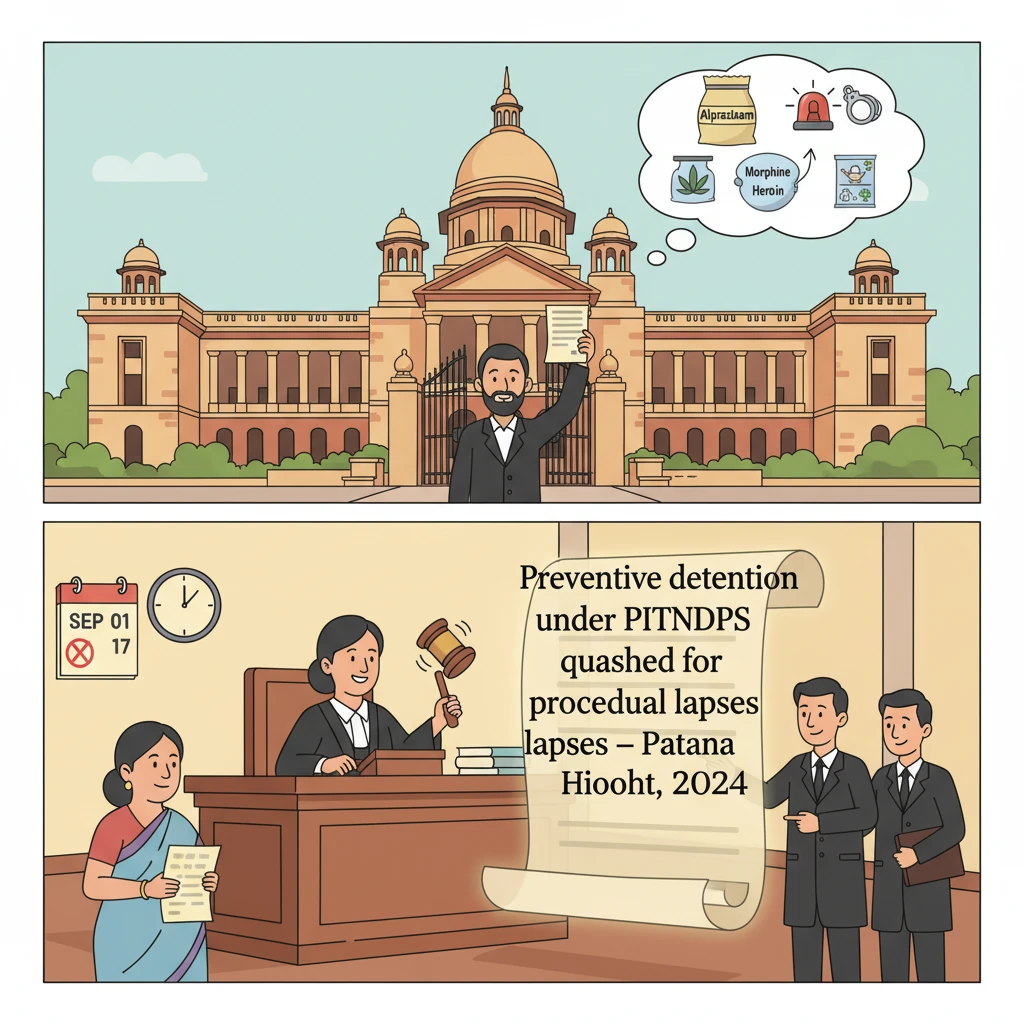
He was alleged to be involved in NCB Crime No.29/2021, NDPS Special Case No.26/2021, relating to seizure on 28.11.2021 of 315 grams of Alprazolam, 270 grams of Morphine and 500 grams of “Patthar”. He was also alleged to be involved in NCB Crime No.04/2022, NDPS Special Case No.71/2022, concerning seizure of 380 grams of heroin on 26.01.2022.
His name surfaced on the basis of statements of co-accused Madan Singh Sondhiya and Vikas Kumar under Section 67 of the NDPS Act, and later a confession attributed to his brother Vinod Dhanuk. There was also Shahpur P.S. Case No.448 of 2023 under Sections 341, 323, 325, 307, 504 read with Section 34 of the Indian Penal Code.
Despite the seriousness of NDPS offences, the petitioner obtained regular bail. In NDPS Special Case No.71/2022 (NCB Case No.04/22), bail was granted on 04.07.2023 in Criminal Misc. No.37896 of 2023. In NDPS Case No.57/2022 (NCB Case No.29/2021), bail was granted on 19.07.2023 in Criminal Misc. No.40976 of 2023. In Shahpur P.S. Case No.448 of 2023, bail was later granted on 09.02.2024 in Criminal Misc. No.5567 of 2024.
While these criminal cases were pending, the Joint Secretary, Government of India, Ministry of Finance (PITNDPS Unit) passed a preventive detention order dated 01.09.2023 under Section 3(1) of the Prevention of Illicit Traffic in Narcotic Drugs and Psychotropic Substances Act, 1988 (PITNDPS). This order proposed to detain the petitioner for his alleged role in illicit trafficking.
On 28.09.2023, the petitioner was taken into custody in Shahpur P.S. Case No.448 of 2023 and remained in jail till 09.02.2024. During this period, on 17.10.2023, the detention order and grounds were served on him in jail.
The Government then referred the matter to the Advisory Board under Section 9(b) of PITNDPS on 03.11.2023. The reference to the Board was communicated to the petitioner on 11.11.2023 and to the Advisory Board on 09.11.2023.
The petitioner’s wife, Babita Devi, sent a detailed representation dated 30.11.2023 by registered post to the Joint Secretary, Government of India, seeking revocation of the detention order. This representation was rejected by memorandum dated 20.12.2023 issued by the Deputy Secretary, Government of India.
The Advisory Board heard the petitioner, deferred its sitting once, and finally recorded its opinion on 22.12.2023. Relying on that opinion, the Deputy Secretary, Government of India, issued an order dated 01.01.2024 under Section 9(f) read with Section 11 of PITNDPS, confirming the detention for one year from the date of detention, treated as 17.10.2023.
The detention order was stated to have been served on the petitioner on 02.01.2024, and again communicated on 09.01.2024 and 07.04.2024 at Mandal Kara, Ara, Bhojpur. The petitioner then approached the Patna High Court in Criminal Writ Jurisdiction Case No.650 of 2024 seeking quashing of the detention and confirmation orders.
What the Court Examined and Decided
The Division Bench of Hon’ble Mr. Justice P. B. Bajanthri and Hon’ble Mr. Justice Alok Kumar Pandey heard detailed arguments from both sides. The Court emphasised that preventive detention is for preventing a possible future crime, not for punishing past acts, and therefore every procedural safeguard must be strictly followed. Any small error must go in favour of the detenue.
The petitioner’s counsel highlighted that he had only studied up to Class VIII and did not understand English. Yet, the detention order, grounds of detention, relied documents, and confirmation proceedings were in English. It was argued that reasonable opportunity to make a representation requires that all materials be supplied in a language the detenue understands, and merely explaining orally in Hindi is not enough when personal liberty is at stake.
Counsel further pointed out that the detention order dated 01.09.2023 along with grounds was served only on 17.10.2023. Under PITNDPS, grounds have to be communicated as soon as may be, ordinarily within five days, and in exceptional cases within fifteen days with reasons in writing. A delay of 46 days, without recorded exceptional reasons, was said to violate the statute.
It was also contended that copies of important documents relied on by the detaining authority, such as bail applications and bail orders, were not fully supplied in Hindi translation. Some documents, including the chemical examination reports, complaint, talash (search) memo, communications, and bail orders, remained in English. This, it was argued, made it impossible for the petitioner to make an effective representation, violating Article 22(5) of the Constitution.
The petitioner’s side also argued that there was no “live and proximate link” between the alleged activities and the preventive detention. After he was granted bail in the NDPS cases, the grounds of detention did not show that he was again in touch with any drug network or involved in similar activities. The advisory and detaining authorities, it was said, ignored the fact that he had already been granted regular bail despite the stringent conditions under Section 37 of the NDPS Act.
Another important challenge was to the handling of the representation dated 30.11.2023 submitted by Babita Devi. The rejection memorandum dated 20.12.2023 merely stated that the representation had been considered and rejected. It did not discuss or answer any of her detailed points spread over three pages and 19 paragraphs. According to the petitioner, this was a non-speaking order, showing non-application of mind and breach of the constitutional duty to consider representations promptly and fairly.
The petitioner also attacked the Advisory Board’s opinion dated 22.12.2023 as unreasoned. The Board simply noted that it had considered the reference and materials, heard the detenue, and was of the opinion that there were sufficient grounds for detention. The opinion did not discuss the representation, the bail orders, or any factual aspect, nor did it specify its reasoning in a separate paragraph as required by Section 9(c) of PITNDPS.
The Union of India, on the other hand, argued that the writ petition was not maintainable and asserted full compliance with the procedure. It stated that the detention order and all relied documents were served on the petitioner on 17.10.2023 at Mandal Kara, Ara, in the presence of the Deputy Superintendent. It also claimed that the petitioner had been apprised in Hindi about the English documents and proceedings.
The Union further contended that the petitioner’s involvement was clear from voluntary statements under Section 67 of the NDPS Act given by co-accused, and his own statement dated 25.01.2022 where he allegedly confessed. They also pointed to alleged criminal antecedents, including Crime No.13 of 2022 under IPC sections, and seizure of immovable property worth about Rs.1,86,40,000/- from the petitioner and his brother, said to be illegally acquired.
After analysing the record, the Patna High Court noted that the petitioner was not directly caught with narcotics in the NCB cases; his name had only emerged in statements of other accused and his brother. The Court acknowledged that his exact role would be tested in the criminal trial, where he had already obtained regular bail even under Section 37 of the NDPS Act.
On the crucial issue of delay, the Court found that the proposed detention order dated 01.09.2023 and grounds were indeed served only on 17.10.2023, resulting in about 46 days’ delay. The statute required service within five days, extendable to fifteen days with written reasons, which were absent. On this ground alone, the Court held that the petitioner had made out a case.
On the supply of documents and language, the Court examined the material and found that while some documents had been translated to Hindi, several important ones had not, including chemical examination reports, complaint petition, communications, bail orders, forensic reports, and jamatalashi documents. The Union’s claim that the petitioner had been orally apprised in Hindi on 17.10.2023 was not supported by any contemporaneous material or acknowledgment signed by the petitioner.
The Court stressed that where liberty is at stake, fairness requires that all documents be translated into a language known to the detenue. Without this, he cannot effectively understand or challenge the allegations. Relying on earlier decisions including P.U. Abdul Rahiman and A. Ahmad Kutty, and Delhi High Court judgments in Sharafat Sheikh and Jasvinder Kaur, the Court held that non-supply and non-translation of key documents violated Article 22(5).
The Court further held that there was no clear material showing that, after being granted bail, the petitioner was likely to indulge in similar narcotics offences so as to justify preventive detention. The reasoning in Sushanta Kumar Banik regarding the need for a “live and proximate link” between past conduct and present detention was found applicable.
Coming to the Advisory Board, the Court reproduced Section 9(c) of PITNDPS and the Board’s opinion dated 22.12.2023. It held that the opinion was vague and unreasoned, did not mention or analyse Babita Devi’s representation, and did not specify its opinion in a separate paragraph as required. Citing the Supreme Court’s decision in Nenavath Bujji, the Court underlined that Advisory Boards must undertake thorough, independent scrutiny and cannot act mechanically.
The Court also evaluated the memorandum dated 20.12.2023 rejecting Babita Devi’s representation. It found this to be a bare rejection without any reasoning or consideration of her detailed points. Relying on precedents like Smt. Icchu Devi Choraria, Kamla Kanyalal Khushalani, Pramod Singla, and ORYX Fisheries (which summarised the law on reasoned orders in quasi-judicial functions), the Court held that such non-speaking rejection was arbitrary and violated principles of natural justice.
Since the Advisory Board’s unreasoned opinion formed the basis of the Central Government’s confirmation order dated 01.01.2024, the Court concluded that the confirmation order too was arbitrary and unsustainable. The Central Government had merely stated that it had considered the Board’s opinion, although that opinion itself lacked reasons and did not reflect consideration of the representation.
In sum, the Court found multiple procedural and constitutional violations—delayed service of grounds, incomplete translation and supply of documents, unreasoned rejection of representation, and a non-speaking Advisory Board opinion. Considering the strict approach required in preventive detention matters, the Court held that the detention could not stand.
Accordingly, the writ petition was allowed. The order of detention dated 01.01.2024 passed by the Deputy Secretary, Government of India, confirming the earlier detention order, was quashed and set aside. The petitioner was ordered to be released forthwith, if not wanted in any other case. Pending interlocutory applications were disposed of.
Why This Judgment Matters
This judgment is important for anyone facing preventive detention under PITNDPS or similar laws. The Patna High Court has clearly said that the government must follow every step of procedure strictly. If there is delay in serving grounds, if documents are not given in a language the detenue understands, or if representations are rejected without reasons, the detention can be struck down.
The decision protects people who may be poor or less educated, like the petitioner who had studied only up to Class VIII and did not know English. It confirms that authorities must provide Hindi translations and not rely only on oral explanations when liberty is at stake.
The Court has also reminded Advisory Boards that they are not rubber stamps. They must give detailed, reasoned opinions after looking at all material, including representations. This strengthens safeguards against misuse of preventive detention powers.
Legal Issues and Answers
Issue: Whether delay of about 46 days in serving the detention order and grounds dated 01.09.2023 on the petitioner violated PITNDPS requirements.
Answer: Yes. The law requires service within 5 days, extendable to 15 days with recorded reasons. No such reasons were shown, so the delay vitiated the detention.
Issue: Whether non-supply and non-translation into Hindi of all relied documents and grounds denied the petitioner his constitutional right under Article 22(5) to make an effective representation.
Answer: Yes. Several key documents remained in English; mere oral explanation was not enough. This violated Article 22(5) and the principle of fairness.
Issue: Whether the Advisory Board’s opinion dated 22.12.2023 and the Central Government’s rejection of the representation and confirmation order dated 01.01.2024 were valid.
Answer: No. Both were non-speaking, unreasoned orders showing lack of application of mind. The Advisory Board failed to comply with Section 9(c) of PITNDPS, and the Central Government’s confirmation, based on such opinion, was held arbitrary.
Cases Cited by the Court
- Union of India v. Meera Mohideen, (1995) 4 SCC 51
- A. Ahmad Kutty v. Union of India, (1990) 2 SCC 1
- P.U. Abdul Rahiman v. Union of India and Others, 1991 Supp. (2) SCC 274
- Sushanta Kumar Banik v. State of Tripura & Others, 2022 SCC OnLine SC 1333
- Bhawarlal Ganeshmalji v. State of Tamil Nadu, (1979) 1 SCC 465
- Kamarunissa v. Union of India, (1991) SCC 128
- Veeramani v. State of T.N., (1994) 2 SCC 337
- Taimoor Khan @ Bhola @ Tamoor v. Union of India, 2024 SCC OnLine Del 416
- Kamla Kanyalal Khushalani v. State of Maharashtra, (1981) 1 SCC 748
- Smt. Icchu Devi Choraria v. Union of India, (1980) 4 SCC 531
- Sharafat Sheikh v. Union of India and Another, 2022 SCC OnLine Del 2725
- Jasvinder Kaur v. Union of India & Others, 2022 SCC OnLine Del 510
- Nenavath Bujji Etc. v. State of Telangana and Others, AIR 2024 SC 1610
- Pramod Singla v. Union of India and Others, 2023 SCC OnLine SC 374
- ORYX Fisheries Private Limited v. Union of India and Others, (2010) 13 SCC 427
- Kranti Associates (referred in ORYX Fisheries)
- Several earlier Supreme Court decisions referred in Icchu Devi Choraria (Niranjan Singh, Shaikh Hanif, Dulal Roy, Nizamuddin, Mohd. Alam, Khudiram Das)
Case Details
Case Number: Criminal Writ Jurisdiction Case No.650 of 2024 (arising out of P.S. Case No.29 of 2021, Government Official Comp., District Bhojpur)
Case Title: Deepak Dhanuk v. Union of India & Others
Citation: 2024 (4) PLJR 715
Coram: Hon’ble Mr. Justice P. B. Bajanthri and Hon’ble Mr. Justice Alok Kumar Pandey
Date of Judgment: 14.08.2024 (CAV date 09.08.2024)
Advocates:
- For the Petitioner: Mr. Ravindra Kumar, Advocate; Mr. Sandeep Kumar Pandey, Advocate
- For the State of Bihar: Mr. P. N. Sharma, AC to AG
- For the Union of India: Mr. Subodh Kumar Jha, Senior CGC; Ms. Parul Prasad, CGC; Mr. Aditya Anand, Advocate; Mr. Shailesh Anand, Advocate
Nature of the Case: Criminal writ petition challenging preventive detention order under Section 3(1) of the PITNDPS Act, 1988 and its confirmation under Section 9(f) of the PITNDPS Act.
Link to Judgment (Patna High Court official website): Click here to access the full judgment
If you found this explanation helpful and wish to stay informed about
how legal developments may affect your rights in Bihar,
you may consider following Samvida Law Associates for more updates.







