
Case Background
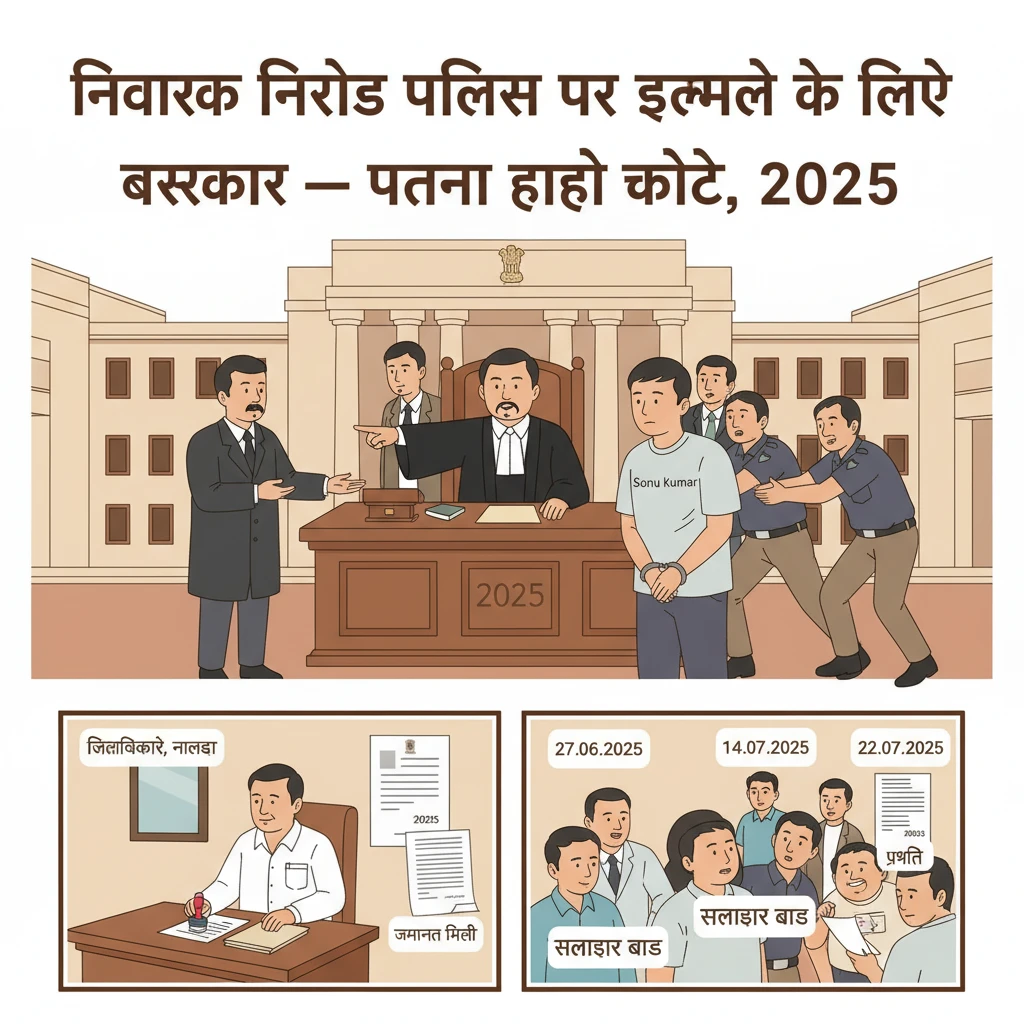
The case arose out of a preventive detention order passed by the District Magistrate, Nalanda, against the petitioner, Sonu Kumar. The order was issued through Memo No. 2509/Legal, Biharsharif dated 17.06.2025.A
The detention was based, among other things, on allegations in Islampur P.S. Case No. 221 of 2025 dated 29.04.2025. In that FIR, the petitioner faced prosecution under Sections 190, 191(2), 191(3), 109, 111, 121(1), 221, 351(3), 352 of the Bharatiya Nyay Sanhita and Section 27 of the Arms Act.
The petitioner challenged not only the original detention order, but also the subsequent actions of the State Government. The Government approved the detention order by Memo No. 8140 dated 27.06.2025. Later, on the opinion of the Advisory Board, the Home (Police) Department confirmed the detention through Memo No. 3453 dated 22.07.2025.
Aggrieved, the petitioner approached the Patna High Court in Criminal Writ Jurisdiction Case No. 2343 of 2025. He questioned both the legality of the District Magistrate’s order and the State Government’s confirmation of his preventive detention.
What the Court Examined and Decided
The Division Bench of the Patna High Court, comprising Hon’ble Mr. Justice Rajeev Ranjan Prasad and Hon’ble Mr. Justice Sourendra Pandey, heard the matter. The oral judgment was delivered by Hon’ble Mr. Justice Rajeev Ranjan Prasad on 24.11.2025.
The petitioner’s senior counsel argued that the detention was not really about maintaining public order. According to him, the authorities mainly relied on the petitioner’s criminal history and the fact that he had obtained bail in earlier cases and was likely to get bail in the new case from Islampur P.S.
The counsel pointed out that the detention order mentioned the possibility of the petitioner being released on bail as a reason to detain him. This, he argued, showed that the authorities wanted to keep the petitioner in custody even after he secured bail from regular criminal courts. In his submission, the detention had been ordered in haste, only to prevent his release.
During earlier hearing on 19.11.2025, the Court had already noted an important fact: in Islampur P.S. Case No. 221 of 2025, the petitioner had been granted bail on 13.06.2025. This was prior to the detention order dated 17.06.2025. The Court also noted that this bail order was well within the knowledge of both the District Magistrate and the Superintendent of Police, Nalanda.
The petitioner’s side claimed that, despite this knowledge, the detention order twisted the facts. According to them, the order attempted to create an impression that the authorities were unaware of the bail and that the petitioner might be released, justifying his preventive detention.
The timeline of events regarding representation was also highlighted by the petitioner. The detention order was passed on 17.06.2025. The grounds of detention were served on him on 19.06.2025. He submitted his representation against the detention to the Under Secretary, Home (Police Branch) on 02.07.2025.
However, before his representation was submitted, the State Government had already approved the detention order under Section 12(3) of the Bihar Control of Crimes Act, 2024, by Memo No. 8140/Patna dated 27.06.2025. Later, after obtaining the opinion of the Advisory Board, the Government confirmed the detention through Memo No. 3453/Patna dated 22.07.2025.
The petitioner specifically argued that before issuing Annexure P/5 (the confirmation order dated 22.07.2025), his representation had not been considered. This, he claimed, violated his rights under the preventive detention framework.
On the other hand, the State, represented by learned GA-5, defended the detention. The State argued that the order was passed not only because of the petitioner’s criminal history but also due to the serious nature of the cases in which he had been chargesheeted.
The State accepted that there is a legal difference between ordinary “law and order” problems and disturbances of “public order”. However, it stressed that the present allegations went beyond a simple law and order issue.
Referring to Islampur P.S. Case No. 221 of 2025, the State submitted that the petitioner had allegedly attacked police personnel along with his associates. During this attack, they allegedly managed to forcibly free two persons, Santosh Kumar @ Lal Badshah and Honey Kumar, from police custody. This was reportedly done by resorting to indiscriminate firing, resulting in injuries to some police personnel.
According to the State, such an incident was a direct assault on the functioning of the police in public. It created fear and disturbed public order. Hence, preventive detention was justified.
On the point of the “bail” remark in the detention order, the State fairly conceded that the District Magistrate did not need to write that the petitioner was likely to come out on bail and therefore needed detention. However, the State argued that this was only one among several reasons mentioned in the order. It contended that even if those comments about bail were ignored, the core grounds of detention remained valid and unaffected.
The State further informed the Court that all statutory timelines under the Bihar Control of Crimes Act, 2024 had been followed. It stated that:
- the approval of the detention order by the Government took place within 12 days from the date of the original order,
- the grounds of detention were communicated to the petitioner within five days,
- the matter was referred to the Advisory Board within three weeks from the date of detention, and
- the Advisory Board submitted its report on 14.07.2025, recording that there were sufficient grounds for detention.
On this basis, the Government issued Memo No. 3453/Patna dated 22.07.2025 confirming the detention.
The State also took a specific stand regarding the petitioner’s representation. It argued that the petitioner did not submit any representation to the Government before the approval order dated 27.06.2025. Moreover, under the scheme of the Act of 2024, consideration of a representation at the approval stage is not envisaged. According to the State, any such representation is to be placed before and considered by the Advisory Board, whose opinion then guides the Government in confirming or revoking detention.
After hearing both sides, the Court turned to the key question: whether the alleged acts attributed to the petitioner amounted to a disturbance of “public order”.
The Bench noted the specific allegation that the petitioner and his associates assaulted police personnel and resorted to indiscriminate firing with the object of freeing their associates from police custody. Some police personnel were injured in the incident.
The Court held that such an alleged offence clearly fell within the category of a case involving disturbance of public order. It recognised the settled legal distinction between “public order” and “law and order”, and the fact that not every crime, even if serious, amounts to a public order problem.
To explain this distinction, the Court referred to the recent Supreme Court judgment in Arjun S/o Ratan Gaikwad vs. State of Maharashtra and Ors., reported in 2024 INSC 968. The Supreme Court in that case had drawn on earlier landmark decisions including the Constitution Bench ruling in Ram Manohar Lohia v. State of Bihar, AIR 1966 SC 740, and Arun Kumar Ghosh v. State of W.B., (1972) 3 SCC 823.
The Patna High Court reproduced paragraph 15 of the Supreme Court’s judgment in Arjun Gaikwad. That paragraph explains, through examples, when an act affects public order and when it remains a matter of ordinary law and order. A murder committed within a house, even if brutal, may not amount to a public order threat. In contrast, behaviour in a public place that creates terror among people can amount to disturbance of public order even without a physical attack.
Applying this principle to the facts before it, the Court concluded that an armed attack on police in the process of freeing accused persons from custody, in a manner that injures police and causes public fear, is a disturbance of public order. It therefore held that the preventive detention in this case was justified under the Act of 2024.
On the issue of non-consideration of representation at the approval stage, the Court found that the petitioner had not submitted his representation before the Government passed the approval order dated 27.06.2025. Because of this factual position, the Court held that the question raised by the petitioner on this point did not arise in the present case.
The Court then examined the confirmation order contained in Memo No. 3453 (Annexure P/5). It held that this order did not suffer from any infirmity, since it was based on the opinion of the Advisory Board and had been passed under Section 23(1) read with Section 24 of the Bihar Control of Crimes Act, 2024.
Before concluding, the Court did make one critical observation. It stated that there was no need for the District Magistrate to record that, because the petitioner would come out on bail, he was required to be detained. The Bench described such observations as “totally irrelevant”. However, it clarified that these remarks did not affect the legality or validity of the detention order, which was otherwise supported by sufficient material.
Ultimately, the Court held that the writ application had no merit. The preventive detention order and its confirmation were upheld, and the writ petition was dismissed.
Why This Judgment Matters
This judgment is important for anyone facing preventive detention in Bihar, particularly under the Bihar Control of Crimes Act, 2024. It shows how strongly the courts view armed attacks on police and attempts to free accused persons from custody.
The Patna High Court treated such acts as more than ordinary crime. It held that they disturb public order because they attack the very system meant to protect society. When police are shot at or injured while performing their duty, it creates fear not just for the officers, but for the public who rely on them.
The ruling also makes clear that even if authorities use some unnecessary language about “bail” in a detention order, the Court will look at the overall substance. If there are strong, independent grounds that justify detention, minor or irrelevant remarks in the order may not be enough to get the detention quashed.
Another important point from this decision is the role of the Advisory Board. Under the Act of 2024, once the Board finds sufficient grounds for detention, the Government’s confirmation order based on that opinion gets strong support. Challenging detention on technicalities becomes harder unless there is clear violation of procedure or lack of material.
For citizens, especially those in districts like Nalanda, this judgment underlines that involvement in violent activities against police, particularly with firearms, can lead not only to normal criminal trials but also to long periods of preventive detention.
Legal Issues and Answers
- Issue: Did the alleged armed attack on police to free associates from custody amount to a disturbance of public order, justifying preventive detention under the Bihar Control of Crimes Act, 2024?
Answer: Yes. The Court held that such conduct clearly falls within disturbance of public order, going beyond ordinary law and order problems. - Issue: Did the detention and its confirmation become invalid because the District Magistrate referred to the petitioner’s likelihood of getting bail and because the petitioner’s representation was not considered before approval of the detention order?
Answer: No. The Court held that the “bail” observations were irrelevant but did not affect the validity of the detention, and the petitioner had not submitted any representation before the approval order; hence that challenge did not arise. - Issue: Was the Government’s confirmation order (Memo No. 3453 dated 22.07.2025) suffering from any legal infirmity?
Answer: No. The Court found it valid as it was based on the Advisory Board’s opinion and passed under Section 23(1) read with Section 24 of the Act of 2024 with statutory timelines followed.
Cases Cited by the Court
- Arjun S/o Ratan Gaikwad vs. State of Maharashtra and Ors., 2024 INSC 968
- Ram Manohar Lohia v. State of Bihar, AIR 1966 SC 740
- Arun Kumar Ghosh v. State of W.B., (1972) 3 SCC 823
Case Details
Case Number: Criminal Writ Jurisdiction Case No. 2343 of 2025
Case Title: Sonu Kumar vs. The State of Bihar & Ors.
Citation: 2026 (1) PLJR 57
Court: High Court of Judicature at Patna
Bench (Coram): Hon’ble Mr. Justice Rajeev Ranjan Prasad and Hon’ble Mr. Justice Sourendra Pandey
Date of Judgment: 24.11.2025
Respondent Authorities Involved: State of Bihar through Principal Secretary, Department of Home; Principal Secretary, Department of Home (Police); Deputy Secretary, Department of Home (Police); District Magistrate, Nalanda; Superintendent of Police, Nalanda
Advocates:
- For the Petitioner: Mr. Rajesh Kumar Singh, Senior Advocate; Mr. Ambrish Kumar, Advocate; Mr. Mukul Kumar, Advocate
- For the State: Mr. Ajay Kumar, G.A. 5; Mr. Saurav Kumar, Advocate; Mr. Pratik Kumar Sinha, Advocate; Dr. Nivedita Chaudhary, Advocate
Nature of the Case: Criminal writ petition challenging preventive detention order and its confirmation under the Bihar Control of Crimes Act, 2024
Relevant Statutes: Bihar Control of Crimes Act, 2024 (including Sections 12(3), 23(1), 24); Bharatiya Nyay Sanhita Sections 190, 191(2), 191(3), 109, 111, 121(1), 221, 351(3), 352; Section 27 of the Arms Act
Link to Judgment: file:///C:/Users/Adity/OneDrive/Documents/Vaktrita%20Final/case%201288.pdf
If you found this explanation helpful and wish to stay informed about how legal developments may affect your rights in Bihar, you may consider following Samvida Law Associates for more updates.







