

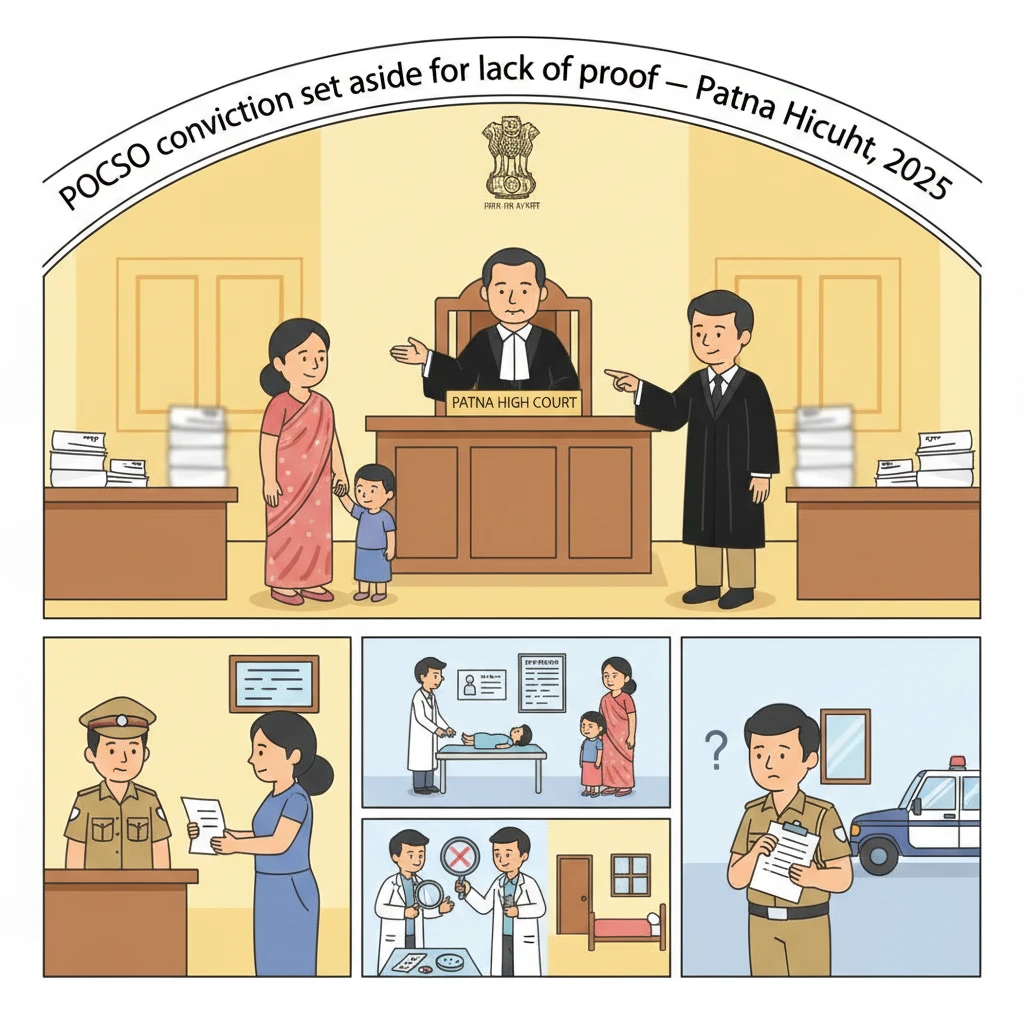
Case Background
This criminal appeal (DB) No. 205 of 2023 arose from Special (POCSO) Case No. 150 of 2020, linked to Sachivalaya P.S. Case No. 89 of 2020, Patna.
The FIR was based on a written application dated 24.08.2020 given by the mother of the minor victim (P.W. 3). She alleged that around 12:30 PM on 24.08.2020, she woke from sleep after hearing her daughter crying. The child allegedly told her that, while she was playing near a vehicle with a boy named Ankit, the appellant (described as “Krishna uncle”), who lived in a nearby room and worked as a Home Guard posted at the residence of a former Chief Secretary, took her inside his room.
According to the written report, once inside the room, the appellant closed the door, took the child on his lap and started inserting his penis inside her anus, then scolded her to remain silent and rubbed his penis on her anus. The child is said to have shouted, freed herself, put on her pant and run back to her house. The mother claimed that, on checking, she found scratches and a wound around the anus of the child. The father was informed and the appellant was scolded.
On this written application, Sachivalaya P.S. Case No. 89 of 2020 was registered on 24.08.2020 under Section 376 IPC and Sections 8 and 12 of the POCSO Act. After investigation, the Investigating Officer submitted charge-sheet No. 92 of 2020 dated 12.11.2020 under Section 376 IPC and Sections 4 and 6 of the POCSO Act.
On 03.04.2021, the Special POCSO Court took cognizance under Section 376-AB IPC and Sections 4 and 6 of the POCSO Act against the appellant. Charges were read over and explained to him in Hindi; he pleaded not guilty and stood trial.
The prosecution examined five witnesses: the father (P.W. 1), the minor victim (P.W. 2), the mother/informant (P.W. 3), the Investigating Officer (P.W. 4) and the doctor (P.W. 5). Material exhibits included the seized pant of the victim, the underwear of the appellant, medical and FSL reports.
By judgment dated 09.11.2022, the Additional Sessions Judge‑VI‑cum‑Special Judge, POCSO, Patna convicted the appellant under Section 6 of the POCSO Act and sentenced him on 15.11.2022 to 20 years’ simple imprisonment and a fine of Rs. 25,000/‑, with six months’ simple imprisonment in default.
The appellant challenged this conviction before the Patna High Court. He was represented by an Amicus Curiae, and the State was represented by the Additional Public Prosecutor. Respondent No. 2 (mother of the victim) did not appear despite valid service of notice.
What the Court Examined and Decided
The Division Bench of Hon’ble Mr. Justice Rajeev Ranjan Prasad and Hon’ble Mr. Justice Sourendra Pandey (authoring judge) closely examined three main areas: consistency of the prosecution story, medical and scientific evidence, and the reliability of the child witness and investigation.
First, the Court compared the original written report with the later oral evidence in court. In the written report, the allegation was that the appellant rubbed his penis around the anus of the child and that the mother saw a bruise around the anus. There was no allegation of vaginal involvement or bleeding.
However, during trial, the father (P.W. 1) said that when he checked his daughter, he saw abrasions around both the anus and the vagina. The mother (P.W. 3) went even further, claiming that blood was coming out from both the vagina and the anus and that the pant of the victim was stained with blood.
The Court noted that this was a clear “improvement” over the written version – moving from rubbing of the penis around the anus to a case of penetrative sexual assault with bleeding from both private parts. These changed versions raised doubt about the genuineness of the initial allegation.
Second, the Bench examined the medical evidence. P.W. 5, Dr. Anju Kumari, had medically examined the child. In her report (Ext. P‑8), she recorded:
- No injury on the general body of the child.
- On pelvic examination, no injury on vaginal or labial region.
- Only redness and swelling around the anal opening.
- No spermatozoa in vaginal or anal swab.
- Age of the victim between 5–6 years.
- Clear opinion that, according to these findings, “opinion about attempt of rape cannot be given”.
During cross‑examination, the doctor accepted that redness and swelling around the anus could be caused by a fall on a hard surface. The Court held that this medical evidence did not support the later version of multiple abrasions and bleeding from both vagina and anus, and that it ruled out penetrative sexual assault.
Third, the Court studied the evidence of the child victim (P.W. 2). She was about six years old at the time of deposition. The Bench observed that the trial court had not put any preliminary questions to test her understanding and competence as a child witness, contrary to the guidance given by the Supreme Court in Pradeep vs. State of Haryana (AIR 2023 SC 2345) and P. Ramesh vs. State Represented by Inspector of Police (2019) 20 SCC 593. Her deposition simply recorded her age and then straight examination‑in‑chief and cross‑examination.
More importantly, in paragraph‑20 of her cross‑examination, the child admitted that she had been taught by her mother and father what to say before coming to court. In paragraph‑21, she added that she had given her earlier statement “as told by Daroga Ji” (the police officer/I.O.). The Bench held that this clear admission of tutoring by parents and police prevented treating her as a “sterling” or wholly reliable witness.
The Court also took note of background tension suggested in the record. The child admitted that the officer, in whose residence her father worked, and his wife used to scold her father when he did something wrong. The appellant, in his statement under Section 313 Cr.P.C., claimed that he had complained to that officer against the father of the victim for alleged misbehaviour, theft of a bag of rice and for consuming alcohol and ganja, and that the father had tried to offer him Rs. 25,000/‑ which he refused. According to the appellant, he was falsely implicated because of these disputes. The High Court considered that, at least, the existence of prior friction could not be ruled out.
The Bench further looked at the investigation. The I.O. (P.W. 4) admitted in cross‑examination that:
- The appellant was not medically examined at any stage, though arrested on the same day. This was contrary to Section 53A Cr.P.C. requirements in sexual offence cases.
- She did not investigate the aspect of previous enmity between the parties.
- She did not record the statement of the officer and his family, in whose residence the victim’s father worked.
- She did not properly detail the room where the incident allegedly happened – no description of door size, locks, or other features which would show whether a five‑year‑old could have locked or unlocked the door as claimed.
- Though she said she recorded the statement of one Moiuddin Khan, whose folding cot was mentioned at the place of occurrence, she did not register that statement.
Scientific evidence also did not support the prosecution. The FSL report (Ext. P‑11) found the blood grouping result inconclusive, so it could not be said that blood on the pant was of the victim. No blood was found on the appellant’s underwear and no semen was detected on either the victim’s pant or the appellant’s underwear.
Given all this, the Court concluded that it was not safe to rely solely on the child’s testimony, especially when she herself admitted being tutored and her story had been improved over time, and when medical and forensic evidence did not show penetration or rape.
The Bench also discussed Section 29 of the POCSO Act, which creates a presumption of guilt once a person is prosecuted for certain offences under the Act. Relying on its earlier decision in Heera Das vs. State of Bihar & Anr. 2025 (2) BLJ 517, and on decisions of the Delhi, Calcutta and Kerala High Courts, the Bench reiterated that:
- The presumption applies only after the prosecution proves the “foundational facts” of the offence.
- If those foundational facts are not proved by cogent, reliable evidence, the presumption under Section 29 cannot be used to convict.
In this case, the Court held that the prosecution failed to establish foundational facts pointing clearly to penetrative sexual assault by the appellant. On the other hand, the defence version of false implication due to disputes was found probable on a preponderance of probabilities.
Finally, the Court observed that the trial court had misdirected itself by treating external rubbing as “penetrative sexual assault” under Section 3 of the POCSO Act despite the clear medical opinion that penetration could not be inferred. In the absence of proof of penetration and in view of serious inconsistencies and investigative lapses, conviction under Section 6 of the POCSO Act (aggravated penetrative sexual assault) could not stand.
Granting the appellant benefit of doubt, the High Court set aside the judgment of conviction dated 09.11.2022 and order of sentence dated 15.11.2022. It directed that the appellant, who was then in custody, be released forthwith if not required in any other case. The appeal was allowed, and the Court also recorded appreciation for the assistance provided by the Amicus Curiae.
Why This Judgment Matters
This judgment shows that, even in sensitive POCSO cases, the Patna High Court will carefully test whether the prosecution story matches the medical, forensic and other evidence. Serious punishment like 20 years’ imprisonment cannot rest on a version that keeps changing.
The Court stresses that a child’s statement, though important, must be reliable and free from tutoring, and that trial courts must first test the competence of child witnesses. It underlines that medical examination of both victim and accused and proper investigation of the scene and possible motives are essential.
For accused persons and families facing similar allegations, the decision highlights that benefit of doubt will be given if there are major contradictions, lack of medical support, and investigation lapses. For victims and their families, it signals the need for prompt, honest reporting and thorough medical and forensic documentation to avoid acquittals due to weak evidence.
Legal Issues and Answers
Issue: Whether the evidence on record proved beyond reasonable doubt that the appellant committed aggravated penetrative sexual assault on a 5‑year‑old child under Section 6 of the POCSO Act and Section 376‑AB IPC.
Answer: No. The Patna High Court held that medical evidence ruled out penetration, the child’s testimony was tutored and inconsistent, scientific evidence did not support the prosecution, and foundational facts were not proved; hence conviction could not be sustained.
Issue: Whether the statutory presumption under Section 29 of the POCSO Act could be invoked to uphold the conviction despite these weaknesses.
Answer: No. The Court held that Section 29 presumption arises only after the prosecution proves foundational facts by cogent evidence. As that did not happen, the presumption could not be used and the appellant was entitled to benefit of doubt.
Issue: Whether failure to test the child witness’s competency and to medically examine the accused affected the validity of the conviction.
Answer: Yes. The Court held that the trial court’s omission to test the child witness’s competence and the I.O.’s failure to get the accused examined under Section 53A Cr.P.C. contributed to serious doubt about the prosecution case.
Cases Cited by the Court
- Pradeep vs. State of Haryana, AIR 2023 SC 2345
- P. Ramesh vs. State Represented by Inspector of Police, (2019) 20 SCC 593
- Rudal Chaupal vs. The State of Bihar, 2024 (2) BLJ 231 (HC)
- Veerpal @ Titu vs. State (Delhi High Court, CRL.A.223/2023, 15.04.2024)
- Subrata Biswas and Another vs. State, 2019 SCC Online Cal 1815
- Joy vs. State of Kerala, (2019) 1 KLT 935
- Heera Das vs. State of Bihar & Anr., 2025 (2) BLJ 517
Case Details
Case Number: Criminal Appeal (DB) No. 205 of 2023; arising out of Special (POCSO) Case No. 150 of 2020 and Sachivalaya P.S. Case No. 89 of 2020
Case Title: Jai Krishna Yadav vs. The State of Bihar & Anr.
Citation: 2026 (2) PLJR 75
Coram: Hon’ble Mr. Justice Rajeev Ranjan Prasad and Hon’ble Mr. Justice Sourendra Pandey
Date of Patna High Court Judgment: 25.11.2025
Trial Court: Court of Additional Sessions Judge‑VI‑cum‑Special Judge, POCSO, Patna
Trial Court Judgment and Sentence: Judgment of conviction dated 09.11.2022 and order of sentence dated 15.11.2022
Advocates: Mr. Md. Irshad, Amicus Curiae for the appellant; Mr. Dilip Kumar Sinha, Additional Public Prosecutor for the State
Nature of the Case: Criminal appeal (Division Bench) against conviction and sentence under POCSO Act and IPC
Final Outcome: Appeal allowed; conviction and sentence under Section 6 POCSO Act set aside; appellant directed to be released if not wanted in any other case
Link to Judgment: Click here to read the full Patna High Court judgment
If you found this explanation helpful and wish to stay informed about
how legal developments may affect your rights in Bihar,
you may consider following Samvida Law Associates for more updates.







