
Case Background
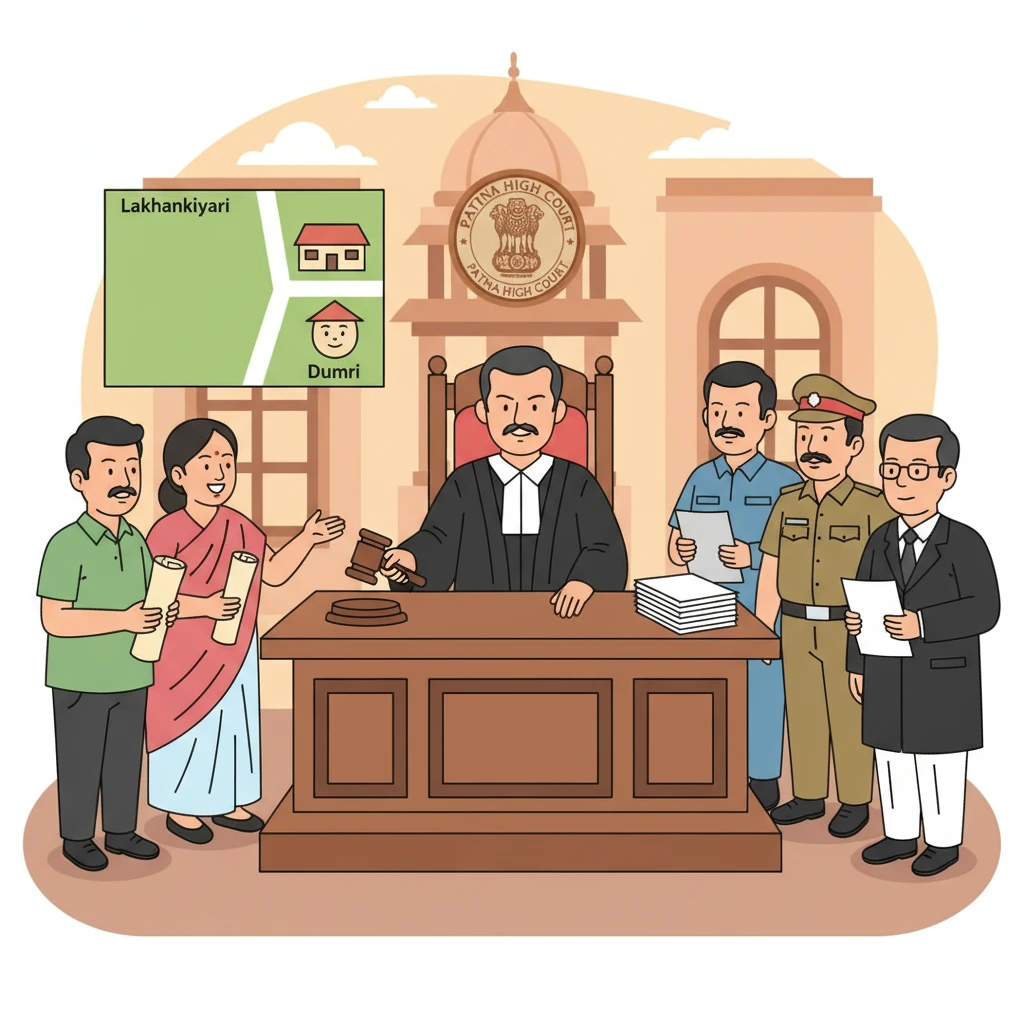
The case arose from a dispute over where a Panchayat Sarkar Bhawan should be built in a panchayat under Sono Block in Jamui district, Bihar. The petitioner is a resident of village Lakhankiyari in the same panchayat area.
The petitioner relied on a directive issued by the Principal Secretary, Department of Panchayati Raj, Government of Bihar, contained in Memo No. 8354 dated 30.08.2024. According to the petitioner, this memo directed all District Magistrates, including the District Magistrate, Jamui, to approve construction of Panchayat Sarkar Bhawans in the most populated village of the panchayat, where the name of the panchayat is notified by the State Government.
The petitioner alleged that, instead of following this directive, the authorities chose a site for the Panchayat Sarkar Bhawan in Revenue Village Dumri, which is the native village of the sitting Mukhiya, rather than in Revenue Village Lakhankiyari. He contended that the earlier selected site did not fulfill the criteria contained in the State Government guidelines for construction of Panchayat Sarkar Bhawans.
On this basis, the petitioner approached the Patna High Court by filing Civil Writ Jurisdiction Case No. 6798 of 2025, invoking its writ jurisdiction against various State and district-level authorities, including the State of Bihar, senior officials of the Department of Panchayati Raj, the District Magistrate, Jamui, local development and panchayat officers, and the Mukhiya and Panchayat Secretary of Gram Panchayat Raj, Lakhankiyari.
When the matter was taken up on 22.09.2025, none appeared for the petitioner. The State was represented by the learned Advocate General. The Court, however, considered the petition and proceeded to decide the matter on merits.
What the Court Examined and Decided
The petitioner had sought multiple reliefs from the Patna High Court. First, he asked for an appropriate writ, order, or direction to compel the authorities to follow the directive contained in Memo No. 8354 dated 30.08.2024, issued by the Principal Secretary, Department of Panchayati Raj. He claimed that this memo required District Magistrates to approve construction of Panchayat Sarkar Bhawans in the most populated village of the panchayat, where the panchayat name is notified by the State Government.
Second, he requested a direction to approve and construct the Panchayat Sarkar Bhawan, Lakhankiyari, in Revenue Village Lakhankiyari, under Khata No. 96, Khesra No. 1248, on land measuring more than two acres, described as Gairmazarua land. He wanted this to be done instead of constructing the building at the already selected location in Revenue Village Dumri.
Third, he sought cancellation of the earlier selected site in Revenue Village Dumri for construction of the Panchayat Sarkar Bhawan for Lakhankiyari Panchayat in Sono Block, Jamui, on the ground that the Dumri site did not meet the criteria laid down in the State Government’s guidelines.
Fourth, he prayed for directions to the respondents to act upon the representations already made by him along with other citizens and local representatives of the panchayat. Finally, he asked for any other writ, order or direction as the Court might deem fit.
The Division Bench, speaking through the Hon’ble Chief Justice, began by setting out the basic legal position regarding judicial interference in government policy. The Court noted that it is well settled that matters like the location and establishment of a Panchayat Sarkar Bhawan fall within the policy-making domain of the Executive.
Unless a policy is shown to be arbitrary, discriminatory, or unconstitutional, the Court cannot substitute its own wisdom for that of the Government. In other words, the Court does not sit as an appellate authority over executive policy choices.
To reinforce this point, the Patna High Court referred to several decisions of the Hon’ble Supreme Court of India. It cited:
- State of Himachal Pradesh and Others vs. Himachal Pradesh Nizi Vyavsayik Prishikshan Kendra Sangh, (2011) 6 SCC 597, where it was held that Courts are not intended to, and should not, substitute their views for those of the Executive in policy matters.
- BALCO Employees’ Union (Regd.) vs. Union of India and Others, (2002) 2 SCC 333, where the Supreme Court held that unless a policy decision is arbitrary, mala fide, or contrary to statutory provisions, Courts cannot interfere.
- Narmada Bachao Andolan vs. Union of India and Others, (2000) 10 SCC 664, where it was held that Courts should not examine the wisdom or correctness of policy choices.
On the basis of these authorities, the High Court concluded that the decision whether or not to establish a Panchayat Sarkar Bhawan in a particular panchayat, and in which exact location within that panchayat, is a matter of governmental policy. Such decisions are usually based on various socio-economic factors, including feasibility, availability of land, accessibility, and administrative considerations.
The Court made it clear that it cannot issue a writ of mandamus compelling the State to deviate from its policy framework. This meant that the Court would not direct the government to change the location of the proposed Panchayat Sarkar Bhawan from Revenue Village Dumri to Revenue Village Lakhankiyari as demanded by the petitioner.
At the same time, the Court did not completely shut the door on the petitioner. It examined the nature of the petitioner’s representation and found that he was seeking construction of the Panchayat Sarkar Bhawan in a particular plot or area. The Court categorically held that citizens cannot decide in which exact place or spot a Panchayat Sarkar Bhawan is to be constructed.
The Court emphasized that the State Government has already evolved a policy for the purpose of construction of Panchayat Sarkar Bhawans. Under that policy framework, the petitioner can legitimately seek construction of the Panchayat Sarkar Bhawan in the relevant panchayat. However, he cannot insist on a specific plot number, khata, or revenue village location within that panchayat.
Balancing these considerations, the Court ultimately dismissed the writ petition. However, it granted liberty to the petitioner to make a detailed representation to the competent authority. The Court directed that this representation be considered in accordance with law and the Government’s policy.
Specifically, the Court directed the concerned authority to consider the petitioner’s representation annexed as Annexure P/3 to the writ petition. Thus, while the Court refused to interfere in the policy decision or to direct a change of site, it ensured that the petitioner’s grievance would at least be formally examined by the appropriate government authority.
In sum, the Patna High Court reaffirmed the limited scope of judicial review in policy matters such as the selection of sites for public buildings, and at the same time allowed the citizen an avenue to be heard by the executive authorities responsible for implementing the policy.
Why This Judgment Matters
This judgment is important for citizens, local leaders, and activists who may feel aggrieved by the location of government buildings such as Panchayat Sarkar Bhawans. The Patna High Court has clearly stated that decisions about where such buildings will be constructed are part of government policy and not for individual citizens to dictate through the Court.
For people in rural areas, this means that even if they believe another site is better or more convenient, the High Court will generally not interfere unless the government policy itself is challenged as arbitrary, discriminatory, or unconstitutional. The Court will not substitute its view for that of the executive on matters of location and planning.
At the same time, the judgment recognizes the right of citizens to make representations. The Court has clarified that while citizens cannot demand that a government building be constructed on a specific plot, they can ask for construction in their panchayat and put forward their concerns and suggestions before the competent authority.
The ruling also reinforces the broader principle that public interest litigations or writ petitions seeking to control executive policy decisions without showing any illegality or constitutional violation are unlikely to succeed. Instead, the appropriate route is to engage with the policy-making and implementing authorities through lawful representations.
Legal Issues and Answers
- Issue: Can the High Court direct the State to construct a Panchayat Sarkar Bhawan at a specific site within a panchayat, contrary to the State’s policy decisions?
Answer: No. The Court held that the decision regarding where to construct a Panchayat Sarkar Bhawan is a matter of government policy based on socio-economic factors. The Court cannot issue a mandamus to alter such policy choices unless the policy is shown to be arbitrary, discriminatory, or unconstitutional. - Issue: What relief is available to a citizen dissatisfied with the chosen site for a Panchayat Sarkar Bhawan?
Answer: The citizen may make a detailed representation to the competent authority, seeking construction of the Panchayat Sarkar Bhawan in the relevant panchayat. The authority must then consider the representation in accordance with law and government policy, but the citizen cannot insist on a particular plot or specific spot.
Cases Cited by the Court
- State of Himachal Pradesh and Others vs. Himachal Pradesh Nizi Vyavsayik Prishikshan Kendra Sangh, (2011) 6 SCC 597 – for the principle that Courts should not substitute their views for those of the Executive in policy matters.
- BALCO Employees’ Union (Regd.) vs. Union of India and Others, (2002) 2 SCC 333 – holding that Courts cannot interfere with policy decisions unless they are arbitrary, mala fide, or contrary to statutory provisions.
- Narmada Bachao Andolan vs. Union of India and Others, (2000) 10 SCC 664 – emphasizing that Courts should not examine the wisdom or correctness of policy choices.
Case Details
Case Number: Civil Writ Jurisdiction Case No. 6798 of 2025
Case Title: Ramashish Rawat vs. The State of Bihar & Others
Coram: Hon’ble the Chief Justice P. B. Bajanthri and Hon’ble Mr. Justice Alok Kumar Sinha
Citation: 2025(4) PLJR 564
Date of Judgment: 22-09-2025
Advocates:
- For the Petitioner: None appeared
- For the Respondents: Mr. P. K. Shahi, learned Advocate General
Nature of the Case: Writ petition under civil writ jurisdiction challenging the location/site selection for construction of a Panchayat Sarkar Bhawan and seeking directions to implement a government memo and consider representations.
Link to Judgment: View full judgment on Patna High Court website
If you found this explanation helpful and wish to stay informed about
how legal developments may affect your rights in Bihar,
you may consider following Samvida Law Associates for more updates.







