

Case Background
The petitioner was an Assistant Professor of an engineering college under the State Government. He was originally from MIT, Muzaffarpur, and was working on deputation at Motihari College of Engineering (MCE), Motihari.
From 07.12.2011 to 15.01.2017, he functioned as Principal In charge of MCE Motihari. The college is a State institution under the Department of Science and Technology, Government of Bihar.
During his tenure as Principal In charge, he was authorised to conduct skill development programmes in six border blocks of the district under the Border Area Development Programme funded by the Central Government. He was nominated as the Principal-cum-Chief Coordinator for this programme.
Later, allegations of financial irregularities in connection with this programme arose. On that basis, Vigilance (Patna) P.S. Case No. 27 of 2018, corresponding to Special Case (Vigilance) No. 16/2018, was registered against the petitioner and others.
While this vigilance criminal case was under investigation, the petitioner superannuated on 31.07.2019 from the post of Assistant Professor, still on deputation at MCE Motihari.
After his retirement, the State sanctioned only 90% provisional pension by order No. 194 dated 20.01.2020. Gratuity, leave encashment and the remaining 10% of pension were withheld by citing Rule 43(c) and Rule 43(d) of the Bihar Pension Rules, 1950, on the ground that a criminal case was pending.
Feeling aggrieved, the petitioner filed this writ petition under Article 226 of the Constitution before the Patna High Court. He sought directions for payment of all retiral benefits, including gratuity, leave encashment and full pension under the 7th Revised Pay Scale, along with statutory interest, and without deduction of 10%.
What the Court Examined and Decided
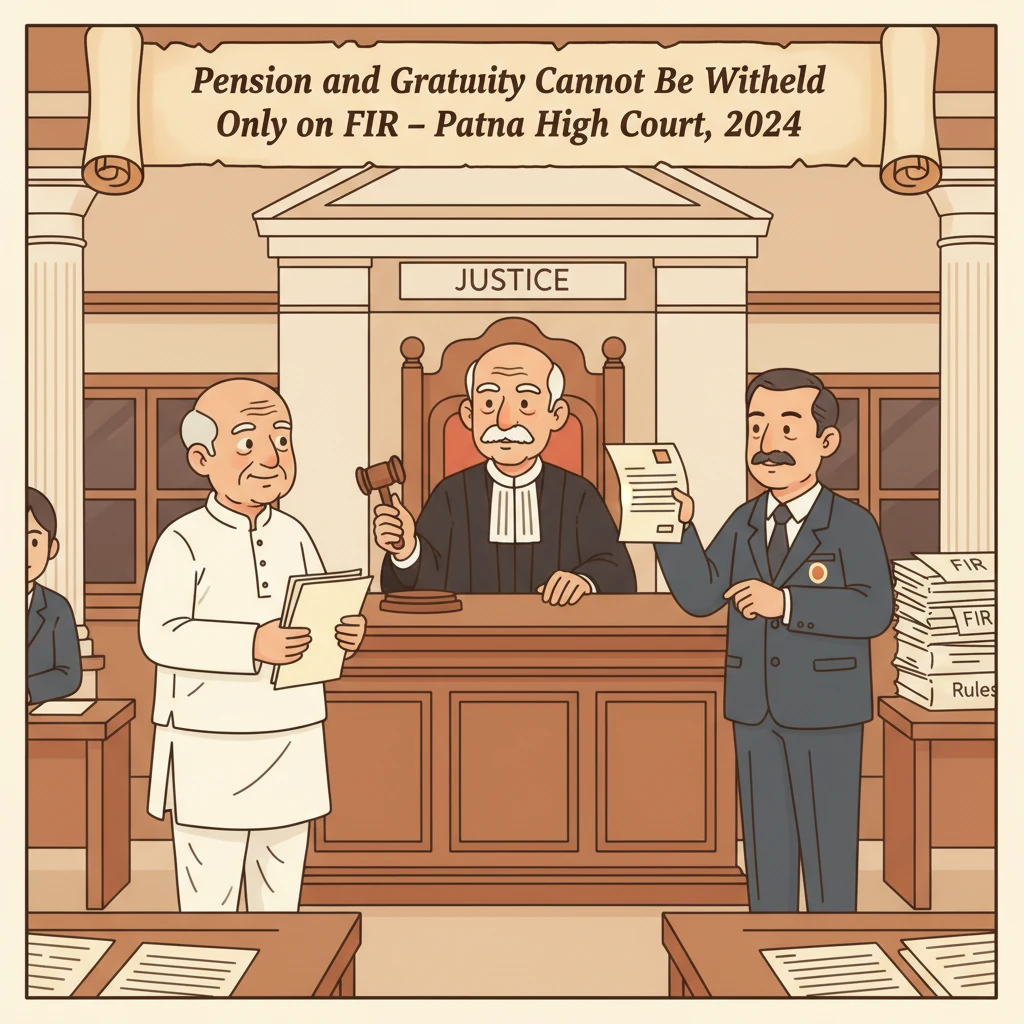
The central dispute was whether the State could legally withhold full gratuity, 10% pension and leave encashment when only an FIR was pending and no charge sheet had yet been filed in court.
The petitioner’s counsel argued that pension rights are governed strictly by the Bihar Pension Rules, 1950. According to him, in the absence of a clear statutory provision, the government cannot retain or reduce pension or gratuity merely because an investigation or FIR is pending.
He focused on Rule 43(b) of the Bihar Pension Rules, 1950. This clause allows the State Government to withhold or withdraw pension, in whole or in part, when the pensioner is found guilty of grave misconduct in a departmental or judicial proceeding. On this reading, the power arises only after conclusion of such proceedings and a finding of guilt, not while proceedings are just pending.
The petitioner also relied on Rule 43(c), inserted with effect from 19.07.2012. This rule says that if a departmental or judicial proceeding, for which prosecution has been sanctioned, is started during service and is still not concluded at the time of retirement, the government may grant provisional pension at less than the maximum but not below 90% of admissible pension.
He argued that Rule 43(c) only permits reduction of pension to provisional status (not less than 90%) and does not authorise stopping gratuity or permanently withholding the remaining 10% pension.
On leave encashment and gratuity, the petitioner cited the Full Bench judgment of the Patna High Court in Arvind Kumar vs. State of Bihar, 2018(2) PLJR 933. The Full Bench had held that an employee facing departmental enquiry or judicial proceeding at the date of retirement is entitled to provisional pension including gratuity to the extent of at least 90% of the total admissible amount.
The Full Bench had further clarified that leave encashment is not governed by the Pension Rules but by executive decisions. Therefore, the State can, by administrative orders, withhold leave encashment in cases where departmental or judicial proceedings are pending, if circumstances so demand. However, gratuity was treated as part of pensionary benefits to which at least 90% must be released.
The petitioner next attacked the use of Rule 43(d), introduced by Memo No. 77 dated 21.01.2019. Under this clause, the State can withhold full gratuity until final conclusion of departmental or judicial proceedings, if such proceedings are pending at the date of superannuation.
He relied upon the coordinate Bench decision in Dr. Aquil Ahmad vs. State of Bihar, 2021(1) PLJR 293. That judgment had considered Rule 43(d) along with the Payment of Gratuity Act, 1972, and the earlier Full Bench decision in Arvind Kumar Singh. It held that the 2019 amendments could not be applied retrospectively to take away vested rights to gratuity, especially where retirement occurred earlier or where rights had already crystallised under the earlier legal position.
The coordinate Bench had also referred to the Supreme Court decision in Madan Mohan Pathak v. Union of India, (1978) 2 SCC 50, holding that legislative or rule amendments cannot negate court judgments by applying them retrospectively, unless clearly provided.
In the present case, the petitioner retired on 31.07.2019, after Rule 43(d) came into force. Even so, he argued that Rule 43(d) could not be invoked without there being a “judicial proceeding” in existence in the sense explained in Rule 43 itself.
This brought the Court to the key interpretative question: when is a “judicial proceeding” in a criminal matter deemed to be instituted under Rule 43?
Explanation (b) to Rule 43 provides the answer. It states that judicial proceedings in criminal cases shall be deemed to have been instituted on the date on which a complaint is made or a charge sheet is submitted to a criminal court. For departmental proceedings, explanation (a) provides that they are deemed to be instituted when the charge is framed or the employee is placed under suspension.
The petitioner highlighted that, in his case, the vigilance investigation was still continuing. No charge sheet had been filed in any criminal court. The Court was also informed, on instructions, by counsel for the Vigilance that no charge sheet had yet been submitted. Therefore, there was as yet no “judicial proceeding” within the meaning of Rule 43(b).
The State Government, relying on its counter affidavit, argued that Rule 43(d) squarely applied. According to the State, once a criminal case is pending against a government servant at the time of retirement, the government is empowered to withhold full gratuity and 10% pension till the case concludes. The State submitted that the vigilance FIR had been registered well before the petitioner’s retirement, and that there were serious allegations of financial irregularity, with possible recovery of defalcated amounts if guilt is ultimately established.
The State further contended that, under existing executive instructions, it was also authorised to withhold leave encashment where criminal or judicial proceedings are pending.
After hearing both sides, the Court carefully analysed Rule 43 and its explanations. It examined Section 2(d) of the Code of Criminal Procedure (definition of “complaint”) and Section 173 CrPC (final report/charge sheet). The Court noted that a final report under Section 173 marks the end of investigation and, where a prima facie case exists, leads to cognizance by the Magistrate.
The Court clarified that mere registration of an FIR is only the first information which sets the criminal law in motion. It is not the institution of a judicial proceeding. Judicial proceedings begin only when either a complaint is filed in court or a charge sheet/final report is submitted to the court after investigation.
Applying the basic rule of literal interpretation, and relying on the Supreme Court’s observations in Kanai Lal Sur v. Paramnidhi Sadhukhan, AIR 1957 SC 907, the Court held that when statutory words are clear and unambiguous, they must be given their plain meaning. Explanation (b) to Rule 43 specifically mentions “complaint” and “charge sheet” and does not mention FIR. Therefore, an FIR alone cannot be treated as a “judicial proceeding”.
On the retrospective effect of Rule 43(d), the Court followed the reasoning in Dr. Aquil Ahmad and reiterated that the 2019 amendments cannot be applied in a way that takes away vested rights to gratuity earned under earlier law without clear statutory language providing for such retrospective operation.
The Court also referred to its earlier decision in Param Hans Kumar Singh vs. State of Bihar, 2023(1) PLJR 635, where withholding of full gratuity, leave encashment and other retiral benefits in terms of Rule 43(d) was found unsustainable when the employee had retired in 2012.
In the present case, the key fact was that, despite the vigilance FIR of 2018, no charge sheet had been submitted till the date of hearing and judgment in 2024. Hence, no “judicial proceeding” could be said to have been instituted against the petitioner under Rule 43, even though investigation was pending.
On this basis, the Court concluded that the State could not legally invoke Rule 43(c) and Rule 43(d) to withhold 10% of pension and full gratuity merely because of a pending FIR and investigation.
The Court therefore held that the impugned withholding was unsustainable. It directed the respondent authorities to pay the remaining 10% pension and full gratuity to the petitioner, preferably within eight weeks from the date of receipt or production of a copy of the judgment.
On leave encashment, however, the Court adopted a different approach. It noted that leave encashment is governed by an executive instruction, namely, Government notification No. 4564 dated 06.07.1993. This notification allows the State to withhold leave encashment until finalisation of departmental enquiry or judicial proceedings where there is a possibility of recovery of any defalcated amount.
Respecting this executive power, the Court did not straightaway direct release of leave encashment. Instead, it directed the department to reconsider the petitioner’s claim afresh. The department must examine whether the pending vigilance case involves serious allegations of financial irregularity or defalcation that may result in recovery. Based on this assessment, the department has to pass a reasoned and speaking order within the same eight-week period.
The writ petition was allowed to the extent of directing payment of the remaining pension and full gratuity, with no order as to costs.
Why This Judgment Matters
This judgment is important for retired or retiring government employees in Bihar who are facing criminal investigations or vigilance FIRs.
The Patna High Court has clarified that an FIR or an ongoing investigation, without a charge sheet or complaint filed in court, is not enough to treat it as a “judicial proceeding” under Rule 43 of the Bihar Pension Rules, 1950.
Because of this, the State cannot indefinitely hold back pension and gratuity simply because of an FIR. Unless and until a complaint is filed or a charge sheet is submitted to a criminal court, the government cannot rely on Rule 43(c) or Rule 43(d) to block these pensionary benefits.
The judgment also reaffirms that pension and gratuity are not charity or favour. They are rights earned by long years of service and can be taken away only according to clear rules and procedures.
At the same time, the Court recognises the government’s power, under executive instructions, to withhold leave encashment where there is a realistic chance of recovery of misappropriated government money. Departments must, however, take a fresh and reasoned decision; they cannot withhold benefits blindly.
Legal Issues and Answers
- Issue: Can the State rely on Rule 43(c) and 43(d) of the Bihar Pension Rules, 1950 to withhold 10% pension and full gratuity when only an FIR is pending and no charge sheet has been filed?
Answer: No. The Patna High Court held that a judicial proceeding in a criminal case is deemed instituted only when a complaint is made or a charge sheet is submitted to a criminal court. Since no charge sheet had been filed, Rule 43(c) and 43(d) could not be invoked, and withholding of 10% pension and full gratuity was unsustainable. - Issue: Does Rule 43(d), inserted in 2019, operate retrospectively to deprive employees of gratuity already earned under earlier law?
Answer: No. Following earlier decisions, the Court held that the 2019 amendments to the Bihar Pension Rules, including Rule 43(d), do not have retrospective effect so as to take away vested rights to gratuity unless clearly provided. - Issue: Can leave encashment be withheld when criminal or judicial proceedings are pending?
Answer: Yes, but only under and in terms of executive instruction No. 4564 dated 06.07.1993. The department must consider afresh whether the pending case involves serious financial irregularity with a chance of recovery and then pass a reasoned, speaking order.
Cases Cited by the Court
- Arvind Kumar vs. State of Bihar, 2018(2) PLJR 933 (Full Bench, Patna High Court)
- Dr. Aquil Ahmad vs. State of Bihar, 2021(1) PLJR 293
- Madan Mohan Pathak v. Union of India, (1978) 2 SCC 50 : AIR 1978 SC 803
- Jaishri Laxmanrao Patil v. State of Maharashtra, (2021) 8 SCC 1
- D.S. Nakara v. Union of India, (1983) 1 SCC 305
- State of Jharkhand v. Jitendra Kumar Srivastava, (2013) 12 SCC 210
- Kanai Lal Sur v. Paramnidhi Sadhukhan, AIR 1957 SC 907
- Delhi Cloth & General Mills Ltd. v. C.I.T., Delhi, AIR 1927 PC 242
- Param Hans Kumar Singh vs. State of Bihar, 2023(1) PLJR 635
Case Details
Case Number: Civil Writ Jurisdiction Case No. 13557 of 2021
Case Title: Akhileshwar Kumar Mishra v. The State of Bihar & Ors.
Court: High Court of Judicature at Patna
Coram: Hon’ble Mr. Justice Harish Kumar
Date of Judgment: 06.08.2024
Citation: 2024 (4) PLJR 313
Advocates:
- For the Petitioner: Mr. Anand Ojha, with Mr. Sangeet Deokuliar, Advocates
- For the State: Mr. Vikash Kumar, Standing Counsel-11
- For the Vigilance: Mr. Anil Singh, Advocate
- For the Accountant General: Mrs. Ritika Rani, Advocate
Nature of the Case: Writ petition under Article 226 of the Constitution of India seeking release of pensionary and retiral benefits (pension, gratuity, leave encashment) withheld due to a pending vigilance case.
Official Link to Judgment: Click here to view the original judgment on the Patna High Court website
If you found this explanation helpful and wish to stay informed about
how legal developments may affect your rights in Bihar,
you may consider following Samvida Law Associates for more updates.







