
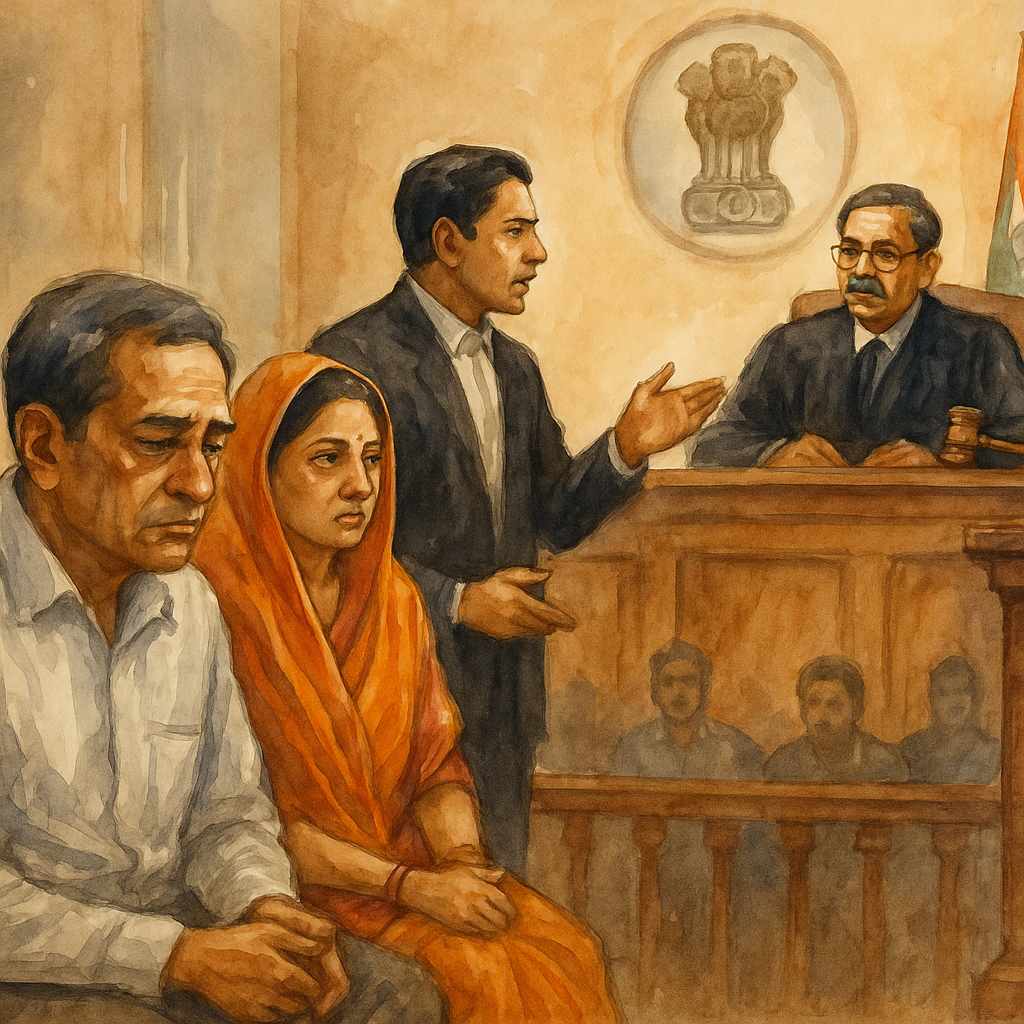
The present post explains a Patna High Court order where criminal proceedings under Section 498A of the Indian Penal Code (IPC) and Section 34 IPC were quashed against the in-laws (parents of the husband) because the complaint contained only general and vague allegations—without specific acts attributed to them. The order was passed on 15 November 2022 by Hon’ble Mr. Justice Dr. Anshuman in a petition under Section 482 of the Code of Criminal Procedure (CrPC).
The petition was filed by the parents of the husband challenging the order dated 22 September 2017 of the learned Additional Chief Judicial Magistrate-15, Muzaffarpur (East), which had taken cognizance under Sections 498A/34 IPC in a complaint case. The High Court was called upon to determine whether the continuation of the prosecution against the parents, in the backdrop of the complaint’s narrative, would amount to an abuse of process.
The dispute arose from a marriage solemnized on 30 May 2014 according to Hindu rites. The complaint alleged that, on the night of marriage, the husband and father-in-law raised a demand for land as dowry. It also narrated that the aggrieved person returned to her parental home on multiple occasions after short stays in the matrimonial house, and it mentioned incidents of alleged cruelty on 7 March 2015, 7 July 2015, and sometime in October 2015. However, the statements recorded in the inquiry and even the complainant’s own examination primarily imputed acts of cruelty to the husband, not specifically to the petitioners (the parents). The allegations against the parents were found to be general, vague, or “omnibus,” with contradictions noted when the inquiry witnesses’ versions were compared.
In support of quashing, the petitioners relied upon judicial precedents cautioning courts against mechanically proceeding on the basis of sweeping allegations in matrimonial disputes. These authorities included: (i) Shiv Jee Rai v. State of Bihar & Anr., 2013 (3) PLJR 139; (ii) Preeti Gupta & Anr. v. State of Jharkhand & Anr., AIR 2010 SC 3363; and (iii) Shurendra Trivedi & Anr. v. State of Bihar & Anr., Cr. Misc. No. 70155 of 2018 (29.01.2020). The essence drawn from these decisions is that exaggerated versions and over-implication in matrimonial complaints are not uncommon and that prosecution of elderly parents on such material can become oppressive, hinder reconciliation, and constitute an abuse of process.
The State opposed the quashing petition, and the complainant’s side argued that cognizance had been taken after the complainant’s examination supported by inquiry witnesses, implying that there were materials to proceed. After hearing both sides and perusing the record, the High Court concluded that the core matrimonial dispute existed between the spouses; the accusations of cruelty were essentially against the husband; and the averments against the parents were only general or omnibus in nature and contradicted by inquiry statements. On this assessment, the Court held that allowing the prosecution to continue against the parents would be an abuse of the process of the Court. Consequently, the impugned order taking cognizance was quashed against the petitioning parents alone, and the application under Section 482 CrPC was allowed.
Simplified Explanation of the Judgment
This case is about whether parents of a husband can be prosecuted under Section 498A IPC (cruelty by husband or relatives) when the complaint does not clearly describe specific acts by them and mainly targets the husband. The Patna High Court examined the complaint, the complainant’s statement, and the inquiry witnesses’ statements. It found that the allegations against the parents were generic and not supported by concrete details or consistent testimony.
According to the record, the marriage took place on 30 May 2014. The complaint mentioned a demand for land on the wedding night, but even in that narration, the focus was on the husband and, at most, the father-in-law; there was no precise allegation against the mother-in-law. Later incidents of alleged cruelty were cited on three dates in 2015. However, when the Court looked at the complainant’s examination and the inquiry witnesses’ statements, it noticed that the specific acts were attributed repeatedly to the husband alone. The statements about the parents were either broadly worded (“they tortured,” “they assaulted”) or inconsistent with what the witnesses said. In other words, the material did not show clear individual roles or overt acts by the parents.
In Indian criminal law, Section 498A is serious and meant to deter and punish cruelty related to dowry or harassment by the husband or his family. But courts have repeatedly cautioned against its misuse—particularly where multiple family members are implicated without distinct allegations. The guiding principle is simple: criminal prosecution must be based on specific and credible material. If the complaint is vague and the inquiry statements do not back up the accusations against particular relatives, continuing the case against them may be unfair.
The petitioners here approached the High Court under Section 482 CrPC, which allows the High Court to prevent abuse of process and secure the ends of justice. Using this power, the Court can quash proceedings when the complaint, taken at face value, does not disclose specific offences against particular accused or when the allegations are inherently improbable or unsupported by the preliminary material.
The Court also took note of earlier judgments that recognize a tendency of “over-implication” in matrimonial disputes. These decisions emphasize that indiscriminate prosecution of elderly parents or distant relatives can cause undue hardship and may ruin any remaining chance of reconciliation between the spouses. In this matter, the Court observed that the real dispute was between the husband and the wife, and the accusations against the parents lacked the required clarity and consistency. Therefore, it held that allowing the criminal case to proceed against the parents would amount to an abuse of court process.
Importantly, the High Court did not comment on the merits of the allegations against the husband, who was not a petitioner before it. The relief granted was limited to the parents (the petitioners); the cognizance order remained undisturbed so far as the husband is concerned. The quashing was thus tailored, not wholesale.
Significance or Implication of the Judgment
For the public and for investigating agencies, this order reinforces a consistent judicial message: in domestic cruelty cases, the law must be used carefully and with precision. Generic or omnibus accusations against multiple family members are not enough to sustain criminal prosecution. Complainants should set out clear, date-wise, incident-specific allegations against each person, and investigators should evaluate whether witnesses actually support those claims, particularly when elderly parents are involved.
For the government and the justice system, the ruling encourages a more evidence-based approach at the cognizance stage. Magistrates should scrutinize whether the materials demonstrate individual roles of each accused. For families, the judgment offers reassurance that while genuine cases of cruelty will be pursued, mere familial relationship with the husband does not automatically translate into criminal liability.
Legal Issue(s) Decided and the Court’s Decision with Reasoning
- Whether a prosecution under Sections 498A/34 IPC can continue against the husband’s parents when the complaint and inquiry materials contain only general, vague, or contradictory allegations against them.
Decision: No. Continuation of prosecution in such circumstances would amount to abuse of process; cognizance can sustain against the principal accused (husband) if supported by material but not against other family members without specific, credible allegations. - Whether Section 482 CrPC can be invoked to quash the proceedings selectively against particular accused.
Decision: Yes. The High Court exercised inherent jurisdiction to quash the cognizance order only as against the parents (petitioners), leaving the case against the husband untouched. - How prior precedents on “over-implication” in matrimonial disputes apply.
Decision: The Court relied on decisions highlighting the prevalence of exaggerated or omnibus allegations in matrimonial cases and held that such unfocused allegations do not justify prosecuting elderly parents.
Judgments Referred by Parties (with citations)
- Shiv Jee Rai v. State of Bihar & Anr., 2013 (3) PLJR 139.
- Preeti Gupta & Another v. State of Jharkhand & Another, AIR 2010 SC 3363.
- Shurendra Trivedi & Anr. v. State of Bihar & Anr., Cr. Misc. No. 70155 of 2018 (Patna High Court, 29.01.2020).
Judgments Relied Upon or Cited by Court (with citations)
- Preeti Gupta (AIR 2010 SC 3363) and other authorities emphasizing caution against exaggerated/omnibus allegations in matrimonial disputes; applied to conclude that prosecution of the husband’s parents would be an abuse of process.
Case Title
Petitioners vs. State of Bihar & Another (names withheld for privacy)
Case Number
Criminal Miscellaneous No. 74429 of 2018
(Arising out of Complaint Case No. 3283 of 2015, P.S. Gaighat/Muzaffarpur)
Citation(s)
2023 (1) PLJR 268
Coram and Names of Judges
Hon’ble Mr. Justice Dr. Anshuman.
Names of Advocates and who they appeared for
- For the petitioner(s): Mr. Nachiketa Jha, Advocate.
- For the State: Mr. Jagdhar Prasad, APP.
- For the complainant/Opposite Party No. 2: Mr. Arvind Kumar Singh, Advocate; Mr. Ajay Kumar Pandey, Advocate.
Link to Judgment
NiM3NDQyOSMyMDE4IzEjTg==-hyZvSweOkkU=
If you found this explanation helpful and wish to stay informed about how legal developments may affect your rights in Bihar, you may consider following Samvida Law Associates for more updates.







