
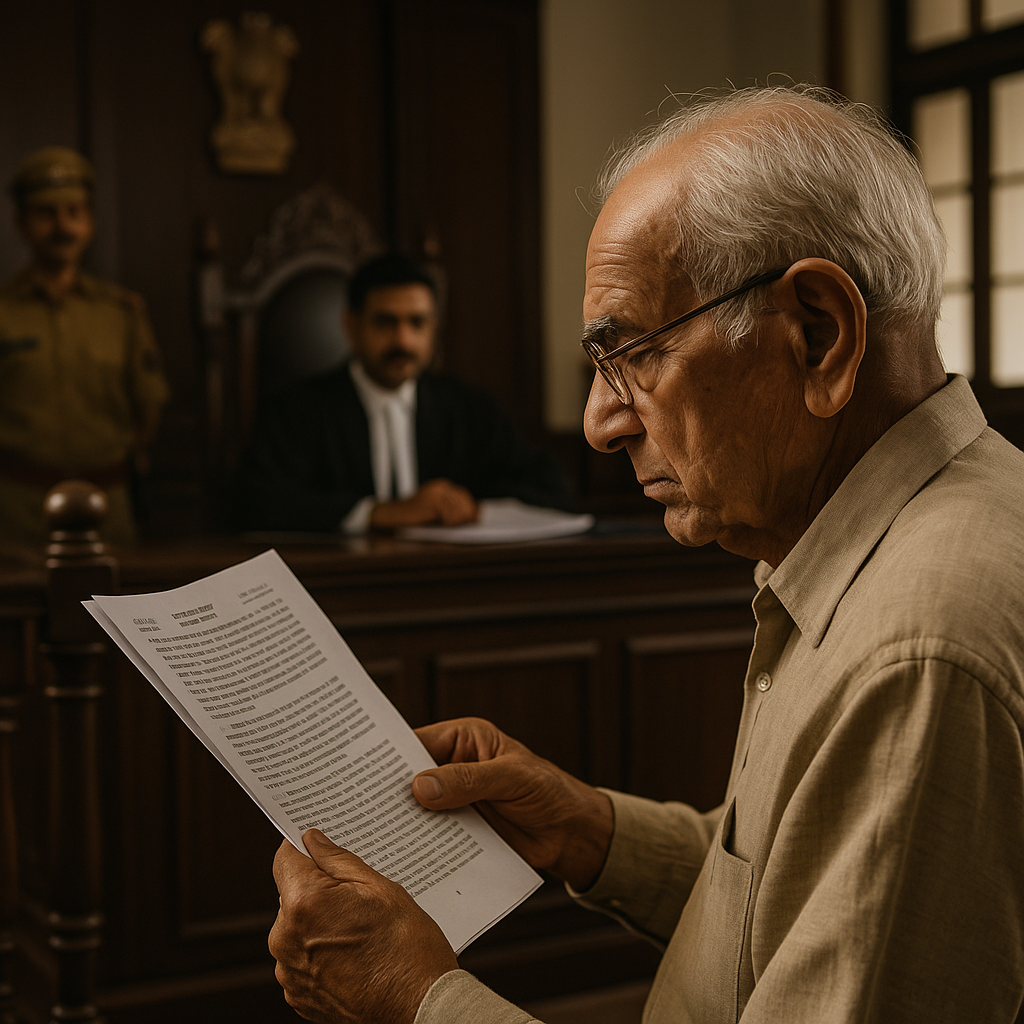
Simplified Explanation of the Judgment
The Patna High Court, in its judgment dated 19 September 2017, set aside an order imposing a 20% permanent reduction in pension under Rule 43(b) of the Bihar Pension Rules, 1950, on a retired government employee of the Minor Irrigation Department. The Court found that the departmental inquiry was fundamentally defective, lacking evidence, witness examination, or reasoning, and hence violated the principles of natural justice.
Background of the Case
The petitioner was a Fitter/Mechanic in the Central Workshop, Sheikhpura, under the Minor Irrigation Department. In March 2003, he was deputed to work under the Tube Well Development Scheme, Mohania (Bhabhua District). The department alleged that instead of reporting for duty, he produced a letter purportedly signed by the then Chief Minister, which stated that his deputation was stayed.
A departmental inquiry was initiated, and in June 2010, the authorities imposed a 20% permanent pension cut, treating a portion of his absence as unauthorized and confirming his suspension period under Rule 97(2) and (3) of the Bihar Service Code, 1952.
The employee challenged this order before the High Court, arguing that:
- The inquiry violated due procedure.
- He was denied the opportunity to cross-examine witnesses.
- The findings of the Inquiry Officer were perverse and lacked reasoning.
- He had already been acquitted in the related criminal case, which should have barred further departmental action.
Court’s Observations
When the case came up, the Court noticed that the complete record of the inquiry was not available. It directed the State to produce it, following which a supplementary affidavit was filed, enclosing the Inquiry Officer’s report dated 26 May 2009.
The Court closely examined the report and found it to be a mere tabulated sheet with five columns — listing charges, the employee’s explanation, departmental comments, and the final finding. The finding section was only twelve lines long and written in Hindi, briefly stating that since the employee had not produced evidence to support his defense, the charges stood proved.
However, the Court pointed out that the report:
- Did not mention any witnesses examined during the inquiry;
- Contained no reference to documentary evidence;
- Failed to explain how or why the charges were held to be proved;
- Was completely non-speaking and mechanical.
The Court concluded that the report lacked application of mind and violated natural justice.
Reliance on Supreme Court Precedent
The Bench referred to the Supreme Court decision in Anil Kumar v. Presiding Officer & Others (AIR 1985 SC 1121), which held that an inquiry officer’s report must show clear reasoning and assessment of evidence. A mere “ipse dixit” (unsupported assertion) of the officer is not sufficient. A finding unsupported by evidence or reasoning renders the inquiry perverse and any disciplinary action based on it invalid.
Applying this precedent, the High Court held that the inquiry report in this case did not satisfy legal standards and could not form the basis of punishment.
The Petitioner’s Defense and Court’s View
The petitioner maintained that he never produced or relied upon any such letter from the Chief Minister and that it was planted by someone in the office out of personal rivalry. He also claimed he had reported to his posting and was working there.
The Court noted that the Inquiry Officer had failed to discuss these critical defense points or provide any reasoning for rejecting them. There was no indication of evidence or witness testimony proving that the petitioner had indeed fabricated or used the letter.
Given this lack of evidence, the Court found the inquiry findings to be perverse, meaning they were so unreasonable that no rational authority could have reached them.
Judgment and Directions
Holding that the inquiry report was invalid, the High Court quashed the punishment order dated 04.06.2010. It also directed the government to restore all consequential benefits — including pension arrears — to the petitioner within a reasonable time.
This judgment thus restored the petitioner’s full pension and cleared the adverse entry based on the defective inquiry.
Significance or Implication of the Judgment
- For Government Departments:
This case underscores the importance of conducting departmental inquiries with transparency, fairness, and detailed reasoning. A mere assertion without evidence or analysis cannot justify punishment. Departments must ensure that inquiry reports contain proper findings based on evidence and adhere to natural justice. - For Employees and Pensioners:
The decision provides relief to retired employees who face arbitrary or procedurally flawed disciplinary actions. It affirms that even post-retirement, pension rights cannot be curtailed without a lawful, evidence-based inquiry. - For Legal and Administrative Practice:
The judgment reinforces that disciplinary proceedings are quasi-judicial and must meet the same standards of fairness and reasoning as judicial processes. It also strengthens accountability in public administration.
Legal Issues Decided and the Court’s Reasoning
- Whether the departmental inquiry complied with procedural fairness and evidence requirements.
→ No. The inquiry lacked witness testimony, documentary support, and reasoning, making the report perverse. - Whether punishment based on such a defective report could be sustained.
→ No. The High Court held that the report violated natural justice and could not legally justify the 20% pension cut. - Whether acquittal in the related criminal case affected the departmental proceeding.
→ Though not the sole ground, the acquittal reinforced the finding that the charges lacked proof. - What relief was granted?
→ The punishment order was quashed, and all consequential benefits were directed to be paid.
Judgments Relied Upon or Cited by the Court
- Anil Kumar v. Presiding Officer & Ors., AIR 1985 SC 1121 — Inquiry report must show reasoning and evidence; mere assertion is not valid.
Case Title
Rameshwar Rai v. The State of Bihar & Others
Case Number
Civil Writ Jurisdiction Case No. 8324 of 2011
Citation(s)
2023 (1) PLJR 173
Coram and Names of Judges
Hon’ble the Chief Justice (Rajendra Menon, CJ)
Names of Advocates and Who They Appeared For
- For the Petitioner: Mr. Sanjeev Kumar Mishra, Advocate
- For the Respondents (State): Mr. Pratik Kumar Sinha, AC to GA-5
Link to Judgment
MTUjODMyNCMyMDExIzEjTw==-WN9–am1–amdw0PE=
If you found this explanation helpful and wish to stay informed about how legal developments may affect your rights in Bihar, you may consider following Samvida Law Associates for more updates.







