
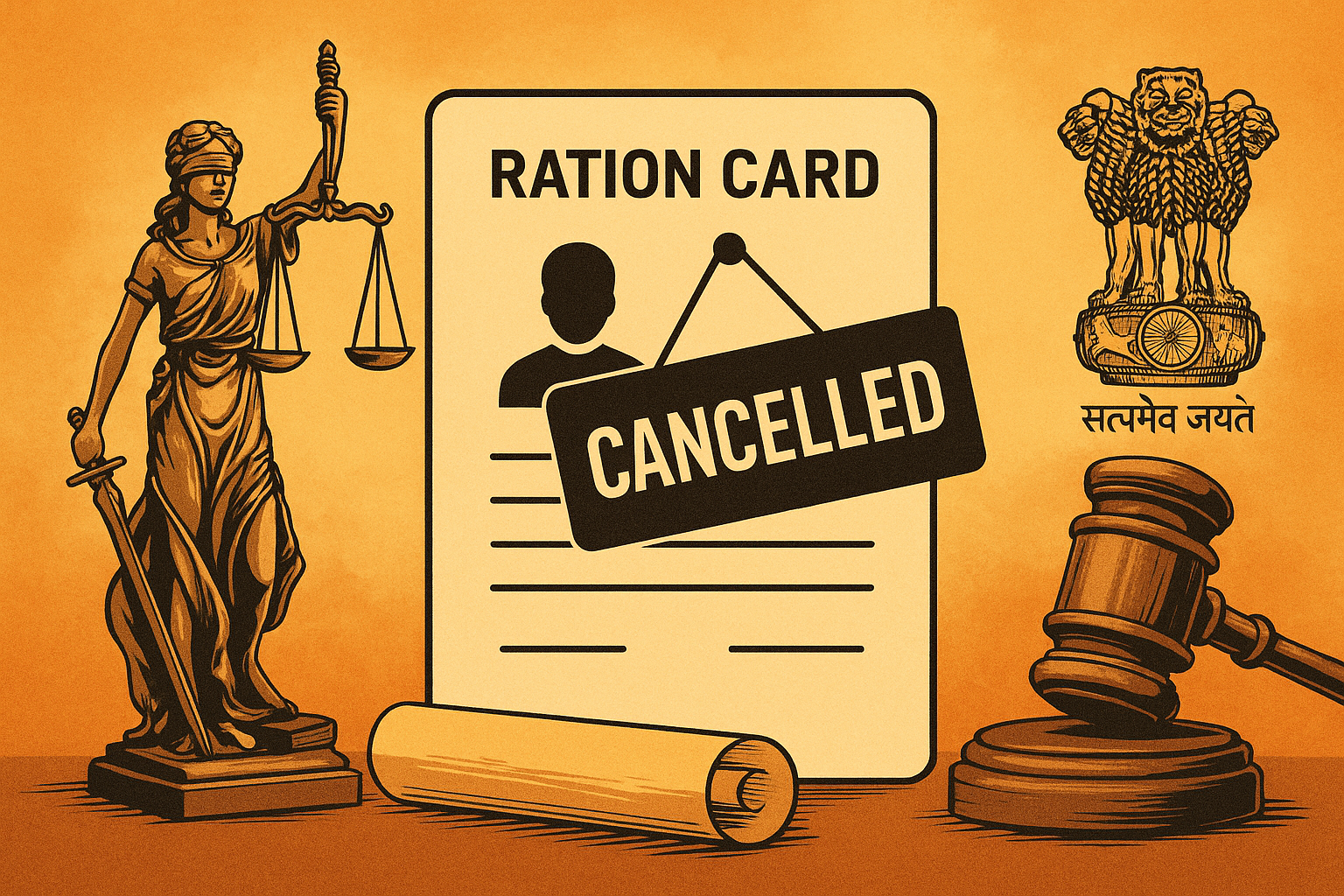
The Patna High Court has clarified an important procedural safeguard in cases involving cancellation of Public Distribution System (PDS) licences. In a writ petition decided on 12 April 2021, the Court set aside the cancellation of a fair price shop licence and the appellate order upholding it, because the show-cause notice did not explicitly tell the licensee that cancellation was proposed. The Court held that such omission violates Clause 27(ii) of the Bihar Targeted PDS Control Order, 2016 and the principles of natural justice.
Simplified Explanation of the Judgment
This case revolves around how government authorities must proceed before cancelling a PDS licence. The petitioner, a fair price shop dealer, faced cancellation of her licence by the Sub-Divisional Officer (SDO), Masaurhi, through an order dated 06 July 2018. Later, on 29 June 2020, the Collector, Patna, dismissed the petitioner’s appeal. The petitioner approached the High Court seeking to quash both orders.
The key legal requirement at the centre of this dispute is Clause 27(ii) of the Bihar Targeted PDS Control Order, 2016. This clause ensures that before any licence is cancelled, the licensee must be given a sufficient opportunity to defend against a “proposal for cancellation.” In simple terms, the show-cause notice must not only list allegations but must clearly state that the authority is proposing to cancel the licence, and ask the licensee to show cause why cancellation should not be ordered.
According to the petitioner, the show-cause notice dated 12 June 2018 did not contain any such express “proposal for cancellation.” Because the notice lacked this explicit warning, the petitioner argued that she was deprived of a fair and meaningful chance to present a complete defence tailored to the grave consequence—loss of her licence. The High Court recorded that the notice indeed did not contain a proposal for cancellation, which meant the petitioner could not fully defend herself against that specific consequence.
To support this argument, reliance was placed on a Division Bench decision of the Patna High Court in LPA No. 499 of 2018 (Ram Bechan Ram v. State of Bihar & Ors.). That judgment clearly explained that the phrase “proposal for cancellation” in the Control Order means the notice must categorically inform the licensee that cancellation is proposed and ask why the licence should not be cancelled. It also criticized cancellation orders passed without considering the licensee’s detailed explanation, terming such action as violative of natural justice. The Division Bench further invoked the principle from Whirlpool Corporation to underscore that writ courts can interfere where there is a statutory or natural justice violation apparent on the face of the record.
The State’s counsel did not dispute the legal position regarding the requirement under Clause 27(ii). That concession, combined with the binding Division Bench precedent, set the stage for the Court’s conclusion.
Applying the law, the High Court held that the show-cause notice was contrary to Clause 27(ii) because it did not mention a proposal to cancel the licence. Consequently, the cancellation order of 06 July 2018 and the appellate order of 29 June 2020 suffered from material legal infirmity and were set aside. At the same time, the Court preserved the authority’s power to proceed afresh, but only “in accordance with law”—meaning any fresh action must comply with the notice and hearing requirements, including a properly worded show-cause notice.
In short, the Court’s reasoning is straightforward: when the law requires the show-cause notice to clearly say “we propose to cancel your licence,” the authority must say exactly that. If the notice is vague or silent on cancellation, the entire process is tainted because the licensee cannot mount a targeted defence to the specific proposed penalty. The Court therefore allowed the writ petition and set aside the impugned orders, leaving liberty to the SDO to take fresh steps that comply with the law.
Significance or Implication of the Judgment
For the general public—especially ration-card holders and PDS beneficiaries—this judgment helps protect the integrity of ration distribution by ensuring that fair price shops are not closed arbitrarily. Proper procedure reduces abrupt disruptions in supply.
For PDS dealers and other licensees under the Bihar Targeted PDS Control Order, the decision underscores a crucial procedural right: a show-cause notice must explicitly convey that cancellation is proposed. Without this, any subsequent cancellation is vulnerable to being set aside in court. The ruling also reaffirms that authorities must meaningfully consider the dealer’s explanation; a cryptic or non-speaking order is unsafe in law.
For government departments, the ruling serves as a compliance checklist. Drafting of notices must be aligned with Clause 27(ii); adjudicating officers should record consideration of the defence before passing orders. This preventive step reduces litigation and ensures that disciplinary measures stand the test of judicial scrutiny.
Legal Issue(s) Decided and the Court’s Decision with reasoning
- Whether a show-cause notice under Clause 27(ii) of the Bihar Targeted PDS Control Order, 2016 must explicitly state a “proposal for cancellation” of the licence.
• Decision: Yes. The notice must categorically inform the licensee that cancellation is proposed and ask why it should not be cancelled. Absence of such wording violates Clause 27(ii) and natural justice. - Whether cancellation and appellate orders based on a deficient notice can stand.
• Decision: No. Because the notice was contrary to Clause 27(ii), the SDO’s cancellation order (06.07.2018) and the Collector’s appellate order (29.06.2020) were set aside. Liberty was granted to proceed afresh according to law. - Whether the Writ Court can interfere despite availability of alternate remedies when there is a clear violation of statutory procedure or natural justice.
• Decision: Yes, consistent with the Division Bench view referencing Whirlpool Corporation, writ intervention is justified where the violation is apparent on the face of the record.
Judgments Referred by Parties (with citations)
- Ram Bechan Ram v. State of Bihar & Ors., LPA No. 499 of 2018 (Patna High Court, 10.07.2018). Relied on by the petitioner to establish that the notice must expressly state a proposal for cancellation and that non-consideration of a detailed explanation violates natural justice.
- Whirlpool Corporation v. Registrar of Trade Marks & Ors., Supreme Court (referred in the Division Bench extract), on writ maintainability in the face of statutory violations or breach of natural justice.
Judgments Relied Upon or Cited by Court (with citations)
- Ram Bechan Ram v. State of Bihar & Ors., LPA No. 499 of 2018 (Patna High Court, 10.07.2018) — followed by the Single Judge in holding that the notice must mention the “proposal for cancellation” and that failure to do so vitiates the action.
Case Title
Petitioner v. State of Bihar & Ors. (Patna High Court)
Case Number
Civil Writ Jurisdiction Case No. 4327 of 2021.
Citation(s)
2021(2) PLJR 384
Coram and Names of Judges
Hon’ble Mr. Justice Mohit Kumar Shah.
Names of Advocates and who they appeared for
- For the petitioner: Mr. Dhananjaya Nath Tiwari.
- For the State: Mr. Upendra Pratap Singh, AC to SC-4.
Link to Judgment
MTUjNDMyNyMyMDIxIzIjTg==-MxnqzFn1aLk=
If you found this explanation helpful and wish to stay informed about how legal developments may affect your rights in Bihar, you may consider following Samvida Law Associates for more updates.







