
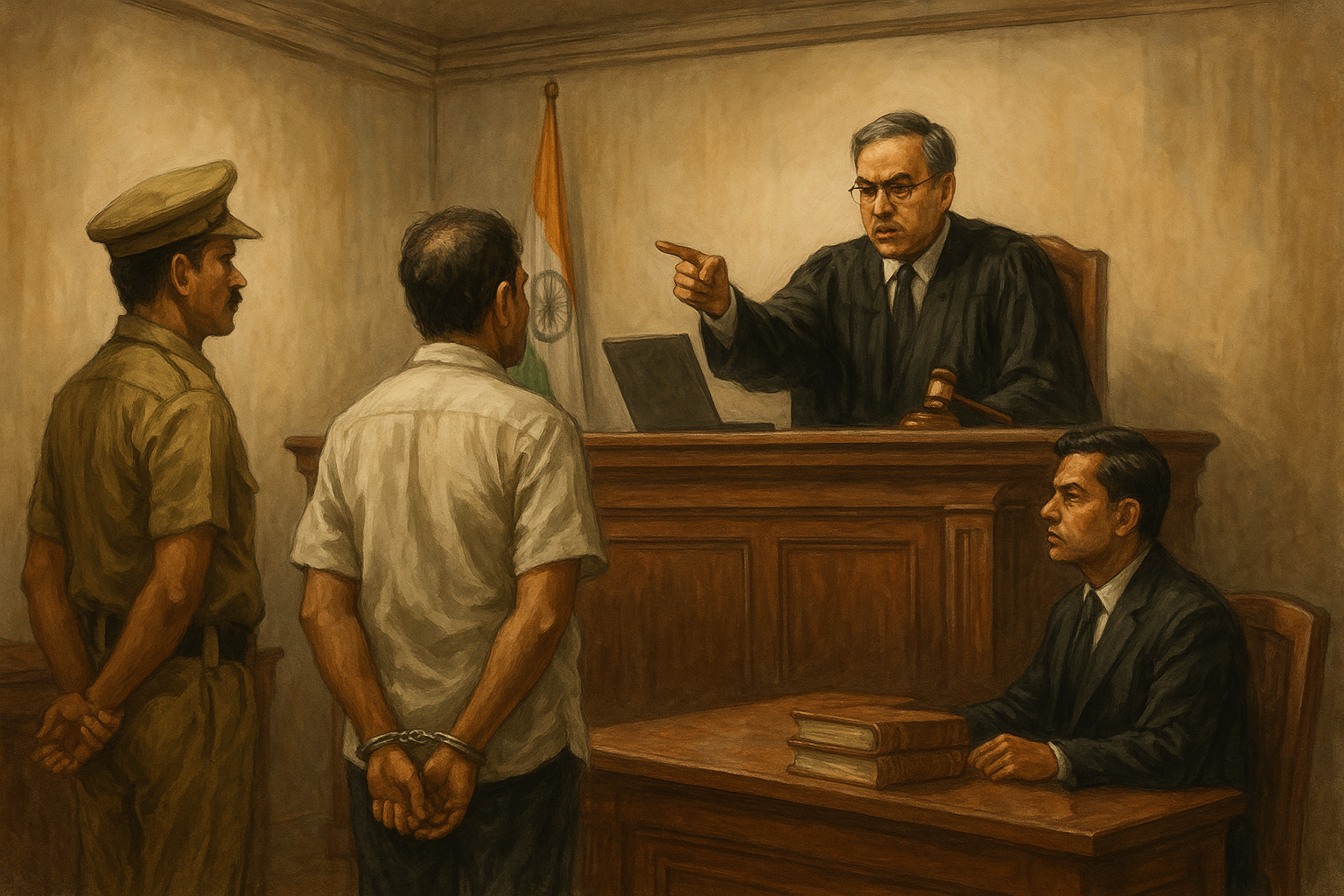
Simplified Explanation of the Judgment
In this case, the Patna High Court delivered an important judgment on unlawful detention and violation of the fundamental right to personal liberty. The petitioner had approached the Court seeking compensation for being illegally detained for eight days between 24 July 2016 and 1 August 2016.
According to the petitioner, he had been an accused in a criminal case (Sadar P.S. Case No. 27 of 1993) under several sections of the Indian Penal Code, the Arms Act, and the Explosive Substances Act. After a full trial, he was acquitted in 2010 by the Additional Sessions Judge, Fast Track Court, Darbhanga, on the ground of lack of evidence.
However, six years later, on 24 July 2016, the Officer-in-Charge of Sonki Outpost (Darbhanga Police Station) arrived at the petitioner’s home with constables and arrested him again in the same case. The petitioner immediately protested and told the police that he had already been acquitted. Despite his protest, he was taken into custody and sent to the Divisional Jail, Darbhanga on the same day.
He then approached the Judicial Magistrate, First Class, Darbhanga, explaining that he had already been acquitted. The Magistrate verified his claim and, after calling for the records of Sessions Trial No. 268/2004, ordered his release on 1 August 2016. The Magistrate noted that the non-bailable warrant had been issued due to a clerical mistake, for which a show-cause notice was served on the concerned clerk. The Magistrate accepted the clerk’s explanation, acknowledging the mistake.
The petitioner then filed this writ petition under Article 226 of the Constitution, seeking compensation for violation of his fundamental right under Article 21, which guarantees the right to life and personal liberty.
Petitioner’s Arguments
The petitioner’s counsel argued that an innocent citizen cannot be detained again after acquittal, and calling such illegal confinement a “clerical mistake” cannot justify the violation of constitutional rights. The counsel relied on:
- Raj Kumar Chaudhary v. State of Bihar (2002) 3 PLJR 637, where the High Court had held that wrongful arrest causes severe mental agony and humiliation to a person and his family, for which compensation must be awarded.
- K.K. Pathak @ Keshav Kumar Pathak v. Ravi Shankar Prasad (2019) 1 PLJR 1051, where it was held that if the State suffers financial loss due to negligence of its officers, the amount must be recovered from those responsible.
State’s Response
The State Counsel, while not denying the illegal detention, argued that the police acted on the basis of a non-bailable warrant and did not act maliciously. However, the State admitted that the warrant was issued mistakenly by the court clerk and that this error led to the wrongful arrest.
Court’s Consideration and Findings
Hon’ble Justice Rajeev Ranjan Prasad of the Patna High Court held that the petitioner’s illegal detention was undeniable. The Court observed that such detention constitutes a clear violation of Article 21 of the Constitution.
The Court cited the Supreme Court’s ruling in Nilabati Behera v. State of Orissa (AIR 1993 SC 1960), where it was held that compensation for violation of fundamental rights under Articles 32 or 226 is a public law remedy based on strict liability — the State cannot claim sovereign immunity in such cases.
The Court reaffirmed that:
- When a person is arrested without justification and kept in custody, it causes mental agony, humiliation, and emotional trauma.
- The family’s peace and reputation suffer, and the State must take responsibility.
- Public officials are accountable for their actions and cannot hide behind “official error” when a citizen’s liberty is violated.
The Court also quoted earlier decisions on public accountability, including Lucknow Development Authority v. M.K. Gupta (1994) 1 SCC 243 and Delhi Airtech Services Pvt. Ltd. v. State of U.P. (2011) 9 SCC 354, to underline that the higher the administrative power, the greater the responsibility to act fairly and lawfully.
Court’s Decision
After reviewing all evidence and legal precedents, the Court ordered:
- The State of Bihar must pay ₹2,00,000 (Two Lakh Rupees) as compensation to the petitioner for his illegal detention.
- The amount must be paid within one month.
- The State has the liberty to recover this amount from the erring officials responsible for the wrongful arrest.
This decision reaffirmed that compensation for illegal detention is a constitutional remedy, not an act of charity.
Significance or Implication of the Judgment
This ruling is a significant reaffirmation of the citizen’s right to liberty and the accountability of the State and its officers.
- It underscores that no person can be deprived of liberty except by lawful means, and even clerical mistakes leading to detention are not excusable.
- The judgment sends a strong message that State officials must verify records before making arrests, especially in old or disposed cases.
- It also emphasizes personal accountability, allowing the government to recover compensation amounts from negligent officers to discourage bureaucratic complacency.
- For the public, this judgment reinforces faith that the judiciary acts as the guardian of constitutional rights, ensuring justice even in cases of administrative negligence.
Legal Issue(s) Decided and the Court’s Reasoning
- Whether detention caused by a clerical error amounts to violation of Article 21?
✅ Yes. The Court held that wrongful confinement, even due to negligence, is a direct infringement of personal liberty. - Whether compensation can be claimed under writ jurisdiction for illegal detention?
✅ Yes. Compensation is a public law remedy under Articles 32 and 226 as per Nilabati Behera v. State of Orissa (1993). - Can the State recover compensation from negligent officials?
✅ Yes. Following K.K. Pathak (2019), the State may recover the paid amount from responsible officers to ensure accountability.
Judgments Referred by Parties
- Raj Kumar Chaudhary v. State of Bihar, 2002 (3) PLJR 637.
- K.K. Pathak @ Keshav Kumar Pathak v. Ravi Shankar Prasad, 2019 (1) PLJR 1051.
Judgments Relied Upon or Cited by Court
- Nilabati Behera v. State of Orissa, AIR 1993 SC 1960.
- Lucknow Development Authority v. M.K. Gupta, (1994) 1 SCC 243.
- Delhi Airtech Services Pvt. Ltd. v. State of U.P., (2011) 9 SCC 354.
Case Title
Petitioner v. State of Bihar & Others (Illegal Detention Case)
Case Number
Criminal Writ Jurisdiction Case No. 401 of 2017
Citation(s)
2023 (1) PLJR 121
Coram and Names of Judges
Hon’ble Mr. Justice Rajeev Ranjan Prasad
Names of Advocates and who they appeared for
- For the Petitioner: Mr. Ram Hriday Prasad, Advocate
- For the State: Mr. Sheo Shankar Prasad, SC-8 and Mr. Sanjay Kumar, AC to SC-8
Link to Judgment
MTYjNDAxIzIwMTcjNSNO-HcvdBR7e7IE=
If you found this explanation helpful and wish to stay informed about how legal developments may affect your rights in Bihar, you may consider following Samvida Law Associates for more updates.







