
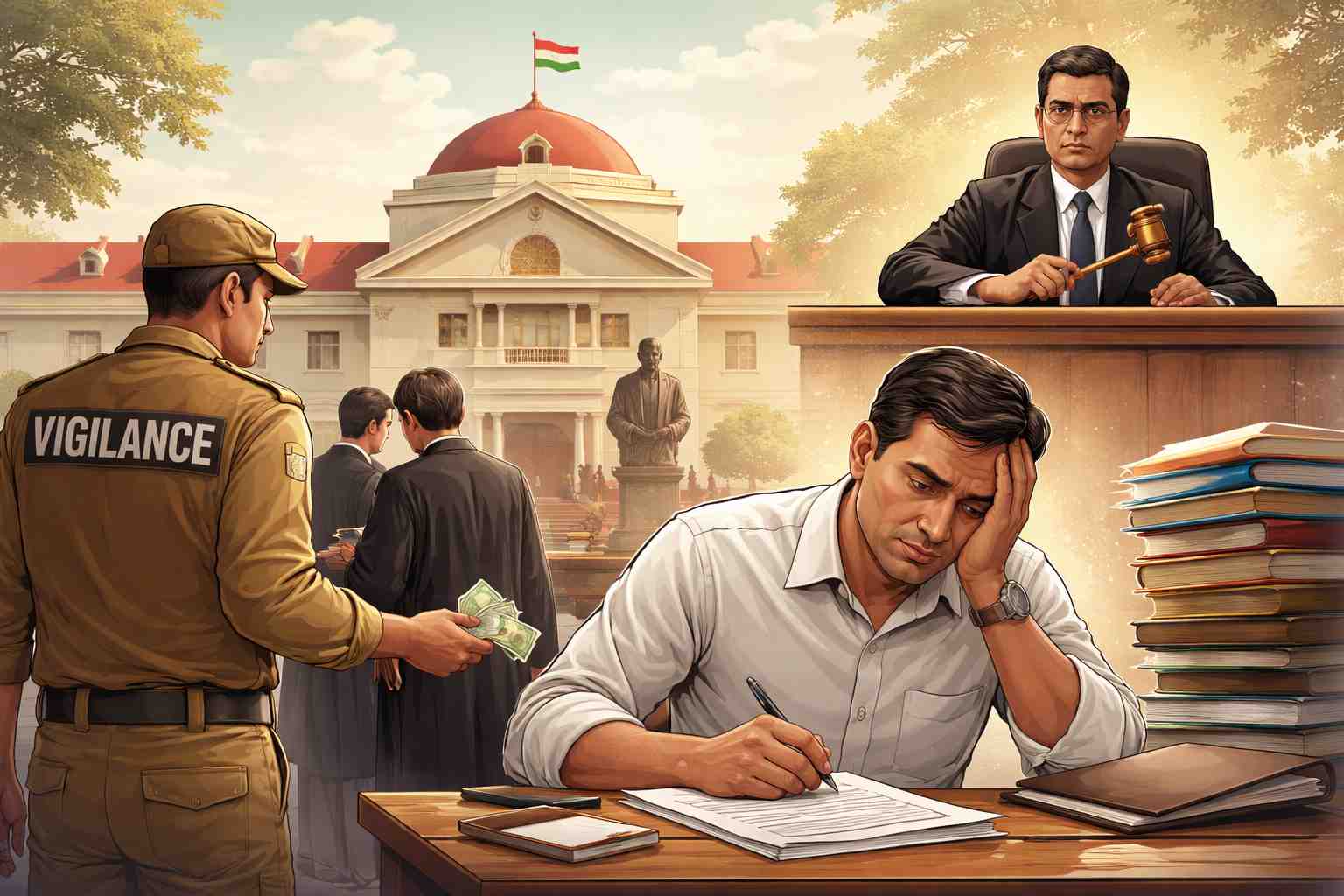
Simplified Explanation of the Judgment
In this case, decided by the Patna High Court in November 2022, the petitioner—a Revenue Clerk—challenged his dismissal from service. He was accused of demanding and accepting a bribe of ₹5,000 for recording a land mutation in the revenue records. The Vigilance Department caught him in a trap operation, leading to his suspension and departmental inquiry.
The Court’s analysis focused not on whether the officer had taken the bribe, but whether the departmental inquiry and punishment were conducted as per law.
Background
The officer was arrested in 2007 and suspended while in jail. After his release in 2008, he resumed duties and was later served a charge sheet under Rule 17 of the Bihar Government Servants (Classification, Control & Appeal) Rules, 2005. The departmental inquiry was initiated while the vigilance case continued.
However, during the inquiry, major procedural lapses occurred:
- The Presenting Officer (who represents the government in such inquiries) wrote a letter stating that the charges were baseless and the bribe allegation could not stand because the land mutation application had been filed after the trap.
- Despite this, a new Enquiry Officer was appointed who, without examining any witnesses or considering evidence, directly asked questions to the accused officer and concluded that he was “negligent in duty.”
- The Disciplinary Authority, without giving reasons, treated this as proof of bribery and ordered dismissal on 18.02.2014.
- The Appellate Authority upheld the dismissal in April and May 2015 without proper reasoning.
The petitioner argued that the entire inquiry was a mockery of justice, conducted without following due process.
Court’s Findings
Justice Sanjeev Prakash Sharma found the departmental inquiry illegal and procedurally defective. The Court highlighted that:
- No witnesses were examined and no documentary evidence was produced during the inquiry.
- The Enquiry Officer acted as both prosecutor and judge, which is forbidden in quasi-judicial proceedings.
- The disciplinary authority punished the petitioner for bribery even though the inquiry officer had only found “supervisory negligence.”
- The department failed to comply with Rule 17 of the CCA Rules, which mandates that evidence must be recorded and cross-examination allowed.
The Court cited multiple landmark judgments, including:
- Anil Kumar v. Presiding Officer (1985) 3 SCC 378 — Departmental inquiries must be reasoned and fair.
- Kuldeep Singh v. Commissioner of Police (1999) 2 SCC 10 — Witnesses must be examined in the delinquent’s presence.
- Roop Singh Negi v. Punjab National Bank (2009) 2 SCC 570 — FIR or investigation documents cannot substitute for evidence.
- State of U.P. v. Saroj Kumar Sinha (2010) 2 SCC 772 — Inquiry officer must remain neutral.
- Union of India v. P. Gunasekaran (2015) 2 SCC 610 — Courts can interfere where the inquiry violates principles of natural justice.
The Court observed that since no real inquiry was conducted, the punishment order was arbitrary, unjustified, and based on no evidence. The departmental proceedings were deemed a nullity in law.
Final Decision
The High Court quashed the dismissal order (dated 18.02.2014) and the appellate orders (dated 17.04.2015 and 15.05.2015). The petitioner was ordered to receive all consequential benefits, including pay, service continuity, and restoration of rights, as if the dismissal never occurred.
The Court concluded that punishing a public servant without evidence and in violation of procedural safeguards violates the principles of natural justice and constitutional fairness under Article 311(2).
Significance or Implication of the Judgment
This judgment is a strong reminder that disciplinary actions in government service must be backed by lawful procedure.
For government departments, it establishes that:
- An inquiry cannot rely on assumption or internal belief; it must be based on recorded evidence.
- The Enquiry Officer must act impartially and cannot act as the department’s representative.
- Orders of punishment without evidence or reasons are liable to be struck down.
For government employees, the decision reinforces their right to fair departmental proceedings. Even if a criminal case is pending, the department must prove its charges independently and fairly.
The case also illustrates how administrative authorities must carefully apply the Bihar C.C.A. Rules, 2005, particularly Rules 17 and 18, which ensure procedural integrity.
Legal Issues Decided and the Court’s Decision
- Was the departmental inquiry conducted as per Rule 17 of Bihar CCA Rules, 2005?
❌ No. No witnesses were examined, and no evidence was recorded. - Did the Enquiry Officer exceed his authority by acting as prosecutor?
✅ Yes. He questioned the petitioner directly and concluded guilt without evidence. - Can the disciplinary authority punish an employee beyond what the inquiry officer found?
❌ No. Without a proper disagreement notice or reasons, it violates natural justice. - Was the dismissal legally sustainable?
❌ No. The inquiry and punishment were based on no evidence and were thus void. - Outcome:
✅ The dismissal and appellate orders were quashed. The petitioner was reinstated with all consequential benefits.
Judgments Referred by Parties
- Anil Kumar v. Presiding Officer & Ors., (1985) 3 SCC 378
- Kuldeep Singh v. Commissioner of Police & Ors., (1999) 2 SCC 10
- Roop Singh Negi v. Punjab National Bank & Ors., (2009) 2 SCC 570
- State of U.P. v. Saroj Kumar Sinha, (2010) 2 SCC 772
- Prem Kumar v. State of Bihar & Ors., (2018) 3 PLJR 969
Judgments Relied Upon or Cited by Court
- Union of India v. H.C. Goel, AIR 1964 SC 364
- Punjab National Bank v. Kunj Bihar Misra, (1998) 7 SCC 84
- Union of India v. P. Gunasekaran, (2015) 2 SCC 610
- Central Industrial Security Force v. Abrar Ali, (2017) 4 SCC 507
Case Title
Kumar Raja v. The State of Bihar & Others
Case Number
Civil Writ Jurisdiction Case No. 19792 of 2015
Citation(s)
2023 (1) PLJR 497
Coram and Names of Judges
Hon’ble Mr. Justice Sanjeev Prakash Sharma
Names of Advocates and who they appeared for
- For the Petitioner: Mr. Manish Chandra Gandhi
- For the Respondents: Mr. Sajid Salim Khan, SC-XXV
Link to Judgment
MTUjMTk3OTIjMjAxNSMxI04=-Kk3yBfis0nQ=
If you found this explanation helpful and wish to stay informed about how legal developments may affect your rights in Bihar, you may consider following Samvida Law Associates for more updates.







