
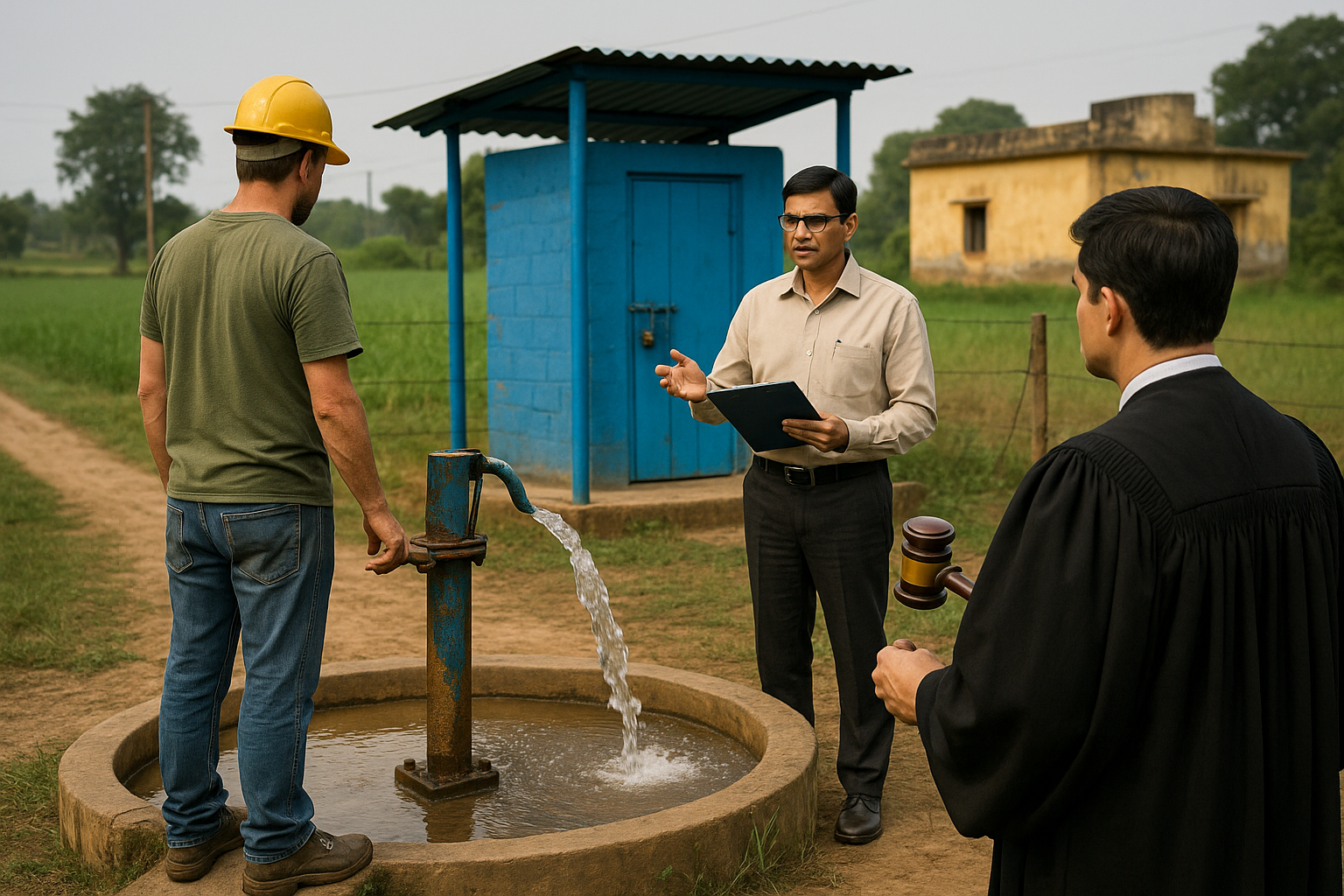
The petitioner challenged an order of the Public Health Engineering Department (PHED), Bettiah, debarring it for an indeterminate period from entering into any contract with any government department. The Patna High Court set aside this order on 1 December 2022, holding that an indefinite debarment is disproportionate, especially when the authority failed to consider the contractor’s explanations—including COVID-19 lockdown disruptions and site issues—before imposing the harshest penalty.
The bench of Hon’ble Mr. Justice Ashutosh Kumar and Hon’ble Mr. Justice Nawneet Kumar Pandey observed that debarment is akin to blacklisting and should be a measure of last resort. The Court noted that although the department later extended time to complete the work—albeit conditionally and with liquidated damages—this very extension undermined the justification for a limitless debarment. Accordingly, the Court annulled the debarment and directed the department to take a fresh decision within thirty days, keeping in view the petitioner’s explanations and the legal position that permanent or indefinite debarment is impermissible.
The dispute arose from a rural water-supply project in West Champaran. The petitioner had been selected as a concessionaire for 13 Single Gram Panchayat/Habitation Piped Water Supply Schemes (SGS/SHS) valued at approximately ₹4.419 crore. However, the initially selected site turned out to be waterlogged and unsuitable for boring; the site change took four months. Soon after, the national COVID-19 lockdown (25 March 2020 to 17 May 2020) halted progress. Only on 17 February 2021 did the department grant an extension—and that too for just 33 days. Later, post-debarment, the department offered a further one-year extension but conditioned it on paying ₹44.19 lakh as liquidated damages.
The Court criticized the authority for not addressing these specific circumstances in its debarment order and for imposing a sanction that effectively results in “civil death” of a commercial entity without a reasoned evaluation of the contractor’s reply to show-cause. Citing Supreme Court precedent, the bench reiterated that permanent or indefinite debarment is unjustified.
Simplified Explanation of the Judgment (700–900 words)
This case involves a government contractor (petitioner) who was debarred by the PHED, Bettiah, from entering into any government contract for an unlimited period. The Patna High Court examined whether such an indefinite debarment was lawful and fair in the circumstances.
First, the background. The petitioner was awarded 13 piped water-supply schemes in West Champaran for a contract price of about ₹4.419 crore. After receiving a go-ahead to start work at a particular site, the contractor discovered that the site was waterlogged and unsuitable for boring/tube-well operations. The issue was promptly reported, and although the department eventually changed the site, it took four months, causing initial delays.
Next, the COVID-19 pandemic intervened. A national lockdown was imposed from 25 March to 17 May 2020, which directly impacted construction activities—especially those requiring a workforce and on-site operations. The petitioner sought an extension, but the department granted one only on 17 February 2021, and even then for just 33 days—a period the petitioner termed arbitrary, given that the project work had not effectively begun due to earlier constraints and the pandemic.
Despite these representations, the department issued an order on 6 April 2021 debarring the petitioner for an indeterminate duration. Notably, the same record shows that while an earlier extension came without liquidated damages, later—after passing the debarment—the authority proposed a further one-year extension subject to the contractor paying ₹44.19 lakh as liquidated damages. This inconsistency became significant: if the performance was so poor as to justify a limitless debarment, how could the department simultaneously contemplate allowing the contractor to continue for another year upon payment?
The High Court identified two central concerns:
- Lack of reasoned consideration of the contractor’s explanation. The show-cause reply detailed problems beyond the contractor’s control—unsuitable site conditions requiring a relocation, the four-month delay in changing the site, and the legally mandated COVID-19 lockdown that halted work. The Court found that these points were not addressed at all in the final debarment decision. Debarment must be preceded by a fair evaluation of the response so that the decision stands the test of objectivity.
- Disproportionate and indefinite nature of the penalty. Debarment/blacklisting is an extreme measure that can effectively end a contractor’s business prospects with government departments. The Court emphasized that such a penalty amounts to “civil death” of a commercial entity and should therefore be imposed only after careful, reasoned analysis. A limitless or permanent debarment is rarely justified and runs contrary to Supreme Court authority.
On the legal standard, the bench relied upon two Supreme Court decisions: M/s Kulja Industries Ltd. v. Chief General Manager W.T. Project, BSNL & Ors. (2014) 14 SCC 731 and Vetindia Pharmaceuticals Ltd. v. State of Uttar Pradesh & Anr. (2021) 1 SCC 804, to underline that an order of permanent debarment is unjustified. These decisions support the principle that punitive administrative measures must be proportionate and reasoned, especially when they have long-term civil consequences.
Applying these principles, the High Court set aside the debarment order. Importantly, the Court did not interfere with the department’s subsequent (conditional) time-extension offer; it left it to the contractor to accept or decline that proposal. Instead, the Court directed the department to pass a fresh, reasoned order within thirty days from receipt of the judgment, explicitly recognizing that a further extension without liquidated damages may be appropriate given that much of the delay was attributable to circumstances beyond the contractor’s control, including the national lockdown.
In sum, the Court restored balance by requiring the authority to reconsider the matter fairly and proportionately, rather than allowing an open-ended bar that ignored real-world constraints like site feasibility and pandemic restrictions.
Significance or Implication of the Judgment (For general public or government)
- For government departments: The judgment reiterates that debarment/blacklisting must be reasoned, time-bound, and proportionate. Authorities must meaningfully engage with the contractor’s show-cause reply and objectively assess external factors such as lockdowns or site infeasibility. Indefinite debarment orders are vulnerable to being quashed.
- For contractors and vendors: This decision underscores the importance of documenting obstacles and promptly informing the department. Where delays are due to circumstances beyond control (e.g., pandemic restrictions, unsuitable sites), contractors are entitled to a fair hearing and proportionate outcomes rather than career-ending sanctions.
- For public projects: The Court’s approach promotes continuity of essential infrastructure work without compromising accountability. Conditional extensions and calibrated remedies (instead of blanket blacklisting) keep projects moving while preserving public interest.
Legal Issue(s) Decided and the Court’s Decision with reasoning
- Whether an indefinite/limitless debarment by a government department is lawful and proportionate in the facts of the case.
Decision: No. The Court set aside the indeterminate debarment as disproportionate and unsupported by a reasoned analysis of the contractor’s explanations. Debarment is akin to blacklisting, has severe civil consequences, and must be imposed sparingly and for a defined period. - Whether the authority properly considered the contractor’s show-cause reply and the impact of COVID-19 lockdown and site infeasibility.
Decision: No. The authority failed to engage with these points, rendering the order unsustainable. The Court emphasized the need for objectivity and a reasoned response to the contractor’s case. - Whether subsequent conditional extension undermines justification for limitless debarment.
Decision: Yes. Granting a further extension (albeit with liquidated damages) contradicts the premise that the contractor’s performance warranted permanent exclusion. - Appropriate relief.
Decision: Debarment order quashed. Department to reconsider afresh within thirty days; contractor may seek extension without liquidated damages where delays were beyond control.
Judgments Relied Upon or Cited by Court (with citations)
- M/s Kulja Industries Ltd. v. Chief General Manager W.T. Project, BSNL & Ors., (2014) 14 SCC 731 — Cited for the principle that permanent debarment is unjustified and penalties must be proportionate.
- Vetindia Pharmaceuticals Ltd. v. State of Uttar Pradesh & Anr., (2021) 1 SCC 804 — Reaffirmed that indefinite debarment is impermissible.
Case Title
Petitioner v. State of Bihar & Ors.
Case Number
Civil Writ Jurisdiction Case No. 21293 of 2021.
Citation(s)
2023 (1) PLJR 167
Coram and Names of Judges
Hon’ble Mr. Justice Ashutosh Kumar and Hon’ble Mr. Justice Nawneet Kumar Pandey (Oral Judgment per Ashutosh Kumar, J.), Date: 01-12-2022.
Names of Advocates and who they appeared for
- For the petitioner: Mr. P. N. Shahi, Senior Advocate.
- For the State (respondents): Mr. Upendra Pratap Singh, AC to SC-4.
Link to Judgment
MTUjMjEyOTMjMjAyMSMxI04=-Q0mrBSvDf1A=
If you found this explanation helpful and wish to stay informed about how legal developments may affect your rights in Bihar, you may consider following Samvida Law Associates for more updates.







