
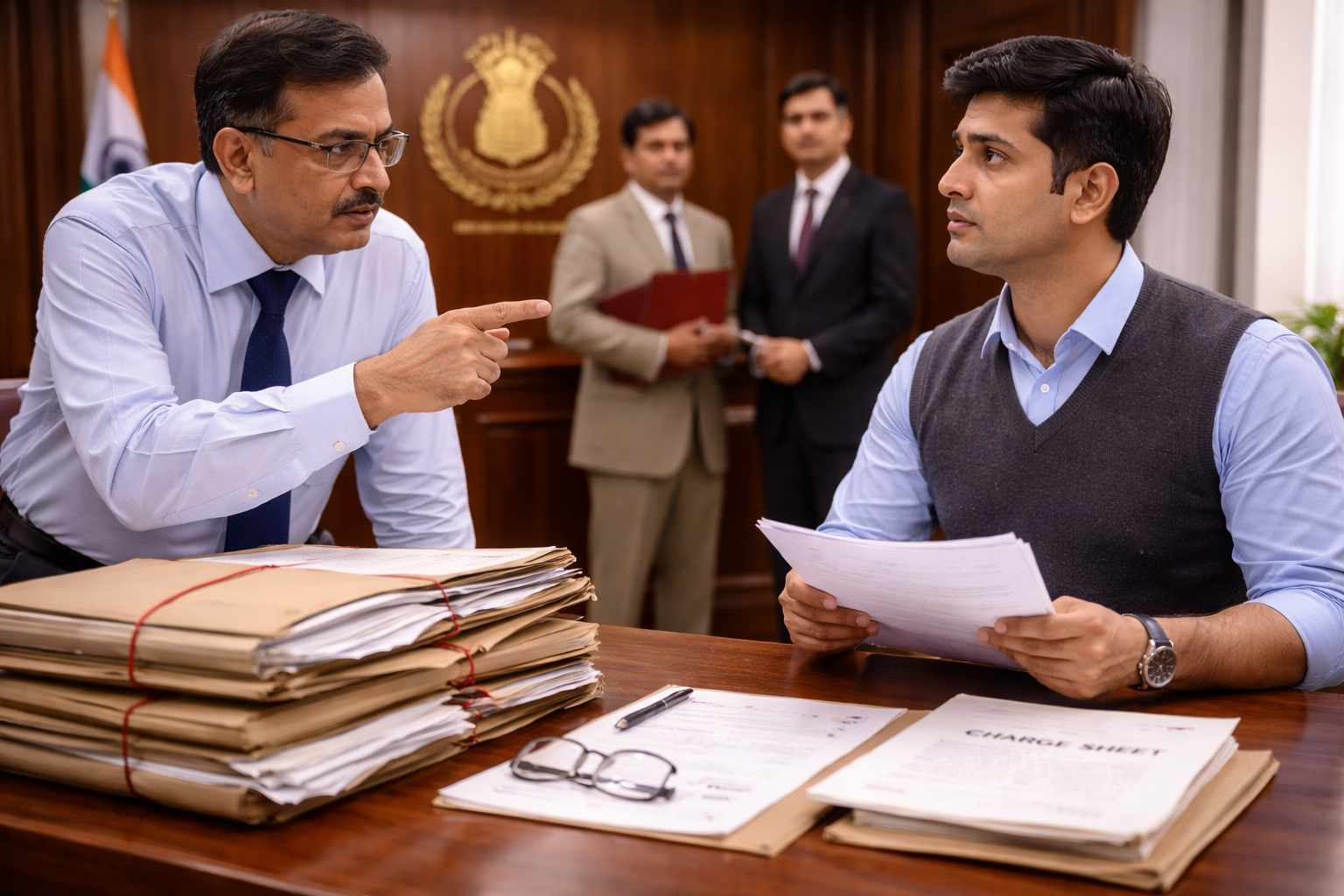
Simplified Explanation of the Judgment
This judgment of the Patna High Court is a significant service law decision dealing with departmental enquiries under the Central Civil Services (Classification, Control and Appeal) Rules, 1965. The Court clearly held that disciplinary authorities must strictly follow statutory procedure, especially when common proceedings are ordered against multiple employees. Any deviation from the prescribed rules can vitiate the entire disciplinary action.
The case arose from disciplinary proceedings initiated against a government employee working in the Indian Audit and Accounts Department. The petitioner was serving as an Assistant Audit Officer and was subjected to departmental action along with two other officials for alleged misconduct relating to official duties.
The petitioner was initially placed under suspension on 08.08.2013 and was subsequently charge-sheeted on 24.10.2013 under Rule 14 of the CCS (CCA) Rules, 1965. Seven charges were framed against him. The petitioner denied all the charges through a written reply dated 04.11.2013.
On the same date, the disciplinary authority revoked the suspension but simultaneously passed an order invoking Rule 18 of the CCS (CCA) Rules, directing that common proceedings (joint enquiry) be held against the petitioner and two other officers, as the allegations arose out of the same transaction.
Despite this explicit order, the Inquiry Officer ignored the direction for common proceedings and proceeded to conduct separate individual enquiries against each officer. The Inquiry Officer ultimately held that charges 1 to 6 were partly proved, while charge no. 7 was not proved.
Thereafter, the disciplinary authority disagreed with the findings of the Inquiry Officer on the charge held “not proved” and issued a second show cause notice. Without curing the procedural defects, the disciplinary authority imposed a penalty of reduction of pay by one stage for three years, along with denial of increments during the penalty period.
The petitioner’s departmental appeal was rejected, and his challenge before the Central Administrative Tribunal (CAT), Patna Bench also failed. Aggrieved, the petitioner approached the Patna High Court under Article 226 of the Constitution.
Core Procedural Lapses Highlighted by the Petitioner
Before the High Court, the petitioner pointed out serious violations of mandatory rules, including:
- Failure to conduct joint enquiry, despite an express order under Rule 18.
- Violation of Rule 14(4) by not supplying a list of witnesses along with the charge-sheet.
- Conducting enquiry solely on the basis of documents, without examining the authors of those documents.
- Improper exercise of power under Rule 15, while disagreeing with the Inquiry Officer’s findings.
- Failure of the CAT to even examine the issue of common proceedings, though it was specifically pleaded.
Stand of the Respondents
The respondents contended that:
- The enquiry was conducted fairly and in accordance with law.
- Charges were proved on the basis of documentary evidence.
- No prejudice was caused to the petitioner.
- The Central Administrative Tribunal rightly refused to interfere.
Key Legal Analysis by the Patna High Court
The Division Bench comprising Hon’ble Justice P. B. Bajanthri and Hon’ble Justice Rajiv Roy undertook a detailed examination of the CCS (CCA) Rules and the record of enquiry.
1. Mandatory Nature of Common Proceedings (Rule 18)
The Court held that once the disciplinary authority consciously invoked Rule 18 and ordered common proceedings, it was mandatory for the Inquiry Officer to conduct a joint enquiry.
The Court observed that:
- Initiation of individual enquiries after ordering common proceedings is legally impermissible.
- The Inquiry Officer acted contrary to the binding direction of the disciplinary authority.
- Even the disciplinary authority failed to notice this fatal defect at later stages, showing non-application of mind.
This lapse alone was sufficient to vitiate the enquiry.
Violation of Rule 14(4): No List of Witnesses
The Court emphasized that Rule 14(4) mandates supply of:
- Articles of charge,
- Statement of imputations,
- List of documents, and
- List of witnesses.
In the present case:
- Though 26 documents were relied upon,
- The list of witnesses was shown as “nil”.
Relying on the Supreme Court judgment in S.C. Girotra v. United Commercial Bank (1995 Supp (3) SCC 212), the Court held that:
- When documents are relied upon, the authors of documents must be examined as witnesses,
- Denial of opportunity to cross-examine such witnesses amounts to violation of principles of natural justice.
Improper Disagreement Under Rule 15
The Court found that while disagreeing with the Inquiry Officer’s report, the disciplinary authority:
- Failed to follow the procedure under Rule 15,
- Did not examine whether further evidence or witnesses were required,
- Issued a mechanical show cause notice without curing earlier defects.
This, according to the Court, rendered the final penalty order unsustainable in law.
Error Committed by the Central Administrative Tribunal
The High Court noted that:
- The petitioner had specifically pleaded about common proceedings before the CAT,
- Yet the Tribunal failed to consider or adjudicate this crucial issue,
- The CAT thus committed a jurisdictional and legal error.
Final Decision of the Patna High Court
In view of the above findings, the Patna High Court:
- Set aside the penalty order dated 25.08.2014,
- Quashed the appellate order dated 06.05.2015,
- Set aside the CAT’s order dated 19.02.2019, and
- Allowed the writ petition.
The Court directed the disciplinary authority to:
- Withdraw the earlier common proceedings order, and
- Restart the enquiry from the defective stage, i.e., by furnishing a proper list of witnesses,
- Conduct the enquiry afresh strictly in accordance with the CCS (CCA) Rules, and
- Complete the process within six months.
Significance or Implication of the Judgment
This judgment is extremely important for government employees and disciplinary authorities because it:
- Reaffirms that procedure is not a mere formality in service jurisprudence.
- Clarifies that once common proceedings are ordered, joint enquiry is compulsory.
- Reinforces the employee’s right to cross-examine witnesses.
- Acts as a warning against casual and mechanical disciplinary actions.
For the general public and government servants, the decision strengthens confidence that courts will intervene when statutory safeguards are ignored.
Legal Issue(s) Decided and the Court’s Decision
- Whether common proceedings under Rule 18 are mandatory once ordered?
➤ Yes. Joint enquiry is compulsory. - Whether enquiry without list of witnesses is valid?
➤ No. It violates Rule 14(4) and natural justice. - Whether CAT erred in ignoring procedural violations?
➤ Yes. The order was set aside.
Judgments Referred by Parties (with citations)
- S.C. Girotra v. United Commercial Bank, 1995 Supp (3) SCC 212
Judgments Relied Upon or Cited by Court (with citations)
- S.C. Girotra v. United Commercial Bank, 1995 Supp (3) SCC 212
Case Title
Government Employee v. Union of India & Others
Case Number
Civil Writ Jurisdiction Case No. 5306 of 2020
Citation(s)
2023 (1) PLJR 582
Coram and Names of Judges
- Hon’ble Justice P. B. Bajanthri
- Hon’ble Justice Rajiv Roy
Names of Advocates and who they appeared for
- For the Petitioner: Mr. Kumar Kaushik, Advocate; Ms. Namrata Dubey, Advocate; Mr. Pushkar Bhardwaj, Advocate
- For the Respondents: Mr. Arun Kumar Arun, Advocate
Link to Judgment
MTUjNTMwNiMyMDIwIzEjTg==-weCw8Vq8JiM=
If you found this explanation helpful and wish to stay informed about how legal developments may affect your rights in Bihar, you may consider following Samvida Law Associates for more updates.







