
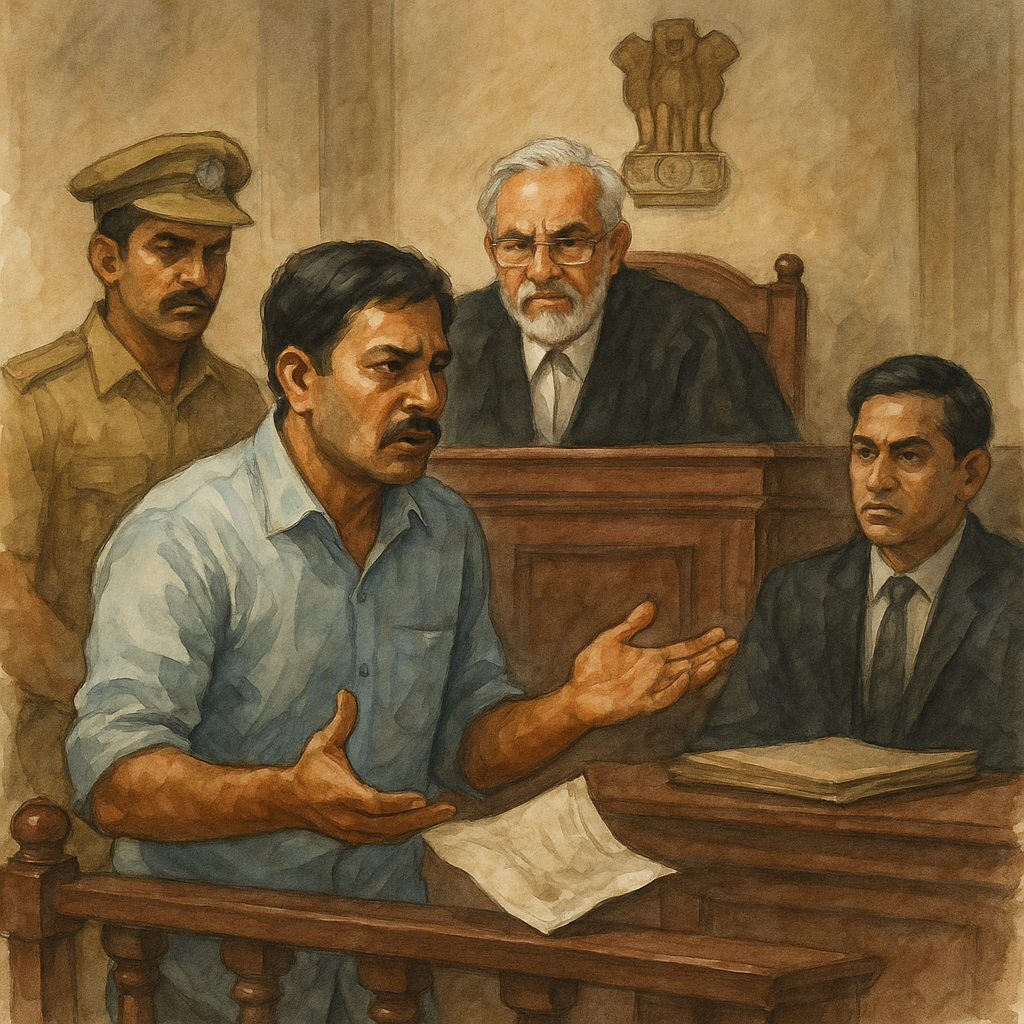
Simplified Explanation of the Judgment
The Patna High Court recently quashed two blacklisting orders issued by the State Transport Authority against two petitioners who were barred from applying for future transport permits. The Court held that the blacklisting was done without following the principles of natural justice, particularly the requirement to issue a show cause notice before taking such a drastic step.
The petitioners, both bus owners, had applied for inter-state stage carriage permits on the Patna–Durgapur route. The application process required submission of various documents, including an objection petition if any applicant wanted to challenge the eligibility of other contenders. The petitioners discovered that one of the applicants, a private respondent, had allegedly submitted forged educational and driving documents to gain an unfair advantage in the permit allocation process. They submitted objections to the transport authority.
According to the rules, each objection needed to be accompanied by a challan (receipt) of ₹1,000. Due to a clerical error, two original challans were attached to only one objection petition, and a photocopy was attached to the second. Instead of rejecting the objection for the missing original challan, the transport authority interpreted this as an attempt to defraud the government and permanently blacklisted the petitioners.
The petitioners challenged this blacklisting before the State Transport Appellate Tribunal, which upheld the decision with minor modifications. Dissatisfied, they approached the Patna High Court.
The High Court emphasized that blacklisting is a serious penalty with long-term implications on a person’s business and livelihood. Citing binding precedents from the Supreme Court, the Court held that:
- Blacklisting must be preceded by a show cause notice and a fair opportunity to be heard.
- Such punishment cannot be imposed for minor lapses unless there is deliberate fraud or misconduct.
- In this case, the authorities had not issued any prior notice, nor had they demonstrated any serious wrongdoing.
The Court concluded that the failure to attach the original challan to one of the objections was, at worst, a clerical lapse — not an intentional fraud. Furthermore, the authorities did not verify the petitioners’ claim that both original challans had been submitted, albeit with one being wrongly placed. The assumption that the petitioners were trying to cheat the government of ₹1,000 was found baseless.
Accordingly, the Court set aside the orders of both the transport authority and the appellate tribunal, and directed that the petitioners be permitted to participate in future permit applications without any impediment.
Significance or Implication of the Judgment
This ruling reinforces the importance of adhering to the principles of natural justice in administrative proceedings, especially when the outcome could severely impact an individual’s business prospects. It clarifies that blacklisting should be reserved only for cases involving grave misconduct or proven fraud, and not used as a punitive measure for procedural lapses. For transporters and small business owners, the judgment offers reassurance that administrative fairness is a legal right and arbitrary exclusion will not be tolerated.
Legal Issue(s) Decided and the Court’s Decision with Reasoning
- Was the blacklisting of the petitioners lawful without issuing a show cause notice?
- Court’s Decision: No. Blacklisting was set aside as it violated principles of natural justice.
- Reasoning: The petitioners were not given any opportunity to explain or justify the clerical error. Supreme Court precedent mandates notice before such punitive actions.
- Is submitting a photocopy of a challan instead of the original a valid reason for permanent debarment?
- Court’s Decision: No.
- Reasoning: Even if the submission was defective, the proper course would be to reject the objection — not to blacklist. The petitioners had paid the correct fees and attached both challans, albeit incorrectly.
- Did the transport authorities identify any fraud or intentional misrepresentation?
- Court’s Decision: No.
- Reasoning: The blacklisting order lacked any legal basis or factual verification. The conclusion of fraud was speculative.
Judgments Relied Upon or Cited by Court
- Erusian Equipment and Chemicals Ltd. v. State of West Bengal, AIR 1975 SC 266
- Raghunath Thakur v. State of Bihar, AIR 1989 SC 620
- S.N. Mukherjee v. Union of India, AIR 1990 SC 1984
Case Title
Md. Shamsh Tabrez Khan & Md. Zafar Alam Khan v. State of Bihar & Ors.
Case Number
CWJC No. 6459 of 2022 and CWJC No. 6252 of 2022
Coram and Names of Judges
Hon’ble Mr. Justice A. Abhishek Reddy
Names of Advocates and Who They Appeared For
- For Petitioners: Mr. Rashid Izhar
- For Respondents:
- In CWJC No. 6459 of 2022: Mr. Ajay Kumar Rastogi (AAG 10)
- In CWJC No. 6252 of 2022: Ms. Anuradha Singh (SC 21)
Link to Judgment
https://www.patnahighcourt.gov.in/ShowPdf/web/viewer.html?file=../../TEMP/70ccf94c-557e-4b64-9381-73c334da09bf.pdf&search=Debarment
If you found this explanation helpful and wish to stay informed about how legal developments may affect your rights in Bihar, you may consider following Samvida Law Associates for more updates.







