
Simplified Explanation of the Judgment
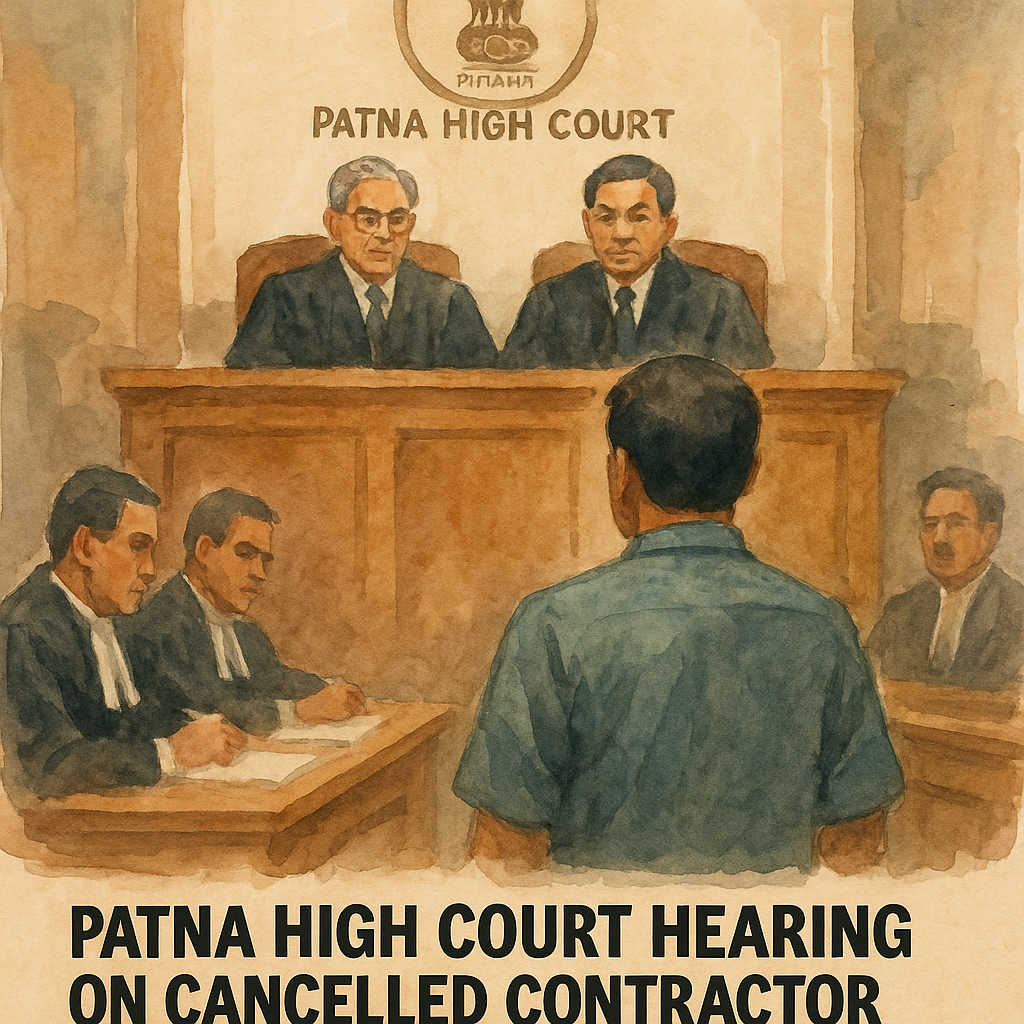
In a significant case concerning administrative fairness, the Patna High Court intervened to protect a contractor’s rights after he was blacklisted for an unusually long period of 15 years by the Bihar Rural Works Department. The petitioner had earlier secured a government contract under Agreement No. 100 MBD/2019-2020. However, following a dispute over alleged failure to complete the work, the department not only canceled his contract but also blacklisted him for 15 years.
The contractor filed a writ petition before the Patna High Court challenging two main actions:
- Cancellation of his work agreement.
- Blacklisting for 15 years via Memo No. 2767 dated 12.12.2022.
The petitioner submitted that he was unable to complete the work due to natural causes, specifically flooding in the project area during the relevant time. He argued that the authority failed to properly consider this explanation and did not pass a “reasoned” or “speaking” order. A speaking order, in legal terms, is one that explains the reasoning behind the decision in clear terms, especially when rights or reputation are at stake.
The Court agreed to examine whether the blacklisting process followed legal and procedural fairness. Although the department had issued a show-cause notice and received a response, the final order lacked any discussion or analysis of the petitioner’s defense. The Court noted this was a classic case of “empty formalities,” meaning the authority completed paperwork without truly engaging with the explanation provided.
In legal proceedings, especially quasi-judicial ones like blacklisting—which can severely affect a person’s career and livelihood—courts have consistently required authorities to record their reasoning and apply their mind to all the material facts. This requirement was emphasized by the Supreme Court in cases like:
- ORYX Fisheries (P) Ltd. v. Union of India [(2010) 13 SCC 427]
- UMC Technologies Pvt. Ltd. v. Food Corporation of India [(2021) 2 SCC 551]
- Isolators and Isolators v. MPMKVVCL [2023 LiveLaw (SC) 330]
- Chauhan Builders v. State of U.P. [2022 LiveLaw (SC) 694]
The Patna High Court concluded that the blacklisting was vitiated by non-application of mind and absence of a proper justification. The order was set aside, and the department was granted liberty to proceed afresh—after issuing a specific notice, allowing for a reasonable hearing, and passing a reasoned decision based on facts and judicial precedent.
Regarding the cancellation of the contract, the Court noted that the petitioner had already filed an appeal. Therefore, it directed the appellate authority to decide the appeal within three months from the date of receipt of the order.
Significance or Implication of the Judgment
This judgment underlines a crucial principle: any punitive action by the government—especially blacklisting—must be justified with clear reasoning and adhere strictly to procedural fairness. The decision protects contractors and vendors who deal with government departments, ensuring they are not arbitrarily excluded from future work.
For administrative authorities, it is a reminder that “completing formalities” is not enough. Show-cause notices and hearings must be followed by a genuine evaluation and reasoned orders. This case strengthens transparency and accountability in governmental contracting procedures.
Legal Issue(s) Decided and the Court’s Decision with Reasoning
- Issue: Was the 15-year blacklisting order valid when no reasoned decision was recorded?
- Decision: No. The order was set aside for being non-speaking and lacking consideration of the petitioner’s defense.
- Reasoning: The authority issued a show-cause notice and received a reply but failed to evaluate the explanation regarding flood-related delays. This violated the requirement of reasoned orders in quasi-judicial actions.
- Issue: What should be done about the appeal against cancellation of contract?
- Decision: The appellate authority must decide the appeal within three months.
- Reasoning: The appeal is already pending and deserves a timely decision to avoid prejudice.
Judgments Referred by Parties
- Not specifically listed in the order.
Judgments Relied Upon or Cited by Court
- ORYX Fisheries (P) Ltd. v. Union of India, (2010) 13 SCC 427
- UMC Technologies Pvt. Ltd. v. Food Corporation of India, (2021) 2 SCC 551
- Isolators and Isolators v. MPMKVVCL, 2023 LiveLaw (SC) 330
- Chauhan Builders v. State of U.P., 2022 LiveLaw (SC) 694
Case Title
Ram Sovit Yadav v. The State of Bihar & Ors.
Case Number
Civil Writ Jurisdiction Case No. 5760 of 2023
Coram and Names of Judges
Hon’ble Mr. Justice P. B. Bajanthri
Hon’ble Mr. Justice Arun Kumar Jha
Names of Advocates and who they appeared for
Mr. D. K. Sinha, Sr. Advocate
Mr. G. C. Jha, Advocate
Mr. Ashish, Advocate – For the Petitioner
Mr. Ajay (GA-5), Mr. Pratik Kumar Sinha, AC to GA-5 – For the Respondents
Link to Judgment
https://www.patnahighcourt.gov.in/ShowPdf/web/viewer.html?file=../../TEMP/e7f81d26-15da-4955-b441-e8edc058fb03.pdf&search=Blacklisting
If you found this explanation helpful and wish to stay informed about how legal developments may affect your rights in Bihar, you may consider following Samvida Law Associates for more updates.







