
Simplified Explanation of the Judgment
This judgment of the Patna High Court addresses a serious disciplinary action taken against a police constable and examines the constitutional validity of dismissing a government employee without conducting a regular departmental inquiry. The case is important because it explains when and how Article 311(2)(b) of the Constitution of India can be invoked, which allows the State to dispense with a departmental inquiry in exceptional circumstances.
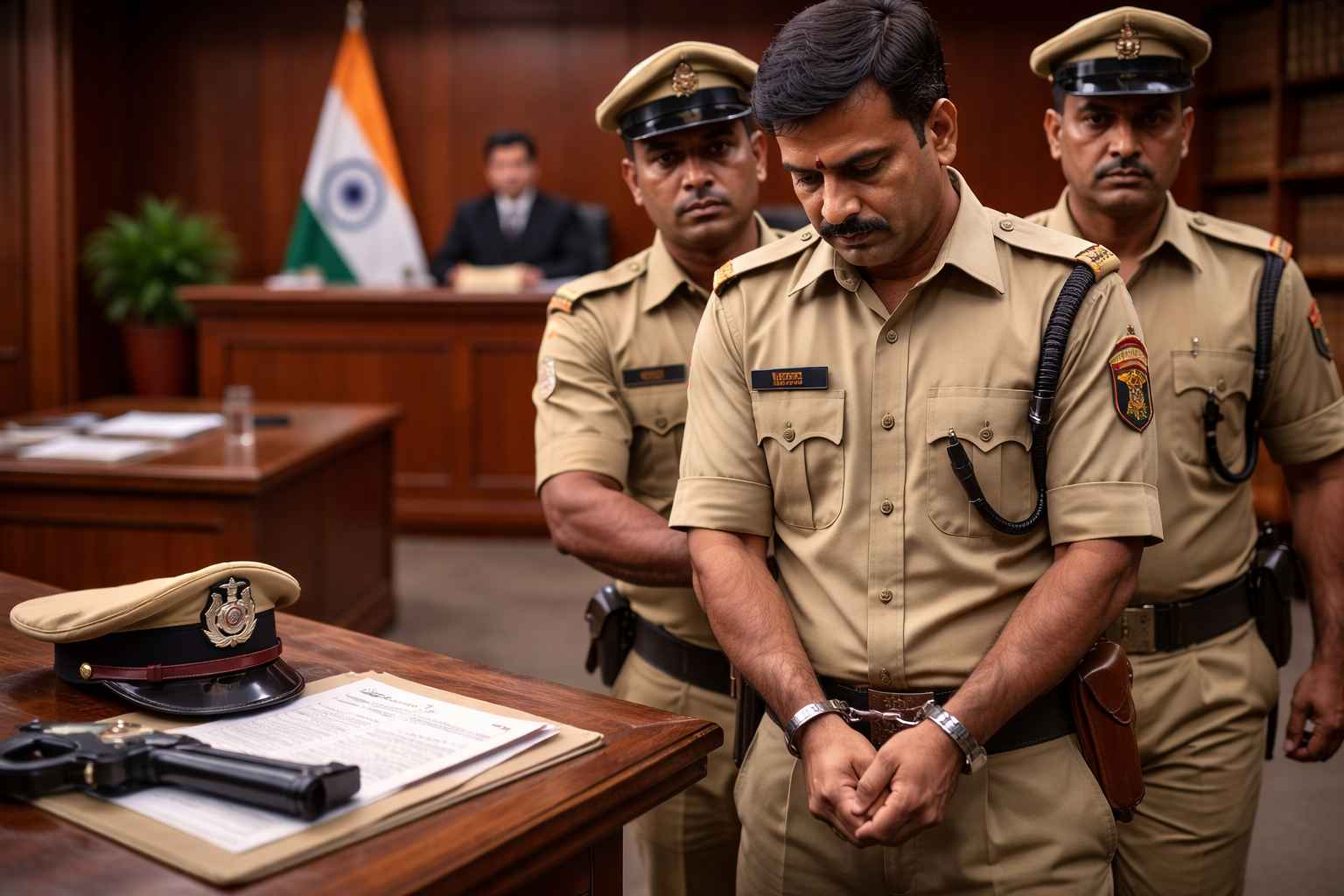
The petitioner was working as a constable in the Railway Police and was part of an escort party on a long-distance express train. According to the case records, a grave incident occurred during duty hours, in which the constable, along with other personnel, was alleged to have been involved in extortion from passengers. During an altercation, it was alleged that the petitioner opened fire, resulting in the death of two persons.
Following the incident:
- A criminal case was registered against the petitioner, including charges under Section 302 of the Indian Penal Code.
- A departmental charge-sheet was issued.
- The petitioner allegedly failed to participate in the departmental inquiry and was declared absconding.
- Proceedings were initiated treating him as an absconder, including issuance of warrants.
In view of these circumstances, the Superintendent of Police (Rail) invoked Article 311(2)(b) of the Constitution and passed an order dated 06.09.2000, dispensing with the departmental inquiry and dismissing the petitioner from service.
The petitioner’s statutory appeal was rejected in June 2001, and a memorial petition was also rejected by the Director General of Police in July 2012. Thereafter, the petitioner approached the Patna High Court seeking:
- Quashing of the dismissal order,
- Quashing of appellate and memorial orders, and
- Reinstatement with full consequential benefits.
Arguments Raised by the Petitioner
The petitioner contended that:
- The power under Article 311(2)(b) was wrongly exercised.
- The reasons cited for dispensing with the inquiry were not cogent.
- He was never absconding, and a separate criminal case alleging escape from custody had ultimately resulted in acquittal.
- Merely because some witnesses were difficult to produce, the inquiry could not have been dispensed with.
- At least some witnesses were police personnel, and no explanation was given as to why they could not be examined.
- His appeal and memorial were rejected mechanically without application of mind.
The petitioner relied on leading Supreme Court judgments, particularly Union of India v. Tulsiram Patel and Sudesh Kumar v. State of Haryana, to argue that dispensing with inquiry is an exception and not the rule.
Stand of the State Authorities
The State defended the dismissal by submitting that:
- The petitioner was declared an absconder, and coercive steps had been taken to apprehend him.
- He did not cooperate with the departmental process despite service of charge-sheet.
- Holding a regular inquiry was not reasonably practicable, as required under Article 311(2)(b).
- Witnesses were scattered across different railway stations and trains, making collection of evidence impracticable.
- The disciplinary authority had recorded detailed reasons before dispensing with the inquiry.
- The High Court should not sit as an appellate authority over disciplinary decisions.
It was further argued that the petitioner had subsequently been convicted in a criminal case under Section 302 IPC, and therefore reinstatement was legally impermissible even otherwise.
Legal Principles Considered by the Court
The Patna High Court, presided over by Hon’ble Justice Sanjeev Prakash Sharma, examined the scope of Article 311, particularly:
- The pleasure doctrine under Article 310,
- The safeguards under Article 311(1) and (2), and
- The exceptions under the second proviso to Article 311(2).
The Court extensively relied upon the Constitution Bench judgment in Union of India v. Tulsiram Patel, which explains that:
- Protection under Article 311 is meant to ensure fairness,
- But it cannot be abused to shield officials whose continuation in service is against public interest, and
- Where holding an inquiry is not reasonably practicable, the Constitution itself permits dispensing with it.
The Court also examined Rule 20(ii) of the Bihar CCA Rules, 2005, which mirrors Article 311(2)(b) and allows disciplinary action without inquiry when it is not feasible to conduct one.
Why the Court Rejected the Petitioner’s Case
After analyzing the record, the High Court held that:
- The disciplinary authority had recorded specific reasons justifying why inquiry was not practicable.
- The petitioner had absconded after receiving the charge-sheet, making it impossible to proceed with the inquiry.
- Conducting an inquiry behind the back of the petitioner would itself violate principles of natural justice.
- The reasons recorded were neither arbitrary nor perverse.
The Court distinguished the petitioner’s reliance on Sudesh Kumar’s case, observing that in that case no reasons were recorded, whereas in the present case, detailed reasons were clearly stated.
The Court further held that under Article 226, judicial review is limited. The High Court cannot:
- Re-appreciate evidence,
- Substitute its opinion for that of the disciplinary authority, or
- Interfere unless the decision is patently illegal or perverse.
Since none of these grounds were made out, the Court found no reason to interfere.
Effect of Criminal Conviction
The Court also took note of the fact that the petitioner had been convicted under Section 302 IPC. It observed that:
- Even if the dismissal had not been passed under Article 311(2)(b),
- Article 311(2)(a) and Rule 20(i) of the Bihar CCA Rules would independently bar reinstatement after conviction on a criminal charge.
Thus, on both counts—procedural and substantive—the petitioner was not entitled to relief.
Final Decision of the Patna High Court
The Patna High Court concluded that:
- The dismissal order was lawful and constitutionally valid,
- The appellate and memorial orders suffered from no illegality, and
- The writ petition was wholly misconceived.
Accordingly, the writ petition was dismissed in entirety.
Significance or Implication of the Judgment
This judgment is significant for government employees and disciplinary authorities alike:
- It reinforces that departmental inquiry is the rule, but public interest exceptions are real and enforceable.
- It clarifies that absconding from inquiry proceedings can itself justify dispensing with inquiry.
- It protects administrative authorities acting within constitutional limits from excessive judicial interference.
- It underscores that public confidence in police and uniformed services is a legitimate ground for swift action.
For the general public, the decision affirms that constitutional safeguards exist for public good, not as shields for grave misconduct.
Legal Issue(s) Decided and the Court’s Decision
- Whether dismissal without inquiry under Article 311(2)(b) was valid?
➤ Yes. The authority recorded valid reasons showing inquiry was not reasonably practicable. - Whether the High Court should interfere with disciplinary satisfaction?
➤ No. Judicial review is limited and does not permit substitution of opinion. - Whether reinstatement was possible after criminal conviction?
➤ No. Article 311(2)(a) and service rules bar reinstatement.
Judgments Referred by Parties
- Union of India v. Tulsiram Patel, AIR 1985 SC 1416
- Sudesh Kumar v. State of Haryana, (2005) 11 SCC 525
Judgments Relied Upon or Cited by Court
- Union of India v. Tulsiram Patel, AIR 1985 SC 1416
- CISF v. Abrar Ali, (2017) 7 SCC 507
Case Title
Constable (Railway Police) v. State Authorities
Case Number
Civil Writ Jurisdiction Case No. 11616 of 2013
Citation(s)
2023 (1) PLJR 552
Coram and Names of Judges
Hon’ble Justice Sanjeev Prakash Sharma
Names of Advocates and who they appeared for
- For the Petitioner: Senior Advocate, assisted by counsel
- For the State: Government Advocate
Link to Judgment
MTUjMTE2MTYjMjAxMyMxI04=-txaKkEeLycU=
If you found this explanation helpful and wish to stay informed about how legal developments may affect your rights in Bihar, you may consider following Samvida Law Associates for more updates.







