
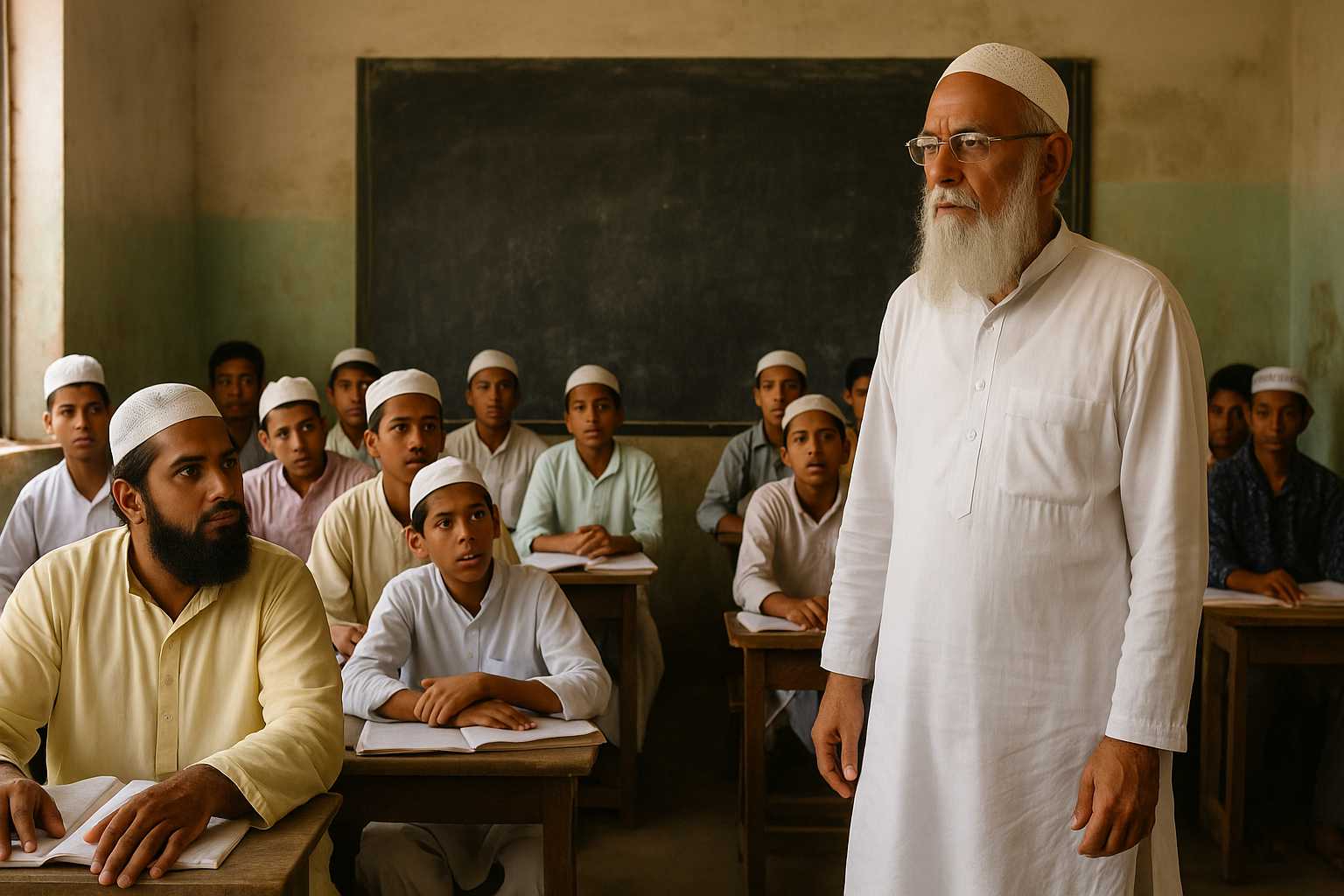
Simplified Explanation of the Judgment
The Patna High Court delivered a significant judgment on November 28, 2022, clarifying that teachers serving in non-government recognized aided Madarsas in Bihar are not entitled to pension, gratuity, or other retiral benefits like government school teachers. The Court disposed of four connected writ petitions together because they raised identical legal questions.
The petitioners were retired teachers from different recognized Madarsas in Bihar. They approached the Court seeking directions to the State Government for payment of leave encashment, gratuity, and other retirement-related benefits at par with teachers of government schools. They contended that since their Madarsas were recognized by the Bihar Madarsa Education Board and received government aid for salaries, they should also be treated equally with government school teachers in matters of service benefits.
Their counsel argued that as per the State Government’s Memo No. 237 dated 20 February 1990, all aided minority institutions, including Madarsas and Sanskrit schools, were entitled to the same allowances and pay scales as government schools. On this basis, they claimed that the same equality should extend to retiral benefits like pension and gratuity.
The State Government, however, opposed these claims. It explained that Memo No. 237 of 1990 was later modified by Memo No. 893 dated 8 November 1990, which limited the extension of pay and allowances only to minority educational institutions. According to the State, recognized aided Madarsas and Sanskrit schools did not fall under the category of minority institutions within the meaning of Articles 29 and 30 of the Constitution. Therefore, they were not entitled to retirement benefits at par with government employees.
The State relied heavily on an earlier Division Bench judgment of the Patna High Court in Baidyanath Jha v. State of Bihar (LPA No. 43 of 2016). That ruling had categorically held that teachers and non-teaching staff of recognized aided Madarsas and Sanskrit schools were not government employees, even though their salaries were paid from government grants. Hence, they were not eligible for superannuation benefits such as pension or gratuity.
The petitioners attempted to rely on certain earlier single-judge decisions where similar benefits were granted to Madarsa teachers. The Court noted, however, that those orders were passed without the State filing counter-affidavits or without considering Memo No. 893 (1990) or the Division Bench decision in Baidyanath Jha. The Court observed that such unconsidered orders could not override a binding Division Bench judgment that had attained finality.
Justice Harish Kumar, who authored the judgment, carefully analyzed the distinction between minority schools and non-government aided Madarsas. The Court explained that minority schools are institutions established and managed by minority communities under Articles 29 and 30 of the Constitution. They are governed by the Bihar Non-Government Secondary Schools (Taking Over of Management and Control) Act, 1981. On the other hand, aided Madarsas are privately managed institutions that merely receive financial assistance (grant-in-aid) from the State. This distinction was crucial: minority institutions enjoy constitutional protection and recognition, whereas aided Madarsas do not automatically acquire the same status as government schools.
Citing the Division Bench judgment in Baidyanath Jha, the Court reiterated that while teachers of aided Madarsas are entitled to revised pay scales and dearness allowance at par with government teachers (as per the 5th and 6th Pay Commissions), they are not entitled to superannuation benefits like pension and gratuity. This is because they are employees of private management committees, not of the State Government.
The High Court also took note that no appeal had ever been filed against the Division Bench’s decision in Baidyanath Jha, meaning that the law laid down in that case had become final. Accordingly, Justice Harish Kumar held that the issue was now settled and binding. Since the petitioners’ claims were directly contrary to that decision, their writ petitions had no merit.
In conclusion, the Court dismissed all four petitions, refusing to grant any retiral or pensionary relief.
Significance or Implication of the Judgment
This judgment carries major implications for thousands of teachers working in aided Madarsas and Sanskrit schools across Bihar. It establishes that such employees, even though paid through government funds, do not enjoy the status of government servants and are not entitled to pension, gratuity, or leave encashment after retirement.
For the government, the decision brings clarity and uniformity in policy implementation. It reaffirms that only those teachers employed directly by the State or in institutions covered by specific constitutional protections (like minority schools) can claim full retirement benefits. The ruling also prevents a potential financial burden on the State exchequer that would have arisen had aided Madarsa teachers been treated as government employees for pension purposes.
For educational institutions, this judgment highlights the need for better clarity in service rules and employment terms. Teachers appointed in aided Madarsas now clearly know that their employment benefits are limited to salary parity and do not extend to pensions or other government-level perks.
The ruling also underscores the legal principle that grant-in-aid does not convert a private employee into a government servant. The autonomy of private management remains intact, even when partial funding is received from the State.
Legal Issues and the Court’s Reasoning
- Whether teachers of aided Madarsas are entitled to pension and retiral benefits at par with government school teachers.
• Decision: No. They are not government employees and are not covered under the State pension framework. - Whether Memo No. 237 (20.02.1990) extended benefits equally to Madarsas and minority schools.
• Decision: No. Memo No. 237 was modified by Memo No. 893 (08.11.1990), which restricted such benefits to minority institutions only. - Whether earlier single-judge decisions granting benefits could prevail.
• Decision: No. Those orders did not consider Memo No. 893 or the Division Bench judgment in Baidyanath Jha, which now governs the issue. - Whether aided Madarsas and minority schools are the same for legal purposes.
• Decision: No. Minority schools operate under constitutional protection (Articles 29–30), while aided Madarsas are privately managed entities supported by State grants. - Final Outcome: All writ petitions were dismissed; aided Madarsa teachers are not entitled to retiral or pensionary benefits.
Judgments Referred by Parties
- Minority Secondary Teachers Association v. State of Bihar, CWJC No. 2897 of 2005
- Md. Rustam Ali v. State of Bihar, CWJC No. 11015 of 2016
- Neyaz Ahmad v. State of Bihar, CWJC No. 4145 of 2019
Judgments Relied Upon or Cited by Court
- Baidyanath Jha v. State of Bihar, LPA No. 43 of 2016 (Division Bench, Patna High Court)
Case Title
Syed Neyaz Ahmad & Ors. v. State of Bihar & Ors.
Case Numbers
CWJC No. 8071 of 2021, CWJC No. 9197 of 2021, CWJC No. 9758 of 2021, and CWJC No. 11870 of 2021
Citation(s)
2023 (1) PLJR 240
Coram and Names of Judges
Hon’ble Mr. Justice Harish Kumar
Names of Advocates and Appearance
For the Petitioners: Mr. Raj Nandan Prasad, Advocate
For the State: Mr. Sanjay Kumar (AC to GP-17), Mr. Arvind Kumar (AC to GP-23), Mr. Lalit Kishore (Advocate General), and Mr. Madanjeet Kumar (GP-20)
Date of Judgment
28 November 2022
Link to Judgment
MTUjODA3MSMyMDIxIzEjTg==-y0PNB05bPUM=
If you found this explanation helpful and wish to stay informed about how legal developments may affect your rights in Bihar, you may consider following Samvida Law Associates for more updates.







