

Case Background
This case arose from a family dispute within a Hindu Mitakshara joint family originally based in Rampur Pratappur, Saran. The common ancestor was Krishna Dayal Singh, who had four sons: Gaya Singh, Hardeo Singh, Kailash Singh and Rajendra Singh.
The present plaintiffs are descendants of Rajendra Singh. The first set of defendants are descendants of Gaya Singh. It is not disputed that the Schedule-I properties at Saran were ancestral in nature. The main controversy related to Schedule-II properties at Katihar.
The plaintiffs claimed that the family, though separate in mess and business since around 1976, had never partitioned their ancestral and joint family properties by metes and bounds. They alleged that they continued as co-sharers and therefore sought partition.
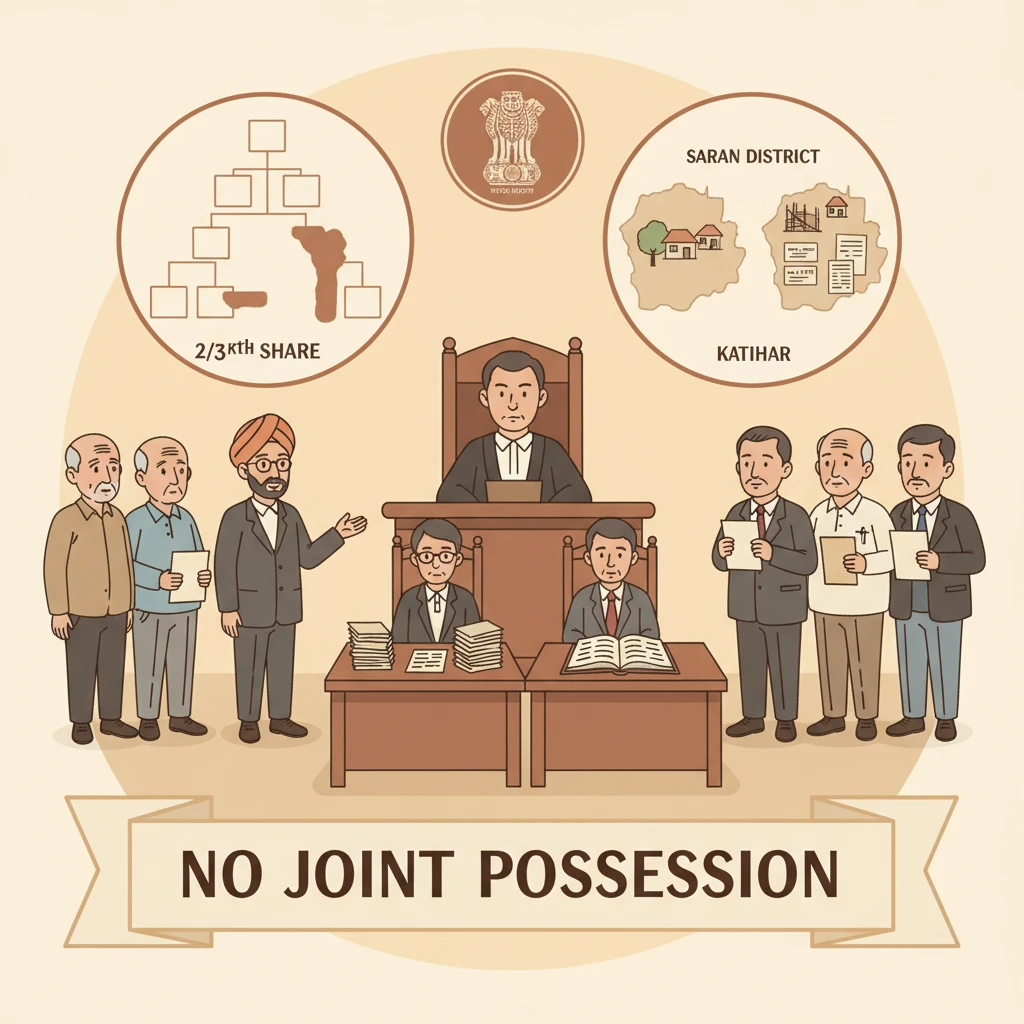
In 2001 they filed Title Suit No. 88 of 2001 before the Sub-Judge III, Katihar, seeking partition of a 2/3rd share in the properties listed in Schedule-I and Schedule-II of the plaint. They said that after the death of the childless brother, Hardeo Singh, his share devolved on Rajendra Singh. On this basis they claimed Rajendra Singh’s branch was entitled to 2/3rd share in the joint family properties.
They also asserted that properties in Katihar (Schedule-II) had been bought in the name of Ram Sumaro Devi, wife of Raghunandan Singh, from joint family income, and so these too were joint family properties.
The defendants contested the suit. They said the family had separated long ago and each branch had been dealing with its own share separately. They specifically denied that the Katihar properties were joint family properties, claiming that those lands were acquired individually and stood recorded in the names of different persons.
After recording evidence, the trial court dismissed the partition suit on 26.02.2011, followed by a decree on 17.03.2011. The trial court held that the plaintiffs failed to prove unity of title and possession and that Schedule-II lands were not established as joint family properties.
The plaintiffs then filed First Appeal No. 82 of 2011 before the Patna High Court, challenging the trial court’s findings and seeking a decree for partition.
What the Court Examined and Decided
The First Appeal came before Hon’ble Mr. Justice Ramesh Chand Malviya of the Patna High Court. The Court examined the pleadings, evidence, and the legal principles that govern suits for partition of joint family property.
The plaintiffs argued that the trial court had travelled beyond pleadings, relied on conjectures and ignored unrebutted evidence. They stressed that the defendants had filed written statements but later did not contest the suit at trial, did not examine any witnesses, and did not cross-examine the plaintiffs’ witnesses.
According to the plaintiffs, their oral and documentary evidence therefore remained unchallenged and should have been accepted. They pointed to sale deeds, rent receipts, khatian entries and other records which, in their view, showed that the properties were joint and that they had a 2/3rd share.
They also relied on their plea that after the death of the issueless brother Hardeo Singh, his share devolved upon Rajendra Singh, strengthening their claim to a larger portion of the estate. They claimed the trial court wrongly concluded that there was no unity of title and possession and that there had been an oral partition.
The respondents, on the other hand, supported the trial court’s judgment. They highlighted that in the plaint itself the plaintiffs admitted that due to family disputes the members had separated long back and were independently dealing with their properties. According to the respondents, this itself showed that the essential ingredients of a partition suit, namely unity of title and unity of possession, were missing.
The respondents further asserted that the Schedule-II properties at Katihar were not joint family properties. Some lands had been purchased by Ram Sumaro Devi from her personal income from her parental home. The revenue records and sales over a long period showed separate ownership.
The respondents also emphasized the long gap between the alleged separation and the filing of the suit, and the fact that Rajendra Singh, during his lifetime, never asserted any exclusive right over Hardeo Singh’s share or took steps to mutate such alleged share in his name.
On the question of burden of proof, the respondents argued that even if they did not actively contest the trial, the plaintiffs could not escape their legal duty to prove their case. Section 101 of the Indian Evidence Act places the burden on the party who asserts a fact. A plaintiff must succeed on the strength of his own case and not on the weakness or absence of the defence.
To support these submissions, the respondents relied on several precedents. The Court referred to the Supreme Court decision in State of Madhya Pradesh v. Ushadevi, (2015) 8 SCC 672, where it was reiterated that parties are bound by their pleadings and the burden lies on the person who pleads to prove, and that the plaintiff must succeed on the strength of his own case, not on the weakness of the defendant.
The Court also noted the principle laid down in Union of India v. Vasavi Cooperative Housing Society Limited, (2014) 2 SCC 269, that the plaintiff cannot rely on the weakness of the defence to obtain a decree. Additionally, the Court referred to a Division Bench decision of the Patna High Court reported in AIR 1977 Pat 59, which held that long-standing separate transactions by family members may be strong evidence of prior partition.
The Court also took note of the Supreme Court’s decision in Ravinder Kaur Grewal v. Manjit Kaur, (2020) 9 SCC 706, where the binding nature of family arrangements and separations intended to maintain harmony was recognized.
Another important precedent cited by the High Court was Asma Lateef v. Shabir Ahmad, (2024) 4 SCC 696. There, the Supreme Court clarified that even where the defendant fails to file a written statement or contest the case, the court can still require the plaintiff to prove his case. A decree cannot follow merely because the defendant is absent; the plaintiff must prove his pleaded case by evidence.
Against this legal background, the High Court examined the material on record. It accepted that the genealogy and ancestral nature of Schedule-I land in Saran were not disputed. The key question was whether unity of title and possession extended to the Schedule-II properties at Katihar, and whether these were joint family properties acquired from a joint nucleus.
The Court noted that the R.S. Khatian (Exhibit-9 series) showed Schedule-II lands recorded in the names of Hardeo Singh and Rajendra Singh jointly to the extent of two shares, and in the name of Raghunandan Singh to the extent of one share. This entry reflected a stage when their ancestors apparently held joint title.
However, the Court treated subsequent conduct and documents as more crucial. The sale deeds (Exhibit-1 series) showed that several plots had been transferred over the years to various purchasers. Some deeds were executed by plaintiffs and their predecessors, some by the defendants’ side, and some jointly.
The Court inferred from these repeated separate and joint transactions that each side had been exercising rights over particular portions of land and selling them to third parties. This pattern suggested that the parties were dealing with distinct shares, not acting as co-sharers over one undivided estate.
On the oral evidence, the Court observed that though the defendants did not cross-examine the plaintiffs’ witnesses, the testimonies were largely general and did not clearly prove continuous joint possession. P.W.-1 only stated that there was no formal partition but did not speak specifically about the Katihar lands. P.W.-2 admitted that some Schedule-II lands had already been sold, and that purchasers had built houses and were residing there.
The plaintiff examined as P.W.-3 asserted that properties in the name of Ram Sumaro Devi were bought from joint family funds. But the Court found no supporting material showing existence of a sufficient joint family nucleus to fund those purchases. Mere assertion, without concrete proof of such a fund, was held to be insufficient.
Another circumstance weighed with the Court: both branches of the family had for a considerable period executed separate sale deeds in respect of suit properties in favour of different purchasers. These purchasers were in possession and had constructed structures on the land. This long-standing, separate dealing across generations supported the conclusion that the parties had earlier separated by mutual partition or family arrangement, and that unity of title and possession no longer existed.
In light of these facts, the High Court held that the plaintiffs had not discharged their burden of proving that the Katihar properties were joint family properties acquired from a joint fund and still under joint possession. The essential ingredients for a decree of partition, namely unity of title and unity of possession, were found lacking.
As an appellate court, the High Court also reminded itself of the limits on interference with findings of fact. Referring to Madhusudan Das v. Narayanibai, (1983) 1 SCC 35, it noted that when conclusions are based on appreciation of oral evidence, an appellate court should not disturb the trial court’s findings unless some crucial feature has been ignored or the findings are clearly improbable or based on misreading or inadmissible material.
Here, the Court found that the trial court had considered both oral and documentary evidence and had applied correct legal principles. There was no material irregularity or perversity. Therefore, there was no reason to take a different view.
Ultimately, the High Court answered the central point for determination against the plaintiffs and in favour of the defendants. It held that the plaintiffs failed to prove unity of title and unity of possession and thus were not entitled to partition of a 2/3rd share in the suit properties.
The Court confirmed the judgment dated 26.02.2011 and decree dated 17.03.2011 of the Sub-Judge III, Katihar in Title Suit No. 88 of 2001. The First Appeal was dismissed. Any interlocutory applications and interim orders or injunctions regarding the disputed land were deemed to have been set aside in light of this final decision. The trial court records were directed to be sent back.
Why This Judgment Matters
This judgment reinforces a simple but important point for families involved in property disputes. Even if relatives once lived together as a joint Hindu family, a court will not assume that all properties remain joint forever.
Anyone asking for partition must prove two key things: that the property is truly joint and that all co-sharers still have unity of title and unity of possession. Old revenue entries or mere statements are not enough if, for many years, family members have been selling or dealing with specific parcels separately.
The judgment also clarifies that just because the other side does not contest the case properly, the plaintiff does not get an automatic victory. Courts will still insist on proper proof. In practical terms, families who have been independently selling land or getting their own names recorded in revenue records may find it difficult to later claim that everything was always joint.
Legal Issues and Answers
- Issue: Did the plaintiffs prove that there was unity of title and unity of possession over the Schedule-I and Schedule-II properties so as to justify partition of a 2/3rd share?
Answer: No. The Patna High Court held that the plaintiffs failed to establish that the properties, especially Schedule-II lands at Katihar, remained joint family properties under joint possession. Long-standing separate dealings and sales indicated otherwise. - Issue: Was the trial court wrong in dismissing the partition suit despite the defendants not adducing evidence or cross-examining the plaintiffs’ witnesses?
Answer: No. The Court held that the burden of proof always remains on the plaintiffs. Even without defence evidence, the plaintiffs had to prove their case through reliable material, which they failed to do. - Issue: Should the appellate court interfere with the trial court’s factual findings on evidence regarding joint family status and possession?
Answer: No. The Court found no perversity or material irregularity in the trial court’s assessment and therefore refused to interfere with its findings on fact.
Cases Cited by the Court
- State of Madhya Pradesh v. Ushadevi, (2015) 8 SCC 672
- Union of India and Ors. v. Vasavi Cooperative Housing Society Limited and Ors., (2014) 2 SCC 269
- Unnamed Division Bench judgment of Patna High Court, AIR 1977 Pat 59
- Ravinder Kaur Grewal & Ors. v. Manjit Kaur & Ors., (2020) 9 SCC 706
- Asma Lateef and Anr. v. Shabir Ahmad and Ors., (2024) 4 SCC 696
- Madhusudan Das v. Narayanibai (deceased) through LRs. and Ors., (1983) 1 SCC 35
Case Details
Case Number: First Appeal No. 82 of 2011
Case Title: Lalita Devi & Ors. v. Jugal Kishor Singh & Ors.
Court: High Court of Judicature at Patna
Coram: Hon’ble Mr. Justice Ramesh Chand Malviya
Date of High Court Judgment: 17.03.2026
Impugned Judgment and Decree: Judgment dated 26.02.2011 and decree dated 17.03.2011 passed by Sub-Judge III, Katihar in Title Suit No. 88 of 2001
Citation: 2026 (3) PLJR 3
Advocates:
- For the appellants: Mr. Ganpati Trivedi, Sr. Adv; Mr. Madan Mohan, Adv; Mr. Ritik Shah, Adv; Mr. Saurav Suman, Adv
- For appellant no. 2: Mr. Anand Kumar Ojha, Adv; Mr. Ram Kishore Singh, Adv
- For the respondents: Mr. Bajarangi Lal, Adv
Nature of the Case: First appeal against dismissal of a partition suit (Title Suit No. 88 of 2001) seeking partition of alleged joint family properties.
Link to Judgment: Click here to read the full Patna High Court judgment
If you found this explanation helpful and wish to stay informed about how legal developments may affect your rights in Bihar, you may consider following Samvida Law Associates for more updates.







