

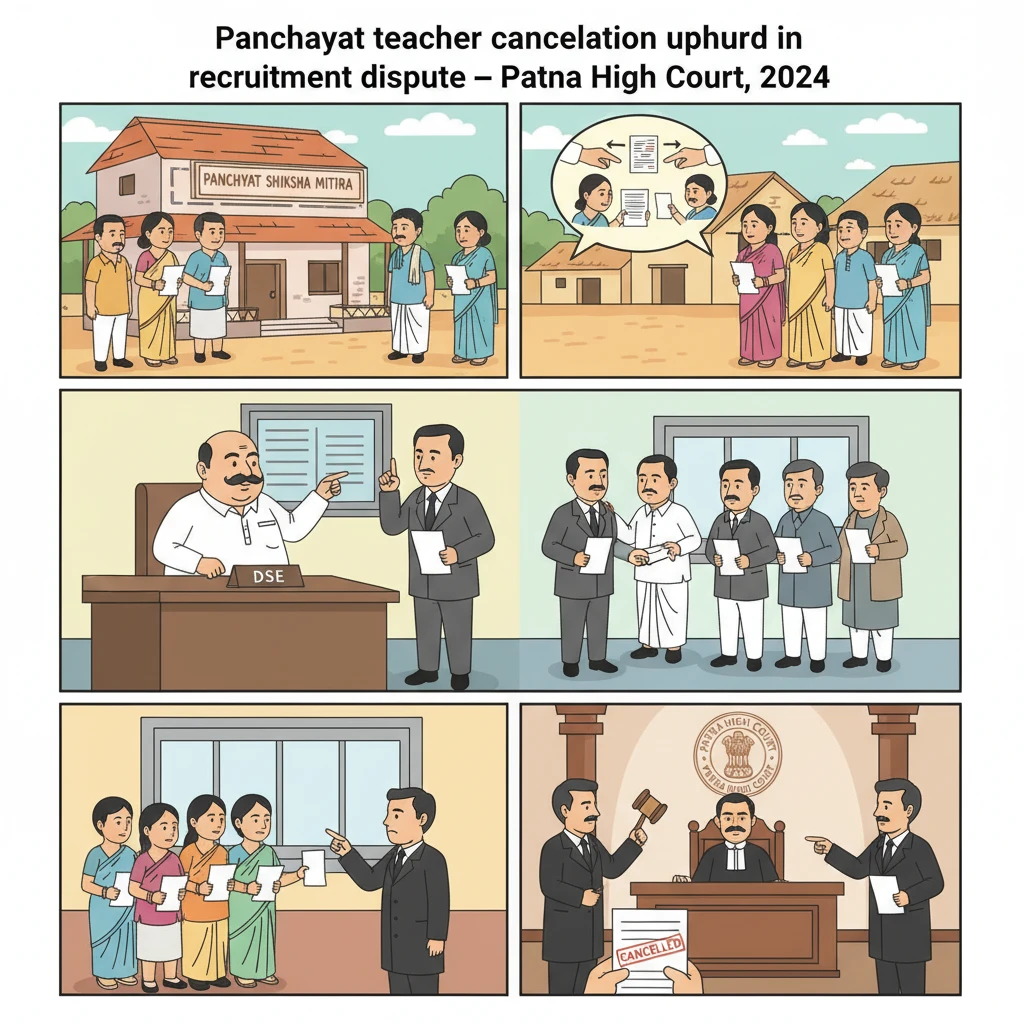
Case Background
The case concerns three petitioners who were engaged as Panchayat Shiksha Mitra (PSM) in the year 2003 in Panchharwa Gram Panchayat, Mejarganj Block, Sitamarhi district.
Their engagement was made on the recommendation of the Sukh Suvidha Samiti of Panchharwa Gram Panchayat. Later they came to be treated as Panchayat Teachers.
A private candidate, arrayed in the writ case as respondent no.12, felt aggrieved by these engagements. He claimed that the employment of PSMs in Panchharwa Gram Panchayat was illegal and also sought his own engagement.
He filed C.W.J.C. No.13698 of 2004 before the Patna High Court. On 22.03.2006, the High Court disposed of that writ petition by directing him to place his grievance before the Collector of the district. The Court ordered that the Collector must consider his representation and pass a speaking order within six weeks.
Acting on this direction, respondent no.12 submitted a representation to the Collector, Sitamarhi. After examining the matter, the Collector passed memo no.14 dated 15.11.2006 cancelling the employment of all PSMs in the Panchayat except one candidate, Pramod Kumar, who belonged to the Scheduled Caste category.
Aggrieved by the Collector’s order, the present petitioners approached the Patna High Court in CWJC No.4422 of 2007. That case, along with analogous matters, was disposed of on 11.07.2011. The High Court gave liberty to the petitioners to approach the District Teacher Employment Appellate Authority.
On this liberty, the petitioners filed Case No.129 of 2011 before the District Teacher Employment Appellate Authority, Sitamarhi. By order dated 05.05.2012, the District Appellate Authority dismissed their appeal and upheld the cancellation.
Later, the petitioners again approached the High Court in C.W.J.C. No.16411 of 2012. By order dated 07.11.2017, the High Court allowed them to file an appeal before the State Appellate Authority.
Accordingly, the petitioners filed Appeal No.170 of 2018 before the State Appellate Authority, Niyojan Bhawan, Patna. On 10.06.2019, the State Appellate Authority dismissed their appeal and affirmed both the Collector’s order dated 15.11.2006 and the District Appellate Authority’s order dated 05.05.2012.
In 2021, the petitioners filed the present writ petition (CWJC No.4923 of 2021) before the Patna High Court. They asked the Court to quash all three orders and to direct their reinstatement as Panchayat Teachers with all consequential monetary benefits.
What the Court Examined and Decided
The writ petition came before Hon’ble Mr. Justice Anjani Kumar Sharan of the Patna High Court. Arguments were heard from counsel for the petitioners, the State, and the private respondents.
The petitioners attacked the cancellation of their engagement mainly on grounds of natural justice, reservation, and violation of constitutional rights.
First, they contended that the Collector, Sitamarhi, had cancelled their employment without giving them any notice or opportunity to be heard. According to them, they were not made parties in C.W.J.C. No.13698 of 2004 or in the proceedings before the Collector. Their services were terminated behind their back, without any show cause notice.
They argued that this was a direct violation of the principles of natural justice. They also said that the District Appellate Authority, while dealing with Case No.129 of 2011, failed to consider this aspect.
Secondly, the petitioners submitted that the District Appellate Authority had wrongly assumed that there was non-compliance with the reservation roster in their engagement. They maintained that their selection was made in accordance with the reservation policy.
The petitioners further claimed that some of the private respondents, namely Upendra Singh, Arun Kumar and Ranjit Kumar Patel, had earlier appeared before the District Programme Officer, Sitamarhi and stated that they were not interested in the post of PSM at the relevant time. They argued that these persons could not later turn around and claim that their own rights were violated.
Thirdly, they argued that they had taken all available statutory remedies. After the dismissal of their case by the District Appellate Authority on 05.05.2012, they approached the High Court in C.W.J.C. No.16411 of 2012. On the basis of the High Court’s order dated 07.11.2017, they filed Appeal No.170 of 2018 before the State Appellate Authority.
In the proceedings before the State Appellate Authority, notices were sent to the private respondents. Only respondent no.12 appeared and filed a counter affidavit. Other private respondents, despite service by speed post, did not join the proceedings. The petitioners pointed out that, despite this, the State Appellate Authority rejected their appeal on grounds which, in their view, were unsustainable.
The petitioners criticised the finding of the State Appellate Authority that the Panchayat authorities had not considered the recommendation of the District Superintendent of Education (DSE), Sitamarhi regarding engagement of PSMs. They contended that this was not a valid reason to cancel their appointments so many years later.
The petitioners also claimed that the action of the authorities violated Articles 14, 16 and 21 of the Constitution of India and offended the principles of justice.
They relied on a judgment of a Co-ordinate Bench of the Patna High Court in Rajni Bara vs. State of Bihar & Ors., reported in 2011 (4) PLJR 846. Paragraph 5 of that judgment, emphasising that a teacher cannot be punished for mistakes in applying the reservation roster when she had the necessary qualifications and when the authorities had long failed to examine the case, was quoted in the present judgment.
The State opposed the writ petition through a counter affidavit. It explained how the District Superintendent of Education, Sitamarhi, had dealt with the proposal for appointment of PSMs in Panchharwa Gram Panchayat.
As per the State, when the Sukh Suvidha Samiti recommended names for PSM, the DSE examined the proposal along with the Block Development Officer’s comments. By letter no.3150 dated 06.08.2003, the DSE held that only the private respondents and one Pramod Kumar could be validly engaged under the rules.
Therefore, the DSE directed the Gram Panchayat to make appointments of PSMs accordingly. He added that if the employment was not made in accordance with his direction, the Government would not be liable to pay grants towards honorarium.
However, according to the State, the Panchayat Employment Unit ignored these instructions and went ahead with its earlier recommendation, engaging the petitioners instead of the candidates approved by the DSE. This was described as a clear violation of the guidelines.
When respondent no.12 later moved the High Court and then the Collector, the Collector examined the case and found that the petitioners’ appointments were invalid. He therefore cancelled their employment by memo dated 15.11.2006, except for Pramod Kumar, whose appointment conformed with the rules.
While considering the matter in Appeal No.170 of 2018, the State Appellate Authority looked into the record. It noted that the Sukh Suvidha Samiti had originally recommended the petitioners and Pramod Kumar. The BDO forwarded this proposal with comments to the DSE, Sitamarhi.
The DSE, after scrutiny, found the Gram Panchayat’s recommendation to be defective and instead recommended the private respondents along with Pramod Kumar. Despite this, the Panchharwa Gram Panchayat authorities did not follow the DSE’s direction and appointed the petitioners and Pramod Kumar pursuant to their earlier recommendation.
On these facts, the State Appellate Authority agreed with the District Appellate Authority that the Sukh Suvidha Samiti had selected and engaged the petitioners in disregard of the government guidelines and the DSE’s letter dated 06.08.2003.
Turning to the reliance placed on Rajni Bara’s case, the Court noted the factual distinction. In that case, the teacher was appointed on 07.02.2006 and there was a specific time limit of 30 days for filing complaints against such appointments. No complaint was filed within that period and, in fact, the complaint was made much later, on 20.08.2009, by a new Mukhiya.
In the present case, the position was different. Here, even at the stage of appointment, the Panchayat Samiti had not complied with the DSE’s directions contained in letter no.3150 dated 06.08.2003. Respondent no.12 promptly challenged the appointments by filing C.W.J.C. No.13698 of 2004, which led to the direction for representation before the Collector. Acting on that representation, the Collector examined the matter and cancelled the petitioners’ employment in 2006.
Therefore, the Court held that the precedent in Rajni Bara did not assist the petitioners, because their case rested on a different factual foundation where the initial appointment itself was contrary to specific directions of the competent education authority.
After assessing the entire record, the Patna High Court concluded that there was no illegality or infirmity in the orders passed by the State Appellate Authority or the District Appellate Authority. The key factor for the Court was that the original appointments of the petitioners had been made in violation of the guidelines and the binding letter of the DSE, Sitamarhi.
The Court also noticed that the petitioners’ employment had already been cancelled in 2006 and that the Collector’s order had never been stayed or quashed by any competent authority till date.
On this basis, the High Court declined to interfere with the cancellation and dismissed the writ petition.
Why This Judgment Matters
This judgment is important for candidates and local bodies involved in teacher engagements under schemes like Panchayat Shiksha Mitra.
It shows that when a competent education authority, such as the District Superintendent of Education, issues clear directions on how appointments must be made, Panchayats cannot legally ignore those instructions.
If appointments are made in violation of such guidelines or directions, the Court can uphold cancellation even years later, provided the challenge was raised in time and examined by the proper authorities.
The judgment also clarifies that reliance on other cases, such as Rajni Bara, will not help if the factual situation is different. Each recruitment dispute will be decided on its own facts, especially on whether the original appointment complied with government rules.
For aspiring teachers, the decision is a reminder that their appointment must stand on firm legal footing. If the process itself was contrary to statutory rules or official instructions, long service alone may not protect the job.
Legal Issues and Answers
- Issue: Whether the cancellation of the petitioners’ engagement as Panchayat Shiksha Mitra and Panchayat Teacher, made by the Collector and upheld by the appellate authorities, was illegal or required interference by the Patna High Court.
Answer: No. The Court held that the appointments were made in violation of government guidelines and the DSE’s specific directions, and therefore found no illegality or infirmity in the cancellation orders. - Issue: Whether the petitioners could rely on the decision in Rajni Bara vs. State of Bihar to protect their appointments.
Answer: No. The Court held that Rajni Bara was based on different facts involving delay in challenging an otherwise regular appointment, whereas in the present case the Panchayat had from the outset disobeyed the DSE’s letter dated 06.08.2003.
Cases Cited by the Court
- Rajni Bara vs. The State of Bihar and Ors., 2011 (4) PLJR 846.
Case Details
Case Number: Civil Writ Jurisdiction Case No.4923 of 2021
Case Title: Rajesh Kumar Mahto & Ors. vs. The State of Bihar & Ors.
Citation: 2024 (4) PLJR 57
Court: High Court of Judicature at Patna
Coram: Hon’ble Mr. Justice Anjani Kumar Sharan
Date of Judgment: 27.08.2024
Nature of Case: Writ petition under civil writ jurisdiction challenging cancellation of engagement as Panchayat Shiksha Mitra/Panchayat Teacher and appellate orders.
Advocates:
- For the petitioners: Mr. Rajeev Kumar Singh, Advocate
- For the respondents (State and others): Mrs. Abhanjalli, Advocate
Link to Judgment: Click here to view the official Patna High Court judgment
If you found this explanation helpful and wish to stay informed about how legal developments may affect your rights in Bihar, you may consider following Samvida Law Associates for more updates.







