
Case Background
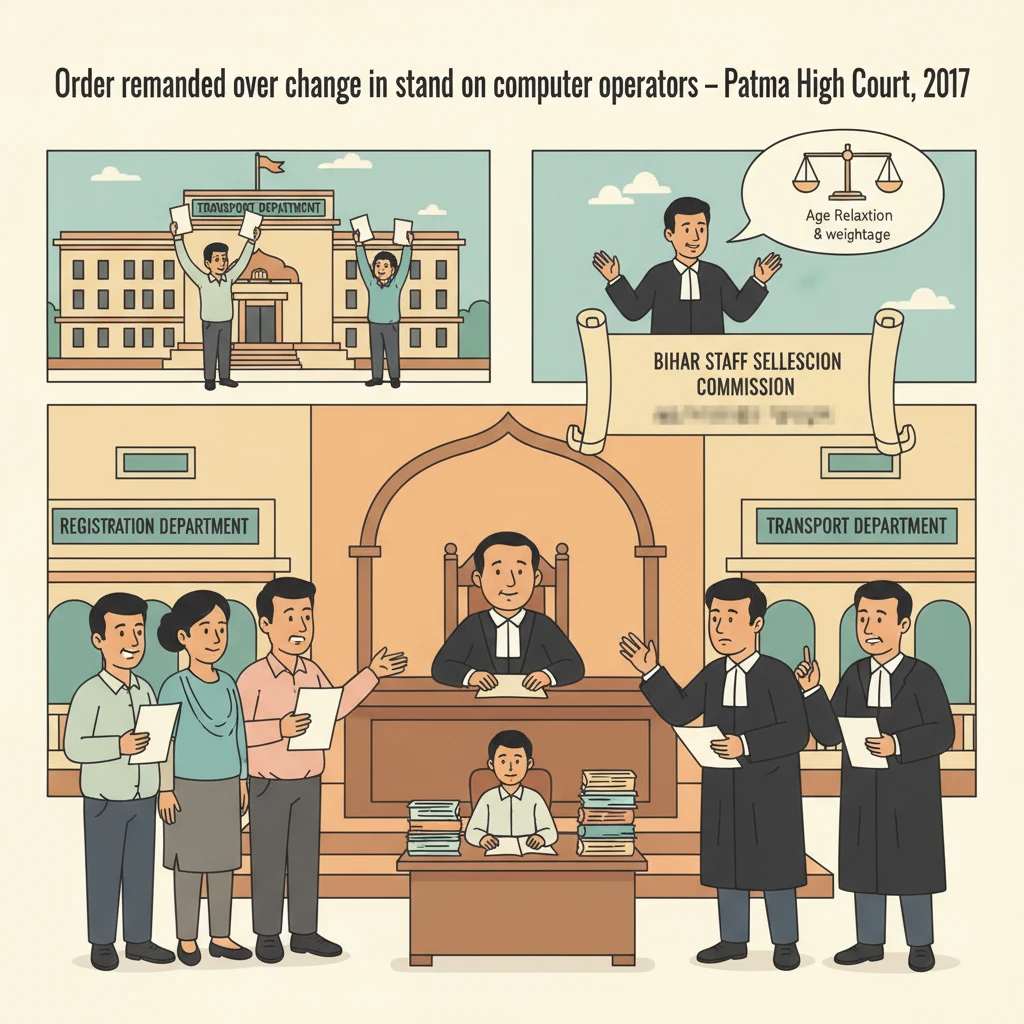
The appellants were working as Computer Operators in the Registration Department of the State of Bihar. According to the judgment, they had been working for more than ten years.
Despite this long service, their jobs were not regularized. Instead, an advertisement was issued to fill up similar posts on a regular basis through open recruitment.
Feeling aggrieved, these Computer Operators approached the Patna High Court in Civil Writ Jurisdiction Case No. 22385 of 2014. They asked the Writ Court to direct the State either to regularize their services or at least to consider them in the ongoing recruitment process by giving them age relaxation and weightage for the years of work they had already put in.
During the writ proceedings, the learned Single Judge sought a counter affidavit from the State and other respondents. The purpose was to find out whether any regularization or benefit could be given to the petitioners in the recruitment process.
On 09.08.2016, after going through the counter affidavit filed by the respondents, the learned Single Judge disposed of the writ petition. The Court recorded the respondents’ categorical stand that all the existing Computer Operators would be given an opportunity in the regular recruitment, with weightage for their past service and concession in age.
Based on this assurance, the Single Judge disposed of the writ application with a direction that the respondents should do the needful in terms of their stand in the counter affidavit. No further directions on regularization or pay were issued at that stage.
Later, the petitioners filed a Letters Patent Appeal (LPA No. 1807 of 2016) before the Division Bench. They pointed out that in other departments, for example the Transport Department, similarly placed workers had been given better benefits, including regularization and reservation of 35% of vacancies for such existing employees.
They argued that in view of these developments and the State’s conduct, the earlier disposal of their writ petition on the basis of the State’s stand was no longer fair or sufficient.
What the Court Examined and Decided
The Division Bench, consisting of Hon’ble the Chief Justice and Hon’ble Mr. Justice Sudhir Singh, heard the appeal. The main complaint before them was that the State had not honoured the stand on which the Single Judge had closed the writ case.
On 09.11.2016, the Division Bench considered various aspects and sought clarifications from the State and other respondents on two specific points.
First, the Court asked whether the State was planning to issue a fresh advertisement for recruitment to the posts of Computer Operators by granting age relaxation to the currently working operators and by giving them suitable weightage for their work experience.
Secondly, the Court questioned why these Computer Operators were not being given regular pay scale at par with regular employees, in view of the Supreme Court judgment in State of Punjab & Ors. vs. Jagjit Singh & Ors., Civil Appeal No. 213 of 2013, decided on 26.10.2016, which deals with the principle of equal pay for equal work.
In response to these queries, the respondents filed a counter affidavit in the LPA. This affidavit, however, took a completely different position from what had earlier been stated before the Single Judge.
In paragraph 6 of the counter affidavit filed in the appeal, the respondents stated that an advertisement had been issued by the Bihar Staff Selection Commission. The Commission was of the view that, being bound by the recruitment rules, it could not grant any exemption or special benefit such as age relaxation or weightage to the existing Computer Operators.
This meant that the promise recorded before the Single Judge—that all Computer Operators would be given an opening with age concession and weightage—was no longer being maintained. The Division Bench described this as the Government taking a “u-turn” from its earlier stand.
The Division Bench noted that the writ petition had been disposed of solely on the basis of the categorical stand in the earlier counter affidavit filed by the respondents in the writ court. The Single Judge had trusted that statement, assumed it would be implemented, and therefore closed the case.
Now, through the new counter affidavit in the appeal, it became clear that the State was not following that stand. No exemption or benefit in recruitment was being given, contrary to what had been represented earlier. Thus, the foundation on which the writ petition was disposed of had effectively disappeared.
Accordingly, the Division Bench held that this was a fit case to set aside the order of the learned Single Judge dated 09.08.2016. The Bench reasoned that since the writ petition had been decided on a consideration which was not adhered to, and the statement made by the respondents was not being complied with, the petition had to be reheard.
The Court therefore quashed the order passed by the Writ Court in C.W.J.C. No. 22385 of 2014. It restored the writ petition to its original file and remanded the matter back to the Single Judge for fresh consideration.
While remanding the case, the Division Bench specifically directed that the learned Writ Court should also consider the question of “equal work for equal wages” in light of the Supreme Court judgment in Jagjit Singh after hearing all concerned parties.
During the pendency of the LPA, the petitioners were transferred and shifted to various offices. For this reason, they had filed I.A. No. 7391 of 2016. The Division Bench did not decide this transfer issue on merits. Instead, it left the matter for the learned Single Judge to examine and pass appropriate orders in accordance with law, after hearing the petitioners.
A further important direction was given regarding ongoing recruitment. The Court observed that any appointment made would be subject to the final outcome of the restored writ petition and to any direction that the learned Writ Court might issue after hearing all concerned.
In the end, the Letters Patent Appeal was disposed of by:
- quashing the Single Judge’s order dated 09.08.2016,
- restoring C.W.J.C. No. 22385 of 2014 to its original number,
- directing listing of the writ petition before the appropriate Bench in the next week for consideration, and
- making ongoing or future appointments subject to the final decision in the writ case.
The Division Bench did not itself grant regularization, age relaxation, weightage, or equal pay. It only ensured that the petitioners get a fresh and full hearing before the Single Judge, this time without being bound by the earlier, now-abandoned stand of the State.
Why This Judgment Matters
This Patna High Court judgment is important for contractual or long-serving workers, especially in government departments, who rely on assurances given by the State in court.
The Division Bench made it clear that if a writ petition is disposed of on the basis of a specific stand taken by the Government, the Government cannot later change that stand and deny the promised benefit without the matter being re-examined.
For the Computer Operators, the ruling keeps their hopes alive. Their main demands—special consideration in recruitment, and possibly equal pay—have not been rejected. Instead, the Court has ordered that these issues be freshly considered in detail by the Single Judge.
The judgment also underlines that, while recruitment rules are important, State authorities must be consistent and truthful in what they place on record before the court. Any departure from their own earlier assurance can lead to the order being set aside and the case being reopened.
For other employees in Bihar, especially those working for many years on non-regular or contractual terms, this case shows that courts look closely at the Government’s changing positions. It also highlights that the principle of equal work for equal wages, as laid down by the Supreme Court, may be invoked in such disputes and must be duly considered.
Legal Issues and Answers
Issue: What should happen when a writ petition has been disposed of based on a promise made by the State, and later the State refuses to follow that promise?
Answer: The Patna High Court held that such an order cannot stand. It quashed the earlier writ order and restored the petition for fresh consideration, since the State had taken a u-turn from its earlier stand.
Issue: Should the claims for age relaxation, weightage in recruitment, and equal pay for equal work of long-serving Computer Operators be finally decided in appeal?
Answer: No. The Court directed that these issues, including the impact of the Supreme Court’s judgment in Jagjit Singh, must be examined afresh by the Single Judge in the restored writ petition.
Issue: What is the status of ongoing or future appointments to the posts concerned during the pendency of the dispute?
Answer: The Court clarified that any such appointments will remain subject to the final outcome of the writ petition and the directions of the learned Single Judge.
Cases Cited by the Court
State of Punjab & Ors. vs. Jagjit Singh & Ors., Civil Appeal No. 213 of 2013, decided on 26.10.2016 (Supreme Court of India) – cited regarding the principle of equal work for equal wages.
Case Details
Case Number: Letters Patent Appeal No. 1807 of 2016 in Civil Writ Jurisdiction Case No. 22385 of 2014
Case Title: Manish Kumar Singh & Ors. v. The State of Bihar & Ors.
Citation: 2019 (3) PLJR 184
Coram: Hon’ble the Chief Justice Rajendra Menon and Hon’ble Mr. Justice Sudhir Singh
Advocates: For the appellants – Mr. Y.V. Giri, Senior Advocate, with Mr. Ashish Giri and Mr. Nikhil Kumar Agrawal, Advocates. For the State – Mr. Anirudh Kundu, S.C. 24, and Mr. Sudhanshu Shekhar, A.C. to S.C. 24. For the Bihar Staff Selection Commission – Mr. K.K. Upadhyay, Advocate.
Nature of the case: Letters Patent Appeal arising out of a writ petition seeking regularization or preferential consideration (age relaxation and weightage) in recruitment and related reliefs for Computer Operators; remand for fresh consideration.
Date of Judgment: 11.04.2017
Link to Judgment: http://Link to Judgment: https://patnahighcourt.gov.in/viewjudgment/MyMxODA3IzIwMTYjMSNP-nKmbMiEO300=
If you found this explanation helpful and wish to stay informed about
how legal developments may affect your rights in Bihar,
you may consider following Samvida Law Associates for more updates.







