
Case Background
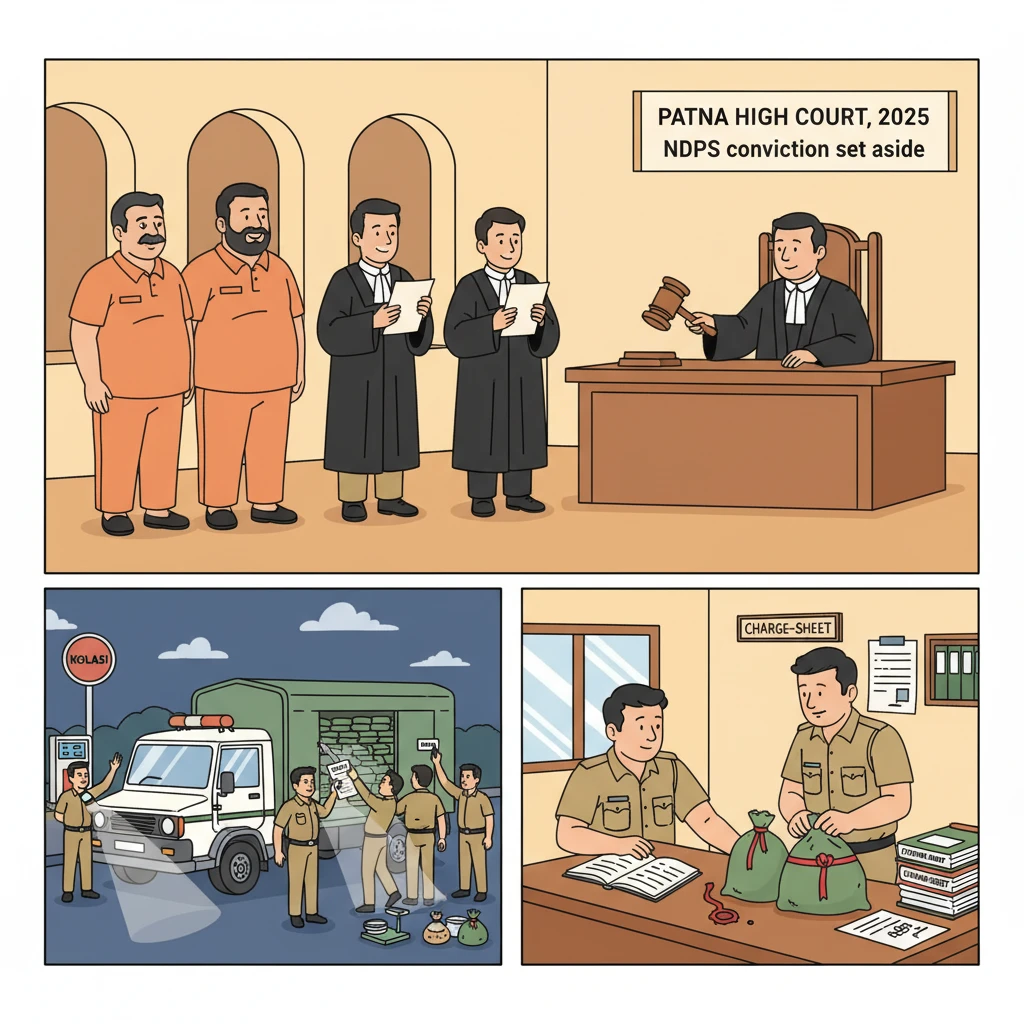
This case arises from an alleged seizure of ganja on 30.01.2018 in Katihar district, Bihar. Officers of the Special Task Force, Patna, allegedly passed secret information to the Station House Officer (SHO) of Katihar Town (Sahayak) Police Station about a truck carrying cannabis from Tripura to Bihar, escorted by a Bolero vehicle.
According to the written report, the SHO formed two raiding teams. Around 05:00 a.m., a Bolero followed by a truck was intercepted near Kolasi Petrol Pump. Seven persons were apprehended from both vehicles. The police claimed that, after serving notice under Section 50 of the NDPS Act and in the presence of independent witnesses, they searched the truck and recovered 110 packets of ganja (weighing 644.5 kg) from a hidden chamber behind the driver’s seat.
Mobile phones and cash were allegedly recovered from the occupants. The contraband was said to have been weighed, samples drawn, and seizure lists prepared and signed by independent witnesses and accused persons. All seven persons were arrested on the spot.
On this basis, Katihar Town (Sahayak) P.S. Case No. 73 of 2018 was registered on 30.01.2018 under Sections 8/20(b)(ii)(C)/25/29 of the NDPS Act. After investigation, charge-sheet No. 189 of 2018 dated 27.07.2018 was submitted under the same sections. Cognizance was taken on 03.08.2018 against seven accused, including the present appellants.
The case was tried as NDPS Case No. 03 of 2018 in the court of the Additional Sessions Judge-III-cum-successor of ASJ-IV, Katihar. The prosecution examined 13 witnesses and produced various documents, including the Forensic Science Laboratory (FSL) report. The trial court held the three appellants guilty under Section 20(b)(C) read with Sections 25 and 29 of the NDPS Act, sentenced them to 14 years’ rigorous imprisonment and a fine of Rs. 1,00,000 each, and ordered two years’ simple imprisonment in default.
The remaining four accused, who were in the Bolero, were not convicted under the NDPS Act. Aggrieved, the three convicted accused filed Criminal Appeal (DB) No. 515 of 2023 and Criminal Appeal (DB) No. 539 of 2023 before the Patna High Court.
What the Court Examined and Decided
The Division Bench of the Patna High Court, comprising Hon’ble Mr. Justice Rajeev Ranjan Prasad and Hon’ble Mr. Justice Sourendra Pandey, heard the appeals. The oral judgment was delivered by Justice Sourendra Pandey on 16.12.2025.
The appellants’ counsel argued that the entire prosecution was vitiated by non-compliance with mandatory provisions of the NDPS Act. Key grounds were violation of Section 42 (information and reporting to superior officers), non-compliance of Sections 50, 52, 52A and 57, failure to prove seizure through independent witnesses, lack of evidence on sampling and safe custody, and delay and irregularity in sending samples to FSL. It was also stressed that the driver, co-driver and a passenger were convicted merely because ganja was allegedly found in a concealed box in the truck, without proper proof that they knowingly possessed or transported it.
The State’s counsel supported the conviction, saying that police witnesses clearly proved search and seizure of 644.5 kg ganja from the truck, and that evidence of police officers cannot be discarded merely because they are official witnesses. She admitted that no application under Section 52A for destruction of seized material was filed, but maintained that otherwise the NDPS requirements were met. She relied on the FSL report, which described the sample as “dry, pressed, greenish brown flowering and fruiting vegetable like substance” found to be ganja.
The High Court carefully re-examined the trial record and evidence of all 13 prosecution witnesses.
Doubts about sampling and chain of custody
The Court first looked at how sampling and custody of the seized material were handled. The FIR stated that small quantities were taken from packets P1, P2, P3 and P4, mixed, and a sample prepared at the spot. However, in his examination-in-chief, the informant (PW-2, the SHO) did not mention any sampling at the place of occurrence. He only said that seizure lists were prepared, the ganja was kept in sacks, sealed, and brought to the police station for keeping in the malkhana. There was no statement about where or how any sample was kept.
Other key witnesses, including PW‑1 and PW‑3, also spoke generally about seizure but did not support the FIR version that sampling was done at the spot. PW‑13 stated that sealing was done at the police station and could not remember in how many packets it was sealed. No witness clearly described when, where and in whose presence samples were drawn.
The Court noted that an application was made by the Investigating Officer (PW‑6) for sending samples to the FSL at Patna and to a laboratory at Kolkata, and permission was granted on the same day. Yet, the FSL report from Patna recorded that the sample was received there only on 23.07.2018, based on memo no. 795 of 2018 dated 30.04.2018—almost three months after the memo date. There was no evidence on where and in what condition the samples remained during this gap.
The Court held that, in these circumstances, “the very sampling of the seized material becomes doubtful”. There was also no document such as a malkhana register produced to show that either the bulk ganja or the samples were ever deposited in safe custody at the police station.
Violation of Section 52A: no inventory or Magistrate certification
The Bench then examined compliance with Section 52A of the NDPS Act, which requires preparation of an inventory, drawing of representative samples, and certification by a Magistrate. Quoting the provision at length, the Court emphasised that the officer must apply to a Magistrate for certifying the correctness of the inventory, taking photographs in the Magistrate’s presence, and allowing representative samples to be drawn and certified.
On perusal of the trial court record, the High Court found no application to any Magistrate for certification, no Magistrate’s certificate, and no photographs. There was also no material to show that samples had been drawn in the presence of a Magistrate. The trial court’s own judgment recorded that the seized narcotics “may be destroyed if the same has not yet been done”, indicating that mandatory pre-disposal certification had not occurred.
The Court held that this amounted to “complete violation of Section 52A” and drew an adverse inference against the prosecution regarding the alleged seizure of such a huge consignment.
Independent witnesses turned hostile
The two independent seizure witnesses, PW‑10 and PW‑11, did not support the prosecution. PW‑10 said that while he was sitting at a tea stall, 2–3 officers asked him to sign some papers, told him it was a formality, and that he had not seen any article being seized. PW‑11 stated he had not seen any truck being seized or any material recovered and could not identify the accused. Both were declared hostile.
With independent witnesses disowning the seizure, and police witnesses giving inconsistent details about fog, the presence of a following vehicle, and other circumstances, the Court felt the prosecution version lost further reliability.
Charge-sheet without FSL report and late production
The Investigating Officer (PW‑6) admitted in cross-examination that he submitted charge-sheet without receiving the FSL report. He candidly stated that charge-sheet was filed in haste so that the accused could not get bail. The FSL report from Patna was dated 27.09.2019 but was produced before the trial court only on 24.11.2021, at the fag end of the trial. Defence counsel objected to its exhibition, yet the trial court overruled the objection and marked it as Exhibit-6.
The High Court noticed a further inconsistency: trial court records showed that objection had been raised, but in paragraph 22 of its judgment the trial court wrongly stated that no party objected to marking the FSL report under Section 293 CrPC.
The appellate court also recorded that the FSL report from Kolkata, though samples were said to be sent there, was never brought on record for reasons unknown.
Non-compliance with Section 42 NDPS Act
The Bench then considered whether Section 42, which governs how secret information is recorded and conveyed to superior officers, was followed. Although the informant claimed to have made a station diary entry about the secret information and to have informed his superior, no such record was produced.
The Court held that a mere general diary entry does not automatically amount to compliance with Section 42(1) and 42(2). Referring to the Supreme Court’s decision in Mahabir Singh v. State of Haryana, (2001) 7 SCC 148, it observed that station diary entries cannot be used as substantive evidence against an accused.
Relying on Boota Singh v. State of Haryana, (2021) 19 SCC 606, and the Constitution Bench ruling in Karnail Singh v. State of Haryana, (2009) 8 SCC 539, the Court reaffirmed that total non-compliance with Section 42 is not permissible, and only delayed compliance with satisfactory explanation can be accepted. It also cited Darshan Singh v. State of Haryana, (2016) 14 SCC 358, to stress that the procedure under Section 42 NDPS Act is distinct from and cannot be substituted by the general Criminal Procedure Code process of FIR registration and forwarding.
In the present case, as nothing was shown to prove written recording of information and its forwarding to superior officers in the manner required by Section 42, the Court held that statutory compliance was lacking.
Inconsistent treatment of co-accused and conscious possession
The trial court had acquitted the four persons travelling in the Bolero, holding that the prosecution failed to connect them with transport of ganja or any conspiracy under Section 29 NDPS Act. Yet, on the same evidence, it convicted the three appellants solely because they were found travelling in the truck from which contraband was allegedly recovered and could not explain how ganja came to be concealed there.
The High Court pointed out that the prosecution case itself was that the truck carrying ganja was being escorted by a Bolero vehicle, and witnesses had consistently said that four persons were apprehended from the Bolero and forwarded to jail. If, on this basis, Bolero occupants were given benefit of doubt, it was inconsistent to deny similar benefit to the truck occupants when the basic legal requirements of seizure, sampling and statutory compliance were not met.
Final conclusion
Taking all these factors together—lack of reliable evidence on sampling, absence of malkhana records, violation of Section 52A, non-compliance with Section 42, hostile independent witnesses, late and irregular production of FSL report, and differential treatment of co-accused—the Court held that the prosecution had failed to prove its case beyond reasonable doubt.
The Patna High Court therefore set aside the judgment of conviction dated 23.02.2023 and the sentence order dated 27.02.2023 passed by the Additional Sessions Judge-III-cum-successor of ASJ-IV, Katihar in NDPS Case No. 03 of 2018. The appellants were acquitted of all charges and granted benefit of doubt, with a direction that they be released forthwith if not required in any other case.
Why This Judgment Matters
This judgment is important for anyone facing charges under the NDPS Act, especially drivers, helpers and labourers picked up with vehicles allegedly carrying contraband. The Patna High Court shows that courts will not uphold harsh NDPS punishments if the police skip mandatory legal steps.
The decision underlines that secret information must be recorded and reported properly under Section 42, seizure and sampling must follow Section 52A, and the chain of custody must be clear. Independent witnesses, malkhana records and timely FSL reports matter. Where these elements are missing or doubtful, courts can give the accused the benefit of doubt, even in cases involving large quantities of alleged drugs.
Practically, this ruling encourages defence lawyers and accused persons to closely question how police conducted search, seizure, sampling and storage, and not to accept police narratives at face value when legal safeguards are ignored.
Legal Issues and Answers
- Issue: Did the prosecution prove beyond reasonable doubt that 644.5 kg of ganja was lawfully seized from the truck and that the appellants were in conscious possession or involved in its transportation under the NDPS Act?
Answer: No. Due to doubtful sampling, lack of malkhana records, hostile independent witnesses, non-compliance with Section 52A and serious gaps in the chain of custody, the Patna High Court held the seizure and link to the appellants were not proved beyond reasonable doubt and acquitted them. - Issue: Was Section 42 of the NDPS Act complied with regarding recording secret information and communicating it to superior officers?
Answer: No. The Court found that a mere general diary entry without production of the written information and proof of forwarding to superior officers did not satisfy Section 42(1) and 42(2), and relying on Supreme Court precedents, held that such non-compliance was impermissible. - Issue: Could the conviction stand despite non-compliance with Section 52A and late, irregular production of FSL reports?
Answer: No. The absence of a Magistrate-certified inventory or sampling, no photographs, no disposal application, and delayed FSL report production fatally weakened the prosecution case, leading the Court to extend benefit of doubt to the appellants.
Cases Cited by the Court
- Mahabir Singh v. State of Haryana, (2001) 7 SCC 148
- Boota Singh v. State of Haryana, (2021) 19 SCC 606
- Karnail Singh v. State of Haryana, (2009) 8 SCC 539 : (2009) 3 SCC (Cri) 887
- Abdul Rashid Ibrahim Mansuri v. State of Gujarat, (2000) 2 SCC 513 : 2000 SCC (Cri) 496
- Sajan Abraham v. State of Kerala, (2001) 6 SCC 692 : 2001 SCC (Cri) 1217
- State of Rajasthan v. Jagraj Singh, (2016) 11 SCC 687 : (2017) 1 SCC (Cri) 348
- Darshan Singh v. State of Haryana, (2016) 14 SCC 358
Case Details
Case Number: Criminal Appeal (DB) No. 515 of 2023 with Criminal Appeal (DB) No. 539 of 2023; arising out of Katihar Town (Sahayak) P.S. Case No. 73 of 2018; NDPS Case No. 03 of 2018.
Case Title: Sanjeev Dev Verma & Anr v. State of Bihar; Sanjeet Verma @ Sanjeet Dev Verma @ Sanjit Debberma v. State of Bihar.
Citation: 2026 (1) PLJR 493.
Court: High Court of Judicature at Patna.
Coram: Hon’ble Mr. Justice Rajeev Ranjan Prasad and Hon’ble Mr. Justice Sourendra Pandey.
Date of Judgment: 16.12.2025 (uploaded on 24.12.2025).
Advocates: For the appellants (in both appeals): Ms. Mira Kumari, Advocate, assisted by Ms. Ankita Roy, Advocate. For the State: Ms. Km. Shashi Bala Verma, Additional Public Prosecutor.
Nature of the Case: Criminal appeals (Division Bench) against conviction and sentence under Sections 20(b)(C) and 25/29 of the NDPS Act by the trial court in an NDPS case.
Link to Judgment: Click here to read the full Patna High Court judgment
If you found this explanation helpful and wish to stay informed about
how legal developments may affect your rights in Bihar,
you may consider following Samvida Law Associates for more updates.







