

Case Background
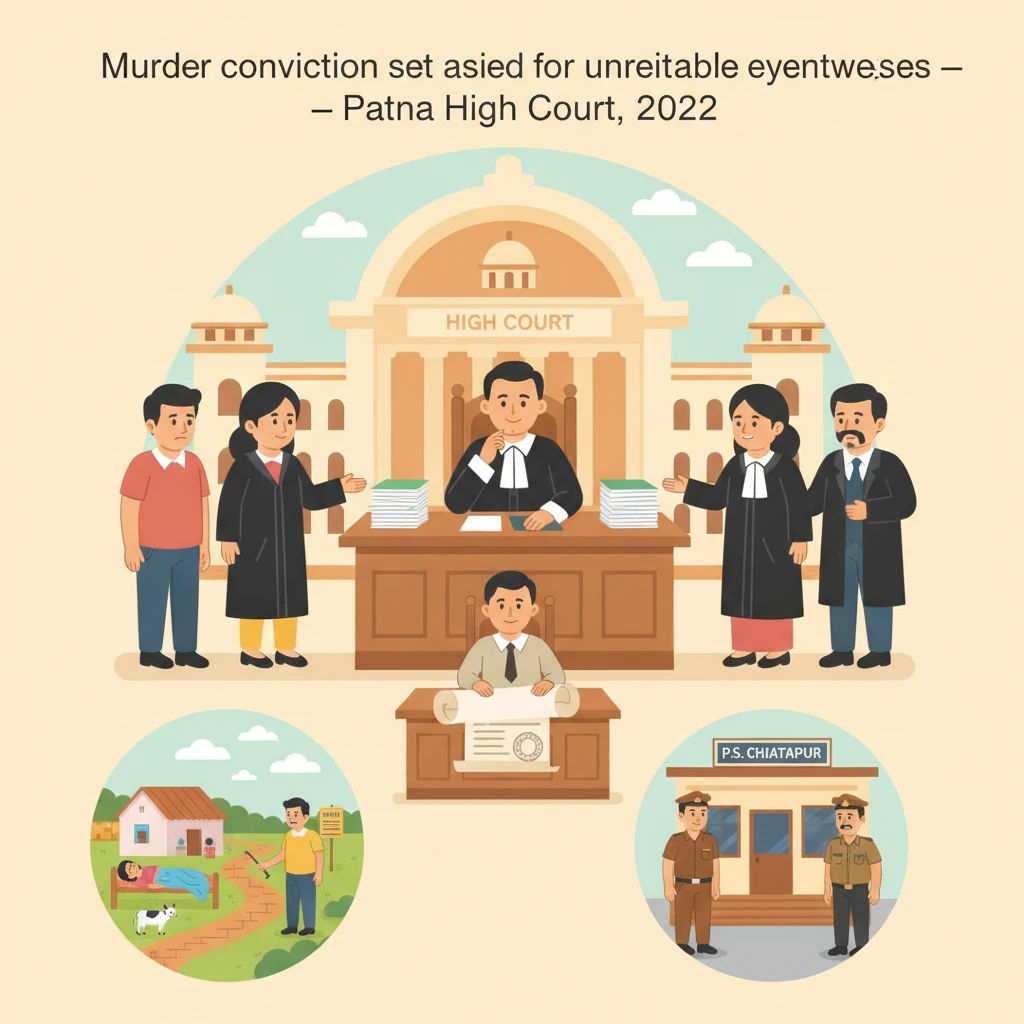
The case arose from Chhatapur P.S. Case No. 141 of 2011 in District Supaul. According to the fardbeyan of the informant, Laxmi Uraon, his wife, aged about 50 years, was allegedly murdered on 24.09.2011 at about 2:30 p.m.
It was alleged that while the informant’s wife, Ramni Devi, was sleeping on a cot (chauki) in the veranda of her house, the appellant, Dhanik Lal Uraon, came with an iron rod and started assaulting her. When she tried to run away, she was allegedly chased on a brick-soling road, forced to lie on the road, her neck pressed with a leg, and then brutally assaulted with iron rod and bricks on her head, damaging both her eyes and causing her death on the spot.
The alleged motive, as recorded in the fardbeyan, was a quarrel one week earlier between the appellant and the deceased over grazing of cattle in the appellant’s field.
On this basis, a formal FIR was lodged, and investigation was taken up. The Investigating Officer recorded statements of witnesses and, after finding the case true, submitted charge-sheet against the appellant under Section 302 of the Indian Penal Code. The case was committed to the Court of Session, and came to be tried as Sessions Trial No. 229 of 2011 before the 2nd Additional Sessions Judge, Supaul.
The trial court framed charge under Section 302 IPC. The appellant pleaded not guilty and claimed to be tried, asserting total innocence and false implication. After trial, by judgment dated 04.08.2015, the Sessions Court convicted the appellant for murder, and by order dated 06.08.2015 sentenced him to imprisonment for life with a fine of Rs. 20,000/-.
The appellant then filed Criminal Appeal (DB) No. 927 of 2015 before the Patna High Court challenging both the conviction and sentence.
What the Court Examined and Decided
The Division Bench of Hon’ble Mr. Justice A.M. Badar and Hon’ble Mr. Justice Sunil Kumar Panwar (authoring the judgment) heard the appeal. The main question before the Patna High Court was whether the prosecution had proved, beyond reasonable doubt, that the appellant had murdered the deceased.
The appellant’s counsel argued that the conviction was based on conjectures and surmises. He pointed out serious contradictions in the “ocular” or eye-witness version, and highlighted that all prosecution witnesses were related and belonged to the same family as the informant.
The State, through the Additional Public Prosecutor, supported the Sessions Court’s decision. It was contended that the prosecution had fully proved its case, and that the witnesses were consistent regarding the place of occurrence, manner of assault, and the weapons allegedly used.
The prosecution examined eight witnesses in total: six lay witnesses (PWs 1 to 6), the Investigating Officer (PW 7) and the doctor who conducted the postmortem (PW 8). The defence did not examine any witness.
Medical evidence
PW 8, Dr. Anit (also referred to as Anish) Kumar Chaudhary, conducted the postmortem and proved the report marked as Exhibit 6. He found serious injuries on the frontal scalp region with comminuted fracture of the frontal bone and bones forming the orbital cavity on both sides, depressed fracture of both maxilla, and laceration of soft tissues of both eye balls. He also noted a lacerated wound on the lower lip and abrasions on both sides of the abdomen.
The doctor opined that death was due to cardio-respiratory failure caused by these injuries inflicted by a hard and blunt substance. Significantly, in cross-examination, he admitted that such injuries could also occur if a person fell on the ground on the frontal side of the face.
Assessment of eyewitnesses
The Bench then carefully examined the credibility of the alleged eyewitnesses. The Court noted that, to be reliable, a witness should have personal knowledge of the incident, actually be present at the scene, pay attention, and tell the truth.
PW 1 (Jai Kumar Uraon) stated that he was preparing jute crop in a ditch at 2:30 p.m. when he heard hulla and ran towards the place of occurrence. He claimed that by then the appellant, along with persons named Babulal and Mahendra Singh, had jointly murdered Ramni Devi with iron rod and bricks.
PW 2 (Saheb Uraon) described the incident differently. He said that the deceased had gone to complain to the appellant about cattle grazing in her field. According to him, there was an altercation, and then the appellant, Babulal and Mahendra Singh assaulted her with rod and bricks. He placed the time of incident about 25 minutes after 2:30 p.m.
PW 3 (Afishlal Kumar Uraon), a minor about 12 years old, said he was studying in his veranda when he saw the appellant assaulting his aunt with an iron rod and pushing her to the ground by her hair, while Babulal and Mahendra Singh hit her with bricks. In cross-examination, he stated that 200 to 400 people had gathered, that no one sprinkled water to try to revive her, and that the police had inquired from him at about 2:30 p.m., although the prosecution case itself said that police were informed about the incident at around 4:00 p.m. This mismatch raised doubts.
PW 4 (Foolchand Uraon), father of PW 3, admitted that his evidence was based on hearsay. In cross-examination, he said that the informant, Laxmi Uraon, was not present at the place of occurrence. According to him, PW 1 and others had gone to the field at the time of occurrence and were not present there. He specifically stated that only the deceased and the wife of Bal Kumar (Bhabhoo) were in the house when the incident happened.
This admission undercut the claim of other family members that they had seen the assault.
Informant’s changing version
PW 5 (Laxmi Uraon), the husband of the deceased and the informant, was considered the star witness. In his fardbeyan, he claimed to be an eyewitness and stated that he had tried to save his wife but was chased away by the appellant with an iron rod.
However, in his evidence before the court, there was a major change. He said that on the day of occurrence at about 2:30 p.m. his wife was assaulted at the house, then ran onto the road where she was allegedly pushed and assaulted with rod and bricks by the appellant. But in cross-examination, he admitted that at the relevant time all family members had gone to a pond 150 yards away to prepare and assemble jute crops, leaving only his wife at home.
He said the house was locked and, on hearing an alarm, a boy came and informed him about the incident. When he reached home, he found his wife already unconscious and surrounded by 100-150 persons. He along with his brother and nephew entered the crowd and found that she had died. He further admitted that he had told the police that he was at the pond at the time of the alarm and that all other family members, including PWs 2, 3, 4 and 6, had gone to the pond at about 8 a.m. that morning.
The High Court concluded from this that PW 5 was not an eyewitness at all, which was contrary to his original claim in the fardbeyan.
PW 6 and his contradictions
PW 6 (Dharmendra Uraon) also tried to project himself as an eyewitness. But in cross-examination, he admitted that when he arrived at the place of occurrence, a crowd had already gathered. He supported the version that all family members had gone to the pond to work with jute crops and only the deceased was at home that day.
He further stated that he reached there when the dead body was being taken away by the police, and that he had not seen the deceased sleeping on the cot in the veranda. This showed that he had not witnessed the assault and contradicted his earlier claim.
Investigating Officer’s evidence
PW 7 (Srikant Prasad Sinha), the Investigating Officer, stated that after investigation he found the case true and filed the charge-sheet against the appellant. However, in cross-examination, he clarified that during investigation the witnesses had not stated that Babulal and Mahendra Singh were involved in the murder or that they assaulted the deceased with bricks.
This sharply contradicted the testimony of PWs 1, 2 and 3, who had tried to implicate Babulal and Mahendra Singh as co-assailants in court.
Findings of the High Court
The Patna High Court observed that the prosecution witnesses, except PW 5, had all tried to bring in the names of Babulal and Mahendra Singh as co-accused, even though the informant himself had not named them in his evidence. The Court regarded this as an exaggeration made to strengthen the prosecution case.
The Bench also noted that the doctor had accepted in cross-examination that injuries of the kind found on the deceased could occur by falling on the land on the frontal side of the face. This opened up an alternative possibility that was never ruled out by reliable direct evidence.
After going through the entire record, the Court concluded that none of the prosecution witnesses had actually seen the occurrence, though several pretended to be eyewitnesses. The Court emphasised that not a single witness claimed to have tried to save the deceased while she was allegedly being assaulted with bricks and an iron rod, though many said they had been present. This conduct further undermined their credibility.
Referring to the settled principle that a contradiction arises when a witness, under oath, testifies to something contrary to his previous statement, the Court held that the testimonies in this case were full of contradictions, inconsistencies, embellishments and material improvements about the manner of occurrence and the involvement of the accused persons.
These factors, taken together, created serious doubt regarding the truthfulness of the prosecution witnesses. The Court concluded that the witnesses had deliberately improved their earlier statements to prejudice the accused, and that it would not be safe to rely on such evidence for upholding a conviction for murder.
On an overall appreciation of evidence and arguments, the Bench held that the prosecution had miserably failed to prove the charge under Section 302 IPC beyond all shadow of reasonable doubt.
Accordingly, the appeal was allowed. The judgment of conviction dated 04.08.2015 and order of sentence dated 06.08.2015 passed by the 2nd Additional Sessions Judge, Supaul in Sessions Trial No. 229 of 2011 were quashed. The appellant was acquitted of the offence under Section 302 IPC and directed to be released forthwith, if not wanted in any other case.
Why This Judgment Matters
This decision of the Patna High Court is important for anyone facing serious criminal charges, especially where the case depends mainly on family witnesses.
The Court made it clear that even in a grave offence like murder, conviction cannot be based on doubtful or improved testimony. If relatives change their versions or claim to be eyewitnesses but admit that they were elsewhere at the time, the Court will not accept such evidence as reliable.
The judgment also shows that medical evidence can sometimes support an alternative possibility, such as death from a fall, which must be considered when eyewitness accounts are weak or contradictory.
For villagers and ordinary citizens, this ruling sends a strong message: statements given to the police and testimony before the court must be consistent and truthful. Exaggerating the case or falsely naming extra accused can seriously damage the entire prosecution and may result in acquittal.
Legal Issues and Answers
Issue: Did the prosecution prove beyond reasonable doubt that the appellant committed the murder of the deceased under Section 302 IPC?
Answer: No. The Patna High Court found major contradictions, improvements and exaggerations in the testimonies, held that no reliable eyewitness account existed, and acquitted the appellant.
Issue: Could the conviction be sustained on the basis of the medical evidence and the alleged ocular versions?
Answer: No. The medical evidence itself allowed the possibility of death by a fall, and the ocular evidence was not trustworthy, so it was unsafe to maintain the conviction.
Cases Cited by the Court
- No previous case law is cited or relied upon in the judgment text. The Court decided the appeal on appreciation of evidence and settled principles about contradictions in testimony.
Case Details
Case Number: Criminal Appeal (DB) No. 927 of 2015, arising out of Chhatapur P.S. Case No. 141 of 2011; Sessions Trial No. 229 of 2011.
Case Title: Dhanik Lal Uraon v. The State of Bihar
Coram: Hon’ble Mr. Justice A.M. Badar and Hon’ble Mr. Justice Sunil Kumar Panwar
Citation: 2022 (2) PLJR 423
Advocates: Mr. Anil Kumar Mukund, Advocate for the appellant; Mr. Purnendu Keshav, Advocate for the appellant; Mr. Anirudh Pandey, Advocate for the appellant; Ms. S.B. Verma, APP for the State.
Nature of the Case: Criminal appeal (Division Bench) against conviction and sentence for offence under Section 302 of the Indian Penal Code.
Date of High Court Judgment: 12.04.2022
Link to Judgment: Click here to access the official Patna High Court judgment
If you found this explanation helpful and wish to stay informed about
how legal developments may affect your rights in Bihar,
you may consider following Samvida Law Associates for more updates.







