
Case Background
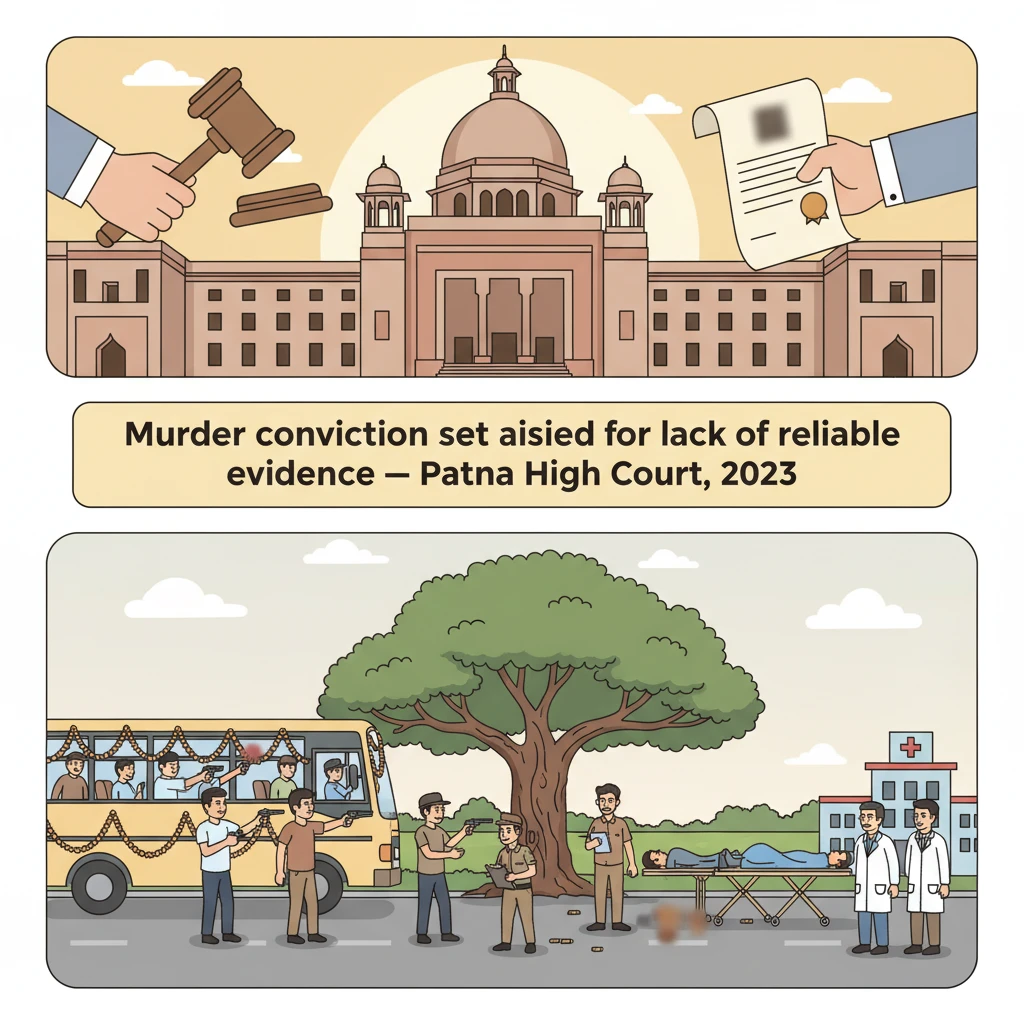
The case started with a fardbeyan given by one Ram Vinay Singh on 29.06.2012 at about 3:30 p.m. at Alexia Hospital, Begusarai. He alleged that his son-in-law Mukesh Kumar Singh @ Puttu Singh was shot dead while returning from a marriage in a city ride bus.
According to the fardbeyan, the baraat had gone from Salimpur village in Patna district to Hadipur village in Begusarai. On its return, when the city ride bus reached near a pakar tree at Maheshpur Mor, two accused, Sonu Kumar Singh and Manoj Singh, allegedly stopped the bus, entered it, and began firing with country-made pistols. Mukesh Kumar Singh was said to have received gunshot injuries on his chest, left arm, below the lips and on the forehead, and died in the bus.
The informant also alleged that when he tried to get down from the bus after the killing, four other accused—Ram Bachan Singh, Munna Singh, Balram Singh and Chhotu Singh—who were standing outside, started firing. The motive given was an old dispute: about three years earlier Mukesh Kumar Singh had filed a case after a conflict with the accused.
On this basis, Bhagwanpur (Tiyai) P.S. Case No. 68 of 2012 was registered. Investigation was taken up, witnesses’ statements were recorded, post-mortem was conducted on the dead bodies, and charge-sheet was submitted. As the offences were triable by the Court of Sessions, the case was committed to the Sessions Judge, Begusarai, and numbered as Sessions Case No. 319 of 2013.
During trial, the prosecution examined 11 witnesses and produced documents. The defence examined 3 witnesses, including the injured person Fudan Thakur. Statements of the accused were recorded under Section 313 Cr.P.C.
By judgment dated 23.01.2017 and sentence order dated 25.01.2017, the Sessions Judge convicted the appellants under Sections 302/34, 120B and 307/34 of the Indian Penal Code and Section 27 of the Arms Act. They were sentenced to life imprisonment for Sections 302/34 and 120B IPC and three years’ rigorous imprisonment under Section 27 of the Arms Act. No separate sentence was recorded for Section 307/34 IPC.
Aggrieved, the convicts filed three separate criminal appeals under Section 374(2) Cr.P.C. before the Patna High Court. These were Criminal Appeal (DB) Nos. 261 of 2017, 288 of 2017 and 365 of 2017. All arose out of the same police case and were heard together.
What the Court Examined and Decided
The Division Bench of Hon’ble Mr. Justice Vipul M. Pancholi and Hon’ble Mr. Justice Rudra Prakash Mishra carefully re-examined the entire evidence. Their focus was on whether the prosecution had proved the charges beyond reasonable doubt.
First, the Court noted that three prosecution witnesses (PW-1, PW-2 and PW-11) did not support the prosecution case and were declared hostile. Thus, the main support for the prosecution came from two alleged eye-witnesses: PW-6 Ram Binay Singh (informant and father-in-law of the deceased) and PW-10 Ram Pravesh Singh (father of the deceased). PW-5 Kiran Devi, wife of the deceased, was a post-occurrence witness.
The judges compared these witnesses’ depositions with the original fardbeyan and with the Investigating Officer’s testimony. They found serious contradictions.
In the fardbeyan, PW-6 had said that only his son-in-law Mukesh Kumar Singh was shot and died in the bus. He made no mention of any other person being injured or killed, even though, as per the later prosecution case, one more person, Saket Chaudhary, died and one Fudan Thakur was injured in the same firing.
In his deposition as PW-6, however, he gave a different version. He stated that when the bus reached near the turning of Maheshpur and Hadipur, the driver Manoj stopped the bus, got down and ran away. Thereafter Sonu and Manoj entered the bus while the others—Munna, Chhotu, Balram and Ram Bachan—stood outside with weapons. PW-6 now claimed that both his son-in-law Mukesh Kumar Singh and one Saket Chaudhary were shot inside the bus, became unconscious on their seats, and were lifted by him.
He also claimed that he had telephoned his daughter Kiran Devi, who came to the place of occurrence while Mukesh was still alive. According to him, Mukesh said something in her ears before dying. None of this appeared in the fardbeyan, which had been recorded four hours after the incident in the hospital.
The Investigating Officer (PW-9) confirmed in cross-examination that in his previous statement PW-6 had not said that he called his daughter, that she came there, or that Mukesh said something in her ear. PW-9 also admitted that in the fardbeyan the informant had clearly stated that Mukesh had died in the bus itself. PW-9 further admitted that in the fardbeyan there was no reference to injuries to Saket Chaudhary or Fudan Thakur by name.
The defence suggested that two lines mentioning that two unknown persons were injured by bullets had later been added in different ink in the fardbeyan. The High Court noted this contention and the absence of names of Saket and Fudan in the original narrative, despite the fardbeyan being recorded in the hospital after four hours.
Regarding PW-10, the father of the deceased, his examination-in-chief suggested he was present in the bus. He said that when the bus reached Pirpaiti, Maheshpur round-about, it was surrounded and the driver Manoj stopped the bus. Sonu and Manoj allegedly boarded and fired inside, injuring Mukesh, while others fired from outside. He claimed that Mukesh spoke a few words on mobile and died there, and that all injured were taken to Alexia Hospital where Mukesh was declared dead.
However, in cross-examination he gave a different picture. He admitted he was not in the bus but in an Alto car following behind at 15–20 yards. He stated that he did not talk to the driver. According to him, the first firing took place outside the bus, he then ran to the bus and saw his son alive and speaking. The Court treated these inconsistencies—about where he was and what exactly he saw—as major contradictions, making him a doubtful eye-witness.
PW-5 Kiran Devi, the widow, was not an eye-witness to the firing. She said her husband went to attend his brother’s marriage and was returning in the city ride bus driven by Manoj Singh. She further stated that Manoj Singh telephoned and called all the accused, the bus was stopped near Maheshpur, Sonu and Manoj boarded the bus and Sonu started firing, injuring her husband. She claimed that the accused demanded extortion money from her husband because he was in the business of vehicles, and since he had earlier filed a case and did not pay, they killed him.
In cross-examination she admitted that the incident was reported by her father and that her own statement was recorded later. She said her father called her around 12:30, that she lived less than half a kilometre from the place of incident and reached there in less than five minutes. She asserted that when she arrived, her husband was alive, narrated all details of the incident to her, and then died during this narration.
The High Court checked this against the fardbeyan and medical evidence. The fardbeyan clearly said Mukesh had died in the bus. There was no mention of Kiran Devi’s presence or of any dying declaration. PW-9 also confirmed that Kiran Devi had not earlier stated that Manoj had called the accused by phone or that there was an extortion demand because her husband was a driver. These omissions weakened her version.
The Court then looked closely at the medical evidence. PW-3, Dr. Raju, who conducted the post-mortem of Mukesh at 4:30 p.m. on 29.06.2012 at Sadar Hospital, Begusarai, found multiple lacerated entry and exit wounds on the face, chest, elbows and knee, and internal bleeding in the cranial and abdominal cavities. He opined that death was due to haemorrhage and shock caused by firearm injuries and that time since death was within 24 hours. In cross-examination, he clarified that in his opinion death should have occurred about six hours before the post-mortem and that except Injuries 1 and 2, the other injuries were not from close range.
The High Court compared these medical findings with the prosecution timeline. According to the prosecution, the incident occurred around 12:30 p.m. and the post-mortem was at 4:30 p.m. the same day. If death occurred about six hours before post-mortem, as the doctor indicated, it did not fully support the prosecution’s exact time of occurrence. Further, the eye-witness version was that accused boarded the bus and fired from a close distance, yet the doctor said most injuries were not from close range. This mismatch further weakened the prosecution story.
The Court also tested the investigation quality. PW-9, the first Investigating Officer, admitted that although the incident allegedly occurred inside the bus, he did not bring the bus to the police station, did not note its seating capacity, and did not seize any article from it. He only seized some fired and misfired 9 mm bullets from the Kharanja road at Maheshpur, Pipapanti Chowk. He also accepted that he did not send the seized cartridges for forensic examination, and they were not with him.
There was no evidence that any country-made pistols used in the offence were recovered. There was no mention of blood stains collected from the road, even though firing was said to have taken place both in and around the bus.
The Bench also noted that, according to the informant, there were six other passengers in the city ride bus apart from the deceased. Yet, none of these independent passengers were examined by the prosecution. Even the injured Fudan Thakur, whose injury was confirmed by PW-8, Dr. Dheeraj Shandilya of Alexia Hospital, was not examined as a prosecution witness. He had to be brought only as a defence witness (DW-1).
Taking all this together, the Court held that PW-6 and PW-10 were “chance witnesses” whose evidence was riddled with major contradictions and new facts not found in the earliest version. PW-5’s account of a dying declaration also could not be accepted in view of the original fardbeyan and the Investigating Officer’s testimony. Medical evidence did not fully support the prosecution timeline or the claim of close-range firing from inside the bus. The investigation suffered from serious lapses, including non-examination of key witnesses and non-seizure and non-testing of crucial material evidence.
In criminal law, once such doubts arise, the accused are entitled to the benefit of doubt. The High Court concluded that the prosecution had failed to prove its case beyond reasonable doubt and that the conviction recorded by the Sessions Court was unsustainable.
Accordingly, the Patna High Court allowed all three appeals. It set aside the common judgment of conviction dated 23.01.2017 and the sentence dated 25.01.2017 in Sessions Case No. 319 of 2013. The appellants Ram Bachan Singh, Munna Singh, Sonu Kumar Singh @ Sonu Singh and Manoj Singh @ Manoj Kumar Singh were acquitted of all charges. As they were in custody, the Court directed that they be released forthwith unless required in any other case.
Why This Judgment Matters
This decision shows how closely the Patna High Court examines evidence in serious criminal cases like murder. Even when a brutal firing has taken place and deaths are clear, the Court will not uphold a conviction unless the prosecution version is consistent, supported by medical and forensic evidence, and backed by reliable witnesses.
The judgment highlights the importance of the first statement (fardbeyan or FIR). Major changes at the time of trial, such as adding new injured persons or new details like phone calls and dying declarations, can make witnesses appear unreliable.
It also underlines how poor investigation can weaken an otherwise strong-looking case. Failure to seize the bus, not examining passengers or injured persons, and not sending bullets to forensic science laboratory all created gaps the defence could use. For families of victims, this shows why timely, careful recording of facts and insisting on proper investigation are crucial.
Legal Issues and Answers
- Issue: Whether the prosecution proved beyond reasonable doubt that the appellants committed murder and related offences in the bus firing incident near Maheshpur Mor on 29.06.2012.
Answer: No. The Patna High Court found major contradictions in key witnesses’ statements, lack of examination of material witnesses, mismatch with medical evidence, and serious investigation lapses, and therefore acquitted the appellants. - Issue: Whether the Sessions Court was justified in relying on the testimonies of PW-5, PW-6 and PW-10 as eye or material witnesses.
Answer: No. The Court held that these witnesses introduced new stories not found in the fardbeyan, gave inconsistent versions, and could not be safely relied upon to sustain conviction. - Issue: Whether deficiencies in seizure of physical evidence and non-examination of injured and independent witnesses affected the prosecution case.
Answer: Yes. Non-seizure and non-testing of firearms and cartridges, non-examination of bus passengers and of injured witness Fudan Thakur as a prosecution witness created serious doubt about the prosecution version.
Cases Cited by the Court
- The judgment, as provided, does not mention or rely upon any other decided cases.
Case Details
Case Number: Criminal Appeal (DB) No. 261 of 2017 with Criminal Appeal (DB) No. 288 of 2017 and Criminal Appeal (DB) No. 365 of 2017; arising out of Bhagwanpur (Tiyai) P.S. Case No. 68 of 2012 and Sessions Case No. 319 of 2013.
Case Title: Ram Bachan Singh v. The State of Bihar; Munna Singh v. The State of Bihar; Sonu Kumar Singh @ Sonu Singh and Manoj Singh @ Manoj Kumar Singh v. The State of Bihar.
Citation: 2024(2) PLJR 113.
Coram: Hon’ble Mr. Justice Vipul M. Pancholi and Hon’ble Mr. Justice Rudra Prakash Mishra.
Advocates: For the appellants in all three appeals: Mr. Ajay Kumar Thakur, Advocate; Mrs. Kiran Kumari, Advocate; Md. Imteyaz Ahmad, Advocate; Mr. Bimal Kumar, Advocate; Mrs. Vaishnavi Singh, Advocate; Mr. Sabal Kumar Jha, Advocate. For the State: Mr. Sujit Kumar Singh, APP.
Nature of the Case: Criminal appeals (Division Bench) under Section 374(2) Cr.P.C. against conviction and sentence for offences under Sections 302/34, 120B, 307/34 IPC and Section 27 of the Arms Act.
Link to the Judgment: Patna High Court Judgment
If you found this explanation helpful and wish to stay informed about how legal developments may affect your rights in Bihar, you may consider following Samvida Law Associates for more updates.







