
Case Background
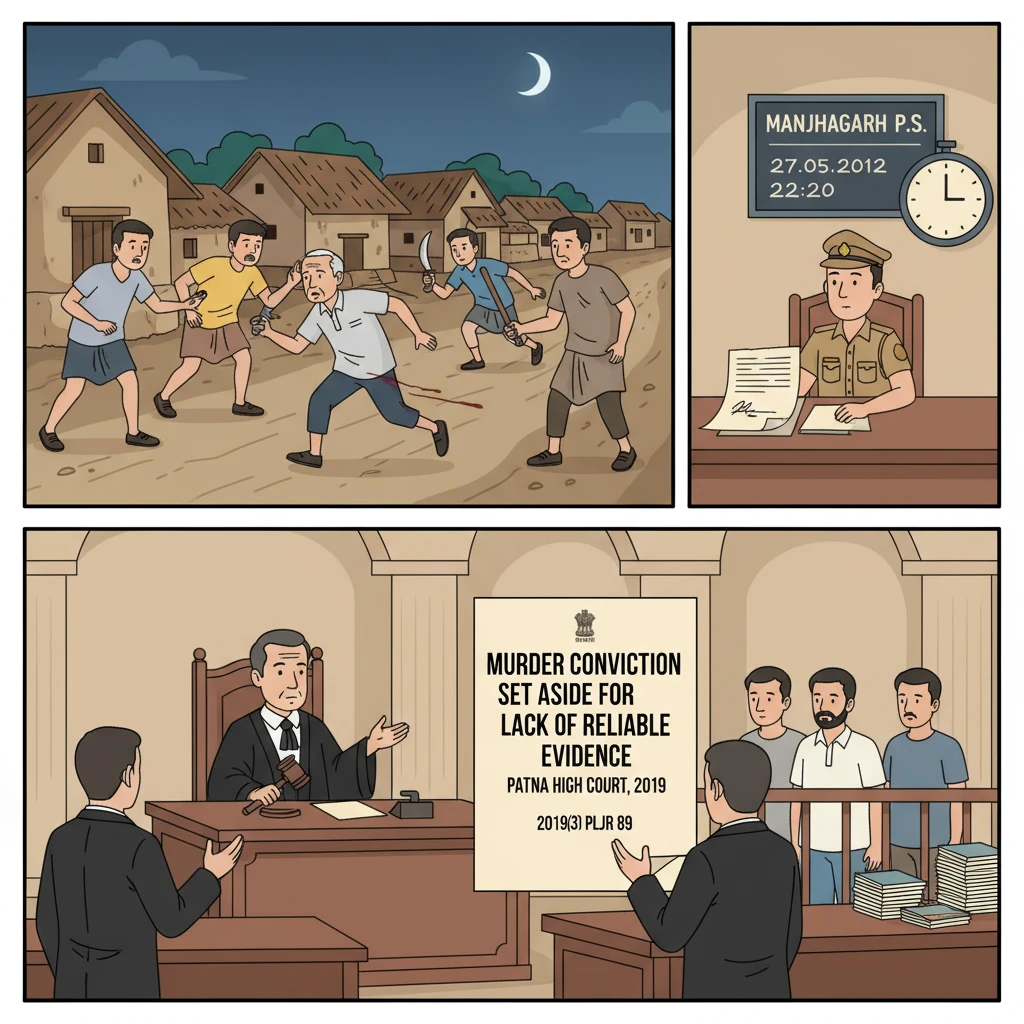
This case arose from Manjhagarh P.S. Case No. 86 of 2012, District Gopalganj. The prosecution case started with a written report dated 27-05-2012, given by the son of the deceased at Manjhagarh Police Station.
According to that report, on 27-05-2012 at about 9:30 P.M., there was a quarrel between one elder uncle of the informant and his three sons near the informant’s house. The deceased, father of the informant, was said to be sitting outside his house when the quarrel suddenly stopped and the accused allegedly surrounded him with knife and lathi.
The informant alleged that two of the accused caught hold of his father while two others inflicted knife blows. The father ran towards the road while shouting for help, fell on the side of the road, and died on the spot due to bleeding. When the informant and his brother tried to save him, they claimed they were assaulted with lathi and rod and suffered serious injuries.
On this written report, Manjhagarh P.S. Case No. 86 of 2012 was registered at 22:20 hrs (10:20 P.M.) on 27-05-2012 under Sections 307, 302 and 34 of the Indian Penal Code against four accused, including the three appellants.
An inquest was prepared on the dead body at 5:30 A.M. on 28-05-2012 and the body was sent for post-mortem examination. During investigation, appellant Ambika Sah was arrested on 28-05-2012, appellant Dadan Sah on 03-06-2012, and appellant Lalan Sah surrendered on 09-07-2012.
After investigation, the police submitted a chargesheet on 24-08-2012 against the three appellants, keeping investigation pending against one co-accused. The Chief Judicial Magistrate, Gopalganj, took cognizance on 25-08-2012 and committed the case to the Court of Sessions on 07-09-2012, where it was numbered as Sessions Trial No. 333 of 2012.
On 08-11-2012, the trial court framed joint charges against all three appellants under Sections 302/34 and 307/34 IPC. By judgment dated 13-09-2013, the trial court convicted two appellants under Section 302 IPC and the third appellant under Section 302/34 IPC. All three were also convicted under Section 307/34 IPC. By order dated 19-09-2013, each appellant was sentenced to life imprisonment and fine of Rs. 10,000/- under Section 302/34 IPC; no separate sentence was passed for Section 307/34 IPC.
Against this common judgment of conviction and sentence, the three convicts filed Criminal Appeal (DB) No. 1038 of 2013 and Criminal Appeal (DB) No. 992 of 2013 before the Patna High Court. Both appeals were heard together and decided by a common judgment dated 13-05-2019.
What the Court Examined and Decided
The Patna High Court examined the entire evidence produced during the trial: eleven prosecution witnesses, medical and injury reports, the investigation record, and defence documents. The core question was whether the prosecution had proved, beyond reasonable doubt, that the appellants had murdered the deceased and attempted to murder his two sons.
P.W.1, the informant and son of the deceased, claimed in court that he was sitting at the door of his house with his father when the accused, who were quarrelling amongst themselves, suddenly surrounded his father. According to him, two accused caught his father’s arms and the other two each inflicted one knife blow. He stated that his father ran outside, followed by him; one appellant allegedly struck his head with a lathi while the other assaulted his brother (P.W.2) with an iron rod. The father fell on the road and died there. He also stated that the written report was drafted by his brother (P.W.2) on his dictation and that there was moonlight and electricity in the village.
However, during cross-examination, crucial contradictions emerged. The investigating officer (P.W.9) deposed that in P.W.1’s earlier statement under Section 161 Cr.P.C., he had only said that, on hearing his father’s cry, he came out and saw his father already lying injured with blood oozing and that he had died. P.W.1 had not then stated that he had witnessed the assault or that he and his brother were also beaten when they tried to save their father.
This meant that P.W.1’s version in court, where he claimed to be an eye-witness to the entire assault and to his own beating, was very different from his earliest version given to the police.
Similar issues arose with P.W.2 (another son of the deceased), P.W.3 (brother of the deceased), P.W.4 (wife of the deceased) and P.W.5 (wife of P.W.1). In court, all these witnesses claimed that they had seen the assault and that the deceased was given knife blows in their presence.
But the investigating officer’s evidence showed that, during investigation, these witnesses had not claimed to be eye-witnesses. Instead, they had stated that the deceased had gone out of the house for urinating, that they were inside the house, and that they came out only after hearing his cry, by which time he was already lying dead on the road.
In paragraph 14 of his cross-examination, the investigating officer clearly stated that none of the witnesses had told him how the deceased was assaulted. This created a serious doubt about whether P.Ws.1 to 5 had actually seen the incident.
The Court also examined the medical evidence. P.W.10, the doctor who conducted the post-mortem at Sadar Hospital, Gopalganj, found a single stab wound on the left upper part of the chest near the left shoulder, measuring approximately 3” x 2” and cavity deep. On internal examination, there was a penetrating injury in the left lung causing massive haemothorax. No other external injuries were noted. The cause of death was the penetrating injury to the lung resulting in shock and death.
This medical finding of only one penetrating stab wound did not match the prosecution version given by the alleged eye-witnesses in court, who repeatedly claimed that two appellants each inflicted one knife blow on the deceased. The High Court noted that the post-mortem report did not corroborate this version.
The injury reports of P.W.1 and P.W.2, proved by P.W.8, showed simple injuries caused by hard and blunt substance. The High Court did not find these sufficient to remove the doubts arising from the contradictions in their statements about witnessing the assault.
The investigation record also raised questions. P.W.1 claimed he had informed the police by telephone, after which the police arrived at the place of occurrence within 15–20 minutes. However, the investigating officer stated that P.W.1 had come to the police station and given a written report there, which was made the basis of the formal FIR drawn at 10:20 P.M. The place of occurrence was about 9 kilometres away from the police station. The Court noted that the timing and method of lodging the FIR, as reflected in the evidence, created doubt in its mind.
Regarding the place of occurrence, the investigating officer stated that the dead body was found on a brick soling road opposite the house of P.W.7. He noticed blood marks near the electric pole where the body was lying but did not notice any blood near the door of the deceased’s house. He also did not find any chair or cot near the door, although the prosecution story suggested that the deceased had first been attacked while sitting near his door.
The defence relied on complaint case records Ext.A and Ext.A/1 to show that there were earlier disputes and litigations between the families of the appellants and key prosecution witnesses. One complaint case had been filed by appellant Ambika Sah against P.W.3 and others; another had been filed by the wife of P.W.3 against the appellants. This indicated an ongoing dispute and possible motive for false implication.
The High Court accepted that relationship of witnesses with the deceased, by itself, is not a ground to discard their evidence. However, when their testimony is inconsistent with their own earlier statements, unsupported by independent witnesses, and contradicted by medical evidence and investigation details, it becomes unsafe to rely on such testimony for a conviction for murder.
The Court acknowledged the legal principle that where there is a conflict between oral and medical evidence, credible oral evidence may prevail. But it stressed that the oral evidence must itself be trustworthy. In this case, because of the serious doubts about whether P.Ws.1 to 5 actually witnessed the incident, and in view of the mismatch with the post-mortem report, the benefit of doubt had to go to the accused.
After considering all these aspects, the Patna High Court held that the prosecution had failed to establish the guilt of the appellants beyond all reasonable doubt. It therefore found it appropriate to interfere with the trial court’s judgment.
The High Court set aside the judgment of conviction dated 13-09-2013 and the order of sentence dated 19-09-2013 passed in Sessions Trial No. 333 of 2012/79 of 2013 by the Adhoc Additional Sessions Judge-II, Gopalganj. Both criminal appeals were allowed.
The Court directed that appellants Lalan Sah and Dadan Sah, who were in custody, be released forthwith if not wanted in any other case. The third appellant, Ambika Sah, who was already on bail, was discharged from the liability of his bail bond.
Why This Judgment Matters
This judgment shows how carefully the Patna High Court checks whether a conviction for a serious offence like murder is based on solid and trustworthy evidence. Even where a death has clearly occurred and there is strong suspicion, the law requires proof beyond reasonable doubt.
The Court did not simply rely on emotional or detailed stories told in the witness box. It compared those stories with what the same witnesses had told the police earlier, with the medical findings, with the physical evidence at the spot, and with the timing of the FIR. When these did not match, the Court refused to uphold the conviction.
For families involved in long-standing disputes, this decision is a reminder that courts look closely at possible motives for false implication. Previous cases between the same parties can be relevant in assessing credibility.
Practically, the judgment reinforces that:
• Witnesses must give consistent statements from the beginning.
• Medical and forensic evidence must support the version of events.
• Investigation records, such as timing and place of FIR, can make or break a case.
For ordinary citizens, this case explains that while the criminal justice system aims to punish the guilty, it also strongly protects against conviction based on doubtful or unreliable evidence. Benefit of doubt goes to the accused, even in grave offences.
Legal Issues and Answers
-
Issue: Did the prosecution prove beyond reasonable doubt that the appellants committed the murder of the deceased and attempted to murder his sons under Sections 302/34 and 307/34 IPC?
Answer: No. Due to serious contradictions between witness statements, medical evidence, and investigation records, the Patna High Court held that the prosecution failed to prove its case beyond reasonable doubt and extended benefit of doubt to the appellants. -
Issue: Can convictions be sustained mainly on the testimony of related witnesses when their version conflicts with earlier statements and medical findings?
Answer: No. The Court held that while related witnesses cannot be discarded solely due to relationship, their evidence must be credible and consistent and should not be contradicted by medical and other objective evidence. In this case, their testimony was found unreliable. -
Issue: How should courts treat conflict between oral and medical evidence in a murder case?
Answer: Courts may give weight to oral evidence over medical evidence only when the oral evidence is trustworthy. Here, because the eye-witness version itself was doubtful and not in line with the post-mortem report, the contradiction became significant and contributed to acquittal.
Cases Cited by the Court
- The judgment does not refer to or rely upon any earlier reported case law by name.
Case Details
Case Number: Criminal Appeal (DB) No. 1038 of 2013 with Criminal Appeal (DB) No. 992 of 2013; arising out of Manjhagarh P.S. Case No. 86 of 2012; Sessions Trial No. 333 of 2012/79 of 2013.
Case Title: Lalan Sah and another v. The State of Bihar; Ambika Sah v. The State of Bihar.
Coram: Hon’ble Mr. Justice Rakesh Kumar and Hon’ble Mr. Justice Anil Kumar Sinha.
Citation: 2019(3) PLJR 89.
Advocates: For the appellants – Smt. Renu Jha, Advocate. For the State – Sri Ajay Mishra, A.P.P. For the informant – Sri Ranjan Kumar Srivastava, Advocate.
Nature of the Case: Criminal appeals (Division Bench) against conviction and sentence for offences under Sections 302/34 and 307/34 IPC.
Link to Judgment: Click here to read the full Patna High Court judgment
If you found this explanation helpful and wish to stay informed about
how legal developments may affect your rights in Bihar,
you may consider following Samvida Law Associates for more updates.







