
Case Background
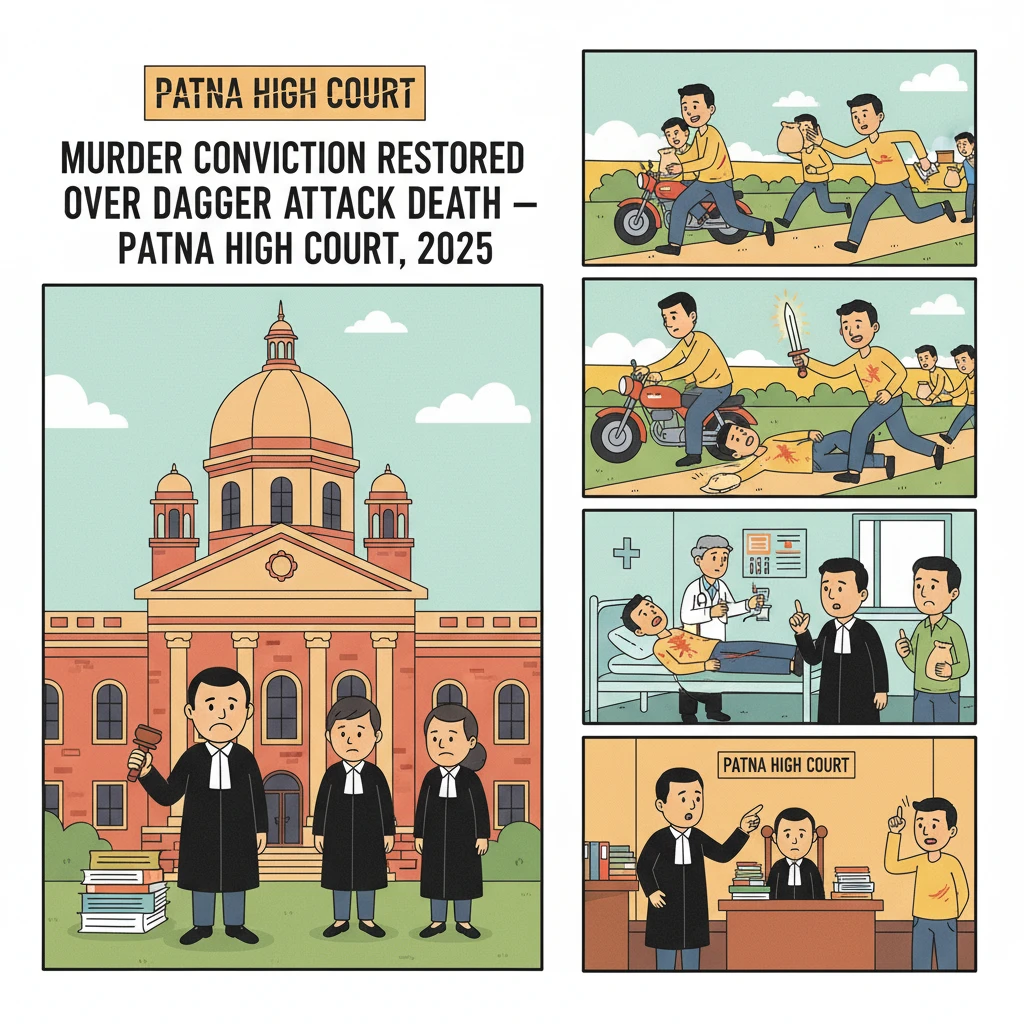
The case arises from Taraiya P.S. Case No. 54 of 2009 in District Saran. On 4 June 2009, in the evening, an incident took place in village Andharwari, leading to serious stab injuries to one Kameshwar Rai, who later died.
According to the prosecution, Kameshwar Rai, the informant (later the deceased), was returning home with his son after grinding flour. Near the house of a villager, he was allegedly attacked with a dagger by one accused, due to previous enmity. His fardbeyan (statement) was recorded the same evening at around 8:00 PM in the emergency ward of the Referral Hospital, Taraiya.
On this fardbeyan, Taraiya P.S. Case No. 54 of 2009 was registered on 4 June 2009 under Sections 341, 324 and 307 of the Indian Penal Code (IPC) against the sole accused. After investigation, police submitted charge-sheet No. 77 of 2009 dated 25 September 2009 under Sections 341, 323, 307 and 302 IPC.
The Magistrate took cognizance on 2/5 October 2009 and committed the case to the Court of Sessions on 5 December 2009. Sessions Trial No. 675 of 2009 was registered and on 21 December 2009, charge under Section 302 IPC (murder) was framed against the accused.
During trial, the prosecution examined ten witnesses and produced medical and investigation documents. The defence did not lead oral evidence but exhibited five documents, including hospital letters, the deceased’s bed-head ticket, a protest petition in another case, and a report on treatment.
By judgment dated 22 November 2022, the trial court acquitted the accused of murder under Section 302 IPC but convicted him under Section 304 Part II IPC (culpable homicide not amounting to murder) and sentenced him on 24 November 2022 to five years’ rigorous imprisonment and fine.
The informant’s son (Arjun Yadav @ Arjun Rai) filed Criminal Appeal (DB) No. 203 of 2023 challenging the acquittal from Section 302 IPC and the lesser conviction. The accused (Baijnath Singh) filed Criminal Appeal (SJ) No. 119 of 2023 seeking complete acquittal. Both appeals came before a Division Bench of the Patna High Court.
What the Court Examined and Decided
The Patna High Court carefully re-examined all prosecution and defence evidence. It did not limit itself to the arguments raised, but reassessed whether the prosecution had proved its case beyond reasonable doubt.
The prosecution story began with the fardbeyan of the informant recorded at Taraiya hospital on 4 June 2009 at about 8:00 PM. He stated that at about 6:30 PM that day, he was returning from village Andharwari with his son after grinding flour. Near the house of one Rajendra Rai, a motorcycle came from Taraiya side and stopped. The accused, Baijnath Singh, got down and, with intention to kill, assaulted him with a dagger twice—in his ribcage and shoulder. He fell unconscious. The accused then tried to assault his son, who fled. The accused allegedly left his motorcycle and fled, and villagers took the informant to Taraiya hospital. The motive stated was previous enmity.
The High Court noted that the initial FIR was under Sections 341, 324, 307 IPC but later, after death of the injured and receipt of post-mortem reports, charges were laid under Section 302 IPC as well.
The trial court had accepted that the accused caused dagger injuries to the informant and that the informant died after about 50 days. However, it concluded that the essential ingredients of murder under Section 300 IPC were not made out. The trial court held that death occurred due to infection and pus formation in the wound, and also observed that the deceased did not receive proper treatment. Relying on Explanation 2 to Section 299 IPC, the trial court took the view that if proper and skilled treatment had been provided, death could have been avoided. It therefore convicted under Section 304 Part II IPC (knowledge of likelihood of death) and not under Section 302 IPC.
The informant’s son, as appellant in the DB appeal, argued that the trial court had misread Explanation 2 to Section 299 IPC. According to him, once it is proved that an injury caused by the accused led to death, it is not open to reduce liability on the basis that better treatment might have saved the victim. He highlighted that the trial court accepted that the accused intentionally assaulted with a dagger on vital parts, and that the prosecution had proved date, time, place and manner of assault.
On the other side, the accused, as appellant in the SJ appeal and respondent in the DB appeal, initially questioned place of occurrence and the presence of the informant’s son as an eye witness. However, when confronted with his own protest petition (Exhibit D), in which he himself described the occurrence of 4 June 2009 in village Andharwari and mentioned the presence of some witnesses who later deposed for the prosecution, he did not press these objections.
He then narrowed his argument to causation of death. Relying on a Madhya Pradesh High Court judgment (Imran Khan v. State of Madhya Pradesh, 1994 MPLJ 862), he submitted that the stab injury was not the “proximate cause” of death. According to him, the chain of consequences was broken because the deceased was admitted in Patna Medical College Hospital (PMCH) only after 40 days, and death occurred due to infection and pus rather than directly due to the original injury. He argued that this was an “unexpected complication” and too remote to hold him liable for murder.
The State supported the trial court’s factual findings but defended the conviction for culpable homicide not amounting to murder.
The High Court first looked at the eye witnesses. PW-1 (Binda Raut), a resident of Andharwari, stated that while he was at home, he saw the accused inflict a dagger blow on the right side of the stomach of Kameshwar Rai; the intestine came out and there was profuse bleeding. He confirmed that the victim was first taken to Chapra and then to Patna. There was no suggestion of any sudden quarrel.
PW-2 (Baharan Rai), another villager, stated that after hearing noise he reached the spot and saw an altercation between the deceased and the accused. The accused then took out a dagger and assaulted the deceased causing three injuries. He also located the occurrence in front of the house of Ram Pravesh Rai.
PW-3 (Arjun Rai), the deceased’s son and prime eye witness, clearly stated that he and his father were returning from the flour mill with flour on a bicycle. Near the house of Ram Pravesh Rai, the accused came on a motorcycle from Taraiya side. There was oral exchange of words over money relating to a Gullar tree. On that, the accused took out a dagger and first stabbed his father on the right shoulder and then on the left side of the stomach. PW-3 tried to tie the wound with his gamchha, and when he tried to catch the accused, the accused chased him, forcing him to flee. Villagers assembled and took his father to Taraiya hospital. PW-3 confirmed that his father’s statement was recorded there and both signed the fardbeyan.
In cross-examination, PW-3 confirmed the layout of village Andharwari and clarified that the houses of Rajendra Rai and Ram Pravesh Rai are only about one “laggi” (about seven hands) apart. This explained the minor variation between the fardbeyan (mentioning Rajendra Rai’s house) and later evidence (referring to Ram Pravesh Rai’s house). The High Court treated this not as a serious contradiction but as a natural description of a small cluster of houses.
PW-5 (Sabha Rai), another eye witness and a relative (brother in gotiya) of the deceased, stated that there was talk about money regarding a Gullar tree, and during this, the accused took out a dagger and stabbed the deceased in the left side of the “panjara” (rib area) and then on the shoulder. He too spoke of the accused chasing him and Arjun, and described blood falling on the ground. His description of surrounding houses matched that of the other witnesses.
PW-6 (Investigating Officer) confirmed that he visited the place of occurrence, which he located on the pucca road north of the house of Ram Pravesh Rai. He recorded statements, received the post-mortem report, and filed the charge-sheet. He also stated that he had recorded a re-statement of the deceased at Sitalpatti when the deceased had returned home with partially healed but still present wounds, before his condition deteriorated and he went again to Patna.
On the medical side, PW-9 (the doctor at Referral Hospital, Taraiya) examined the injured on 4 June 2009 and found: an incised wound 2” x 1” deep to chest cavity on the lower back of chest on the left side, and another incised wound on the right shoulder joint. He referred the patient to Sadar Hospital, Chapra, for proper treatment and proved the injury report (Exhibit 4).
PW-7 (the doctor who conducted post-mortem at Sadar Hospital, Chapra) later found multiple infected and partially healed wounds on the abdomen with marks of stitches and gaping. He opined that “shock and exhaustion due to infection of the wounds, gaping of the abdominal wound and injury to intestine were the cause of death,” and that injuries could be caused by a chura (dagger). In cross-examination he accepted that infection may arise from many causes and lack of proper treatment increases chances of infection, but maintained that the death was due to infection and pus formation.
The High Court then turned to the legal question of causation and classification of the offence. It reproduced Section 299 IPC with Explanation 2, which clearly says that where death is caused by bodily injury, the person who caused that injury is deemed to have caused the death “although by resorting to proper remedies and skilful treatment the death might have been prevented.”
The Court found that the trial court had misapplied this provision. Instead of reading Explanation 2 as a rule fixing liability despite possible better treatment, the trial court wrongly treated the lack of proper treatment as a reason to downgrade the offence from murder to culpable homicide not amounting to murder.
The Division Bench rejected this reasoning. It emphasized that the deceased died due to infection and pus formation in the very wounds caused by the dagger blows. This was not any new, independent cause but a natural development of the original serious injury to the intestine and abdomen.
On the Madhya Pradesh High Court’s judgment in Imran Khan, the Patna High Court quoted paragraph 11, which explained that if death results from complications that are the “natural or probable or necessary consequence” of the injury and reasonably contemplated as its result, the injury can be said to have caused death. Only if an unexpected complication breaks the chain can the causal connection be considered too remote. The Patna High Court held that, in this case, the infection and pus formation were a natural development of a serious stomach stab injury and not any new, independent mischief. Therefore, the causal chain was intact and death remained a proximate result of the original attack.
Next, the Court analysed whether the case fit within murder under Section 300 IPC. It observed that the accused inflicted two dagger blows, both aimed at vital parts. One cut on the shoulder, which is near the neck region, fortunately remained skin-deep; the other penetrated into the stomach and intestine, clearly a vital area.
The Court concluded that the accused intentionally caused such bodily injury as he knew was likely to cause death, and that the injury was sufficient in the ordinary course of nature to cause death. The fact that he came armed with a dagger, intercepted the deceased in another village, and gave repeated blows after an exchange of words indicated premeditation and clear intention to cause fatal injuries, not a sudden, unplanned scuffle.
The Bench carefully considered the five exceptions to Section 300 IPC (provocation, exceeding right of private defence, acts of public servants, sudden fight, and consent by person above 18 years) and found that none applied. There was no grave and sudden provocation, no self-defence, no public servant role, no mutual sudden fight without cruelty, and no consent of the victim.
Accordingly, the Court held that the act of the accused fell squarely within the definition of “murder” under Section 300 IPC. The trial court erred in treating it as only culpable homicide not amounting to murder under Section 304 Part II IPC.
Criminal Appeal (DB) No. 203 of 2023, filed by the informant’s side, was therefore allowed. The conviction of the accused was altered from Section 304 Part II IPC to Section 302 IPC. At the same time, Criminal Appeal (SJ) No. 119 of 2023, filed by the accused, was dismissed as being without merit.
The Court also noted that the accused was on bail. It cancelled his bail bond, ordered that he be taken into custody and sent to Beur Jail, and fixed a date (7 May 2025) for hearing on sentence, directing that the accused be produced on that day.
Why This Judgment Matters
This judgment is important for both victims’ families and accused persons in serious assault cases in Bihar.
First, the Patna High Court has made it clear that if a person intentionally causes a serious injury with a deadly weapon on a vital part of the body, they cannot escape a murder conviction just because death occurs after some time or after medical complications like infection and pus. If the death flows naturally from the original injury, the attacker remains responsible for murder under Section 302 IPC.
Second, the Court has clarified how Explanation 2 to Section 299 IPC works. Families of victims often face arguments that “hospital negligence” or “poor treatment” broke the chain of causation. The Court has reaffirmed that the law does not allow an offender to benefit from such arguments when the original injury itself was serious and life-threatening.
Third, the judgment also shows that small discrepancies, like whether the attack occurred in front of one brother’s house or another’s when both houses are side by side, will not by themselves destroy the prosecution case if the overall story is consistent and supported by medical evidence.
For common readers, this case underscores that carrying a dagger, intercepting someone, and stabbing them in the stomach is very likely to be treated as “murder” by courts, especially when there is clear evidence of intention and there is no grave provocation or self-defence situation.
Legal Issues and Answers
-
Issue: Whether the death of the informant, occurring about 50 days after the stabbing due to infection and pus in the abdominal wound, could be legally attributed to the accused so as to sustain a conviction for murder under Section 302 IPC.
Answer: Yes. The Court held that the death was caused by the original dagger injury; infection and pus formation were natural consequences of that injury. Under Explanation 2 to Section 299 IPC and the principles in Imran Khan, the causal chain was intact, so the accused was liable for murder. -
Issue: Whether the facts justified treating the offence only as culpable homicide not amounting to murder under Section 304 Part II IPC, as the trial court had done.
Answer: No. The Court held that the accused intentionally inflicted two dagger blows on vital parts with knowledge that such injuries were likely to cause death and that the injuries were sufficient in the ordinary course of nature to cause death. No exception to Section 300 IPC applied. Therefore, the offence amounted to murder under Section 302 IPC. -
Issue: Whether alleged lack of proper or skilled medical treatment could reduce the accused’s criminal liability from murder to a lesser offence.
Answer: No. The Court ruled that, in view of Explanation 2 to Section 299 IPC, the possibility that proper treatment might have prevented death does not reduce the liability of the person who inflicted the original life-threatening injury.
Cases Cited by the Court
- The Court referred to and relied upon the Division Bench judgment of the Madhya Pradesh High Court in Imran Khan v. State of Madhya Pradesh, reported in 1994 MPLJ 862, particularly paragraph 11, on the principles of causation and proximate cause of death.
Case Details
Case Numbers:
Criminal Appeal (DB) No. 203 of 2023
Criminal Appeal (SJ) No. 119 of 2023
Arising out of Taraiya P.S. Case No. 54 of 2009, District Saran
Case Titles:
Criminal Appeal (DB) No. 203 of 2023: Arjun Yadav @ Arjun Rai v. The State of Bihar & Anr.
Criminal Appeal (SJ) No. 119 of 2023: Baijnath Singh v. The State of Bihar
Court:
High Court of Judicature at Patna
Coram:
Hon’ble Mr. Justice Rajeev Ranjan Prasad
Hon’ble Mr. Justice Ashok Kumar Pandey
Date of CAV Judgment: 05-05-2025
Citation: 2025 (2) PLJR 856
Advocates:
In Criminal Appeal (DB) No. 203 of 2023:
For the Appellant: Ms. Nikita Mittal, Advocate
For the State: Mr. Mukeshwar Dayal, APP
For Respondent No. 2: Mr. Ansul, Senior Advocate
In Criminal Appeal (SJ) No. 119 of 2023:
For the Appellant: Mr. Ansul, Senior Advocate
For the State: Mr. Mukeshwar Dayal, APP
Nature of the Case:
Criminal appeals against judgment of conviction and sentence in Sessions Trial No. 675 of 2009, involving reclassification of offence from Section 304 Part II IPC to Section 302 IPC and challenge by the convict to his conviction.
Link to the Judgment:
Click here to access the official Patna High Court judgment
If you found this explanation helpful and wish to stay informed about
how legal developments may affect your rights in Bihar,
you may consider following Samvida Law Associates for more updates.







