
Case Background
This case arose from Gopalganj P.S. Case No. 17 of 2021, registered on 05.01.2021. The First Information Report (FIR) alleged that the informant’s father was shot dead near their village in Gopalganj district.
The prosecution charged the private respondents with offences punishable under Section 302 read with Section 34 of the Indian Penal Code and Section 27 of the Arms Act. The case proceeded as Sessions Trial No. 83 of 2022 before the Court of the Additional Sessions Judge-VIII, Gopalganj.
On 18.07.2023, the trial court acquitted the accused persons of all charges, holding that the prosecution had failed to prove the case beyond reasonable doubt.
The deceased’s son, who was also the informant (PW-4), then filed Criminal Appeal (DB) No. 832 of 2023 under Section 372 of the Code of Criminal Procedure, 1973, before the Patna High Court. He sought reversal of the acquittal and conviction of the accused.
What the Court Examined and Decided
The Division Bench of the Patna High Court, consisting of Hon’ble Mr. Justice Vipul M. Pancholi and Hon’ble Mr. Justice Rudra Prakash Mishra, heard the appeal and delivered an oral judgment on 01.02.2024.
Counsel for the appellant argued that there were four eye‑witnesses to the incident: PW‑1, PW‑2, PW‑3 and PW‑4. PW‑4 was the informant and son of the deceased; PW‑1 was the nephew; PW‑3 was the brother of the deceased. According to them, the firing took place between 11:30 a.m. and 11:45 a.m. on 05.01.2021 in the agricultural field.
The informant claimed that he saw the incident while he was in the field and named the accused in his fardbeyan given to the police. All these witnesses described how the accused allegedly fired at the deceased. The appellant argued that their statements were consistent and supported by medical evidence, and that the trial court wrongly relied on alleged defects in investigation to acquit the accused.
To support the appeal, counsel for the appellant cited four Supreme Court decisions: Suresh Rai & Others vs. State of Bihar, Dhanaj Singh @ Shera & Ors. vs. State of Punjab, Ram Avtar Rai & Ors. vs. State of Uttar Pradesh, and Baso Prasad & Ors. vs. State of Bihar. These decisions broadly deal with appreciation of eye‑witness testimony, defective investigation, and the role of medical evidence.
On the other side, counsel for the accused strongly opposed the appeal. They argued that the prosecution had failed to prove the case beyond reasonable doubt, and that the trial court’s acquittal was correct.
The defence highlighted that the supposed eye‑witnesses were only “projected” as eye‑witnesses and were not actually present at the time of the firing. They pointed to contradictions and to the medical evidence, which did not support the prosecution version.
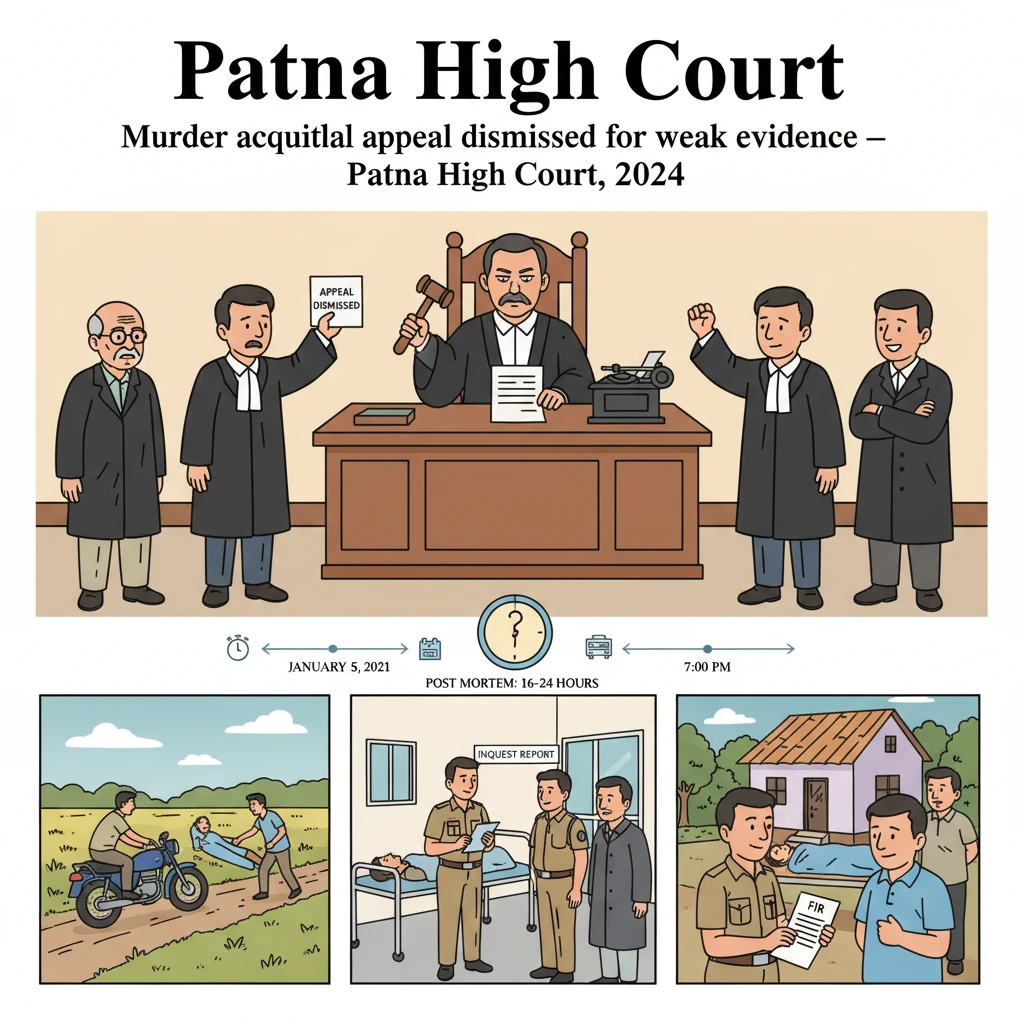
A crucial circumstance was the delay in lodging the FIR. As per the prosecution, the incident occurred around 11:30–11:45 a.m., but the FIR was registered at about 7:00 p.m., more than eight hours later. The injured was allegedly taken to Sadar Hospital, Gopalganj, on a motorcycle immediately after the incident and was declared dead there.
The inquest report was prepared at 14:20 hours in the Sadar Hospital by a police officer from Nagar Thana, Camp‑Sadar Hospital, Gopalganj. In “column 8” of the inquest, it was recorded that PW‑2 Deepu Singh (cousin of the informant and nephew of the deceased) and one Aditya Dubey informed the police that the deceased had died due to gun‑shot injury. However, even at this stage, no names of assailants were given to the police.
The High Court noted that this was significant. The police were already present in the hospital, yet no FIR was registered there, and no names were disclosed. Instead, the fardbeyan was later recorded at the informant’s house when the dead body was brought there in the evening, and only then were the accused named.
The Bench observed that the information given at the time of the inquest, coming from the so‑called eye‑witness, ought to have been treated as the earliest information and, in substance, as the FIR. The failure to name the assailants at that first stage raised serious doubt about the prosecution story. The conduct of the informant, being the son of the deceased, in not immediately naming the attackers or insisting on an FIR in the hospital, was held to be “not natural”.
The Court also examined the prior relationship between the parties. During cross‑examination, PW‑4 admitted that there were disputes between the families and that 2–3 cases were already pending. This background of enmity, combined with the late naming of the accused, strengthened the defence contention of false implication.
On the medical side, PW‑6, the doctor who conducted the post mortem at about 4:50 p.m. on 05.01.2021, stated in his examination‑in‑chief that the “time since death is about 16–24 hours.” The prosecution case, however, was that the shooting took place at about 11:30–11:45 a.m. the same day, i.e., only about five hours before the post mortem.
This clear medical opinion meant that the death had occurred much earlier than the time put forward by the eye‑witnesses. The High Court held that this independent medical evidence did not support the prosecution timeline and undermined the credibility of the eye‑witnesses.
The Court then looked at the investigation evidence through PW‑5, the Investigating Officer. PW‑5 stated that he went to the place of occurrence on the same night and searched for empty cartridges but could not find any. He also did not seize the motorcycle which, according to prosecution witnesses, had been used to transport the injured to the hospital. He recorded statements of close relatives and one independent witness, PW‑7 Hirdeyanand Yadav.
However, PW‑7 did not support the prosecution in court and was declared hostile. The murder weapon (pistols) was never recovered from the accused. These factors added to the doubts surrounding the prosecution version.
The appellant argued that failure to recover blood‑stained soil, cartridges or weapons was a defect in investigation, and that the court should not acquit on that ground alone, relying on decisions like Dhanaj Singh and Ram Avtar Rai. The High Court accepted the legal principle that a faulty investigation by itself cannot be a reason to acquit if there is otherwise credible evidence.
But in this case, the Bench found that the Investigating Officer had, in fact, acted promptly after FIR registration, visiting the spot and attempting to collect evidence. More importantly, the Court held that the real weakness of the prosecution lay not in the investigation but in its own evidence: the eye‑witness version was inconsistent with medical evidence and with the conduct of the witnesses.
For instance, PW‑4 admitted during cross‑examination that he could not describe the exact place of occurrence. He also admitted hearing the sound of firing earlier in the morning, while his fardbeyan claimed that he was present in the field at about 11:30–11:45 a.m. when the firing occurred. These contradictions further shook his credibility.
Given these facts, the Court held that PW‑1 to PW‑4 had been “projected” as eye‑witnesses and that their presence at the place of occurrence was doubtful. Their testimony was not corroborated by medical evidence. In such circumstances, the Supreme Court decisions cited by the appellant, which rely on trustworthy eye‑witnesses and supportive medical evidence, were found inapplicable.
The Bench then turned to the legal standard for interfering with an acquittal. Relying on the Supreme Court decision in Chandrappa and Ors. vs. State of Karnataka, as well as later cases like Nikhil Chandra Mondal vs. State of West Bengal and Rajesh Prasad vs. State of Bihar, the Court reiterated that there is a “double presumption” of innocence in favour of an accused who has been acquitted by the trial court.
The rule is that if two reasonable views are possible on the evidence, the appellate court should not disturb the acquittal. The Court also referred to N. Vijayakumar vs. State of Tamil Nadu, where the Supreme Court held that even if a different view is possible, an acquittal based on one possible view should not be overturned unless that view is unreasonable.
Applying these principles, the Patna High Court concluded that the trial court’s view—that the prosecution had failed to prove guilt beyond reasonable doubt—was not only a possible view, but a correct one on the evidence. The medical opinion on time of death, the unexplained delay and manner of lodging the FIR, the failure to name the assailants at the inquest, the lack of independent support, and contradictions in the testimony all combined to create serious doubt.
Therefore, the Court held that there was no ground to interfere with the acquittal. The criminal appeal filed by the informant was dismissed, and the accused continued to stand acquitted of the offences under Section 302/34 IPC and Section 27 of the Arms Act.
Why This Judgment Matters
This judgment shows how carefully courts examine murder cases where the main witnesses are close relatives of the deceased and where there is prior enmity between families. The Patna High Court did not accept the eye‑witness version simply because the witnesses were related.
The decision underlines that delays in lodging FIRs, failure to name the assailants at the earliest opportunity, and contradictions with medical evidence can all weaken a case. If these doubts are strong, even serious charges like murder may fail.
For complainants and victims’ families, the case highlights the importance of promptly reporting incidents, fully disclosing names of assailants to police at the earliest, and ensuring that statements match medical evidence and other documents. Courts will insist on proof “beyond reasonable doubt” before reversing an acquittal.
Legal Issues and Answers
Issue: Should the Patna High Court interfere with the trial court’s acquittal of the accused for murder under Section 302/34 IPC and Section 27 Arms Act based on the evidence on record?
Answer: No. The Court held that the prosecution failed to prove the case beyond reasonable doubt, the eye‑witnesses were unreliable and unsupported by medical evidence, and the trial court’s acquittal was a reasonable and possible view which should not be disturbed.
Issue: Can alleged defects in investigation alone justify setting aside an acquittal when the prosecution evidence itself is doubtful?
Answer: No. The Court held that investigation in this case could not be termed faulty in a way that would vitiate the trial, and in any event, where eye‑witness testimony and medical evidence do not inspire confidence, the accused cannot be convicted by blaming the investigation.
Cases Cited by the Court
- Suresh Rai & Others vs. State of Bihar, (2000) 4 SCC 84
- Dhanaj Singh @ Shera & Ors. vs. State of Punjab, (2004) 3 SCC 654
- Ram Avtar Rai & Ors. vs. State of Uttar Pradesh, (1985) 2 SCC 61
- Baso Prasad & Ors. vs. State of Bihar, (2006) 13 SCC 65
- Chandrappa and Ors. vs. State of Karnataka, (2007) 4 SCC 415
- Nikhil Chandra Mondal vs. State of West Bengal, (2023) 6 SCC 605
- Rajesh Prasad vs. State of Bihar, (2022) 3 SCC 471 : (2022) 2 SCC (Cri) 31
- N. Vijayakumar vs. State of Tamil Nadu, (2021) 3 SCC 687
Case Details
Case Number: Criminal Appeal (DB) No. 832 of 2023; arising out of Gopalganj P.S. Case No. 17 of 2021; Sessions Trial No. 83 of 2022
Case Title: Anuj Kumar Singh vs. The State of Bihar & Ors.
Citation: 2024 (1) PLJR 839
Coram: Hon’ble Mr. Justice Vipul M. Pancholi; Hon’ble Mr. Justice Rudra Prakash Mishra
Advocates: Mr. Devashish Giri, Advocate for the appellant/informant; Mrs. Soni Shrivastava, Advocate, Mr. Indrajeet Bhushan, Advocate, and Mr. Ravi Bhardwaj, Advocate for respondent nos. 2 and 3; Mr. Binod Bihari Singh, Additional Public Prosecutor for the State
Nature of the Case: Criminal appeal under Section 372 CrPC against a judgment of acquittal in a murder case
Date of High Court Judgment: 01.02.2024
Impugned Trial Court Order: Judgment and order of acquittal dated 18.07.2023 passed by the Additional Sessions Judge-VIII, Gopalganj, in Sessions Trial No. 83 of 2022
Link to Judgment: Click here to read the full Patna High Court judgment
If you found this explanation helpful and wish to stay informed about
how legal developments may affect your rights in Bihar,
you may consider following Samvida Law Associates for more updates.







