

Case Background
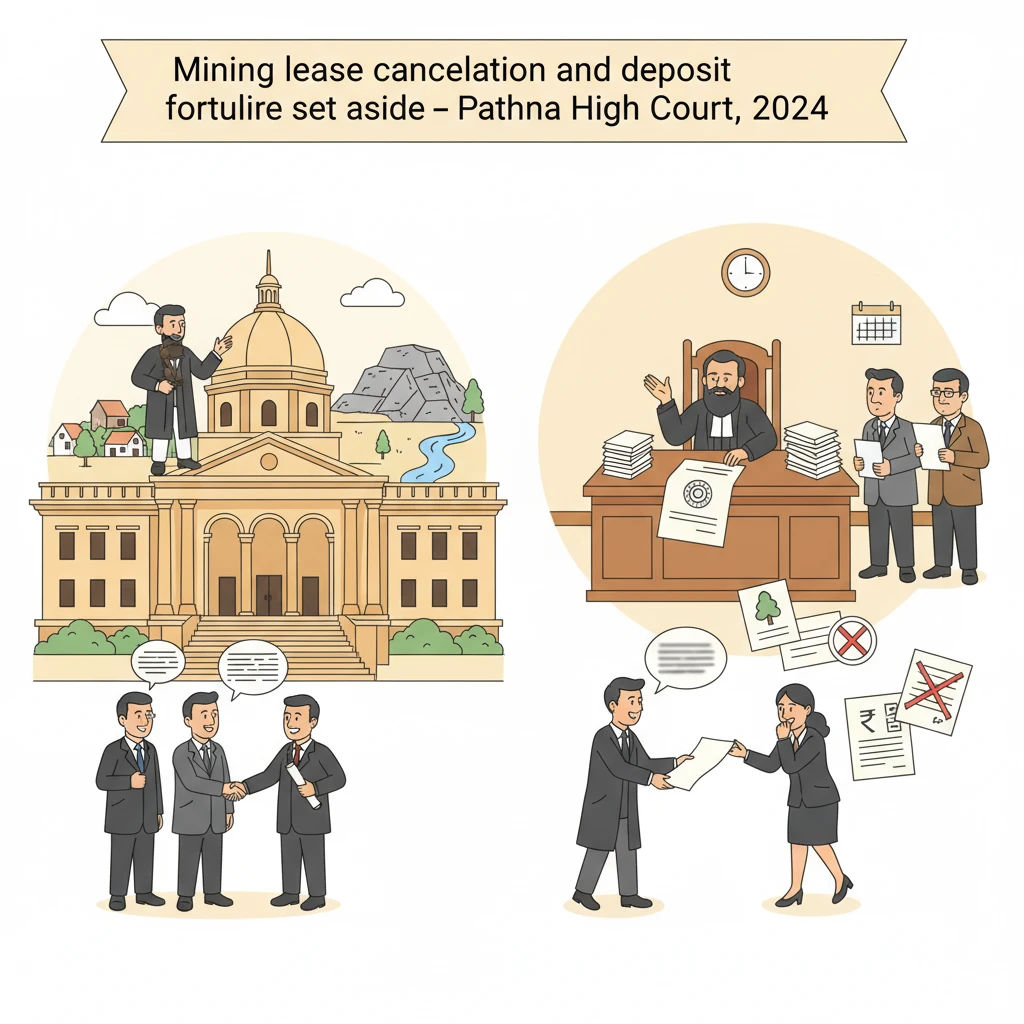
This case arises out of an e-auction held on 24.05.2016 for a stone mining block at village Madurna, Thana Bhabhua, District Kaimur, Bihar.
The petitioner company was declared the highest bidder for the Madurna Stone Mining Project, covering an area of 8.937 hectares with an approximate production of 4,95,285.12 TPA. An initial Letter of Intent (LOI) or “in-principle sanction order” was issued in its favour on 26.07.2016.
The mining plan, including a progressive mine closure plan, was approved by the Department of Mines & Geology on 22.09.2017 and communicated to the petitioner by Letter No. 2857 dated 22.09.2017.
After the LOI, the petitioner started the process of obtaining Environmental Clearance (EC). It approached the State Environmental Impact Assessment Authority (SEIAA), deposited the prescribed fees, and complied with various directions from the forest department and pollution control board. Public hearing on the project was held on 11.09.2020 and the project was appreciated at the local level, mainly for employment potential.
Despite these steps, Environmental Clearance was not finally issued by the Ministry of Environment, Forest and Climate Change (MoEF&CC), Government of India. The petitioner claimed that all required documents and clarifications had been given.
Aggrieved by non-issuance of EC, the petitioner earlier filed CWJC No. 17521 of 2022 before the Patna High Court. On 30.01.2023, that writ petition was disposed with a direction that if the petitioner approached the Principal Secretary, Department of Mines and Geology (respondent no. 3 in that case) with all materials, the authority should decide its request in accordance with law, also keeping in mind a communication dated 27.05.2022, within two months.
Following this order, the petitioner submitted a detailed representation on 18.04.2023 before the Additional Chief Secretary, Department of Mines & Geology.
However, even before this representation could be decided, the District Magistrate-cum-Collector, Kaimur (the competent authority and licensing authority) passed an order dated 24.02.2023 (Memo No. 182/M). By this order the Collector:
- Cancelled the “in-principle approval/settlement” of the Madurna stone block; and
- Forfeited the security deposit of Rs. 51,50,000/-
The main reason given was that even after six years and six to seven months from the LOI, the petitioner had not produced Environmental Clearance, had not deposited the installment amount and other sums, and had not submitted essential documents for execution of the formal lease in Form-B, in violation of Rule 28 of the Bihar Minerals (Concession, Prevention Of Illegal Mining, Transportation & Storage) Rules, 2019.
The petitioner filed an appeal (Appeal No. 2/2023) before the Mines Commissioner, Bihar-cum-Additional Chief Secretary, Department of Mines & Geology. On 11.08.2023, this appeal was rejected and the Collector’s order was affirmed.
Challenging both orders—Collector’s order dated 24.02.2023 and appellate order dated 11.08.2023—and seeking consequential directions for issue of work order and completion of the lease, the petitioner approached the Patna High Court in the present writ petition.
What the Court Examined and Decided
The Patna High Court, through Hon’ble Mr. Justice Purnendu Singh, first recorded the petitioner’s main prayers: quashing the cancellation and forfeiture orders, direction to issue work order, direction to help procure Environmental Clearance, and extension of time to execute the lease even beyond 180 days as permitted under Rule 28 of the 2019 Rules where the settlee is not responsible for delay.
Petitioner’s key submissions
The petitioner argued that it had invested huge amounts, including earnest money of Rs. 5 crores and cost of stone crushing machinery, after the in-principle sanction of 26.07.2016.
According to the petitioner, the delay in issuance of Environmental Clearance was not solely its fault. Different departments and authorities took time at each stage, and the COVID-19 pandemic further slowed all processes worldwide, especially between 2019–2021.
It relied on the earlier High Court order in CWJC No. 17521 of 2022. Under that order, the Principal Secretary/Additional Chief Secretary of the Mines Department was required to take a decision within two months once the petitioner approached with all materials. The petitioner filed a representation on 18.04.2023, but instead of acting on it, the Collector passed the cancellation order on 24.02.2023 and later the appellate authority simply upheld it.
The petitioner complained that the Collector’s order was ex parte, passed without adequate hearing, in disregard of the High Court’s earlier direction and in violation of principles of natural justice. It argued that such an initial illegal action vitiates all subsequent proceedings, relying on State of Punjab v. Davinder Pal Singh Bhullar, (2011) 14 SCC 770.
The petitioner also pointed out that it had complied with the Mining Plan conditions, especially Clause 4 requiring it to obtain relevant approvals. It had submitted the Progressive Mine Closure Plan, obtained forest verification showing the site was 4.8 km from Kaimur forest and 3.2 km from reserved forest, deposited amounts with the pollution control board, participated in public hearing, submitted the District Survey Report (DSR) and other documents, and made multiple representations for early disposal of EC.
It emphasised that the Expert Appraisal Committee (EAC) had once commented about “poor performance” only because an updated, valid LOI was not uploaded—something which depended on action by the State authorities and not on the petitioner alone.
State and Mines Department’s stand
The Mines Department defended the Collector’s and appellate orders. It argued that under Rule 28 of the 2019 Rules (substituting Rule 25(1) of the 1972 Rules), a lease deed must be executed within 180 days from the date of approval of settlement or auction, and that failure to comply justified cancellation.
They contended that the petitioner was repeatedly issued notices (Annexure R/A series) but still did not produce Environmental Clearance, other documents or installments even after 6 years 7 months from the LOI. Hence, the Collector had no option but to cancel the in-principle sanction and forfeit the security deposit by Memo No. 182 dated 24.02.2023.
They asserted that the appellate authority (Additional Chief Secretary) had given the petitioner a hearing and considered all facts before affirming the Collector’s decision. They also stated that no third party rights had yet been created in the mining block.
Court’s analysis on delay, DSR and Environmental Clearance
The Court carefully examined the factual record and the counter affidavit of the respondents. It found that the State had not denied key facts:
- The petitioner’s mining plan and progressive closure plan had been approved.
- The petitioner had made the required presentation before the EAC and a public hearing had been held on 11.09.2020, where the project was appreciated for employment benefits.
- The Divisional Forest Officer had confirmed the distance from forest areas and raised no objection.
- The petitioner had submitted a DSR and other required documents to the competent authorities.
The Court then discussed in detail the Supreme Court’s directions in State of Bihar v. Pawan Kumar (Civil Appeal No. 3661–3662 of 2020, decided on 10.11.2021), which in turn relied on Deepak Kumar v. State of Haryana, (2012) 4 SCC 629.
These decisions require that a valid DSR be prepared before any auction/e-auction or grant of mining lease or LOI. The DSR must be prepared by a Sub-Divisional Committee after site visits, public consultation, and scrutiny by SEAC and SEIAA.
The Court noted that in Bihar, DSRs for sand and stone mining had to be re-done and approved afresh in line with these guidelines. In the present case, the initial auction and LOI of 2016 were based on an earlier DSR. The counter affidavit did not clearly state when the final DSR for this cluster was prepared and approved by SEAC/SEIAA, as required after Pawan Kumar.
Still, the authorities had proceeded with the auction and granted LOI, and all subsequent administrative steps, including Terms of Reference issued on 07.07.2018, public hearing, and further processing of EC, were based on that initial framework. The Court underlined that once the State itself continues on that basis, it cannot penalise the bidder alone for delays largely caused by regulatory and policy shifts.
The Court also took judicial notice of the COVID-19 pandemic between 2019–2021, which affected all governmental functions and further slowed environmental and mining clearances.
On forfeiture of security deposit and legal principles
The Court then examined whether the State could forfeit the petitioner’s security deposit of Rs. 51,50,000/- when no final lease agreement had yet been executed.
Rule 22(6) of the Bihar Minerals (Concession, Prevention of Illegal Mining, Transportation & Storage) Rules, 2019 allows forfeiture of security deposit if the successful bidder fails to deposit the required security deposit and taxes within the prescribed time. Here, however, the petitioner had already deposited earnest money and security. The alleged failure was non-production of Environmental Clearance and related documents, not non-deposit of amounts.
Relying on Supreme Court decisions like Maula Bux v. Union of India, Fateh Chand v. Balkishan Das, and Saurabh Prakash v. DLF Universal Ltd., the Court recalled that forfeiture of deposits is in the nature of penalty and must meet the test of “reasonable compensation” under Section 74 of the Indian Contract Act. Earnest money and security deposit cannot be mechanically forfeited when the contract has not been completed and when the default is not solely on one party.
The Court observed that the petitioner had “almost furnished” all required documents, and the only remaining step was issuance of Environmental Clearance by MoEF&CC. The State’s decision to cancel the in-principle sanction and forfeit security deposit merely on account of delay—much of which was due to departmental processing, policy changes regarding DSR, and COVID-19—was found to be arbitrary.
Natural justice and earlier High Court order
The Court further held that the Collector’s order dated 24.02.2023 was passed without properly considering the earlier High Court order in CWJC No. 17521 of 2022 and without adequately addressing the petitioner’s case.
The representation dated 18.04.2023—filed as per the High Court’s direction—remained pending, but the cancellation had already been ordered earlier on 24.02.2023. The appellate order dated 11.08.2023 also failed to address these aspects. This, according to the Court, violated principles of natural justice and fair play.
The Court referred to Chairman, State Bank of India v. M.J. James, (2022) 2 SCC 201, reiterating that while natural justice is flexible, it is fundamentally about ensuring a just and fair decision. Where a decision causes serious civil consequences like cancellation of mining settlement and forfeiture of large sums, fairness and proper consideration are essential.
Final directions of the Court
After reviewing the entire material, the Patna High Court concluded that interference under Article 226 was justified because the impugned orders had serious civil consequences and were passed in arbitrary exercise of power.
The Court held:
- The Collector’s order dated 24.02.2023 (Memo No. 182) cancelling the in-principle approval/settlement and forfeiting security deposit of Rs. 51,50,000/-; and
- The Mines Commissioner/Additional Chief Secretary’s appellate order dated 11.08.2023 affirming the Collector’s decision;
are set aside and quashed.
In light of the earlier order in CWJC No. 17521 of 2022, the Court directed the Competent Authority-cum-District Magistrate to extend the time and issue work order followed by final settlement of contract of lease, within six weeks.
The Court also addressed the need for a valid, updated DSR in the post-Pawan Kumar framework. It directed that a modified DSR be prepared and, along with a valid LOI and applicable Terms of Reference, be submitted expeditiously to MoEF&CC for Environmental Clearance for the concerned stone cluster.
Recognising that the petitioner had already applied for fresh EC on 19.08.2021 (Annexure P-22) which remained pending, the Court directed MoEF&CC not to delay further and to “take decision to issue Environmental Clearance Certificate forthwith”.
The Court fixed an outer limit of eight weeks from the date of communication of its order for the petitioner and all concerned respondents to complete this entire exercise: modified DSR, submission to MoEF&CC, decision on EC, and thereafter issuance of work order and execution of final lease deed.
The writ petition was accordingly disposed of, with no order as to costs.
Why This Judgment Matters
This judgment is important for mining lease holders and bidders in Bihar who face delays in Environmental Clearance and approvals from multiple departments.
First, the Patna High Court made it clear that when the State itself takes years to process DSRs, Terms of Reference, public hearings and EC proposals, it cannot simply blame the private bidder for delay and cancel the settlement after six or more years.
Second, the Court protected bidders from arbitrary forfeiture of large security deposits when there is no final lease and when the bidder has substantially complied with all requirements. The State must act reasonably and show real loss before forfeiting deposits.
Third, the judgment reinforces that earlier High Court directions must be followed in letter and spirit. Authorities cannot bypass such orders by passing ex parte decisions without considering pending representations.
Fourth, the Court balanced environmental safeguards with the need for legal mining and government revenue, by insisting that a valid, updated DSR and Environmental Clearance be obtained, but also ensuring that this is done quickly and fairly rather than used as a tool to defeat genuine bidders.
For others similarly placed—especially small and medium mining contractors—this decision shows that if they have complied with procedures and delays are due to government inaction or systemic issues (like COVID-19 disruptions), courts can step in to prevent undue financial punishment and cancellation.
Legal Issues and Answers
- Issue: Could the Collector and Mines Department cancel the in-principle approval and forfeit the petitioner’s security deposit for non-production of Environmental Clearance after six years, when the petitioner had substantially completed required formalities and delays were also due to authorities and COVID-19?
Answer: No. The Patna High Court held that the cancellation and forfeiture orders were arbitrary, ignored earlier court directions, and failed to account for the role of the authorities and pandemic-related delays. Both orders were set aside and quashed. - Issue: Was the petitioner entitled to extension of time, issuance of work order, and completion of lease despite expiry of 180 days under Rule 28 of the 2019 Rules?
Answer: Yes. The Court directed the Competent Authority-cum-District Magistrate to extend time and issue work order followed by final settlement of lease within six weeks, noting that Rule 28 permits extension where the settlee is not responsible for delay. - Issue: What steps must be taken regarding District Survey Report and Environmental Clearance in light of Supreme Court decisions in Deepak Kumar and Pawan Kumar?
Answer: The Court ordered preparation and submission of a modified DSR with valid LOI and TOR to MoEF&CC, and directed MoEF&CC to promptly decide and issue Environmental Clearance, so that mining activities can legally commence after completion of all formalities.
Cases Cited by the Court
- State of Punjab v. Davinder Pal Singh Bhullar and others, (2011) 14 SCC 770
- Deepak Kumar v. State of Haryana and Others, (2012) 4 SCC 629
- State of Bihar v. Pawan Kumar and Others, Civil Appeal No. 3661–3662 of 2020, decided on 10.11.2021
- Chairman, State Bank of India and Anr. v. M.J. James, (2022) 2 SCC 201
- Laxminarayan R. Bhattad v. State of Maharashtra, (2003) 5 SCC 413
- South Eastern Coalfields Ltd. v. S. Kumar’s Associates AKM (JV), (2021) 9 SCC 166
- Shrijee Sales Corporation v. Union of India, (1997) 3 SCC 398
- Pawan Alloys and Casting (P) Ltd. v. U.P. SEB, (1997) 7 SCC 251
- STO v. Shree Durga Oil Mills, (1998) 1 SCC 572
- Rajasthan Co-operative Dairy Federation Ltd. v. Maha Laxmi Mingrate Marketing Service (P) Ltd., (1996) 10 SCC 405
- Maula Bux v. Union of India, (1969) 2 SCC 554
- Fateh Chand v. Balkishan Das, (1963) 1 SCR 515 (referred via later cases)
- Saurabh Prakash v. DLF Universal Ltd., (2007) 1 SCC 228
- M.C. Mehta v. Kamal Nath, (1997) 1 SCC 388
- Kasturi Lal Lakshmi Reddy & Ors. v. State of J&K & Anr., (1980) 4 SCC 1
Case Details
Case Number: Civil Writ Jurisdiction Case No. 13213 of 2023
Case Title: M/s Starnet Marketing Private Ltd. v. The State of Bihar & Ors.
Citation: 2024 (4) PLJR 749
Court: High Court of Judicature at Patna
Coram: Hon’ble Mr. Justice Purnendu Singh
Date of Judgment: 09.02.2024 (Uploading Date 20.02.2024)
Advocates:
- For the Petitioner: Mr. Suraj Samdarshi, Advocate; Mr. Jai Vardhan Narayan, Advocate
- For the State: Mr. Gyan Prakash Ojha (GA-7); Ms. Sangha Mitra Ghosh, AC to GA-7
- For the Mines Department: Mr. Naresh Dikshit, Advocate; Mr. Brij Bihari Tiwary, Advocate
Respondents: State of Bihar through Additional Chief Secretary, Department of Mines and Geology; District Magistrate-cum-Collector, Kaimur at Bhabhua; Mineral Development Officer, Department of Mines and Geology, Kaimur at Bhabhua
Nature of Case: Writ petition under Article 226 of the Constitution challenging cancellation of in-principle mining settlement and forfeiture of security deposit; seeking directions for Environmental Clearance, extension of time and execution of mining lease.
Link to Judgment: Click here to read the full Patna High Court judgment
If you found this explanation helpful and wish to stay informed about
how legal developments may affect your rights in Bihar,
you may consider following Samvida Law Associates for more updates.







