

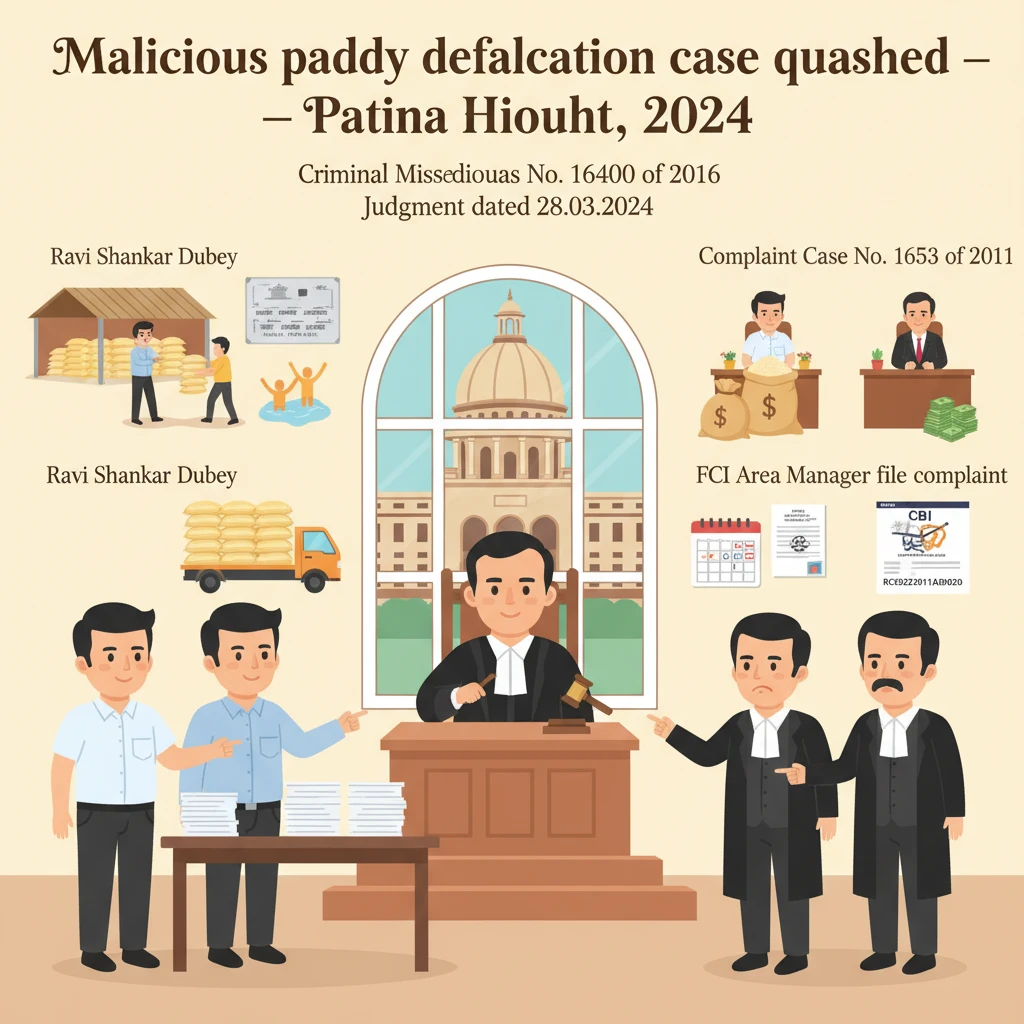
Case Background
The dispute arose from lifting of food grains from a Food Corporation of India (FCI) godown at Koini, Gopalganj.
According to the complaint, the complainant was the Godown Manager of FCI, Koini, Gopalganj. The petitioner was the Godown Manager Incharge of the Bihar State Food Corporation (SFC).
The system described in the complaint was that the petitioner used to lift rice from the FCI godown after depositing the price. For the period between 30.08.2010 and 31.12.2010, the complainant alleged that the petitioner deposited a total sum of Rs. 62,82,212.50 with FCI, Chapra. Against this amount, a delivery order was issued for lifting 58,928.25 quintals of rice.
The complainant further alleged that during this period he became busy with flood relief work. Taking advantage of his engagement in relief work, the petitioner allegedly lifted an additional 11,322 quintals of rice from the godown.
When the complainant confronted the petitioner about this alleged excess lifting, the petitioner is said to have assured him that he would deposit the cost of the extra grains. On this factual basis, Complaint Case No. 1653 of 2011 was filed in the court at Gopalganj.
On 16.03.2013, the Judicial Magistrate, Gopalganj, in TR No. 1566/2013 took cognizance against the petitioner for offences under Sections 406, 420 and 504 of the Indian Penal Code. The present criminal miscellaneous application (Cr. Misc. No. 16400 of 2016) before the Patna High Court sought quashing of that cognizance order.
What the Court Examined and Decided
The Patna High Court, through Hon’ble Mr. Justice Chandra Shekhar Jha, heard the matter on 28.03.2024. The Court heard counsel for the petitioner, the learned A.P.P. for the State, and counsel for opposite party no. 2 (the complainant).
The petitioner’s counsel argued that the complaint was filed by the FCI godown manager in his private capacity, not as an authorised person on behalf of the SFC. It was emphasised that this was not an official complaint by the corporation.
The petitioner’s side pointed out that an in-house inquiry had been initiated by SFC in respect of a defalcated amount of paddy. After this in-house inquiry started, the complainant lodged the present criminal complaint against the petitioner. This sequence was projected as significant, suggesting that the complaint was a reaction to the inquiry.
The Court was also informed that, for the same set of facts, the Area Manager of FCI had already lodged another criminal case. That case was registered as RC0232011A0020 dated 30.11.2011 for offences under Section 120B read with Section 409 of the IPC and Section 13(1)(c) and (d) of the Prevention of Corruption Act, 1988.
This second case was handed over to the Central Bureau of Investigation (CBI) for investigation. Thus there were two parallel tracks: the CBI case arising from an FCI officer’s complaint, and the private complaint case launched by the FCI godown manager.
The petitioner’s counsel submitted that the petitioner was an Assistant Manager of SFC, while opposite party no. 2 (the complainant) was the Manager Incharge. After CBI investigation in RC Case No. 20(A)/2011, the CBI allegedly found the complainant himself to be responsible for the defalcated paddy. A charge-sheet was filed against the complainant for offences under Sections 406 and 420 IPC.
Importantly, in that CBI case, the petitioner was not an accused. Instead, his name appeared as a prosecution witness at serial no. 14 in the list of witnesses.
On these facts, petitioner’s counsel argued that continuing the complaint case against the petitioner was a “classical case of malicious prosecution”. They submitted that since the premier investigating agency had, after full investigation, charge-sheeted the complainant himself for the same occurrence, “nothing survives” against the petitioner in the private complaint.
They therefore urged that the order of cognizance dated 16.03.2013 against the petitioner be set aside and quashed.
On the other side, the learned A.P.P. for the State, assisted by counsel for opposite party no. 2, opposed the quashing application. However, they fairly conceded one key fact: the complaint was lodged after initiation of in-house inquiry against the complainant regarding defalcation of paddy.
This concession supported the petitioner’s narrative that the complaint could be a reaction to the inquiry proceedings and not a neutral attempt to report crime.
The High Court then turned to the settled law on quashing of criminal proceedings. It specifically reproduced paragraph 102 of the Supreme Court’s judgment in State of Haryana and Ors. v. Bhajan Lal and Ors, (1992) Supp (1) SCC 335.
In Bhajan Lal, the Supreme Court had listed illustrative categories of cases where the High Court can use its powers under Article 226 of the Constitution or Section 482 of the Code of Criminal Procedure to quash criminal proceedings. These include situations where:
(i) even if the allegations in the complaint or FIR are taken at face value, they do not disclose any offence,
(ii) the allegations are so absurd or inherently improbable that no prudent person could conclude there is sufficient ground for proceeding, and
(iii) the criminal proceeding is manifestly attended with mala fide or has been maliciously instituted with an ulterior motive, such as to wreak vengeance due to personal grudge.
After reproducing this passage, the Patna High Court applied these principles to the facts before it.
The Court observed that, considering the submissions of the parties, the CBI had found the allegations true against the complainant for the same transaction which formed the basis of the private complaint case. In the CBI case, the petitioner was a prosecution witness, not an accused.
On this basis, the Court held that, prima facie, the present complaint case appeared to be nothing but a malicious prosecution brought by the complainant with an ulterior and oblique motive.
The Court then expressly stated that the present case fell within guideline numbers 1, 5 and 7 of Bhajan Lal. In simple terms, the Court saw this as a situation where:
• the complaint, taken at face value along with surrounding material, did not justify proceeding against the petitioner,
• the allegations were such that a prudent person would not find sufficient ground to continue prosecution, and
• the proceedings were attended with mala fides and were maliciously instituted to harass the petitioner, especially in light of the CBI investigation outcome.
Accordingly, the Court quashed and set aside the impugned cognizance order dated 16.03.2013 passed by the Judicial Magistrate, Gopalganj in TR No. 1566/2013, in so far as it related to the petitioner, along with all consequential proceedings against him.
The criminal miscellaneous application was allowed. The Court directed that a copy of the judgment be sent to the trial court immediately.
Why This Judgment Matters
This judgment is important for employees and officers facing criminal cases that are filed after internal inquiries or official investigations have begun.
The Patna High Court has shown that where a specialised agency like the CBI investigates a case and finds someone else responsible for the alleged offence, a parallel private complaint against a witness in that case can be treated as malicious.
For people working in government corporations and in food grain handling, the decision offers protection against retaliatory criminal cases filed by colleagues or superiors when inquiries tighten around them.
The judgment also reinforces that the High Court will use its powers under Section 482 CrPC to prevent abuse of the criminal court process, especially when the complaint appears to be driven by personal grudge rather than genuine grievance.
Legal Issues and Answers
- Issue: Whether the criminal complaint case alleging criminal breach of trust, cheating and insult against the petitioner should continue when, for the same incident, the CBI had already charge-sheeted the complainant and treated the petitioner as a witness.
Answer: The Patna High Court held that the complaint amounted to malicious prosecution and, applying the Bhajan Lal guidelines, quashed the Magistrate’s order taking cognizance and all proceedings against the petitioner. - Issue: When can the High Court exercise its inherent power to quash criminal proceedings under Section 482 CrPC in cases of alleged defalcation and parallel investigations?
Answer: Relying on Bhajan Lal, the Court clarified that such power can be exercised where the allegations, even if accepted, do not prima facie constitute an offence against the accused, are inherently improbable, or the proceedings are manifestly attended with mala fide and instituted with an ulterior motive.
Cases Cited by the Court
- State of Haryana and Ors. v. Bhajan Lal and Ors, (1992) Supp (1) SCC 335.
Case Details
Case Number: Criminal Miscellaneous No. 16400 of 2016, arising out of Complaint Case No. 1653 of 2011, TR No. 1566/2013.
Case Title: Ravi Shankar Dubey v. The State of Bihar & Chandeshwar Rai.
Citation: 2024(4) PLJR 565.
Coram: Hon’ble Mr. Justice Chandra Shekhar Jha.
Date of Judgment: 28.03.2024.
Advocates: Mr. Mukesh Kant, Advocate for the petitioner; Mr. Md. Arif, A.P.P. for the State; Mr. Lokesh Kumar Singh, Advocate for opposite party no. 2.
Nature of the Case: Criminal miscellaneous application seeking quashing of order taking cognizance in a complaint case under Sections 406, 420 and 504 IPC.
Link to the Judgment: Patna High Court Judgment
If you found this explanation helpful and wish to stay informed about how legal developments may affect your rights in Bihar, you may consider following Samvida Law Associates for more updates.







