
Case Background
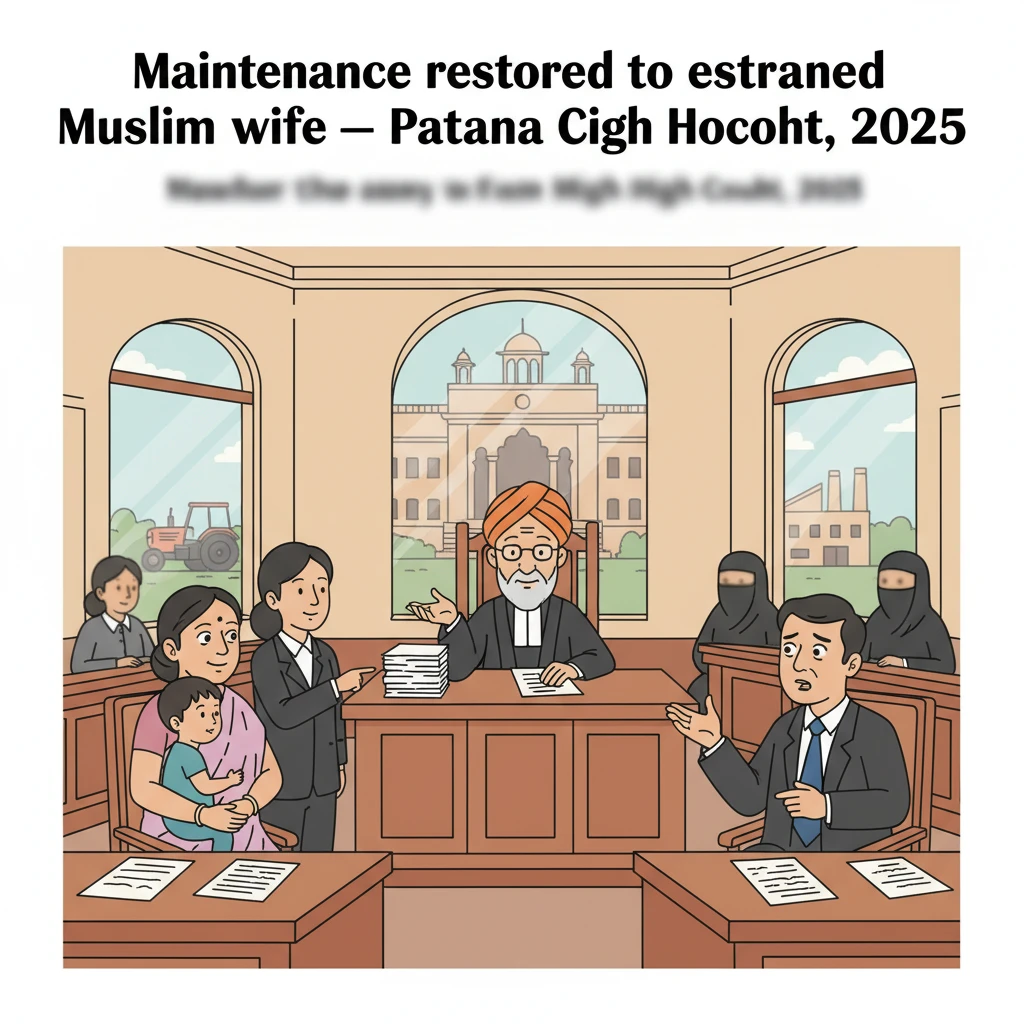
This criminal revision arose from Maintenance Case No. 295 of 2017 filed under Section 125 of the Code of Criminal Procedure (Cr.P.C.) before the Principal Judge, Family Court, Purnia.
The first petitioner, a Muslim woman, married respondent no. 2 on 18.02.2013 as per Muslim rites and customs. After marriage she started living in her matrimonial home. A son, petitioner no. 2, was born in March 2014.
According to the petitioners, during pregnancy she returned to her parental home due to ill behaviour of her husband’s relatives. After the child’s birth, her husband and his family allegedly demanded Rs. 5 lakhs as additional dowry and threatened that if the demand was not met, the husband would marry another woman. On 17.07.2017, she was allegedly ousted from the matrimonial home with the child and her ornaments were taken.
She claimed that the husband later remarried one Kajal Khatoon and stopped maintaining her and their minor son. She asserted that he had about ten acres of agricultural land, a tractor and a corn factory machine, earning about Rs. 5 lakhs annually. She and her minor son sought Rs. 20,000 per month as maintenance.
The husband (respondent no. 2) appeared, admitted the marriage and paternity of the child, but contested the maintenance claim. He alleged that the wife developed an illicit relationship with one Md. Tarikat, left the matrimonial home on 14.06.2017, then left her parental home with him along with the child. He claimed he convened village panchayats on 16.06.2017, 21.06.2017 and 01.07.2017 and was advised to move court.
He then approached Darul Kaja Edara Sharia, Purnia, informed that his wife had “become characterless” and stated that he divorced her. He asserted she had been living with Md. Tarikat since 14.06.2017, that she was no longer his wife, that no dowry was given, and that he was a landless labourer earning about Rs. 3,000–3,500 per month.
After trial, the Family Court on 04.04.2020 rejected the wife’s maintenance claim but granted Rs. 4,000 per month to the minor son from the date of order. Aggrieved, the wife and child filed Criminal Revision No. 509 of 2021 before the Patna High Court seeking Rs. 20,000 per month and setting aside the denial of maintenance to the wife.
What the Court Examined and Decided
Hon’ble Mr. Justice Jitendra Kumar of the Patna High Court heard the criminal revision. The Court first outlined the limited but important revisional jurisdiction under Sections 397 and 401 Cr.P.C. It noted that while the High Court does not normally re-appreciate evidence like an appellate court, it can interfere where findings are based on no evidence, on inadmissible evidence, or are perverse and cause miscarriage of justice.
The Court identified the key questions arising from the pleadings:
- whether the wife had been validly divorced,
- whether she left the matrimonial home without sufficient reason,
- whether she was “living in adultery”,
- whether she was entitled to maintenance and at what amount,
- whether Rs. 4,000 per month to the child was just, and
- whether maintenance should run from the date of application or order.
On evidence, the wife examined herself (P.W. 2), her brother (P.W. 1) and a co-villager from her parental village (P.W. 3). They supported her version of dowry demand, ill-treatment and ouster from the matrimonial home. She admitted in cross-examination that she had lodged a criminal complaint against her husband but no police complaint for assault and had no documents to prove his alleged land or tractor. She firmly denied illicit relationship with Md. Tarikat, denied fleeing with him, denied any panchayat or valid divorce, and denied living with him.
The husband examined seven witnesses, including himself. He produced panchayat documents as exhibits (panchnamas dated 16.06.2017 and 01.07.2017 and an application dated 21.06.2017). In his deposition as OPW-5 he reiterated that the wife fled with Md. Tarikat, that he later remarried and had a daughter from the second marriage, and that he divorced the petitioner through Darul Kaja. He admitted the talaknama did not bear the wife’s signature or thumb impression and that he had not paid dain mehar (denmehar). He also admitted he earned about Rs. 5,000 per month as a labourer.
His supporting witnesses were mostly co-villagers. Some claimed to have seen “illicit relations” between the wife and Md. Tarikat but could not give clear dates, times or concrete particulars and also admitted they had not seen her actually fleeing with him. One witness acknowledged he was only hearsay. Panchnama witnesses confirmed presence at panchayat but also stated that there was no signature of the wife on the panchanama, and one admitted he himself was an accused in the wife’s criminal case under Section 498A IPC.
The High Court then turned to the legal framework under Section 125 Cr.P.C. It reproduced the provision, stressing that:
- a wife unable to maintain herself can claim maintenance from a husband with sufficient means who neglects or refuses to maintain her;
- “wife” includes a divorced woman who has not remarried; and
- a wife is barred from maintenance only if she is “living in adultery”, refuses to live with her husband without sufficient reason, or lives separately by mutual consent.
The Court referred to the landmark judgment in Mohd. Ahmed Khan v. Shah Bano Begum, holding Section 125 Cr.P.C. to be secular and applicable to Muslim divorced women. It then discussed the Muslim Women (Protection of Rights on Divorce) Act, 1986, and the Constitution Bench decision in Danial Latifi v. Union of India, which clarified that a Muslim husband’s responsibility to make a “reasonable and fair provision” for his divorced wife can extend beyond the iddat period if she is unable to maintain herself and has not remarried.
The Court also analysed the legal status of triple talaq. Relying on the Constitution Bench decision in Shayara Bano v. Union of India, it noted that talaq-e-biddat (instant triple talaq) has been declared arbitrary and unconstitutional. Further, under the Muslim Women (Protection of Rights on Marriage) Act, 2019, pronouncement of triple talaq is void and illegal and attracts penal consequences, while the wife remains entitled to subsistence allowance.
The Court then cited the recent Supreme Court judgment in Mohd. Abdul Samad v. State of Telangana, (2025) 2 SCC 49, summarising that Section 125 Cr.P.C. applies to all married women, including Muslim women; applies to all non-Muslim divorced women; and also applies to divorced Muslim women, with the 1986 Act being an additional remedy, not a bar. It emphasised that in cases of illegal divorce under the 2019 Act, a Muslim woman can seek subsistence either under that Act or under Section 125 Cr.P.C.
On quantum of maintenance, the Court relied on the principles laid down by the Supreme Court in Rajnesh v. Neha and other cases, noting that the aim of maintenance is to prevent destitution of the dependent spouse and child, not to punish the other spouse. Factors such as status of parties, reasonable needs, earning capacity and liabilities must be balanced. An able-bodied husband is presumed capable of maintaining his wife and children, and lack of clear income disclosure may invite adverse inference.
The Court then examined whether the triple talaq claimed by the husband was valid. It found that the husband had pronounced triple talaq in one sitting, with only one witness, without paying even a paisa for iddat maintenance or making any provision for the wife’s future, and had not even paid dain mehar. In light of Shayara Bano and the 2019 Act, such triple talaq was held to be illegal and invalid. There was also no pleading or proof of any other legal form of divorce. Therefore, the wife could not be treated as a divorced wife for denying maintenance.
Even assuming divorce for argument’s sake, the Court held that the husband’s liability to maintain his former wife would still continue unless he had made reasonable and fair provision for her during iddat, which he had not done at all.
On the allegation of adultery, the Court stressed the difference between “committing adultery” and “living in adultery”. For denying maintenance, “living in adultery” must mean a continuous course of adulterous conduct, not isolated lapses. Referring to various High Court precedents, the Court held that one or two lapses, or mere suspicion, is not enough.
Applying this law to the facts, the Court found:
- there was no direct, cogent evidence that the wife was living in adultery with Md. Tarikat;
- no one had seen her leaving the matrimonial or parental home with him;
- no criminal complaint had been filed by the husband against Md. Tarikat despite the alleged long-standing relationship; and
- witnesses gave no specific dates, times or concrete details of any alleged adulterous acts, and some were hearsay witnesses.
On the other hand, there was reliable evidence that the wife had been living at her parental home with her minor son, and that she had filed a criminal complaint under Section 498A IPC for cruelty and dowry demands against the husband and others.
The Court concluded that the husband had failed to prove that the wife was living in adultery or that she had left the matrimonial home without sufficient cause. Instead, it accepted that she had been forced to leave due to ill-treatment and illegal dowry demand, and so had just ground to live separately.
The Court then turned to the Family Court’s order. It held that the finding that the wife was “living in adultery” was based on no cogent evidence and amounted to perverse appreciation. Consequently, denial of maintenance to her was unsustainable and had to be set aside.
On quantum, the High Court noted that the husband was working as a labourer and that he had four dependants: the petitioner-wife, their son, his second wife and a minor daughter from the second marriage. The Family Court had already granted Rs. 4,000 per month to the son. In these circumstances, the Court found it just to award Rs. 2,000 per month as maintenance to the wife.
On the starting date, the Court relied on Section 125(2) Cr.P.C. and the Supreme Court’s direction in Rajnesh that maintenance should ordinarily be awarded from the date of application. It therefore directed that both the Rs. 2,000 per month to the wife and Rs. 4,000 per month to the child would be payable from 30.10.2017, the date of filing of the maintenance petition, and not merely from the date of the Family Court’s order.
The criminal revision was allowed. The impugned order was set aside to the extent it denied maintenance to the wife and limited the starting date for the son’s maintenance. The Lower Court Record was ordered to be sent back, and the Registrar General was directed to circulate this judgment to all Family Courts in Bihar and to the Bihar Judicial Academy for training discussions.
Why This Judgment Matters
This judgment is important for Muslim women in Bihar and beyond who are driven out of their matrimonial homes and then denied support on vague allegations of “characterlessness” or triple talaq.
The Patna High Court clearly applied the law that triple talaq is void and illegal and cannot be used as a shortcut to escape maintenance. Even where divorce is claimed, the husband has to show that he has made a fair and reasonable provision for the wife’s future, failing which his duty continues.
The Court also sent a strong message that mere gossip or weak, vague accusations of adultery will not deprive a woman of her right to maintenance. To bar maintenance under Section 125 Cr.P.C., the husband must prove that the wife is “living in adultery” as a continuous course of conduct, which was not done here.
Practically, the judgment reinforces that:
- wives ousted due to dowry demands and cruelty can claim maintenance even if the husband alleges adulterous conduct;
- Family Courts must award maintenance from the date of the application, not just from the date of order; and
- poor or labourer husbands still have a legal responsibility to support their wives and children according to their capacity.
By directing circulation of this judgment to all Family Courts and the Judicial Academy, the Patna High Court has aimed to improve uniformity and sensitivity in maintenance cases across Bihar.
Legal Issues and Answers
- Issue: Was the wife validly divorced by triple talaq and therefore disentitled to maintenance?
Answer: No. The alleged triple talaq in one sitting, without any provision for the wife and without payment of even dain mehar, was illegal and invalid in light of Shayara Bano and the 2019 Act. - Issue: Was the wife “living in adultery” so as to bar her claim under Section 125 Cr.P.C.?
Answer: No. The husband failed to produce cogent, specific evidence of a continuous adulterous relationship. Mere allegations and vague testimony did not prove “living in adultery”. - Issue: Is the wife entitled to maintenance, and from when, and is the maintenance for the child adequate?
Answer: Yes. The wife, having been forced to leave due to ill-treatment and dowry demands and having no means of her own, is entitled to Rs. 2,000 per month from the date of application (30.10.2017). The child’s maintenance at Rs. 4,000 per month is upheld but also made payable from the date of application.
Cases Cited by the Court
- Akalu Ahir and Others v. Ramdeo Ram, (1973) 2 SCC 583
- K. Chinnaswami Reddy v. State of A.P., 1962 SCC OnLine SC 32
- Duli Chand v. Delhi Administration, (1975) 4 SCC 649
- Janta Dal v. H.S. Chowdhary and Others, (1992) 4 SCC 305
- Vimal Singh v. Khuman Singh and Another, (1998) 7 SCC 323
- State of Kerala v. Puttumana I.J. Namboodiri, (1999) 2 SCC 452
- Thankappan Nada and Others v. Gopala Krishnan, (2002) 9 SCC 393
- Jagannath Chaudhary v. Ramayan Singh, (2002) 5 SCC 659
- Bindeshwari Prasad Singh @ B.P. Singh and Others v. State of Bihar (Now Jharkhand) and Another, (2002) 6 SCC 650
- Manju Ram Kalita v. State of Assam, (2009) 13 SCC 330
- Amit Kapoor v. Ramesh Chander, (2012) 9 SCC 460
- Ganesha v. Sharanappa and Another, (2014) 1 SCC 87
- Shlok Bhardwaj v. Runika Bhardwaj and Others, (2015) 2 SCC 721
- Sanjaysinh R. Chavan v. D.G. Phalke, (2015) 3 SCC 123
- Malkeet Singh Gill v. State of Chhattisgarh, (2022) 8 SCC 204
- Mohd. Ahmed Khan v. Shah Bano Begum and Others, (1985) 2 SCC 556
- Danial Latifi v. Union of India, (2001) 7 SCC 740
- Shayara Bano v. Union of India, (2017) 9 SCC 1
- Joseph Shine v. Union of India, (2019) 3 SCC 39
- Mohd. Abdul Samad v. State of Telangana and Another, (2025) 2 SCC 49
- Various High Court decisions on “living in adultery” including:
- Hitesh Deka v. Jinu Deka, 2025 SCC OnLine Gau 259
- Sukhdev Pakharwal v. Rekha Okhale, 2018 SCC OnLine MP 1687
- Ashok v. Anita, 2011 SCC OnLine MP 2249
- Sandha v. Narayanan, 1999 SCC OnLine Ker 64
- Pandurang Barku Nathe v. Leela Pandurang Nathe and Another, 1997 SCC OnLine Bom 264
Case Details
Case Number: Criminal Revision No. 509 of 2021 (arising out of Maintenance Case No. 295 of 2017, District Purnia)
Case Title: Bulbul Khatoon & another v. The State of Bihar & another
Citation: 2025 (3) PLJR 557
Coram: Hon’ble Mr. Justice Jitendra Kumar
Date of Judgment: 07.07.2025 (CAV; CAV date 26.06.2025)
Advocates:
- For the Petitioners: Md. Fazle Karim, Advocate
- For the State: Mr. Anuj Kumar Shrivastava, APP
- For the Informant/Respondent no. 2: Mr. N.K. Agrawal, Senior Advocate; Dr. Bidhu Ranjan, Advocate; Mr. Saroj Kumar Choudhary, Advocate
Nature of the Case: Criminal revision under Section 397 read with Section 401 Cr.P.C. against a Family Court order in a maintenance proceeding under Section 125 Cr.P.C.
Court: High Court of Judicature at Patna
Link to Judgment: Click here to view full Patna High Court judgment
If you found this explanation helpful and wish to stay informed about
how legal developments may affect your rights in Bihar,
you may consider following Samvida Law Associates for more updates.







