
Case Background
The Patna High Court was hearing three connected first appeals: First Appeal No. 361 of 2001, First Appeal No. 375 of 2001 (both from Gopalganj), and First Appeal No. 182 of 2003 (from Buxar).
All three matters arose out of disputes involving wills and probate proceedings under the Indian Succession Act, 1925. In the Gopalganj matters, the challenges were to a judgment and decree dated 22.06.2001 passed by the learned District Judge, Gopalganj in Title Suit No. 27 of 1987 and in Probate Case No. 11 of 1997. In the Buxar matter, the challenge was to the judgment and decree dated 28.05.2003 passed by the learned 1st Additional District Judge, Buxar in Title Suit No. 15 of 1992 arising out of Probate Case No. 21 of 1990.
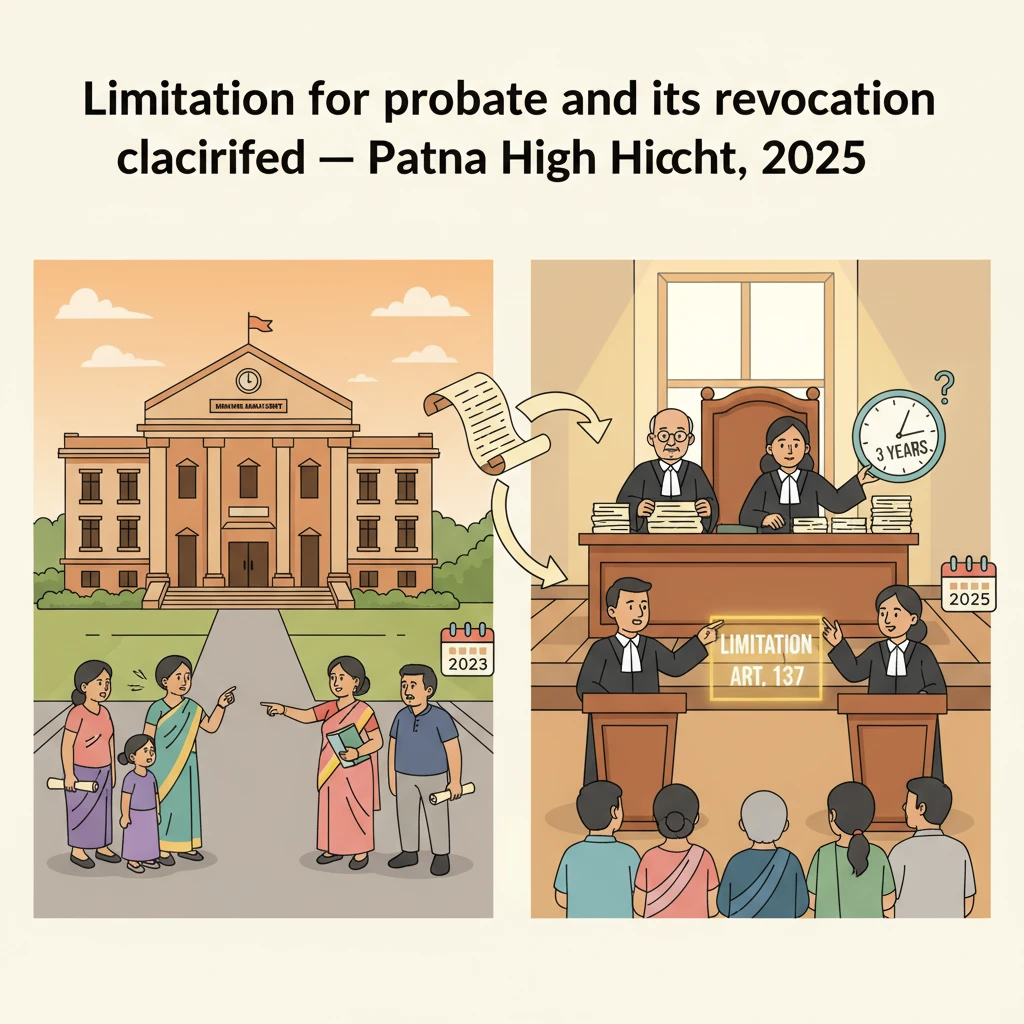
During the hearing of these appeals before a Single Judge, an important legal doubt arose. The question was: when does the “cause of action” arise, that is, from which date should courts calculate limitation for filing a petition for probate or for letters of administration under the Indian Succession Act, in light of Article 137 of the Limitation Act, 1963?
On 27.02.2020, by Order No. 41, the Single Judge framed a reference on this question and, after obtaining permission from the Hon’ble Chief Justice, placed the matter before a Division Bench. The Division Bench, comprising Hon’ble Mr. Justice Bibek Chaudhuri and Hon’ble Mr. Justice Dr. Anshuman, heard all parties together and delivered a CAV judgment on 18.12.2025.
What the Court Examined and Decided
The Division Bench’s task was limited but crucial: to answer the reference on whether Article 137 of the Limitation Act applies to probate matters and, if so, from what point of time the limitation period starts in different types of probate-related proceedings.
At the outset, counsel for the appellants pointed out that earlier a Patna High Court judgment in Ramanand Thakur v. Parmanand Thakur, AIR 1982 Pat 87, had held that no provision of the Limitation Act applied to probate or letters of administration. However, later Supreme Court decisions, especially Kunvarjeet Singh Khandpur v. Kirandeep Kaur, (2008) 8 SCC 463, and Krishna Kumar Sharma v. Rajesh Kumar Sharma, 2009 (3) PLJR 80 (SC), had taken a different view and held that Article 137 does apply.
Counsel for the appellants also relied on the three‑Judge Bench decision in Ramesh Nivrutti Bhagwat v. Dr. Surendra Manohar Parakhe, reported in 2020 (3) BLJ 190 (SC). In that decision, the Supreme Court discussed several earlier rulings, including Kerala State Electricity Board v. T.P. Kunhaliumma, (1977) 1 SCR 996; Sameer Kapoor v. State through Sub‑Divisional Magistrate (South) New Delhi, 2019 Online SCC 630 :: 2019 (4) BLJ 328 (SC); Lynette Fernandes v. Gertie Mathias, 2018 (1) BLJ 92 (SC) :: (2018) 1 SCC 271; and Rukumini Devi v. Narendra Lal Gupta, (1985) 1 SCC 144.
Significantly, learned counsel for the appellants candidly accepted that, in light of Ramesh Nivrutti Bhagwat, the reference would likely be decided against their earlier stand. Yet they considered it their duty to assist the Court by placing the correct legal position.
On the other side, counsel for the respondents in First Appeal Nos. 361 and 375 of 2001 relied on a long list of judgments. Some of these related to limitation and cause of action in other contexts, such as Section 80 of the Code of Civil Procedure or territorial jurisdiction in criminal complaints. The Division Bench carefully went through each citation and explained which ones applied and which did not.
The Court first rejected precedents that were not directly relevant. For example, State of Madras v. C.P. Agencies, AIR 1960 SC 1309 dealt with Section 80 CPC, and Gurdit Singh v. Munsha Singh, AIR 1977 SC 640, discussed limitation in a context other than probate. Similarly, Alchemist Limited v. State Bank of Sikkim, AIR 2007 SC 1812, and Rajiv Modi v. Sanjay Jain, (2009) 13 SCC 241, related to company law and criminal jurisdiction respectively and were found inapplicable.
The Bench then closely examined older decisions which had shaped probate limitation law, such as Ramanand Thakur (Patna High Court) and Vasudev Daulatram Sadarangani v. Sajni Prem Lalwani, AIR 1983 Bom 268. In these cases, it had been held that while Article 137 applied, the right to apply for probate or letters of administration was a “continuous right”. It could be exercised any time after the testator’s death as long as the right and the object of the trust existed. Delay beyond three years was only a factor creating suspicion, not an absolute bar.
The Patna High Court noted that its own earlier decision in Prabhunath Singh & Another v. Sukhdeo Rai (First Appeal No. 102 of 1980) had adopted this reasoning. The right to apply was said to arise when it became “necessary” to apply, not automatically on the date of death, and any delay only had to be explained, not treated as final.
However, the legal landscape changed with subsequent Supreme Court rulings. The Division Bench pointed out that in Kunvarjeet Singh Khandpur and Krishna Kumar Sharma, the Supreme Court clearly held that Article 137 of the Limitation Act applies to applications for grant or revocation of probate and letters of administration. They relied on the earlier Constitution Bench‑type reasoning in Kerala State Electricity Board v. T.P. Kunhaliumma, which had clarified that Article 137 covers applications under any Act, not only under the Code of Civil Procedure.
In Kunvarjeet Singh Khandpur, the Supreme Court described the key phrase “right to apply” and confirmed that Article 137 applies to petitions for grant of letters of administration. It also observed that an application for grant of probate or letters of administration is essentially for recognition by the court to perform a legal duty and is, by nature, a continuous right.
Ramesh Nivrutti Bhagwat, a three‑Judge Bench decision, then considered in detail the provisions of the Indian Succession Act (Sections 228, 263 and 276) and Article 137. It addressed directly the limitation for an application seeking cancellation of letters of administration. The Supreme Court referred to Lynette Fernandes, which had held that a grant of probate operates as a judgment in rem, binding not only on the parties but on the whole world. For the purpose of limitation under Article 137 in revocation proceedings, time starts from the date of grant (subject to disability like minority).
In Lynette Fernandes, the applicant had waited 31 years after attaining majority to challenge the probate. The Supreme Court held that the application was clearly time‑barred and that no acceptable explanation for the delay was offered.
Drawing from this body of law, the Patna High Court identified four types of petitions commonly filed under the Succession Act in relation to wills:
(i) Application for issuance of probate; (ii) Application for issuance of letters of administration; (iii) Application for revocation of probate; and (iv) Application for revocation of letters of administration.
The Division Bench then clearly differentiated between the limitation position for “grant” petitions and for “revocation” petitions.
For applications seeking initial issuance of probate or letters of administration, the Court held that Article 137 applies, but without creating an absolute bar. The right to apply starts from the death of the testator, yet it is a continuing right. It can be exercised any time after death as long as the right survives and the object of the will or trust remains. Here, delay of more than three years does not automatically kill the case. Instead, such delay raises suspicion about the genuineness of the will or the claim. The longer the delay, the stronger the suspicion. The applicant must explain this delay in terms of Sections 4 and 5 of the Limitation Act. Once execution and attestation of the will are proved, the suspicion caused by delay no longer operates.
On the other hand, for applications seeking cancellation or revocation of an already granted probate or letters of administration, the Court followed the stricter line taken by the three‑Judge Bench in Ramesh Nivrutti Bhagwat and Lynette Fernandes. Here, Article 137 creates an absolute bar. If an aggrieved person does not move the court within the three‑year limitation period, counted from the date of grant of probate (subject to normal extension principles for disability), the petition for revocation is barred by time.
The reasoning rests on the nature of a probate decree. Since a grant of probate by a competent court is a judgment in rem, it is binding not only on the parties but against the world at large. Once granted, it confirms the legal character of the executor or administrator. Therefore, there must be certainty, and challenges to such a grant cannot be kept open indefinitely.
Finally, having answered the reference question in these terms, the Division Bench directed that all three first appeals be placed before an appropriate Bench for decision on their individual merits, now guided by the clarified position on limitation.
Before parting, the Court recorded appreciation for the “honest and fair attitude” of the appellants’ counsel, Mr. Vishwajeet Kumar Mishra. Despite knowing that the Supreme Court’s three‑Judge Bench decision went against his clients’ earlier stand, he assisted the Court in placing the correct legal position. The Bench commended his sense of duty and professional commitment.
Why This Judgment Matters
This judgment is important for anyone dealing with wills in Bihar, especially families where a will comes to light many years after the death of the person who made it.
First, it confirms that people can still apply for probate or letters of administration even after three years of the death, but they must be ready to explain the delay. The court will look at the delay with suspicion, but it will not reject the case only because of time.
Second, it draws a strict line for those who want to cancel or revoke an already granted probate. Once a probate has been granted, a person who is unhappy with it normally has only three years from the date of grant to challenge it. If they sleep over their rights beyond that, their challenge may be thrown out as time‑barred.
Third, by following recent Supreme Court rulings, the Patna High Court has brought clarity and uniformity to this area. Earlier confusion from older High Court decisions has now been settled. Lawyers and ordinary citizens can better decide when to file and whether their challenge is still within time.
Legal Issues and Answers
- Issue: Does Article 137 of the Limitation Act, 1963 apply to applications for grant and revocation of probate or letters of administration under the Indian Succession Act, 1925?
Answer: Yes. Article 137 applies both to applications for issuance of probate/letters of administration and to applications for their revocation or cancellation. - Issue: For applications seeking grant of probate or letters of administration, does the three‑year period under Article 137 operate as an absolute bar?
Answer: No. The right to apply is a continuous right starting from the testator’s death. Delay beyond three years only raises suspicion, which must be explained. It is not, by itself, an absolute bar. - Issue: For applications seeking cancellation or revocation of granted probate or letters of administration, what is the effect of Article 137?
Answer: In such cases, Article 137 creates an absolute bar if the concerned party does not approach the court within three years from the date of grant (subject to normal limitation principles). After that, the revocation petition is time‑barred because probate operates as a judgment in rem.
Cases Cited by the Court
- Ramanand Thakur v. Parmanand Thakur, AIR 1982 Patna 87 :: (1982) BLJ 205
- Vasudev Daulatram Sadarangani v. Sajni Prem Lalwani, AIR 1983 Bombay 268
- Prabhunath Singh & Another v. Sukhdeo Rai, First Appeal No. 102 of 1980
- Kunvarjeet Singh Khandpur v. Kirandeep Kaur & Others, (2008) 8 SCC 463
- Krishna Kumar Sharma v. Rajesh Kumar Sharma, AIR 2009 SC 3247 :: 2009 (3) PLJR 80 (SC)
- Ramesh Nivrutti Bhagwat v. Dr. Surendra Manohar Parakhe, 2020 (3) BLJ 190 (SC)
- Kerala State Electricity Board, Trivandrum v. T.P. Kunhaliumma, (1977) 1 SCR 996
- Sameer Kapoor and Another v. State through Sub‑Divisional Magistrate South, New Delhi and Others, 2019 Online SCC 630 (SC) :: 2019 (4) BLJ 328 (SC)
- Lynette Fernandes v. Gertie Mathias, 2018 (1) BLJ 92 (SC) :: (2018) 1 SCC 271
- Rukumini Devi v. Narendra Lal Gupta, (1985) 1 SCC 144
- Smt. Nalini Mishra & Others v. Braj Kishore Mishra, 2010 (4) PLJR 355
- Y. Abraham Ajith and Others v. Inspector of Police, Chennai and Another, AIR 2004 SC 4286 (not applied to present facts)
- Other cited cases on territorial jurisdiction and company law were discussed but held not directly applicable.
Case Details
Case Numbers: First Appeal No. 361 of 2001; First Appeal No. 375 of 2001; First Appeal No. 182 of 2003
Case Titles:
First Appeal No. 361 of 2001: Arun Kumar v. Smt. Nirmal Devi & Others
First Appeal No. 375 of 2001: Arun Kumar v. Smt. Nirmal Devi & Others
First Appeal No. 182 of 2003: Smt. Usha Devi & Others v. Dina Nath Prasad
Coram: Hon’ble Mr. Justice Bibek Chaudhuri; Hon’ble Mr. Justice Dr. Anshuman
Citation: 2026 (1) PLJR 507
Date of Judgment: 18.12.2025
Advocates:
In First Appeal No. 361 of 2001 (Appellant: Arun Kumar): Mr. Vishwajeet Kumar Mishra, Advocate
For Respondents: Mr. Shashi Shekhar Dvivedi, Senior Advocate; Mr. Parth Gaurav, Advocate; Mr. Anshu Raj Singh, Advocate; Mr. Aditya Singh, Advocate; Mr. Rahul Kumar, Advocate; Mr. Ashutosh Kumar Pandey, Advocate
In First Appeal No. 375 of 2001 (Appellant: Arun Kumar): Mr. Vishwajeet Kumar Mishra, Advocate
For Respondents: Mr. Shashi Shekhar Dvivedi, Senior Advocate; Mr. Parth Gaurav, Advocate; Mr. Anshu Raj Singh, Advocate; Mr. Aditya Singh, Advocate; Mr. Rahul Kumar, Advocate; Mr. Ashutosh Kumar Pandey, Advocate
In First Appeal No. 182 of 2003 (Appellants: Smt. Usha Devi & Others): Mr. B.M. Kumar Singh, Advocate
For Respondent: Mr. Rajni Kant Jha, Advocate; Mr. Shantanu Bhattacharjee, Advocate; Mr. Prisu Snehil, Advocate; Mr. Aman Anand, Advocate
Nature of Case: Reference on limitation in three connected first appeals arising out of title suits and probate cases under the Indian Succession Act, 1925 (civil appeals on probate/letters of administration issues)
Link to Judgment: Full text of Patna High Court judgment
If you found this explanation helpful and wish to stay informed about
how legal developments may affect your rights in Bihar,
you may consider following Samvida Law Associates for more updates.







