
Case Background
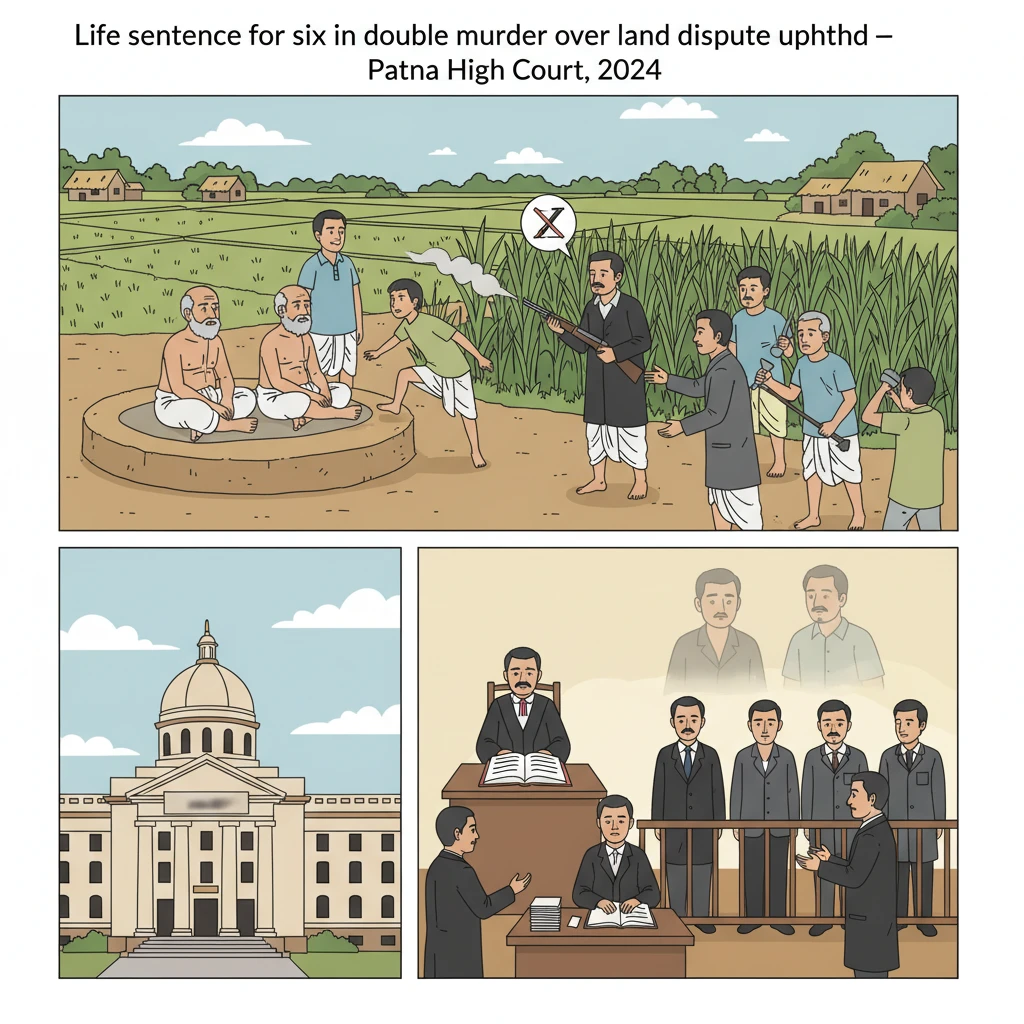
The case arises from a violent incident on 08.09.2016 at Chhathia Ghat Chabutra, near village Basantpur, P.S. Sathi, District West Champaran. According to the prosecution, the informant Mannan Yadav was sitting on a platform at the ghat with his father Jhapas Yadav and uncle Jhagru Yadav after inspecting their agricultural field.
Around 5:15 p.m., a group of villagers, including the six appellants and other co-accused, allegedly surrounded them. The informant claimed that the attack was linked to a long-standing land dispute between the two sides. His grandfather had got some land registered from “Mishraji and Koina Ji”, which had led to recurring quarrels, panchayats and threats.
During the attack, firearms and traditional weapons like farsa, bhala and lathi were allegedly used. The informant managed to escape and hid in a nearby field, while his father and uncle were brutally assaulted. Co-villagers later helped take the injured to Chanpatia Hospital and then to Bettiah. Jhapas Yadav died on the way to Bettiah, and Jhagru Yadav died at MJK Hospital, Bettiah, when being lifted into an ambulance for referral to Patna.
On the basis of the fardbeyan of Mannan Yadav recorded at 23:50 hours on 08.09.2016 near the emergency ward of MJK Hospital, Sathi P.S. Case No. 118 of 2016 was registered on 09.09.2016 under Sections 147, 148, 149, 341, 323, 324, 302 and 504 of the Indian Penal Code and Section 27 of the Arms Act against 11 named accused persons and 4–5 unknown persons.
After investigation, charge-sheet was submitted only against the six appellants, keeping investigation pending against the remaining co-accused. The Magistrate took cognizance and committed the case to the Court of Session. In Sessions Trial No. 418 of 2017, charges were framed for offences under Sections 147, 148, 341/149, 302/149 of the Indian Penal Code and Section 27(3) of the Arms Act, 1959.
On 22.04.2019, the Additional Sessions Judge, FTC-II, West Champaran at Bettiah convicted all six appellants. On 26.04.2019, the Court sentenced each of them to one year rigorous imprisonment under Section 147 IPC and life imprisonment with fine of Rs. 5,000/- each under Section 302 IPC. In default of payment of fine, they were to undergo three months’ further rigorous imprisonment. Appellant Garjan Yadav received an additional two years rigorous imprisonment under Section 148 IPC, and appellant Dhruv Yadav three years rigorous imprisonment and Rs. 5,000/- fine under Section 27 of the Arms Act. All sentences were to run concurrently.
The six convicts filed separate criminal appeals (DB) before the Patna High Court, which were heard together and decided by a Division Bench on 11.09.2024.
What the Court Examined and Decided
The Patna High Court carefully examined the trial record: nine prosecution witnesses, five defence witnesses, several documents including postmortem reports, the FIR, seizure lists, and multiple earlier FIRs filed between the parties.
The core prosecution story came from the informant (P.W.-6) and five other non-official witnesses (P.W.-1 to P.W.-5). The defence argued that these witnesses were either “chance witnesses” or interested relatives and therefore unreliable. They also claimed that the appellants were elsewhere at the time of the incident, putting forward several alibi witnesses.
The Bench first clarified some basic legal principles for assessing evidence. It noted that a “chance witness” is not automatically unreliable; rather, the Court must see whether his presence at the spot is naturally and convincingly explained. Similarly, testimony from relatives of the deceased cannot be thrown out merely because of relationship; courts simply need to exercise extra caution while weighing such evidence.
The judges also recalled that minor contradictions or omissions in witness statements are common and do not, by themselves, destroy the prosecution case. Normal errors of observation, memory lapses due to time, panic at the time of crime, and the rustic background of village witnesses must all be kept in mind.
On defects in investigation, the Court stated that even a poor or negligent investigation cannot be a reason to acquit an accused, unless those defects cause real prejudice. The trial must rest on the totality of evidence, not on the perfection or otherwise of the investigation.
Turning to the specific evidence, the Bench analysed each key witness in detail.
Informant Mannan Yadav (P.W.-6) repeated in Court what he had said in his fardbeyan. He described sitting with his father and uncle at Chhathia Ghat Chabutra, the arrival of all appellants and co-accused, the exhortation by appellant Dhruv Yadav to kill them for pursuing the land case, and the first gunshot fired at his father’s leg. He stated that he fled when firing started, hid in nearby fields, and from there saw further firing and assaults with lathi, bhala and farsa. He returned after about half an hour to find his father dead and uncle unconscious, and saw police present at the spot.
In cross-examination, the defence questioned him on prior criminal cases involving his father and uncle, trying to show they were criminals killed in some family partition dispute. He admitted earlier litigations between the two groups and that his father and uncle had gone to jail in an earlier murder case, but he firmly denied any internal family killing or false implication of the appellants. He also denied suggestions that he was absent from the scene or that specific accused were named only because of enmity.
P.W.-1 Tara Devi, an illiterate grass cutter and aunt of the informant, said she was cutting grass near the Chabutra when the accused emerged from the sugarcane field carrying gun, farsa and gadasa. She saw them “cutting the victims like a butcher” and then ran to the village raising alarm. She denied that she was deposing falsely due to past cases allegedly lodged against her. Her presence near the field was natural and consistent with other evidence.
P.W.-2 Rajdeo Pandit testified that he had gone to see his batai land at Chhathia Ghat when he saw Dhruv Yadav carrying a gun and others with weapons. According to him, Dhruv ordered that Jhapas and Jhagru be killed for not allowing them to plough the land and fired, hitting Jhapas in the leg. He heard three shots and later came to know both victims had died. In cross-examination, he stood by his account, though he could not remember which accused carried which weapon—something the Court treated as a minor inconsistency.
P.W.-3 Megha Yadav, cousin of the deceased, testified that around 18 people were at the scene, including 11 accused and several grass cutters and passers-by. He said that Dhruv and Rajendra Yadav fired from 5–10 “deg” (short distance), that the pellets passed through Jhagru’s thigh, and that others assaulted with farsa and lathi, breaking Jhapas’s limbs. He confirmed earlier criminal litigation between his family and appellant Dhruv but firmly denied that internal family members had killed the deceased.
P.W.-4 Binod Yadav, who was grazing his buffalo nearby, also fully supported the prosecution. He said he saw the attack after hearing cries, saw Dhruv firing first, and identified all appellants. He stated that police seized four live cartridges at the spot in his presence and that he signed the seizure list. He placed Tara Devi, Megha, Mannan and others at specific positions around the Chabutra and stated clearly that he had no litigation with the accused.
P.W.-5 Dinanath Rai explained that he had gone from his own village to Binod’s house to purchase a buffalo and followed Binod to the grazing spot. As he moved back after checking the buffalo, he saw Dhruv, Garjan, Ramdat, Guddu, Ramparsan, Shivparsan and others coming out of the sugarcane field with guns and other weapons. He described Dhruv’s exhortation and firing at Jhapas, followed by assaults with lathi, garansa and bhala. In cross-examination, he clarified the layout of the area and firmly denied the suggestion that he was not present.
On medical evidence, P.W.-7 Dr. Sanjay Kumar Gupta conducted the postmortem on both deceased. For Jhapas Yadav he found lacerated wounds on the skull and multiple wounds and fractures on both arms and the left leg, including a “punctured lacerated wound with inverted irregular margin” on the leg, consistent with firearm injury, besides injuries from hard blunt and sharp objects. For Jhagru Yadav he found abrasions and fractures on the arm and leg, and punctured lacerated wounds on the thigh and leg, caused by hard blunt and sharp objects. He opined that death in both cases was due to haemorrhage and shock and that the injuries were antemortem. He did not, however, recover any pellets from the bodies.
P.W.-8 Dr. Vijay Kumar, under whom the postmortems were conducted, proved the signatures of the doctors on the postmortem reports and confirmed the findings.
P.W.-9 Manjar Alam, the Investigating Officer, described the place of occurrence: a Chabutra under a pipal tree at Chhathia Ghat near Sikrahana river, surrounded by land of Dhruv Yadav to the north, sugarcane field of deceased Jhapas to the south, river to the east and land of Bhola Yadav to the west. He confirmed finding blood at the spot and seizing four live cartridges in presence of Binod and Dadan Yadav. He also stated that he recorded the statements of Tara Devi, Megha, Rajdeo, Dinanath and others at the place of occurrence and that they supported the informant’s account.
The defence tried to establish alibis for different appellants through D.W.-1 to D.W.-5, saying some were at court, some at Saidpur working as labourers, and some at the house of Sabhapati Yadav for marriage talks. However, on cross-examination these witnesses appeared unsure about basic details like dates, names of house owners, number of persons present, and time periods. Some admitted they had come to depose at the instance of particular appellants and not on court summons. One defence witness also disclosed that appellant Dhruv was his relative (father-in-law of his daughter).
The Bench found these defence witnesses unreliable and held that the plea of alibi was not proved with the strict scrutiny required by law. It also noted that none of the appellants had mentioned such alibi in their statements under Section 313 Cr.P.C., where they merely said that the prosecution evidence was false.
After weighing all material, the Court concluded that:
- All six non-official prosecution witnesses were natural witnesses whose presence at the scene was convincingly explained.
- Their testimonies were broadly consistent, inspired confidence and were corroborated by medical evidence and the site inspection.
- Minor discrepancies did not affect the core story of a group attack using firearms and sharp weapons, leading to the death of both victims.
- There was a clear and strong motive—long-standing land dispute and repeated litigations between the two groups.
- The investigation did not suffer from such defects as to create reasonable doubt; FIR and inquest reports were timely, and there was no delay in sending the FIR to the Magistrate.
Accordingly, the Patna High Court held that the prosecution had proved the case beyond all reasonable doubt. It affirmed the findings of guilt under Sections 147 and 302/149 IPC for all appellants, Section 148 IPC for Garjan Yadav, and Section 27 Arms Act for Dhruv Yadav, and upheld the sentences imposed by the trial court. All four criminal appeals were dismissed, with the appellants continuing in custody.
Why This Judgment Matters
This judgment is important for families involved in violent land disputes in rural Bihar. It shows that even when there is long-standing enmity and many cross-cases between two sides, a court can still rely on eye-witnesses if their presence is natural and their stories are consistent.
The Patna High Court explains in simple terms that relatives of the victim and so-called “chance witnesses” are not automatically disbelieved. What matters is whether their version matches medical evidence and the physical facts on the ground. Small mistakes in their memory, especially for poor and illiterate villagers, do not save the accused if the main story is clear.
The decision also underlines that claiming to be elsewhere (alibi) is serious business. Such a plea must be supported by strong and specific evidence. Vague statements from friendly witnesses, without proper details or earlier mention in statements under Section 313 Cr.P.C., will not be accepted.
For victims of similar crimes, the ruling reinforces that timely reporting, consistent statements, and cooperation with the investigation can lead to conviction, even years later. For accused persons, it is a reminder that courts will look at the totality of evidence, not only at technical defects or minor gaps in the investigation.
Legal Issues and Answers
- Issue: Whether the conviction of the appellants for rioting and double murder under Sections 147 and 302/149 IPC, and of two appellants under Section 148 IPC and Section 27 Arms Act, was sustainable on the evidence on record.
Answer: Yes. The Court held that consistent eye-witness accounts, supported by medical and investigative evidence and a clear land-dispute motive, proved the charges beyond reasonable doubt. - Issue: Whether the testimonies of related and “chance” witnesses, and minor contradictions, made the prosecution case unreliable.
Answer: No. The Court ruled that relationship alone does not discredit a witness, chance witnesses can be relied on if their presence is explained, and minor discrepancies that do not touch the core of the case are natural and do not warrant acquittal. - Issue: Whether alleged defects in investigation and the appellants’ plea of alibi created reasonable doubt.
Answer: No. The Court found no major investigative defect causing prejudice and held that the alibi was not proved by cogent evidence, particularly because such plea was not even raised in statements under Section 313 Cr.P.C.
Cases Cited by the Court
- The judgment refers to several Supreme Court and High Court decisions on chance witnesses, related witnesses, contradictions in evidence, defects in investigation, plea of alibi, and standard of proof, including:
- Ravi Mandal Vs. State of Uttrakhand, AIR 2023 SC 2554
- Baby @ Sebastian & Anr. Vs. Circle Inspector of Police, Adimaly, (2016) 13 SCC 333
- Jarnail Singh Vs. State of Punjab, (2009) 9 SCC 719
- Sarvesh Narain Shukla Vs. Daroga Singh, (2007) 13 SCC 360
- Acharaparambath Pradeepan Vs. State of Kerala, (2006) 13 SCC 643
- Sachchey Lal Tiwari Vs. State of U.P., (2004) 11 SCC 410
- Harjinder Singh Vs. State of Punjab, (2004) 11 SCC 253
- State of A.P. Vs. K. Srinivasulu Reddy, (2003) 12 SCC 660
- Shankarlal Vs. State of Rajasthan, (2004) 10 SCC 632
- Satbir Vs. Surat Singh, (1997) 4 SCC 192
- Abhishek Sharma Vs. State (NCT of Delhi), 2023 SCC OnLine SC 1358
- Yogesh Singh Vs. Mahabeer Singh & Ors., (2017) 11 SCC 195
- Mano Dutt and another Vs. State of Uttar Pradesh, (2012) 4 SCC 79
- State Vs. Saravanan, AIR 2009 SC 152
- State of U.P. Vs. Kishanpal, (2008) 16 SCC 73
- Namdeo Vs. State of Maharashtra, (2007) 14 SCC 150
- State of A.P. Vs. S. Rayappa, (2006) 4 SCC 512
- Pulicherla Nagaraju Vs. State of A.P., (2006) 11 SCC 444
- Harbans Kaur Vs. State of Haryana, (2005) 9 SCC 195
- Hari Obula Reddy and Ors. Vs. State of Andhra Pradesh, (1981) 3 SCC 675
- Piara Singh and Ors. Vs. State of Punjab, (1977) 4 SCC 452
- C. Muniappan & others Vs. State of T.N., (2010) 9 SCC 567
- State of U.P. Vs. Krishan Master, AIR 2010 SC 3071
- Appabhai & Anr. Vs. State of Gujrat, AIR 1988 SC 696
- Shivaji Sahebrao Bobade & Anr Vs. State Of Maharashtra, 1973 AIR 2622
- State of Madhya Pradesh Vs. Dal Singh, (2013) 14 SCC 159
- Smt. Shamim Vs. State (GNCT of Delhi), 2018 (4) PLJR 160
- S. Govidaarju Vs. State of Karnataka, 2013 (10) SCALE 454
- Narotam Singh vs. State Of Punjab And Anr., AIR 1978 SC 1542
- Leela Ram Vs. State of Haryana, (1999) 9 SCC 525
- Subal Ghorai and Ors. Vs. State of West Bengal, (2013) 4 SCC 607
- Ranjeet Kumar Ram @ Ranjeet Kumar Das Vs. The State of Bihar, 2015 (2) PCCR 416
- Sukhdeo Yadav & Ors. Vs. State of Bihar, (2001) 8 SCC 86
- Binay Kumar Singh Vs. State of Bihar, (1997) 1 SCC 283
- Kamal Prasad Vs. State of Chhattisgarh, (2023) 10 SCC 172
- Collector of Customs Vs. D. Bhoormal, (1972) 2 SCC 544
- Kali Ram Vs. State of HP, (1973) 2 SCC 808
- Dharm Das Wadhwani Vs. State of U.P., (1974) 4 SCC 267
- Dilavar Hussain Vs. State of Gujarat, (1991) 1 SCC 253
- Narender Kumar Vs. State (NCT of Delhi), (2012) 7 SCC 171
Case Details
Case Numbers: Criminal Appeal (DB) No. 615 of 2019; Criminal Appeal (DB) No. 591 of 2019; Criminal Appeal (DB) No. 719 of 2019; Criminal Appeal (DB) No. 748 of 2019, all arising out of Sathi P.S. Case No. 118 of 2016 and Sessions Trial No. 418 of 2017.
Case Title: Shambhu Yadav vs. The State of Bihar; Banka Yadav vs. The State of Bihar; Dhruv Yadav @ Dhrup Yadav & Ors. vs. The State of Bihar; Guddu Yadav vs. The State of Bihar.
Citation: 2024 (4) PLJR 147.
Court: High Court of Judicature at Patna.
Coram: Hon’ble Mr. Justice Ashutosh Kumar and Hon’ble Mr. Justice Jitendra Kumar (CAV Judgment delivered by Hon’ble Mr. Justice Jitendra Kumar).
Date of Judgment: 11.09.2024.
Advocates for Appellants: In Criminal Appeal (DB) No. 615 of 2019 and No. 748 of 2019: Mr. Bimlesh Kumar Pandey, Mr. Vikash Shukla, Mr. Krishnakant Pandey, Mr. Mithilesh Kumar, Ms. Anjali Kumari, Advocates. In Criminal Appeal (DB) No. 591 of 2019: Mr. Umesh Chandra Verma, Mr. Abhishek Kumar, Ms. Rashmi Jha, Mr. Hemant Ray, Advocates. In Criminal Appeal (DB) No. 719 of 2019: Mr. Uday Pratap Singh, Ms. Bharti Rai, Mr. Rajesh Kumar, Advocates.
Advocate for the State: Mr. Abhimanyu Sharma, APP, in all appeals.
Nature of Case: Criminal appeals (Division Bench) against judgment of conviction and order of sentence for offences under the Indian Penal Code and Arms Act arising from a double murder related to land dispute.
Link to Judgment: Click here to read the full Patna High Court judgment
If you found this explanation helpful and wish to stay informed about how legal developments may affect your rights in Bihar, you may consider following Samvida Law Associates for more updates.







