
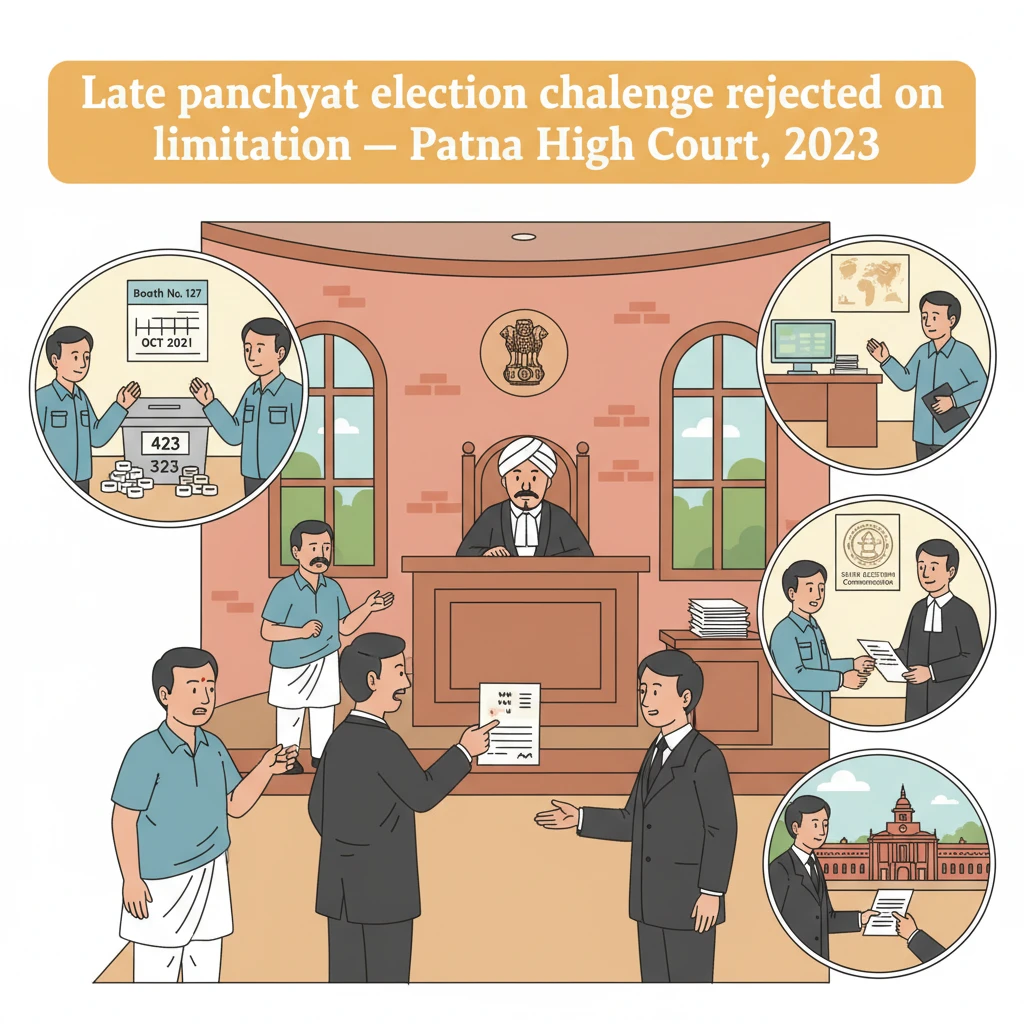
Case Background
The dispute arises from the Gram Panchayat Election, 2021 for the post of Mukhiya of Ratni Faridpur Gram Panchayat in Jehanabad district. The polling took place on 08.10.2021 along with elections for Panchayat Samiti Member, Ward Member, Sarpanch and Panch.
Counting of votes for all these posts was conducted together on 10.10.2021. On the same day, the results were declared. The petitioner had contested for the post of Mukhiya but lost. Respondent no. 7 was declared elected Mukhiya.
According to the petitioner, the voter turnout report for Booth No. 127 showed that 423 votes were polled. For other posts, all 423 votes were counted. But for the Mukhiya post, only 323 votes were counted. The petitioner claimed that this difference of 100 votes was due to manipulation and corrupt practice in counting and totalling of votes.
The petitioner says he objected immediately during counting, but his objection was ignored. He then submitted a written objection to the Block Development Officer-cum-Block Returning Officer, Ratni, pointing out the alleged irregularities in counting.
When no action followed, he filed another application before the Secretary, State Election Commission, Bihar, again alleging corrupt practice and manipulation of vote numbers that resulted in the declaration of respondent no. 7 as Mukhiya.
Relying on a Full Bench judgment of the Patna High Court in Rajani Kumari Vs. The State of Bihar and Others, reported in 2019 (4) PLJR 673, the petitioner filed a complaint before the State Election Commission on 19.10.2021 seeking that the Mukhiya election of 2021 for Ratni Faridpur be declared null and void.
As no decision came from the State Election Commission, the petitioner approached the Patna High Court in CWJC No. 18740 of 2021 seeking directions for adjudication of his complaint. On 30.11.2021, that writ petition was dismissed as not maintainable.
Thereafter, the petitioner received a letter, Memo No. 2157 dated 13.12.2021, from the Returning Officer (Panchayat)-cum-Block Development Officer, Ratni Faridpur. The memo stated that necessary correction on the online portal had been done. The petitioner treated this memo as an admission of mistakes and manipulation in counting, and as the point when a fresh cause of action arose.
He then filed Election Petition Case No. 25 of 2021 before the Civil Judge (Junior Division), Election Tribunal, Jehanabad, on 24.12.2021, challenging the Mukhiya election result.
The Election Tribunal dismissed the election petition at the admission stage by order dated 10.01.2022. It held that the petition was barred by limitation because it had been filed beyond the period prescribed under Rule 106 of the Bihar Panchayati Election Rules, 2006, which allows 30 days from the date of declaration of the election result.
Aggrieved, the petitioner filed the present writ petition, CWJC No. 2760 of 2022, before the Patna High Court challenging the Tribunal’s order of dismissal and seeking a direction to hear the election petition on merits.
What the Court Examined and Decided
Justice Harish Kumar of the Patna High Court heard the matter and focused on one central question: whether the Election Tribunal could condone the delay in filing the election petition by applying the Limitation Act, 1963, or whether it was strictly bound by Rule 106 of the Bihar Panchayat Election Rules, 2006.
The petitioner argued that his election petition was within time if limitation was counted from 13.12.2021, the date of Memo No. 2157, rather than from the date of result declaration, 10.10.2021. He claimed that only when he received this memo did a cause of action truly arise, because it allegedly showed that the authorities had admitted manipulation in counting of votes.
On this basis, he contended that the Election Tribunal should have treated 13.12.2021 as the starting point for limitation. Counting 30 days from that date, the filing of the election petition on 24.12.2021 would then be within time.
The petitioner also attacked the Tribunal’s reliance on Kailash Vs. Nankhu and Others, AIR 2005 SC 2441, and Md. Zakir Hussain Vs. Hareshwar Prasad Singh and Others, 2002 (1) BLJR 102. He pointed out that those decisions concern the applicability of the Code of Civil Procedure to election proceedings, not limitation. Therefore, according to him, they were not relevant for rejecting his case as time-barred.
Further, the petitioner relied on the Supreme Court judgment in Shaik Saidulu @ Saida Vs. Chukka Yesu Ratam and Others. He read this judgment as saying that in exceptional circumstances the statutory period of limitation for filing an election petition can be relaxed by applying Section 5 of the Limitation Act, which allows condonation of delay.
He cited the Supreme Court’s discussion in that case about the importance of not allowing elections to be insulated from challenge simply due to technicalities, especially where the State’s own actions prevent timely filing before a properly constituted tribunal.
Lastly, the petitioner invoked the Supreme Court’s suo motu order in “Re-Cognizance For Extension Of Limitation”, Suo Motu Writ Petition (C) No. 3 of 2020, where limitation was extended due to the Covid-19 pandemic. He argued that this general extension, even for special laws, should favour his petition.
On the other hand, the State Election Commission opposed the writ petition. Its counsel pointed to Section 137(1) of the Bihar Panchayat Raj Act, 2006, which provides the forum for election petitions, and Rule 106 of the Bihar Panchayati Election Rules, 2006, which governs the time limit.
Rule 106 clearly states that an election petition against any elected candidate may be filed under Section 137 before the prescribed court of law within 30 days from the date of declaration of the election result. There is no provision empowering the Tribunal to condone delay. According to the Commission, this shows that the legislature intentionally made the 30-day period strict and non-extendable.
The Commission submitted that the Limitation Act does not apply to election petitions under the Bihar Panchayat Raj Act and Rules, which form a complete self-contained code. It relied heavily on the Supreme Court decision in Hukumdev Narain Yadav Vs. Lalit Narain Mishra, (1974) 2 SCC 133, where it was held that Section 5 of the Limitation Act does not apply to election petitions under the Representation of the People Act.
Counsel for respondent no. 7, the returned Mukhiya, supported the State Election Commission’s stand. He also relied on the Patna High Court judgment in Ramesh Singh Vs. The State of Bihar and Others, 2013 (2) PLJR 160. In that case, the Court had held that where the legislature fixes a limitation period for filing an election petition but does not provide any power to condone delay, the election court cannot resort to the general provisions of the Limitation Act to entertain a belated petition.
After hearing both sides, the Patna High Court first examined the nature of the Bihar Panchayat Raj Act, 2006 and the Bihar Panchayati Election Rules, 2006. It observed that the provisions relating to filing and trial of election petitions form a complete code. These provisions create rights, specify how those rights are to be enforced, and confer jurisdiction on a special Election Tribunal to the exclusion of all other courts.
The Court then closely read Rule 106. It noted that the Rule, in clear and unambiguous terms, requires that an election petition under Section 137 must be filed within 30 days from the date of declaration of the election result. Unlike some other statutes, there is no proviso or accompanying provision allowing condonation of delay. Because of this, the Court held that the 30-day period prescribed in Rule 106 is mandatory.
Turning to the Limitation Act, the Court referred to settled legal principles that the Act applies to all civil proceedings and some special criminal proceedings unless expressly or impliedly excluded. However, where a special law is a complete and self-contained code, like the Representation of the People Act, the Limitation Act will not apply unless clearly incorporated.
The Court relied on the Supreme Court’s decision in Hukumdev Narain Yadav and its reasoning that Section 5 of the Limitation Act does not govern the filing or trial of election petitions. It reaffirmed the principle that special legislation prevails over general law, especially where the special statute comprehensively regulates the area.
Applying these principles, the Court held that the Bihar Panchayat Raj Act and Rules similarly exclude the application of the Limitation Act to panchayat election petitions. Since the scheme is a complete code and does not contain any provision equivalent to Section 5, the Election Tribunal had no authority to condone delay beyond the 30-day limit.
The Court then addressed the petitioner’s reliance on Shaik Saidulu @ Saida. It examined that judgment and found that the statutory framework there was different. Under the Hyderabad Municipal Corporation Act, 1955, two months’ time was prescribed for filing an election petition. Crucially, Section 671 of that Act, placed in the miscellaneous provisions, expressly applied Sections 5, 12 and 13 of the Limitation Act to appeals and applications under the Act.
In that context, the Supreme Court held that an election petition under that Act could be treated as an application for the purpose of Section 671, thereby allowing Section 5 to apply. The Supreme Court emphasised that otherwise, the very purpose of providing an election challenge could be defeated, especially where the State delayed in constituting the Election Tribunal.
The Patna High Court noted that the crucial factor in Shaik Saidulu was the presence of Section 671, which explicitly brought in the Limitation Act. In Bihar’s Panchayat law, there is no such provision. Therefore, the Court held that the decision in Shaik Saidulu could not be applied to the present case.
The Court also made it clear that limitation in election matters must be counted strictly from the date of declaration of the election result, not from any later date when another document or memo may be issued. The memo dated 13.12.2021, even if treated as acknowledging some correction, could not extend or shift the statutory starting point of limitation fixed by Rule 106.
Regarding the Covid-19 suo motu extension of limitation by the Supreme Court, the Patna High Court did not record any finding that this order altered the mandatory 30-day period under Rule 106 for this particular case. It treated the special election code as governing the situation completely.
In the end, the Court found no infirmity in the Election Tribunal’s decision to dismiss Election Petition Case No. 25 of 2021 as time-barred. It upheld the view that, in the absence of a specific power to condone delay, neither the Tribunal nor the High Court could override the statutory deadline.
Accordingly, by oral judgment dated 09.10.2023, the Patna High Court dismissed the writ petition and declined to interfere with the Tribunal’s order. No order as to costs was made.
Why This Judgment Matters
This judgment is important for anyone contesting panchayat elections in Bihar. It makes clear that challenges to election results must be filed very quickly. The law gives only 30 days from the date the result is declared.
The Court has said that this 30-day limit is strict. It cannot be extended by using the general Limitation Act, and it will not shift based on later complaints, memos, or discoveries of irregularity.
For losing candidates and voters, the message is straightforward: if you want to challenge a Mukhiya or other panchayat election, you must move the Election Tribunal within 30 days of the result. Complaints to officers or the State Election Commission, or even separate writ petitions, will not stop or extend this deadline.
The decision also confirms that the Bihar Panchayat Raj Act, 2006 and the Bihar Panchayati Election Rules, 2006 together form a complete code for panchayat election disputes. Courts will strictly follow the procedures and time limits written in these laws.
Legal Issues and Answers
- Issue: Does the Limitation Act, 1963 apply to election petitions filed under Section 137 of the Bihar Panchayat Raj Act, 2006, allowing delay beyond 30 days to be condoned?
Answer: No. The Patna High Court held that the Bihar Panchayat Raj Act, 2006 and the Bihar Panchayati Election Rules, 2006 form a complete code for panchayat election disputes. Rule 106 fixes a mandatory 30-day limit from the date of declaration of results, with no power to condone delay. The Limitation Act does not apply. - Issue: From which date must limitation for filing a panchayat election petition be counted under Rule 106 of the Bihar Panchayati Election Rules, 2006?
Answer: Limitation must be counted from the date of declaration of the election result, not from any later date such as issuance of a memo, correction on an online portal, or other alleged cause of action. - Issue: Was the Election Tribunal right in dismissing Election Petition Case No. 25 of 2021 as time-barred?
Answer: Yes. Since the result was declared on 10.10.2021 and the election petition was filed on 24.12.2021, it was well beyond the 30-day period. In the absence of any statutory power to condone delay, the Tribunal correctly dismissed the petition as barred by limitation.
Cases Cited by the Court
- Rajani Kumari Vs. The State of Bihar and Others, 2019 (4) PLJR 673 (relied upon by petitioner, referred in narration of facts).
- Kailash Vs. Nankhu and Others, AIR 2005 SC 2441 (considered by Tribunal; noted by High Court as cited).
- Md. Zakir Hussain Vs. Hareshwar Prasad Singh and Others, 2002 (1) BLJR 102 (considered by Tribunal; noted by High Court as cited).
- Shaik Saidulu @ Saida Vs. Chukka Yesu Ratam and Others (Supreme Court; cited by petitioner, distinguished by High Court).
- Hukumdev Narain Yadav Vs. Lalit Narain Mishra, (1974) 2 SCC 133 (relied upon by State Election Commission and accepted by High Court).
- Ramesh Singh Vs. The State of Bihar and Others, 2013 (2) PLJR 160 (Patna High Court; relied upon by respondent no. 7 and followed).
- Re-Cognizance For Extension Of Limitation, Suo Motu Writ Petition (C) No. 3 of 2020 (Supreme Court; cited by petitioner).
Case Details
Case Number: Civil Writ Jurisdiction Case No. 2760 of 2022
Case Title: Ajay Kumar vs. The State Election Commission & Others
Citation: 2024 (2) PLJR 332
Court: High Court of Judicature at Patna
Coram: Hon’ble Mr. Justice Harish Kumar
Date of Judgment: 09.10.2023
Advocates:
- For the petitioner: Mr. Mukesh Kumar No. 1, Advocate
- For the State/Respondents: Mr. P.K. Verma, AAG-3
- For respondent no. 7: Mr. Prakash Chandra Jha, Advocate; Mr. Rajesh Kumar Choudhary, Advocate
- For the State Election Commission: Mr. Sanjeev Nikesh, Advocate; Mr. Girish Pandey, Advocate
Nature of the Case: Writ petition challenging dismissal of a panchayat election petition as time-barred (election dispute under Bihar Panchayat Raj Act, 2006 and Bihar Panchayati Election Rules, 2006).
Link to Judgment: Full text of Patna High Court judgment
If you found this explanation helpful and wish to stay informed about
how legal developments may affect your rights in Bihar,
you may consider following Samvida Law Associates for more updates.







