
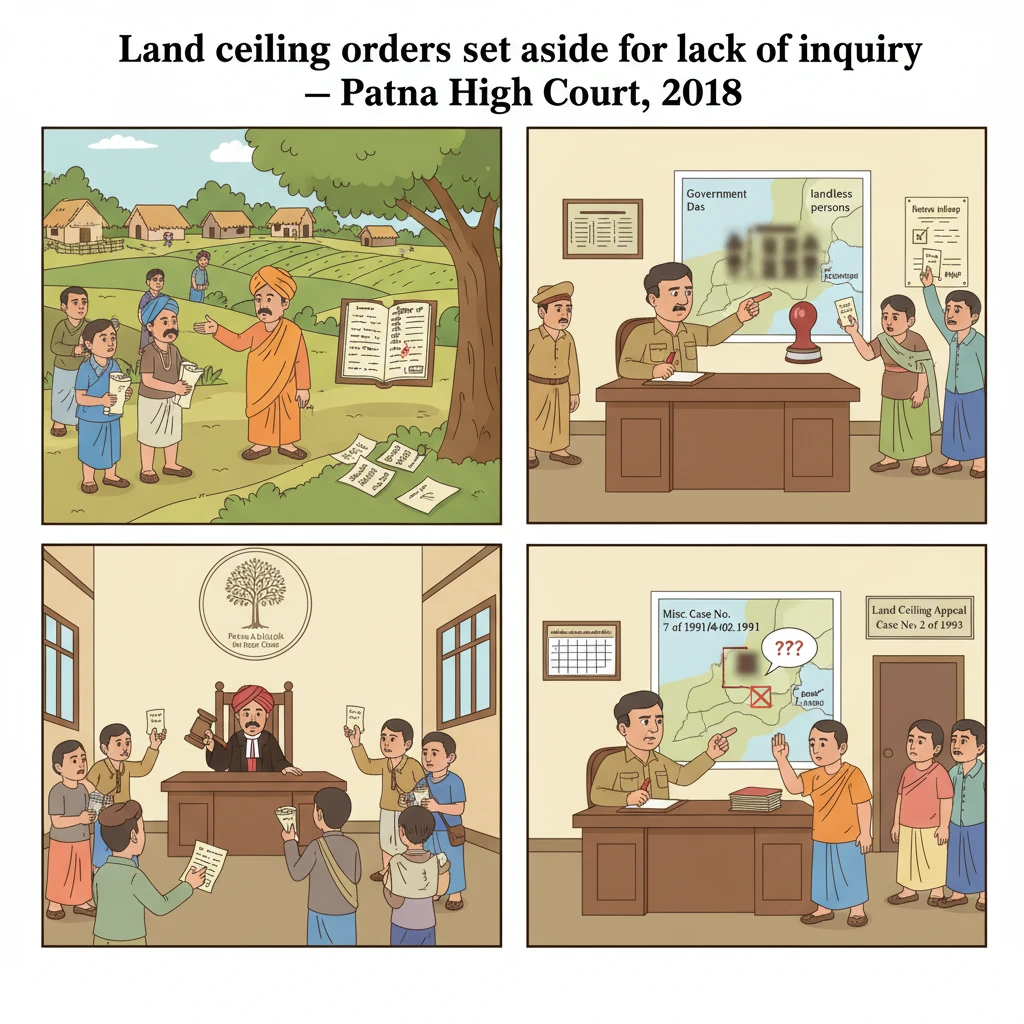
Case Background
The dispute arises out of land ceiling proceedings under the Bihar Land Reforms (Fixation of Ceiling Area and Acquisition of Surplus Land) Act, 1961. These proceedings were initially started against a religious head, the Guru of respondent no. 9, late Mahanth Sudarshan Das, in Land Ceiling Case No. 1 of 1973–74 at Sitamarhi.
The ceiling case included lands not only in Sitamarhi district but also in other districts, including Madhubani. The lands in Madhubani form the subject matter of this writ petition filed before the Patna High Court.
The petitioners claim that they or their forefathers had purchased certain plots from the Mahanth and also from other vendors long before the cut-off date of 22.10.1959. They say that after these registered purchases, their names were mutated in the revenue records of Madhubani and they have been paying rent and receiving rent receipts.
Despite this, during the land ceiling proceedings, the authorities treated these plots as if they still belonged to the landholder (the Mahanth) and declared them surplus. A notification under Section 15(1) of the Act was issued by the Revenue and Land Reforms Department to this effect.
According to the petitioners, they were never given notice of these proceedings. They came to know about the ceiling case only when an Amin started measuring the disputed land on the spot. On making inquiries, they discovered that their land had been included and treated as surplus.
The petitioners then approached the Patna High Court earlier in CWJC No. 6612 of 1990. That writ petition was disposed of on 04.01.1991, giving them liberty to move the Collector, Sitamarhi under Section 45B of the Act for reopening of the land ceiling case.
Acting on this liberty, the petitioners filed an application under Section 45B before the Collector, Sitamarhi. The Collector accepted their application, reopened the proceedings, and transferred the matter to the Additional Collector, Sitamarhi. This was numbered as Miscellaneous Case No. 7 of 1991/4 of 1991.
On 18.02.1993, the Additional Collector rejected the petitioners’ claim. The petitioners appealed before the Collector, Sitamarhi in Land Ceiling Appeal Case No. 2 of 1993. On 18.09.1995, the Collector dismissed the appeal and confirmed the Additional Collector’s order.
The petitioners then filed Revision Case No. 118 of 1995 before the Additional Member, Board of Revenue, Bihar, Patna. On 14.10.1996, the Additional Member dismissed the revision and upheld the orders of the lower authorities.
Aggrieved by these three concurrent orders, the petitioners filed the present writ petition (CWJC No. 1424 of 1997) before the Patna High Court seeking a writ of certiorari to quash them.
During the pendency of the writ petition, two of the original petitioners died. Petitioner no. 1, Ram Sugarath Thakur @ Ram Sagath Thakur, was substituted by his son, and petitioner no. 5, Jamuna Thakur, was recorded as deceased, his son already being on record as petitioner no. 6. Their names were duly corrected by order dated 18.01.2018.
The writ petition was admitted for hearing on 27.01.1999. On the same date, the Court granted a conditional interim order: if the petitioners had not been dispossessed by that time, they were not to be dispossessed from the disputed land until final disposal of the writ petition.
What the Court Examined and Decided
Justice Jyoti Saran heard arguments from the petitioners, the State, and the private respondents (the “purcha-holders” who had been allotted the surplus land by the State). There was no representation on behalf of respondent no. 9.
The core argument of the petitioners, advanced by senior counsel Mr. Vishwanath Prasad Sinha, was straightforward. They said their purchases were by registered sale deeds executed well before 22.10.1959, the cut-off date under the Act. On the strength of these documents, the revenue authorities in Madhubani had already mutated their names and were issuing rent receipts.
Mr. Sinha submitted that Section 5(1)(iii) of the Act places an obligation on the Collector and other ceiling authorities to examine whether lands have been transferred before the cut-off date and, if so, to exclude such bona fide transfers from the landholder’s ceiling area. According to him, this duty was not performed.
He argued that the authorities acted mechanically. They did not verify the petitioners’ sale deeds, did not check the mutation orders, and did not even make an inquiry with the revenue authorities in Madhubani. Instead, they simply continued to show these lands as if they belonged to late Mahanth Sudarshan Das and declared them surplus.
He added that some of the disputed plots were not even purchased from the Mahanth but from other private vendors. Even these plots were wrongly dragged into the ceiling case. All this, he said, happened without any notice or opportunity of hearing to the petitioners, despite their names being in the revenue records and their payment of rent.
On the other side, counsel for the private respondents, Mr. Ramchandra Lal Das, submitted that the land declared surplus had already been distributed to purcha-holders, who were in possession on the basis of government settlement. He argued that the petitioners were not even clear about which plots they claimed and were ignorant that the purcha-holders were occupying the land.
The learned State counsel took the stand that the transactions relied upon by the petitioners were not trustworthy. According to the State, none of the petitioners could establish their claim during the earlier hearings before the land ceiling authorities, and therefore their objections were rightly rejected.
After hearing the parties and perusing the records, the Patna High Court narrowed the dispute to one central question: whether the petitioners’ claim of valid, pre-22.10.1959 transactions required a more serious consideration than what was reflected in the impugned orders.
The Court noted that the petitioners’ case was not based on mere oral settlements or informal arrangements. Their claim rested on registered sale deeds, followed by mutation orders, all of which were of dates much prior to the cut-off date. Such transactions, the Court observed, enjoy statutory protection under the scheme of the Act.
However, when the Court examined the orders of the Additional Collector, the Collector, and the Additional Member, Board of Revenue, it found them “nondescript.” None of the orders dealt with the specific points raised by the petitioners. There was no proper discussion of the sale deeds, the mutation orders, or the rent receipts issued in Madhubani.
In simple terms, the Court found that the authorities had not written “speaking orders.” A speaking order must show that the authority has applied its mind to the facts and law, discussed the rival claims, and given reasons for accepting or rejecting each point. In this case, that essential obligation was missing.
The Court then discussed Section 45B of the Act. This provision earlier gave power to the State Government to call for and examine the records of any proceeding disposed of by the Collector. It has since been deleted by Amendment Act 18 of 2016. But, the Court said, that change in law did not affect this case because the Collector, Sitamarhi had already reopened the proceedings under Section 45B long before the deletion.
Justice Jyoti Saran emphasised that once the Collector had reopened the matter on the liberty granted by the High Court in CWJC No. 6612 of 1990, the authorities were bound to handle the case with “much more seriousness” than what the impugned orders showed.
The Court also took note of the special feature that the ceiling case was initiated in Sitamarhi against a landholder based there, but it included lands situated in Madhubani district as well. This made it all the more important for the Sitamarhi authorities to coordinate with the Madhubani revenue officials and to verify the petitioners’ records. The Court felt that either this point escaped the notice of the authorities or they did not apply their mind to it at all, because it was not reflected anywhere in their orders.
Referring again to Section 5 of the Act, the Court highlighted that the Collector is empowered and required to hold proper inquiry into the issue of surplus land. In this case, the petitioners claimed purchases as early as 1948 or before, clearly predating the cut-off date. The Court held that such an assertion “required serious attention.”
Instead, what happened was a “mechanical approach,” which, in the Court’s words, “is confirmed all through until the Board of Revenue.” In other words, every authority repeated the same non-speaking, non-reasoned rejection without grappling with the petitioners’ documents.
Given this, the Patna High Court concluded that the matter required reconsideration from the original stage. It therefore quashed:
- the order dated 14.10.1996 of the Additional Member, Board of Revenue, Bihar, Patna in Board Revision Case No. 118 of 1995;
- the order dated 18.02.1993 of the Additional Collector, Sitamarhi in Misc. Case No. 7 of 1991/4 of 1991; and
- the order dated 18.09.1995 of the Collector, Sitamarhi in Land Ceiling Appeal Case No. 2 of 1993.
The Court remitted the matter to the Additional Collector, Sitamarhi for fresh proceedings and disposal in accordance with law. It directed the parties to appear before the Additional Collector along with a copy of the judgment on or before 26.11.2018.
The Court also clarified that if either side failed to appear on that date, the Additional Collector would be at liberty to proceed with the matter and dispose of it, bearing in mind the issues noted in the High Court’s judgment.
With these directions, the writ petition was allowed.
Why This Judgment Matters
This decision is important for landowners and purchasers whose lands are caught in old land ceiling cases in Bihar, particularly under the Bihar Land Reforms (Fixation of Ceiling Area and Acquisition of Surplus Land) Act, 1961.
The Patna High Court made it clear that authorities cannot simply brush aside claims based on registered sale deeds and mutation records, especially when the transactions took place before the statutory cut-off date. They must hold a proper inquiry and pass a reasoned, speaking order.
For people who have purchased land long ago and are suddenly told that their land is “surplus” and has been given to others, this judgment shows that higher courts will insist on fair procedure. If land ceiling authorities do not check basic records like sale deeds, mutation orders, and rent receipts, their decisions can be set aside.
The case also shows that when the High Court allows reopening of a land ceiling proceeding, the authorities must then handle the matter with appropriate seriousness and not treat it as a mere formality.
Legal Issues and Answers
-
Issue: Did the land ceiling authorities properly consider the petitioners’ claim that they had purchased the disputed lands through registered sale deeds and mutation orders before 22.10.1959, so that the lands should not be treated as surplus under the Act?
Answer: No. The Patna High Court held that the authorities acted mechanically, did not conduct the required inquiry, and did not pass speaking orders addressing the petitioners’ documents and claims. Therefore, their orders were quashed and the matter was remitted for fresh consideration. -
Issue: After reopening of the ceiling case under Section 45B, were the subsequent proceedings and orders valid in law?
Answer: The reopening itself stood, but the subsequent disposal was held to be unsatisfactory and legally deficient due to lack of proper inquiry and reasoning. Hence all subsequent orders were set aside and the case was sent back to the Additional Collector for a fresh decision.
Cases Cited by the Court
- No prior judgments are expressly cited or relied upon in the text of this decision.
Case Details
Case Number: Civil Writ Jurisdiction Case No. 1424 of 1997
Case Title: Sanjay Kumar & Ors. v. The State of Bihar & Ors.
Coram: Hon’ble Mr. Justice Jyoti Saran
Citation: 2019(2) PLJR 1027
Advocates:
- For the petitioners: Mr. Vishwanath Pd. Sinha, Senior Advocate; Mr. Nand Kishor Singh, Advocate
- For the State: Mr. Mukand Mohan Jha, AC to GP 27
- For the private respondents (respondent nos. 10 to 20): Mr. Ramchandra Lal Das, Advocate
Nature of the Case: Writ petition (civil) challenging orders passed in land ceiling proceedings under the Bihar Land Reforms (Fixation of Ceiling Area and Acquisition of Surplus Land) Act, 1961, including orders on a reopening application under Section 45B, an appeal, and a revision.
If you found this explanation helpful and wish to stay informed about
how legal developments may affect your rights in Bihar,
you may consider following Samvida Law Associates for more updates.







