

Case Background
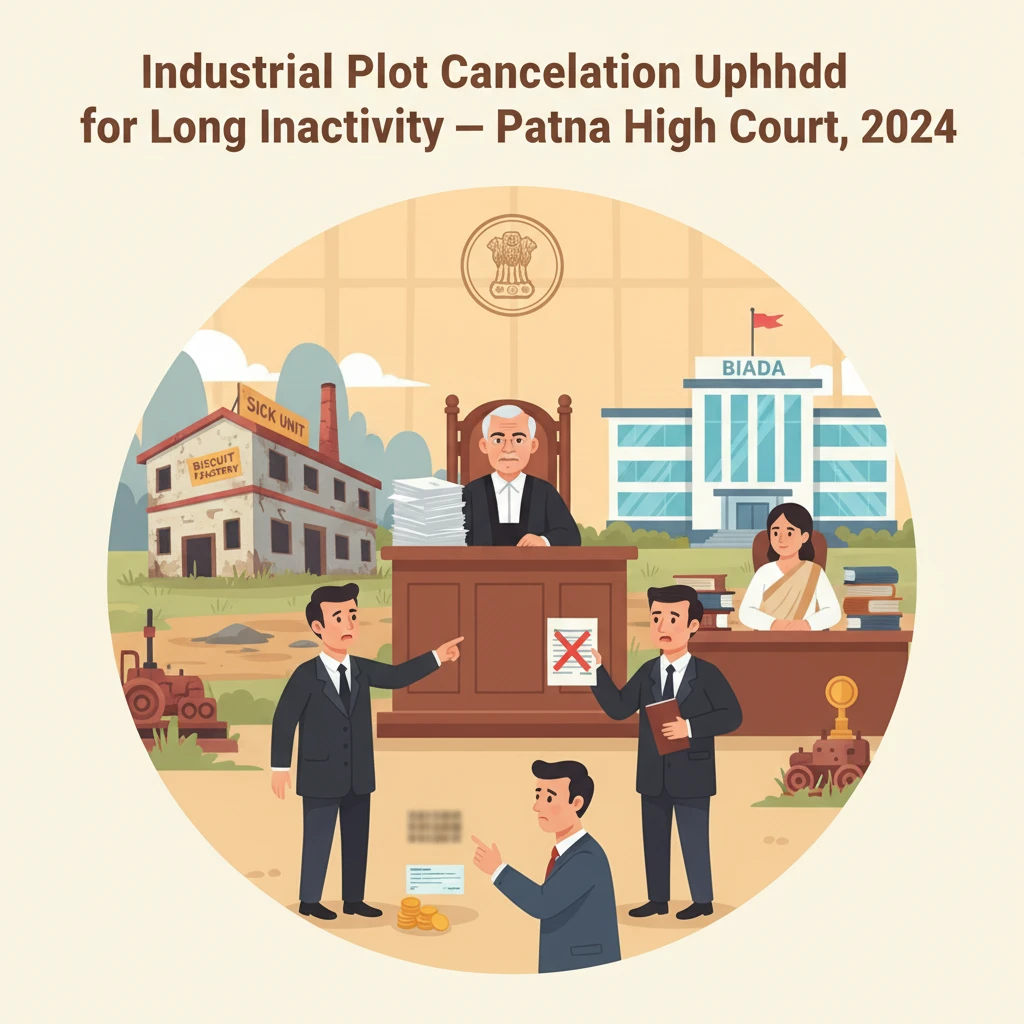
This case arose from a long-running dispute between a private biscuit manufacturing company and the Bihar Industrial Area Development Authority (BIADA) over an industrial plot in the Hajipur Industrial Area, Vaishali district.
The petitioner, Poonamika Foods (India) Pvt. Ltd., was allotted one acre of land bearing Plot Nos. B-16P, 17 and 18P (43560 sq ft) in the industrial area at Hajipur by BIADA through allotment letter no. 131 dated 15.05.1992 for setting up a biscuit manufacturing unit. Physical possession of the land was handed over on 20.05.1992.
Under the terms of allotment, the unit had to get its factory plan approved within two months, submit necessary plans within a month of taking possession, and start production or at least show positive progress, including training local and displaced persons. The allotment also carried a clear warning: non-compliance with these terms could lead to cancellation and BIADA could take back possession.
Initially, the petitioner got itself registered with the Directorate of Industries and obtained a Permanent Registration Certificate as a Small Scale Industry on 20.09.1995 for manufacturing and processing biscuits. However, the industrial unit could not run smoothly and, according to the petitioner itself, became sick around the year 2000. The Director, Industries, Bihar, officially declared the unit sick by letter no. 1058 dated 19.05.2000, for five years or until rehabilitation, whichever was earlier.
Despite this, commercial production did not commence. BIADA issued a series of notices over many years to press for payment of dues and start of production. These efforts and the petitioner’s continued inaction eventually led to cancellation of the allotment and a chain of appeals, culminating in this writ petition before the Patna High Court.
What the Court Examined and Decided
The Patna High Court, speaking through Hon’ble Mr. Justice Rajiv Roy (for the Bench also comprising Hon’ble the Chief Justice K. Vinod Chandran), examined the full history of the allotment, the conduct of the petitioner over three decades, and the decisions of the BIADA authorities and appellate authority.
The petitioner sought multiple reliefs. It asked the Court to quash:
• the order dated 01.11.2022 passed in Appeal No. 226/2022 by the Principal Secretary, Department of Industries (Appellate Authority), which had upheld cancellation of the plot; and
• the earlier cancellation order dated 27.08.2022 (memo no. 77/D) passed by the Deputy General Manager, Hajipur Cluster, BIADA.
Along with quashing these orders, the petitioner also asked for mandamus directions to restore its allotment and possession, allow reasonable time to settle dues with Bihar State Credit & Investment Corporation Ltd. (BICICO), and enable revival of its industrial unit.
The petitioner’s narrative was that it was a genuine industrial unit that had suffered sickness, tried to revive itself using State industrial policies and assistance from investors including BICICO, and was unfairly dispossessed without proper opportunity or inventory of its plant and machinery.
According to the petitioner, the State’s Industrial Policy, 1995 and later the Industrial Incentive Policy, 2006 and Industrial Policy, 2011 gave sick units benefits like exemption from certain electricity and payment surcharges and allowed rehabilitation support even a second time on recommendation of a competent committee. On this background, the petitioner claimed it tried to mobilize resources and investors but could not fully revive due to continued difficulties and the impact of the COVID-19 pandemic.
It asserted that BIADA had, under a One Time Settlement Scheme (OTS-19), calculated its dues at Rs. 6,54,621/- vide letter no. 356 dated 09.03.2019, and it claimed to have deposited this amount via demand draft no. 268413 dated 30.03.2019. It also claimed to have made investments in raw materials and inventories in 2019 toward revival.
When BIADA cancelled the allotment first through memo no. 4360/D dated 15.12.2021, allegedly on the ground of non-payment of Rs. 6,54,621/- and closure of the unit, the petitioner argued that no real opportunity was given to demonstrate its intent to revive, including ongoing negotiations with biscuit companies. It had represented on 04.01.2022 to withdraw the cancellation but got no relief.
The petitioner then filed Appeal No. 15 of 2022 before the Industries Development Commissioner (Appellate Authority). This appeal was allowed by order dated 08.04.2022. Importantly, that order recorded the petitioner’s own undertaking: it agreed to start trial production within 3 months, commercial production within 6 months, and to clear BIADA’s dues within one month. The advocate for the appellant also agreed that the petitioner would not pursue any further legal remedy if those conditions were violated. The appeal was allowed only subject to these conditions.
After this, BIADA (Respondent No. 6) informed the petitioner through letter no. 1794/D dated 06.05.2022 that its current dues stood at Rs. 25,228/-. The petitioner claims it immediately paid this amount via demand draft no. 705981 (4671) dated 23.05.2022, enclosing the draft with a letter dated 23.05.2022.
The petitioner further claimed that heavy rains and flooding in June and July 2022 restricted industrial activities, but it kept the unit running and paid electricity bills, including Rs. 72,035/- on 30.07.2022, with another bill generated on 05.08.2022.
Despite this, BIADA again cancelled the allotment. The Deputy General Manager, Hajipur Cluster, issued memo no. 77/D dated 27.08.2022, citing a site inspection on 29.07.2022 which allegedly found no industrial activity and a disconnected electricity connection. BIADA also took possession of the land. The petitioner filed Appeal No. 226/2022 on 29.09.2022, but the Principal Secretary dismissed it on 01.11.2022, mainly relying on the earlier conditional order dated 08.04.2022 in Appeal No. 15/2022.
Before the High Court, the petitioner attacked the cancellation mainly on grounds of violation of natural justice and alleged inconsistency in BIADA’s stand. It argued that it was not given adequate opportunity before cancellation and that BIADA ignored its efforts and payments.
The respondents, particularly BIADA, placed a detailed counter affidavit. They pointed out that the unit had been sick since 2000, never commenced commercial production, and had accumulated large dues of Rs. 25,42,038/-. They showed that several notices were issued over the years:
• notice no. 182 dated 04.07.2007 directing deposit of dues within 15 days and start of commercial production, with a clear warning of cancellation;
• reminder notice no. 651 dated 03.08.2011;
• show cause notices no. 7220 dated 19.12.2011, no. 1245 dated 08.02.2013, and no. 2580/D dated 24.04.2013, again for starting commercial production and clearing dues.
Despite these repeated communications, the petitioner took no effective action. BIADA further stated that the Regional Incharge had reported on 14.03.2020 that the unit had neither deposited dues of Rs. 6,54,621/- nor carried out any industrial activity, leading to a final notice no. 324 dated 17.03.2020, and another final notice memo no. 559 dated 04.06.2021. The petitioner still did nothing.
An inspection on 27.11.2021 resulted in inspection report no. 283, with photographs showing no industrial activity. Based on this, BIADA first cancelled the allotment on 15.12.2021 (memo no. 4360/D) and forfeited the amount deposited.
Even after the appeal was allowed on conditions, BIADA contended that the petitioner did not fulfil its undertaking to start trial and commercial production as promised. As a result, the Deputy General Manager cancelled the allotment again on 27.08.2022 and the appeal (No. 226/2022) was dismissed on 01.11.2022 relying on the petitioner’s own undertaking that it would not pursue legal remedy in case of violation of conditions.
BIADA also submitted that the petitioner’s unit had been financed by BICICO, whose dues had reached Rs. 106 lakhs. Under an agreement between BIADA and BICICO for industrialisation, BIADA had purchased the petitioner’s land by paying Rs. 88 lakhs to BICICO vide letter no. 343 dated 18.02.2022. Possession was handed over to BIADA by BICICO, and therefore, according to BIADA, the petitioner had lost every right over the land.
On the issue of alleged payment of Rs. 6,54,621/-, the respondents categorically denied receipt. The Court examined Annexure-2 (produced by the petitioner as proof) and found there was no receipt from any competent authority on the forwarding letter. The Court concluded that these were created documents and accepted BIADA’s stand that the amount had not been deposited.
After recounting the timeline, the Court emphasised that the land was allotted in 1992, yet no commercial or industrial activity took place for decades. Inspection reports repeatedly showed the absence of activity. The few bills produced by the petitioner as evidence of “heavy investment” showed only a purchase of about Rs. 11,473/- and some odd amounts in 2019, which could not establish any real industrial operation.
Significantly, physical inspection revealed that part of the land had been let out to a third person, who was running the show. This was in clear violation of the allotment terms, which did not permit such unauthorised transfer or creation of third-party rights.
The Court also noted that the petitioner had defaulted on the written undertaking recorded in the appellate order dated 08.04.2022 to start trial and commercial production within fixed timelines and clear BIADA’s dues within a month, and to refrain from further legal remedies if these were violated. Despite this, it neither complied with conditions nor refrained from litigation.
Taking all these facts together, the Court held that the petitioner had acted against the specific terms of allotment, had not initiated commercial activity even after long opportunities, had allowed third parties to use the land, and had violated its own undertaking. These acts disentitled it from continuing with the allotment. The creation of third-party rights on the property was noted as an additional serious factor.
Accordingly, the Court found no error in the orders passed by BIADA authorities or the appellate authority. It dismissed the writ petition and upheld the cancellation of the industrial plot allotment and forfeiture of amounts.
Why This Judgment Matters
This judgment is important for entrepreneurs and industrial units operating on land allotted by BIADA and similar development authorities in Bihar.
First, it shows that industrial land is not meant to be kept idle for years. If a unit does not start production and ignores repeated notices, the authority can lawfully cancel the allotment and take back possession.
Second, it underlines that promises and undertakings given before authorities are serious. Here, even after getting a second chance through appeal, the unit did not keep its word. The Court treated this breach of undertaking very seriously and refused to interfere.
Third, the judgment warns against unauthorised letting out or creating third-party rights on industrial plots. The Court held that such conduct, combined with failure to start production, disentitles the allottee from retaining the land.
Finally, the decision clarifies that in long-drawn cases where the authority has paid off financial institutions like BICICO and taken back land, courts are unlikely to restore allotments unless the record clearly supports the allottee. Claims of payment or investment without proper receipts or proof will not be accepted.
Legal Issues and Answers
- Issue: Whether cancellation of the petitioner’s industrial plot allotment by BIADA and upholding of that cancellation in appeal were illegal or violated principles of natural justice.
Answer: No. The Court held that repeated notices were issued over many years, inspections showed no industrial activity, the petitioner failed to honour its own undertaking after getting relief in appeal, allowed third-party use of the land, and even allegedly produced created documents. There was no error in BIADA’s actions or in the appellate authority’s orders. - Issue: Whether the petitioner was entitled to restoration of allotment and possession of the industrial plot with more time to clear dues and revive the unit.
Answer: No. Given decades of non-production, breach of terms of allotment, breach of undertaking, creation of third-party rights, and BIADA’s purchase of the land from BICICO, the petitioner had lost every right over the land and was not entitled to restoration.
Cases Cited by the Court
- The judgment does not record or rely on any cited precedents or external case law. The decision is based on the facts, documents, contractual terms, and conduct of the parties.
Case Details
Case Number: Civil Writ Jurisdiction Case No. 79 of 2023
Case Title: Poonamika Foods (India) Pvt. Ltd. v. The State of Bihar & Ors.
Citation: 2024(1) PLJR 923
Court: High Court of Judicature at Patna
Coram: Hon’ble The Chief Justice K. Vinod Chandran, Hon’ble Mr. Justice Rajiv Roy
Date of Judgment: 08.02.2024
Advocates:
For the petitioner: Mr. Harsh Singh, Advocate
For the State of Bihar: Mr. Kinkar Kumar, S.C.-9
For BIADA: Mr. Lalit Kishore, Sr. Advocate; Mr. Ravi Kumar, Advocate
Respondents: State of Bihar through Principal Secretary, Department of Industries; Principal Secretary, Department of Industries; Industries Development Commissioner; Bihar Industrial Area Development Authority (BIADA) through its Managing Director; Managing Director, BIADA; Executive Director, BIADA; Deputy General Manager, Hajipur Cluster, BIADA.
Nature of Case: Writ petition under civil writ jurisdiction challenging cancellation of industrial plot allotment and dismissal of statutory appeals.
Link to Judgment: Click here to read the full judgment of the Patna High Court
If you found this explanation helpful and wish to stay informed about how legal developments may affect your rights in Bihar, you may consider following Samvida Law Associates for more updates.







