

Case Background
The dispute relates to the post of Gramin Dak Sevak Branch Postmaster at Sujatpur Branch Post Office, under Choraut Sub Post Office in the Sitamarhi Postal Division.
The Superintendent of Post Offices, Sitamarhi, notified this post on 06.05.2008. The last date for filing applications was 04.06.2008. Respondent no. 7 in the writ case (the applicant before the Tribunal) applied for this post.
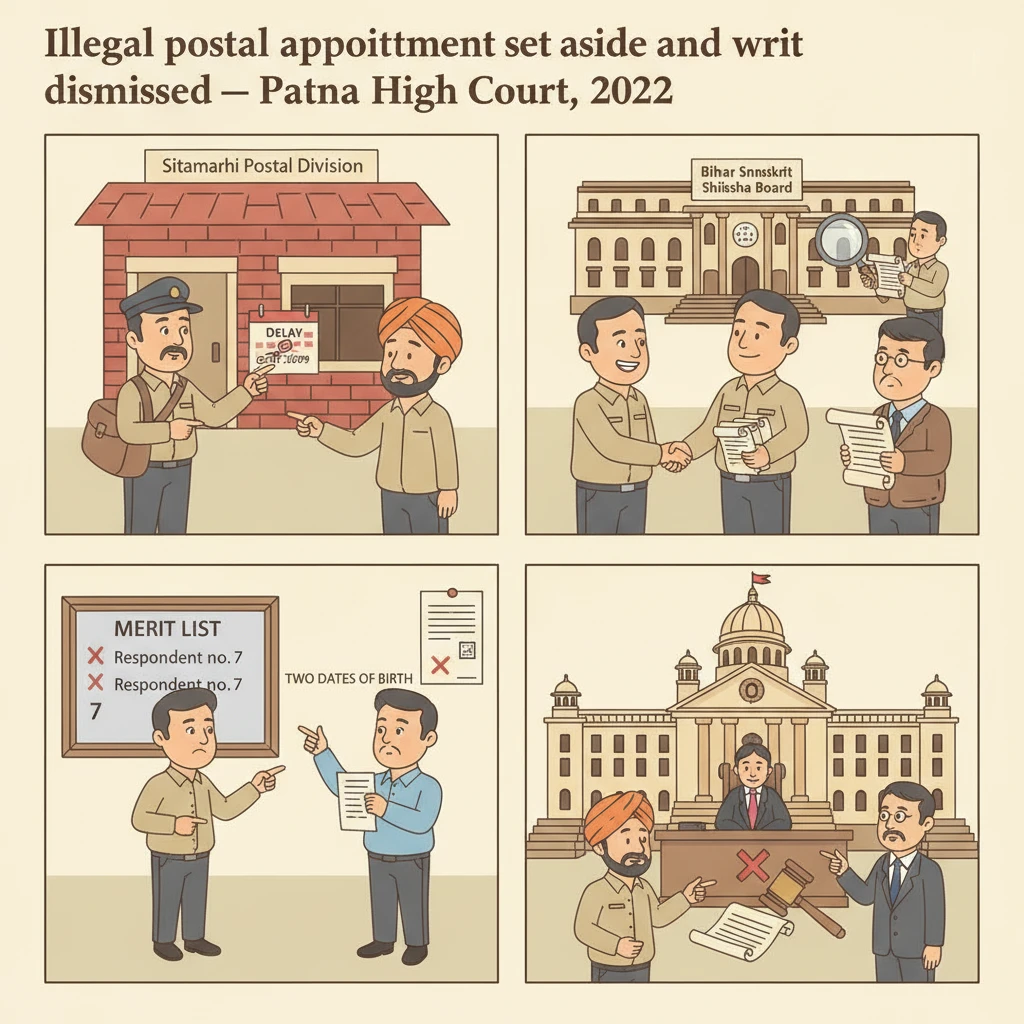
An interview was scheduled for 05.07.2009. According to respondent no. 7, his interview call letter was deliberately delivered to him late. Because of this delayed delivery, he could not appear in the interview on that fixed date.
Respondent no. 7 raised a representation against the delay in delivery of the interview letter. On this representation he was allowed to appear in the interview on a later date, i.e., 15.12.2009. He then submitted all his relevant certificates and documents, which were checked by the authorities.
On 20.04.2010, the Superintendent of Post Offices, Sitamarhi Postal Division, directed the Sub Divisional Inspector of Post (SDI)(P) to verify the educational certificates of respondent no. 7 from the concerned school. The Headmaster of that school, by letter dated 22.04.2010, authenticated the certificate as genuine.
Further, the Assistant Superintendent of Post Offices (Headquarters) verified the register of the Bihar Sanskrit Shiksha Board. He also found that the certificate produced by respondent no. 7 was genuine.
Despite these verifications, respondent no. 7 was not appointed. Instead, the present writ petitioner was appointed as Gramin Dak Sevak Branch Postmaster at Sujatpur by order dated 11.10.2010.
Feeling aggrieved, respondent no. 7 approached the Central Administrative Tribunal (CAT), Patna Bench, by filing Original Application (O.A.) No. 797 of 2010. In that O.A., he challenged the petitioner’s appointment and sought consideration of his own claim for the same post.
The Tribunal allowed O.A. No. 797 of 2010 by order dated 07.08.2015. It set aside the appointment of the present petitioner and directed the postal authorities to consider respondent no. 7 for appointment to the post.
The petitioner then filed the present Civil Writ Jurisdiction Case No. 13602 of 2015 before the Patna High Court, assailing the CAT’s order dated 07.08.2015.
What the Court Examined and Decided
The Patna High Court, speaking through Hon’ble Mr. Justice Madhuresh Prasad (with Hon’ble Mr. Justice Chakradhari Sharan Singh agreeing), examined whether the Tribunal was correct in cancelling the petitioner’s appointment and directing consideration of respondent no. 7.
The Court first noted the recruitment process. A merit list of 10 candidates for the GDS BPM, Sujatpur post had been prepared. In that list, respondents found that candidates at serial numbers 1, 2, 4 and 6 were fake. Respondent no. 7 stood at serial number 3. The present petitioner was placed lower down, at serial number 7.
Before the Tribunal, the postal authorities tried to justify the petitioner’s appointment by casting doubt on the date of birth of respondent no. 7. They claimed that there was a difference of 10 years in his date of birth as recorded in two verification reports—one from the Inspector of Posts and another from the Assistant Superintendent of Posts (Headquarters).
On this supposed difference of 10 years in date of birth, reflected in the report dated 08.07.2010 issued by the Assistant Superintendent of Posts (HQ), the authorities treated respondent no. 7 as having two dates of birth and did not consider him for appointment. The same stand was taken in respect of another candidate placed at serial number 5. In this way, the authorities excluded candidates from serial numbers 1 to 6 on various grounds and ultimately appointed the candidate at serial number 7, who is the present writ petitioner.
To clear the confusion about his date of birth, respondent no. 7 produced three documents before the Tribunal:
(i) The report of the Assistant Superintendent of Posts (HQ) dated 08.07.2010.
(ii) The report of the Headmaster of the school from which he had passed the examination, dated 03.07.2010.
(iii) The certificate dated 04.05.2011 issued by the Bihar Sanskrit Shiksha Board.
The Court observed that, from these documents, it was clear that the date of birth of respondent no. 7 was 28.02.1976. There was no basis for contending that he had another date of birth, much less 28.02.1986. Thus, the alleged 10-year difference in date of birth had no factual support.
Once these documents were on record, the date-of-birth objection against respondent no. 7 collapsed. At that stage, the petitioner raised a fresh objection before the Tribunal. He argued that respondent no. 7 had already passed the matriculation examination in third division, and had later appeared in the Madhyma examination conducted by the Bihar Sanskrit Shiksha Board.
The petitioner submitted that, having once passed matriculation, respondent no. 7 was debarred from taking the Madhyma examination later. He further argued that, in any event, where a candidate holds two such qualifications, the earlier qualification with lesser marks should prevail and the candidate must be considered only on that basis. On this logic, he contended that respondent no. 7 could not claim appointment on the strength of higher marks obtained later.
The High Court carefully noted that these grounds—about prior matriculation, supposed debarment from Madhyma, and preference for earlier lesser marks—had never been invoked by the postal authorities at the time of selection. They were neither raised before the authorities when they considered the candidates, nor relied upon for rejecting respondent no. 7 then.
Before the Tribunal, the authorities were given time to produce any departmental rule or instruction supporting the petitioner’s stand about candidates holding two degrees or two different examinations. However, neither the petitioner nor the official respondents could place any material to show that such a rule existed.
They also failed to bring any material before the Tribunal to prove that respondent no. 7 in fact had two different dates of birth differing by 10 years. In absence of such material, there was no legal basis to treat respondent no. 7 as disqualified.
The Tribunal hence concluded that respondent no. 7, who stood at serial number 3 of the merit list, was fully eligible for consideration and appointment as GDS BPM, Sujatpur. Since candidates at serial numbers 1 and 2 were found to be fake, respondent no. 7 should have been offered the post. The petitioner, being at serial number 7, had no rightful claim to appointment.
On a thorough review of the record, the High Court agreed with the Tribunal’s appreciation of the facts. It held that the petitioner’s appointment had been made by ignoring the legitimate claim of a higher-ranked and eligible candidate, respondent no. 7. Therefore, the appointment of the petitioner was illegal.
Consequently, the Tribunal was justified in quashing the petitioner’s appointment and directing the authorities to consider respondent no. 7 for appointment to the post of GDS BPM, Sujatpur.
The petitioner’s counsel tried to rely on an order dated 01.07.2009 issued by the Chief Postmaster General, Bihar Circle, Patna. In that order, the department had directed that an alternative appointment to any vacant post be given to the applicant in O.A. No. 23/2006 to comply with a prior Tribunal order.
The High Court examined this order and distinguished it on facts. In O.A. No. 23/2006, at the time of selection, two conditions were essential: that the candidate should hold property in his own name and that he should be resident of the concerned village of the Post Office. Those requirements were later declared unconstitutional. As a consequence of that declaration, the applicant in O.A. No. 23/2006, who had been otherwise eligible and duly appointed, was terminated. Therefore, the department directed that he be given an alternative appointment.
The Court clearly recorded that such circumstances did not exist in the present case. Here, the issue was not about a qualification being declared unconstitutional after appointment. Instead, the appointment of the present petitioner was itself found to be illegal because it had ignored the prior claim of a more meritorious candidate.
In these circumstances, the Court held that there was no basis for directing the postal authorities to give any alternative appointment to the petitioner on any other vacant post. The principles applicable in O.A. No. 23/2006 were not attracted.
Finding no reason to interfere with the Tribunal’s order dated 07.08.2015 in O.A. No. 797 of 2010, the Patna High Court dismissed the writ petition as being devoid of merit.
Why This Judgment Matters
This judgment is important for candidates competing for public or semi-public posts such as Gramin Dak Sevak. It shows that authorities cannot bypass higher-ranked, eligible candidates on vague or unsupported grounds.
If a candidate’s certificates and date of birth have been duly verified and found genuine, the department cannot later invent doubts without any documentary base. The Court will look at what material actually existed before the authorities and whether real rules were applied.
The decision also explains that a person whose appointment is found illegal, because it ignored the rights of a more meritorious candidate, cannot demand an alternative post as a matter of right. Relief like alternative appointment is exceptional and depends on very specific circumstances, which were absent here.
For aspirants in Bihar and elsewhere, especially for postal jobs, the judgment of the Patna High Court reinforces that transparent merit-based selection must be followed, and higher-ranked genuine candidates cannot be sidelined casually.
Legal Issues and Answers
-
Issue: Whether the Central Administrative Tribunal rightly quashed the petitioner’s appointment as Gramin Dak Sevak Branch Postmaster, Sujatpur, and directed consideration of respondent no. 7 for the post.
Answer: Yes. The Patna High Court held that respondent no. 7 was a higher-ranked, eligible candidate, that doubts about his date of birth and qualifications were unsupported by any rule or material, and that the petitioner’s appointment was therefore illegal. -
Issue: Whether the petitioner, whose illegal appointment was cancelled, was entitled to an alternative appointment on any other vacant post.
Answer: No. The Court held that the earlier departmental direction for alternative appointment in another case (O.A. No. 23/2006) was based on very different facts, namely, later invalidation of essential qualifications. As the present petitioner’s appointment itself was illegal from the beginning, no such relief could be granted.
Cases Cited by the Court
- No earlier judicial decisions are cited or relied upon in the text of this judgment.
Case Details
Case Number: Civil Writ Jurisdiction Case No. 13602 of 2015
Case Title: Alok Kumar Jha v. The Union of India and Others
Coram: Hon’ble Mr. Justice Chakradhari Sharan Singh; Hon’ble Mr. Justice Madhuresh Prasad
Date of Judgment: 17.01.2022
Citation: 2022(1) PLJR 737
Advocates:
For the petitioner: Mr. Pushkar Narayan Shahi, Senior Advocate
For Union of India: Mr. Ram Anurag Singh, Central Government Counsel (CGC)
For C.B.I.: Mr. Bipin Kumar Sinha
For respondent no. 8 (Bihar Sanskrit Shiksha Board): Mr. Satyam Shivam Sundaram
Respondents: Union of India and its postal authorities; individual private respondent (respondent no. 7); Bihar Sanskrit Shiksha Board
Nature of the case: Writ petition under civil writ jurisdiction challenging an order of the Central Administrative Tribunal, Patna Bench, in O.A. No. 797 of 2010 concerning appointment to the post of Gramin Dak Sevak Branch Postmaster.
Link to full judgment: Patna High Court Judgment in CWJC No. 13602 of 2015
If you found this explanation helpful and wish to stay informed about
how legal developments may affect your rights in Bihar,
you may consider following Samvida Law Associates for more updates.







