
Case Background
The case arose from Chapra Town P.S. Case No. 446 of 2019, registered on 10.08.2019. The prosecution story was based on the fardbeyan of the victim (PW-4), recorded at 21:10 hours on 10.08.2019 at Patna Medical College and Hospital (PMCH), Patna, by S.I. Kumari Vibha Rani (PW-5) of Saran Mahila Police Station.
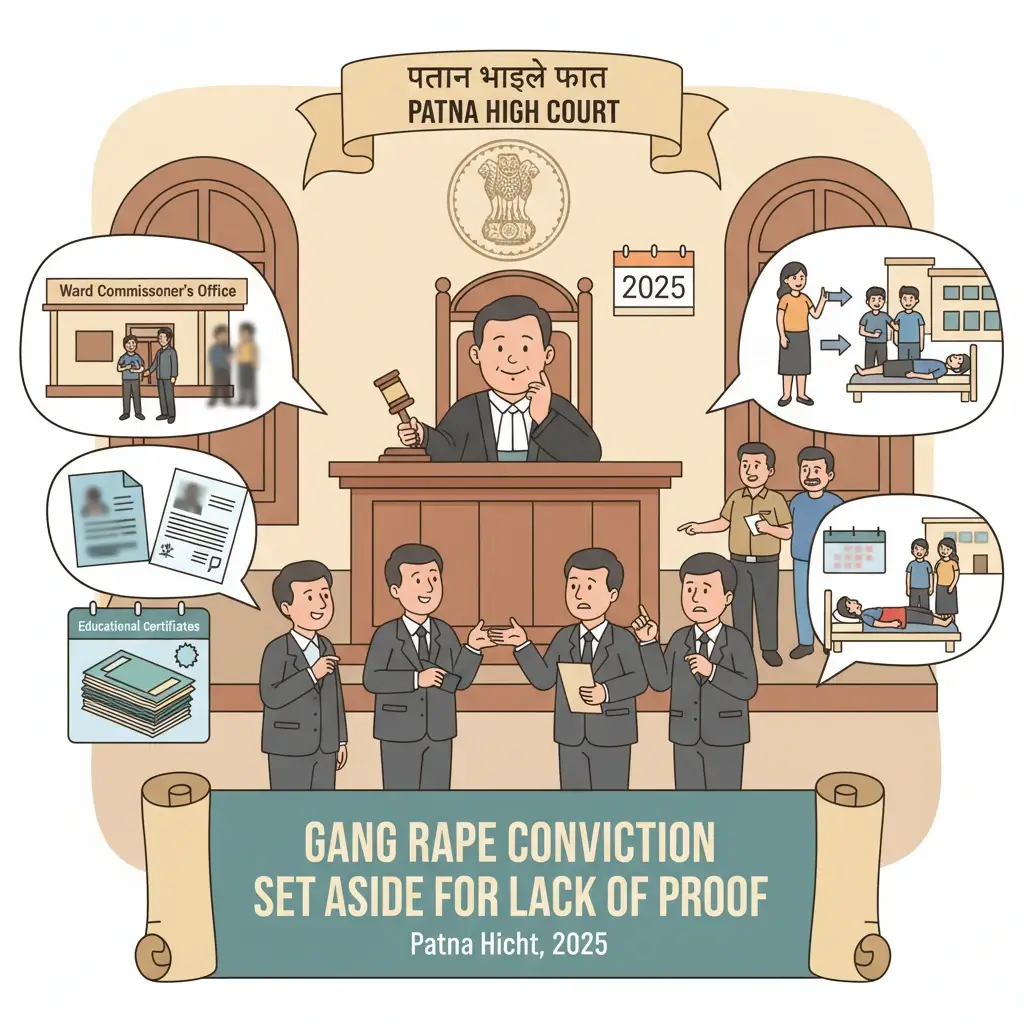
The victim alleged that around 12:00 noon on 10.08.2019, after appearing in her school examination, three named accused forcibly took her to the office of a Ward Commissioner in Chapra and committed gang rape. She claimed that she started bleeding profusely, managed to reach home, narrated the incident to her mother, and was then taken to Sadar Hospital, Chapra, from where she was referred to PMCH for better treatment.
On the basis of the fardbeyan, an FIR was registered under Sections 376(D)/34 of the Indian Penal Code and Sections 4, 5, 5(g) and 6 of the Protection of Children from Sexual Offences Act, 2012. After investigation, chargesheet No. 660 of 2019 dated 30.09.2019 was submitted against three accused under Section 376D IPC and Sections 4, 5, 5(g) and 6 POCSO. Cognizance was taken on 23.10.2019. On 19.11.2019, charges were framed under Section 376D IPC and Section 6 POCSO against all three accused, who pleaded not guilty.
The Exclusive Special Judge (POCSO), Saran at Chapra conducted Sessions Trial (POCSO) No. 86 of 2019. The prosecution examined seven witnesses, including the victim, her parents, the investigating officer, and two doctors. Several documents, including the fardbeyan, FIR, seizure lists, medical report and FSL report, were exhibited. The defence examined three witnesses and produced educational documents as defence exhibits.
By judgment dated 11.08.2021, the trial court convicted all three accused under Section 376D IPC and Section 6 POCSO, and by order dated 17.08.2021, sentenced each to 20 years’ rigorous imprisonment and a fine of Rs. 20,000/-, with three months’ simple imprisonment in default.
The three criminal appeals (DB) Nos. 670 of 2021, 765 of 2021 and 221 of 2022 were filed before the Patna High Court challenging this conviction and sentence.
What the Court Examined and Decided
The Division Bench of Hon’ble Mr. Justice Rajeev Ranjan Prasad and Hon’ble Mr. Justice Ashok Kumar Pandey examined the entire trial record, including oral and documentary evidence, and the reasoning of the trial court. The Court focused on whether the prosecution had proved the case beyond reasonable doubt and whether foundational facts for applying the POCSO Act were established.
The victim’s version changed on a key point. In her fardbeyan, she stated that she was forcibly taken while returning from school to home. In her examination-in-chief before the trial court, she stated that she reached home first, and then the accused came there, caught her, pressed her mouth and took her to the Ward Commissioner’s office. The High Court noted this material shift in the place from where she was allegedly taken.
The Court also examined the evidence relating to the girl’s age. In the fardbeyan, her age was recorded as about 17 years. In court, she claimed her age as 15 years. In cross-examination, she stated she had her age recorded as 14 years in the fardbeyan, which conflicted with the IO’s version. PW-5 (IO) stated the victim gave her age as 17 years and denied any mention of 14 years. No school certificate or other documentary proof of age was produced. No age-related medical test (such as ossification) was conducted.
Doctors PW-6 and PW-7 merely “assessed” her age as about 17 years but did not conduct any formal age determination. The Court held that the trial court failed to follow the mandatory scheme of Section 94 of the Juvenile Justice (Care and Protection of Children) Act, 2015 for age determination, and that the prosecution had not proved that the victim was below 18 years at the time of the alleged incident.
Since POCSO applies only if the victim is a “child” under Section 2(d) of the Act, the High Court stressed that proving age is a foundational fact before the presumption under Sections 29 and 30 POCSO can operate. Referring to earlier decisions, including Md. Mahmood Alam and other High Court judgments, the Bench reiterated that without proof of age, POCSO presumptions cannot be used against the accused.
The Court then turned to the evidence regarding the clothes, medical treatment and seizure of material exhibits. PW-2 (mother) said in examination-in-chief that she took her daughter first to Sadar Hospital, Chapra, then to PMCH, and that police came to Patna hospital and recorded the victim’s statement the same day. However, in cross-examination, she stated clearly that she had no meeting with police on the date of occurrence, and police did not record anyone’s statement that day. She further stated police recorded her own statement at Patna on the next day of occurrence.
PW-2 also stated that the seizure list of clothes was prepared the next day (around 10–11 a.m.) and that her daughter was not wearing a pad on the date of occurrence, though she claimed to have handed over a janghiya with pad and a red salwar to police at PMCH. This conflicted with the seizure list prepared by the IO (Exhibit 4), which was shown as dated 10.08.2019 at 21:30 hours in PMCH, with the victim’s clothes (janghiya with pad and red salwar) produced there and then.
PW-6 (doctor) stated that no blood-soaked cloth of the victim was seized in PMCH, which again clashed with PW-2 and the IO’s version. The High Court found that PW-2’s statement that no police interaction occurred on the date of the incident and that the seizure papers were prepared only the next day raised serious doubt about the genuineness of the fardbeyan and seizure list being shown as dated 10.08.2019. The Court concluded that the fardbeyan and seizure list appeared to be antedated and antetimed.
The prosecution story about the girl’s treatment at Sadar Hospital, Chapra was also found doubtful. No medical documents from Sadar Hospital were produced, and no doctor from there was examined. PW-2 claimed they reached Sadar Hospital at about 1:30 pm, stayed about half an hour, and that no treatment was given; yet she also claimed her daughter was not in a position to speak. The victim, however, said she was treated for only one to two minutes before being referred.
PW-6 recorded that when the victim was admitted in PMCH around 9:00 pm on 10.08.2019, she already had intra cath in her right hand, haemaccel running, and a vaginal pack in situ, with no active bleeding. This indicated substantial prior treatment, inconsistent with the very short alleged treatment at Chapra Sadar Hospital. The High Court viewed the absence of bed head ticket, discharge summary or contemporaneous PMCH treatment records as a serious gap and suggested suppression of the true first version and treatment history.
The investigation at the alleged place of occurrence was also found highly deficient. PW-5 claimed to have visited the place on 11.08.2019 and found blood marks on a brick platform and scattered papers. However, she did not seize these materials herself. She said an FSL team along with one Rajesh Kumar visited and collected evidence, and that seizure lists were prepared by Rajesh Kumar/Rajesh Chaudhary. Neither Rajesh Kumar nor Rajesh Chaudhary was examined at trial, nor were the seizure list witnesses produced.
There was even overwriting on the date in one seizure list (from 10.08.19 to 11.08.19), and this seizure list did not bear the “seen” endorsement of the court, unlike the fardbeyan and other seizure list. Order sheets of 11.08.2019 and 12.08.2019 did not record the filing of this disputed seizure list. The IO admitted she did not record statements of persons residing around the place of occurrence, nor of the Ward Councillor or family members whose house was the alleged spot. No school enquiry was conducted to verify whether the victim had an examination that day or to collect her age record.
The Court also noticed that although the IO claimed that sperm samples of all three accused were collected in Sadar Hospital, Chapra, no doctor who did this was examined, no medical reports of accused were brought, and there was no clarity where these samples were kept for over a month before being sent to FSL on 18.09.2019. There was also no evidence that blood samples of accused or victim were collected for matching.
The FSL report (Exhibit P8) showed that blood was found on several exhibits, including the alleged underwear and salwar of the victim, and the underwear of one accused. However, semen was detected only on the accused’s underwear and on the preserved semen samples of the accused in vials, not on the victim’s underwear or salwar. There was no serological report placed on record showing origin or blood group of these blood and semen stains or any matching with the victim or accused. The promised serological report “would follow” was not produced.
In light of the Supreme Court’s decision in Krishna Kumar Malik, the High Court observed that in serious sexual offence cases, matching of semen and blood and, where appropriate, DNA testing have become vital tools. Here, with no semen on the victim’s clothes and no matching of blood or semen, the FSL evidence did not support the prosecution case.
On the procedural side, the FSL report was marked as an exhibit under Section 294 CrPC without calling any witness to tender it, it was not supplied to the accused, and they were not confronted with its contents during their examination under Section 313 CrPC. The Court distinguished between admissibility of such a report (as per Section 293/294 CrPC and the Supreme Court’s ruling in Mast Ram) and its reliability and weight in a fair criminal trial. Relying also on the Division Bench judgment in State of Bihar v. Durgawati, the Court held that in these circumstances no safe reliance could be placed on the FSL report against the accused.
The trial court had treated the victim as a “sterling witness”. The High Court applied the test laid down by the Supreme Court in Rai Sandeep, which requires that a sterling witness be wholly consistent, natural, unshaken in cross-examination and fully supported by surrounding material. The Bench found that the victim’s evidence was materially inconsistent on core issues, including the place from which she was taken, her age, and her movements between school, home, hospital, and the place of occurrence. It held that she could not be treated as a sterling witness whose sole uncorroborated testimony would sustain conviction.
The Court also noted that no charge of kidnapping (such as under Sections 363 or 364 IPC) was framed, suggesting that even the prosecution did not fully rely on the version of forcible taking from school or home.
Putting these strands together—failure to prove age, doubtful fardbeyan and seizure timing, lack of credible evidence of initial treatment and reporting, serious defects in collection and proof of physical evidence, and inconsistencies in the victim’s testimony—the High Court held that the prosecution had not proved its case beyond reasonable doubt. Important foundational facts were either missing or unreliable.
Accordingly, the Court set aside the judgment of conviction dated 11.08.2021 and the order of sentence dated 17.08.2021, and acquitted all the appellants giving them the benefit of doubt. As they were in custody, the Court directed that they be released forthwith if not wanted in any other case. The Court also recorded appreciation for the assistance of the Amicus Curiae and directed payment of honorarium.
Why This Judgment Matters
This judgment of the Patna High Court is important for both victims and accused in serious sexual offence cases, particularly those under the POCSO Act. It shows that even in emotionally charged allegations like gang rape of a school-going girl, courts will not uphold a conviction unless the basic facts are proved with reliable evidence.
First, the judgment underlines that in POCSO cases, the age of the victim must be proved properly through documents or age-determination procedures under Section 94 of the Juvenile Justice Act. Merely stating a rough age in oral testimony is not enough when age is disputed.
Second, the Court highlights the need for a clean and honest investigation. Antedated or suspicious documents, non-examination of key witnesses (including FSL and medical personnel), unexplained gaps in medical records, and poor seizure and sealing of clothes or biological samples can all destroy the prosecution case. This serves as a warning to investigating agencies to strictly follow procedure.
Third, the judgment reiterates that forensic evidence must be collected, preserved, and proved in court properly. Simply producing an FSL report without confronting the accused with its contents or linking its findings to proper samples and witnesses will not carry weight.
Finally, for readers, the case demonstrates that a victim’s testimony is central but cannot be labelled “sterling” if it contains serious contradictions on crucial facts. Courts must balance sympathy with strict scrutiny, to ensure no one is punished on an unsafe or incomplete record.
Legal Issues and Answers
-
Issue: Whether the prosecution proved beyond reasonable doubt that the victim was a “child” under POCSO and that the appellants committed gang rape as alleged.
Answer: No. The Court held that the age of the victim was not proved in accordance with law, foundational facts were missing or doubtful, and the overall evidence was insufficient to sustain conviction. The appellants were acquitted on benefit of doubt. -
Issue: Whether the trial court was right in treating the victim as a “sterling witness” whose sole testimony could sustain conviction.
Answer: No. The High Court found material inconsistencies in her statements regarding age, how and from where she was taken, and treatment history. Applying the Supreme Court’s test in Rai Sandeep, it held that she could not be treated as a sterling witness. -
Issue: Whether the FSL report and other scientific/medical evidence were properly collected, proved and could be safely relied upon.
Answer: No. Key FSL team members and doctors were not examined on crucial aspects; the report was not put to the accused under Section 313 CrPC; there was no matching of blood or semen; and serious doubts existed about the chain of custody. The Court declined to rely on this material against the accused.
Cases Cited by the Court
- State of Bihar v. Durgawati, 2021 (4) PLJR 516 (HC)
- Krishna Kumar Malik v. State of Haryana, (2011) 7 SCC 130
- State of Punjab v. Gurmit Singh, (1996) 2 SCC 384
- Santhosh Moolya & Anr. v. State of Karnataka, (2010) 5 SCC 445
- State of H.P. v. Mast Ram, AIR 2004 SC 5056
- Md. Mahmood Alam v. State of Bihar, 2024 (4) PLJR 795
- Heera Das v. State of Bihar and Anr., Cr. Appeal (DB) No.103 of 2019, decided on 19.06.2024
- Dharmender Singh v. State (Govt. of NCT of Delhi), 2020 SCC Online Del 1267
- Sahid Hossain Biswas v. State of West Bengal, 2017 SCC Online Cal 5023
- Joy V. S. v. State of Kerala, 2019 SCC Online Ker 783
- Navin Dhaniram Baraiye v. State of Maharashtra, 2018 SCC Online Bom 1281
- Rai Sandeep v. State (NCT of Delhi), (2012) 8 SCC 21
Case Details
Case Number(s): Criminal Appeal (DB) No. 670 of 2021; Criminal Appeal (DB) No. 765 of 2021; Criminal Appeal (DB) No. 221 of 2022; arising out of Chapra Town P.S. Case No. 446 of 2019; Sessions Trial (POCSO) No. 86 of 2019.
Case Title: Sonu @ Tarjan @ Saddam Hussain v. The State of Bihar & Anr.; Aatish Kumar @ Atish Kumar Sharma @ Atish Kumar v. The State of Bihar & Anr.; Ravi Raj Sharma @ Dhyani Sharma @ Dhyani v. The State of Bihar.
Citation: 2025 (2) PLJR 407.
Coram: Hon’ble Mr. Justice Rajeev Ranjan Prasad; Hon’ble Mr. Justice Ashok Kumar Pandey.
Advocates:
In Criminal Appeal (DB) No. 670 of 2021:
For the Appellant: Mr. Chandra Mohan Jha, Advocate.
For the State: Mr. Dilip Kumar Sinha, Addl. Public Prosecutor.
For the Informant: Mr. Manish Chandra Gandhi, Advocate; Mr. Himanshu Ranjan, Advocate.
In Criminal Appeal (DB) No. 765 of 2021:
For the Appellant: Mr. Chandra Mohan Jha, Advocate.
For the State: Mr. Abhimanyu Sharma, Addl. Public Prosecutor.
For the Informant: Mr. Manish Chandra Gandhi, Advocate; Mr. Himanshu Ranjan, Advocate.
In Criminal Appeal (DB) No. 221 of 2022:
For the Appellant: Ms. Surya Nilambari, Amicus Curiae.
For the State: Ms. Shashi Bala Verma, Addl. Public Prosecutor.
For the Informant: Mr. Manish Chandra Gandhi, Advocate; Mr. Himanshu Ranjan, Advocate.
Nature of the Case: Criminal appeals (division bench) against conviction and sentence under Section 376D IPC and Section 6 of the POCSO Act, arising from a Special POCSO Court judgment.
Date of High Court Judgment: 05.03.2025.
Link to Judgment: Click here to read the full Patna High Court judgment
If you found this explanation helpful and wish to stay informed about how legal developments may affect your rights in Bihar, you may consider following Samvida Law Associates for more updates.







