

Case Background
The case arose from Mahila P.S. Case No. 72 of 2021 in Muzaffarpur district. The appellant is an employee of North Bihar Gramin Bank, posted at Motihari. The informant is his daughter, who was about fourteen years old when she approached the police.
On 12.09.2021, the girl lodged a written report at Mahila Police Station, Muzaffarpur. She alleged that in September 2018, her father had subjected her to sexual intercourse under the pretence of treating her and had threatened her not to disclose the incident to anyone. She claimed she told her mother (P.W. 3), who in turn informed her brother, a 24‑year‑old living in Mumbai, after which the written report was filed.
The girl further alleged that her father had married another woman in April 2021, during the subsistence of his marriage with her mother. On the basis of her written report, an FIR was registered on 12.09.2021 under Section 376 of the Indian Penal Code and Section 4 of the POCSO Act, 2012 against the father. He was arrested the very next day.
On 14.09.2021, the girl’s statement was recorded before a Magistrate under Section 164 of the Code of Criminal Procedure. On the same day, the mother and the brother of the girl also gave statements under Section 164 Cr.P.C. before the Magistrate.
After investigation, the case went to trial before the 7th Additional Sessions Judge‑cum‑Special Judge, POCSO (W), Muzaffarpur. By judgment dated 23.02.2023, the Trial Court convicted the father under Section 376 IPC and Section 6 of the POCSO Act. By order dated 28.02.2023, he was sentenced to imprisonment for the remainder of his natural life and directed to pay a fine of Rs. 1,00,000/‑, in default to suffer one year’s further imprisonment. The fine amount was to be given to the girl. The DLSA, Muzaffarpur, was also requested to pay Rs. 5,00,000/‑ as compensation to the girl. No separate sentence under Section 6 POCSO was awarded due to Section 42 of the Act.
Aggrieved by his conviction and the sentence of life imprisonment till natural life, the father filed Criminal Appeal (DB) No. 490 of 2023 before the Patna High Court. The appeal was heard by a Division Bench comprising Hon’ble Mr. Justice Ashutosh Kumar and Hon’ble Mr. Justice Nani Tagia. The oral judgment was delivered on 12.12.2023.
What the Court Examined and Decided
The Patna High Court carefully traced how the story changed at different stages and how this affected the credibility of the prosecution case.
First, the Court looked at what the girl had told the Magistrate shortly after the FIR. In her Section 164 Cr.P.C. statement on 14.09.2021, she clearly denied that her father had committed any sexual act with her. She stated that the case was lodged only because of the abusive behaviour of her father, so that he could be kept away.
The brother and mother of the girl also gave statements under Section 164 Cr.P.C. on the same day. The brother said that his mother was extremely temperamental and that the FIR was lodged due to some marital dispute between his parents. The mother admitted that she was aggrieved because the appellant had married another woman with whom he was living at Motihari.
Thus, immediately after the case was lodged, all three key witnesses — the girl, her mother, and her brother — did not support any allegation of rape before the Magistrate. This was a crucial starting point for the High Court.
The Court then examined what happened at trial. Before the Trial Court, the girl fully supported the prosecution version. She repeated that her father had raped her multiple times and also stated that he did not allow her brother to come home, and that the FIR was lodged only after her brother came from Mumbai and was told about the incidents.
When confronted with her earlier Section 164 statement, she claimed that she, her mother, and her brother had made those statements under duress and threat from the appellant. The brother and the mother, examined as P.W. 2 and P.W. 3, also supported the accusations in Court and similarly tried to explain away their earlier statements by alleging threats.
The brother said that he had only orally informed the police that he came to know of the incident from his mother, and claimed that his silence before the Magistrate was due to threats from his father, who was then in jail. The mother admitted that the marriage was going through a rough phase and that she had filed the case, but said her Magistrate statement was also made under threat. She denied that the case was filed only because the appellant had married again.
The Court then turned to the evidence of the Investigating Officer who had registered the FIR and recorded statements. The officer denied that the girl had ever given her the specific details described later in Court — such as being disrobed under the pretext of treatment for colic pain, or being told that this act was what she would otherwise suffer after marriage. She also denied that the brother had orally informed her that he came to know of the incident from his mother when he returned from Mumbai. The officer further stated that there was no disclosure by the girl of repeated rape at the time her statement was recorded by the police.
The medical examination of the girl was also considered. The doctor (P.W. 5) reported that the hymen was ruptured but no injuries were detected. The Court did not treat this as confirming repeated rape, especially in the absence of consistent and trustworthy testimony.
On behalf of the appellant, it was argued that the criminal case was essentially a result of marital discord and unhappiness with the appellant’s second marriage in April 2021. Counsel pointed out that the FIR was lodged three years after the alleged first incident in September 2018, and only five months after the second marriage. The appellant, in his Section 313 Cr.P.C. statement, stated that his wife knew of his second marriage and had raised no objection earlier, and that there was a possibility that the family turned against him when he did not agree to deal with his property in the way they wanted.
The defence also argued that the explanation of “threats” for the witnesses’ non‑support before the Magistrate was unbelievable. By the time of their Section 164 statements, the appellant was already in custody. No written complaint or even oral report about any unknown persons threatening the witnesses was ever made to the police or the Magistrate.
The High Court found these arguments persuasive. It noted that all three key witnesses themselves admitted that they were not under fear when giving statements before the Magistrate. Since the father was already in jail, there was no realistic reason for the girl, her mother, or her brother to be afraid at that stage.
The Court stressed that there was no complaint on record from any witness about being threatened by “two unknown persons” or anyone else to change their version. In such a situation, the later theory of threats was viewed as an afterthought.
The timing of the FIR also weighed heavily. The first alleged sexual assault took place in 2018. Yet no action was taken for years, even though the appellant was living at Motihari while the girl and her mother stayed in Muzaffarpur and the brother was pursuing his studies in Mumbai. The Court observed that there were many opportunities for the girl and her mother, with support from the brother, to go to the police earlier if such serious crime had actually occurred and continued.
The Court acknowledged that in sexual offence cases, families may sometimes hesitate to come forward out of social fear. But it held that such “stereotypes” cannot automatically justify every delay, especially when the facts show sufficient opportunity to report the crime earlier and when statements are inconsistent.
The Division Bench examined the witnesses’ testimony with great sensitivity, overlooking minor discrepancies, keeping in mind that if the allegations were true it would indeed be difficult for the girl and her mother to speak up. But ultimately, the background facts — especially the three‑year delay, the second marriage, the complete denial of rape in the Section 164 statements, and the absence of any earlier specific details to the police — did not convince the Court that the witnesses were speaking the truth at trial.
The Court held that the girl, her mother, and her brother could not be treated as “sterling witnesses.” It reiterated that while conviction can rest on the sole testimony of the prosecutrix, this is only when her evidence passes the test of truthfulness and reliability. Here, the evidence did not inspire confidence.
The Bench also considered several decisions cited by the informant’s counsel — Phool Singh v. State of Madhya Pradesh, Criminal Appeal No. 1520 of 2021; Ganesan v. State, (2020) 10 SCC 573; Santosh Prasad v. State of Bihar, (2020) 3 SCC 443; State of H.P. v. Manga Singh, (2019) 16 SCC 759; and State (NCT of Delhi) v. Pankaj Chaudhary, (2019) 11 SCC 575. In those cases, the statements of the prosecutrix had been found to be reasonable and truthful. In contrast, the present case showed shifting versions and unexplained contradictions.
Accordingly, the Court held that the prosecution had failed to prove the charges beyond reasonable doubt. It found that broader probabilities did not support the accusation and that benefit of doubt had to go to the appellant.
On the sentencing aspect, counsel for the appellant had also argued that a sentence of imprisonment for the remainder of natural life could only be imposed by higher courts, referring to Union of India v. V. Sriharan alias Murugan & Ors., (2016) 7 SCC 1. However, since the High Court ultimately set aside the conviction itself, it did not have to separately recast the sentence.
In the result, the Patna High Court set aside the judgment of conviction dated 23.02.2023 and the sentencing order dated 28.02.2023. The appellant was acquitted of all charges and directed to be released forthwith if not detained in any other case. The Court also directed that a copy of its judgment be sent to the Superintendent of the concerned jail and that the trial court records be returned.
Why This Judgment Matters
This judgment is significant because it shows how the Patna High Court approaches serious allegations of sexual assault within the family, especially under the POCSO Act. The Court emphasized that while the testimony of a victim is very important and can by itself lead to conviction, it must still appear truthful and consistent when read with other evidence.
For families and victims, the judgment underlines that delayed complaints are not automatically disbelieved, but unexplained delays and changing versions can create strong doubts, particularly when earlier statements before a Magistrate are completely different from what is later said in Court.
For accused persons, especially in sensitive offences, this decision shows that higher courts will carefully examine whether the trial court may have been overly swayed by the seriousness of the charge and the relationship involved, and whether the basic rule of proving guilt beyond reasonable doubt has been followed.
The ruling also reminds the police and trial courts that what is recorded in initial statements and how consistently the victim and other witnesses speak at different stages will play a decisive role in upholding or overturning convictions.
Legal Issues and Answers
- Issue: Whether the conviction of the appellant for rape under Section 376 IPC and Section 6 of the POCSO Act could be sustained on the basis of the evidence led at trial.
Answer: No. The Patna High Court held that the evidence of the girl, her mother, and her brother was not of sterling quality, was inconsistent with their earlier Section 164 Cr.P.C. statements, and did not inspire confidence. The prosecution failed to prove guilt beyond reasonable doubt, so the appellant was acquitted. - Issue: Whether delay of about three years in lodging the FIR and the surrounding circumstances affected the credibility of the prosecution case.
Answer: Yes. The Court noted that the alleged first incident occurred in 2018, while the FIR was filed only in September 2021, five months after the appellant’s second marriage. Given the living arrangements and opportunities to complain earlier, and in the absence of a convincing explanation, the timing of the FIR contributed to serious doubts about the prosecution story. - Issue: Whether allegations that Section 164 Cr.P.C. statements were given under threat were acceptable in the facts of the case.
Answer: No. The Court found that when the statements were made, the appellant was already in jail, the witnesses themselves admitted they were not under fear before the Magistrate, and no complaint of threats by any unknown persons was ever made. The explanation of threats was therefore rejected.
Cases Cited by the Court
- Union of India v. V. Sriharan alias Murugan & Ors., (2016) 7 SCC 1
- Phool Singh v. State of Madhya Pradesh, Criminal Appeal No. 1520 of 2021
- Ganesan v. State, (2020) 10 SCC 573
- Santosh Prasad v. State of Bihar, (2020) 3 SCC 443
- State of H.P. v. Manga Singh, (2019) 16 SCC 759
- State (NCT of Delhi) v. Pankaj Chaudhary, (2019) 11 SCC 575
Case Details
Case Number: Criminal Appeal (DB) No. 490 of 2023; arising out of Mahila P.S. Case No. 72 of 2021, District Muzaffarpur
Case Title: Laxman Das v. The State of Bihar
Citation: 2024(2) PLJR 122
Court: High Court of Judicature at Patna
Bench (Coram): Hon’ble Mr. Justice Ashutosh Kumar; Hon’ble Mr. Justice Nani Tagia
Date of High Court Judgment: 12.12.2023
Trial Court: 7th Additional Sessions Judge‑cum‑Special Judge, POCSO (W), Muzaffarpur
Trial Court Conviction Judgment: 23.02.2023
Trial Court Sentence Order: 28.02.2023
Offences Alleged: Section 376 IPC; Sections 4 and 6 of the POCSO Act, 2012
Trial Court Sentence: Imprisonment for remainder of natural life; fine of Rs. 1,00,000/‑ (in default one year’s further imprisonment); compensation of Rs. 5,00,000/‑ recommended through DLSA, Muzaffarpur; no separate sentence under Section 6 POCSO due to Section 42
High Court Outcome: Conviction and sentence set aside; appellant acquitted of all charges; ordered to be released forthwith if not required in any other case
Advocates:
For the Appellant: Mr. Pranav Kumar, Advocate; Mr. Rajeev Ranjan No. II, Advocate; Ms. Priyanka Kumari, Advocate; Ms. Anjana Gupta, Advocate; Ms. Kumari Seema Singh, Advocate
For the State (Respondent): Mr. Bipin Kumar, APP
For the Informant (victim): Mr. Surendra Kishore Thakur, Advocate; Ms. Y. Madhavi, Advocate
Nature of the Case: Criminal appeal (Division Bench) against conviction and sentence under IPC and POCSO Act
Link to the Judgment: Click here to access the full Patna High Court judgment
If you found this explanation helpful and wish to stay informed about how legal developments may affect your rights in Bihar, you may consider following Samvida Law Associates for more updates.
Meta Description: Patna High Court acquits a father of rape charges under IPC and POCSO, setting aside life sentence after finding key witness evidence unreliable.
Focus Keyword: Patna High Court rape conviction appeal
Permalink: patna-high-court-rape-conviction-doubtful-evidence
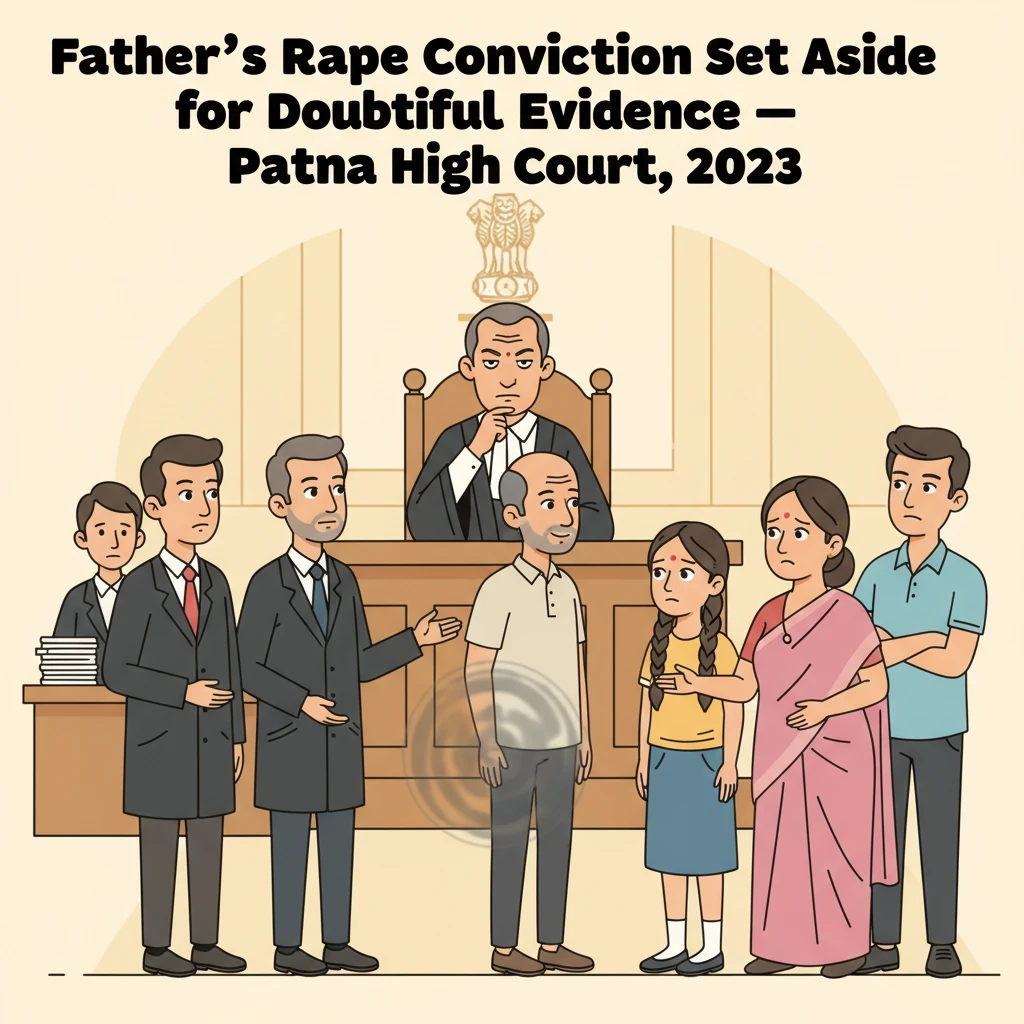
Image Alt Text: Inside view of a courtroom in the Patna High Court during a criminal appeal hearing.
Image Caption: The Patna High Court re‑examined evidence in a POCSO and rape conviction appeal from Muzaffarpur.







