

Case Background
Tez Narayan Yadav was appointed in 1983 as a daily wage Peon (Daftari) in the Registration Department. For many years he continued to work as a daily wager without being brought on the permanent rolls.
In 2003, he approached the Patna High Court by filing Civil Writ Jurisdiction Case No. 1304 of 2003. In that case he sought a direction for regularisation of his service.
On 08.02.2008, the Patna High Court disposed of his earlier writ petition. The Court directed the State authorities to consider his case for regularisation in terms of the Supreme Court decision in State of Karnataka vs. Uma Devi, reported in 2006(2) PLJR 363 (SC).
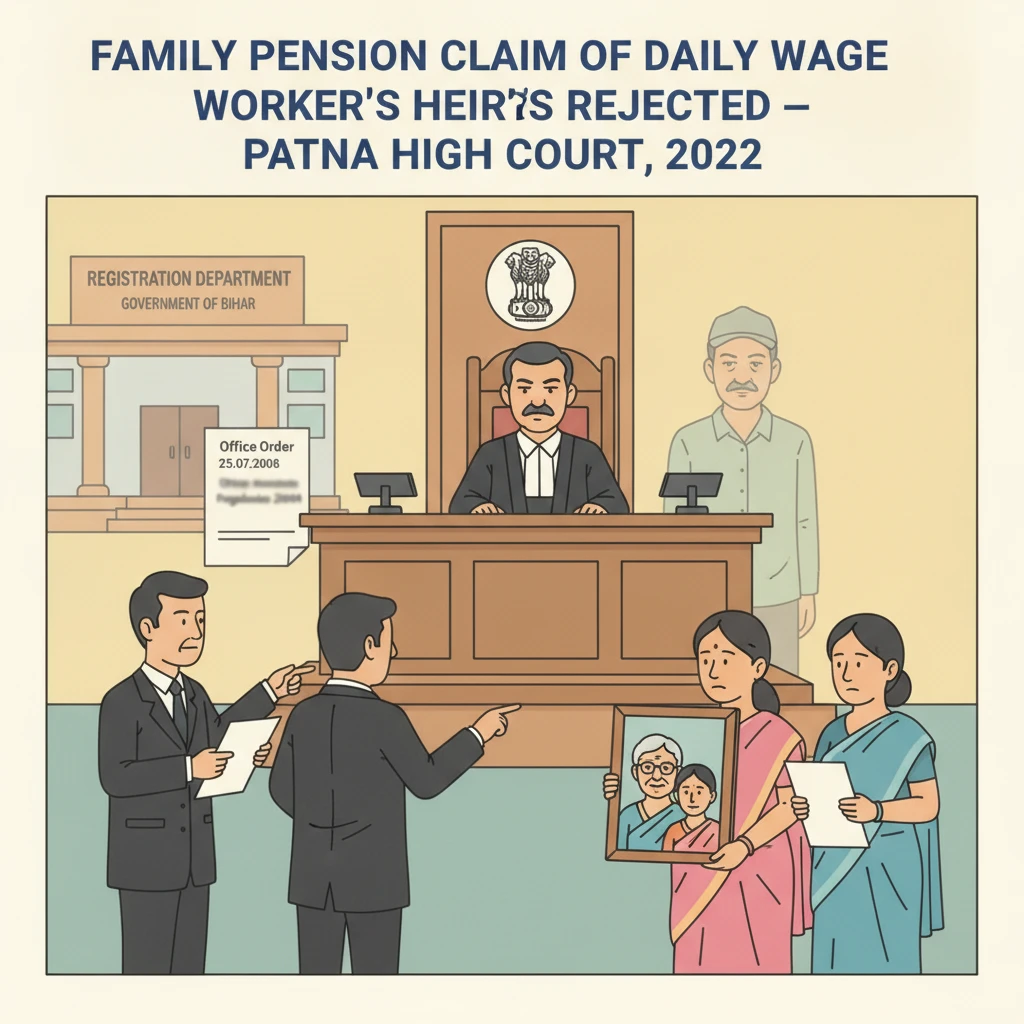
Pursuant to this direction, the Registration, Excise and Prohibition Department, Government of Bihar, issued an office order dated 25.07.2008. By this order, the service of Tez Narayan Yadav was regularised with effect from the date of issuance of that order.
After his regularisation, he continued in service until he died in harness on 07.04.2016.
Nearly three years after his death, his widow filed the present writ application, Civil Writ Jurisdiction Case No. 6973 of 2019. She sought family pension and all other retiral benefits by asking the authorities to treat his regularisation as effective from 03.10.1983, the date when he was first engaged as a daily wage worker.
During the pendency of the present writ petition, the original petitioner, the widow, also passed away. She was substituted by her son and daughter as petitioners before the Court.
What the Court Examined and Decided
The Patna High Court, through Hon’ble Mr. Justice Chakradhari Sharan Singh, heard arguments from both sides. The Court carefully examined the employment history of the deceased worker, the regularisation order, and the applicable pension rules.
The key fact noted by the Court was that the New Pension Scheme came into force with effect from 01.01.2004. This scheme does not provide for family pension. The earlier Bihar Pension Rules, 1950, under which family pension is available, apply only to employees appointed before the New Pension Scheme and fulfilling the required conditions.
The basic question before the Court was: what should be treated as the “date of appointment” of the deceased government servant for pension purposes? If it was taken as 25.07.2008, the date of regularisation, he clearly fell under the New Pension Scheme, and his family would not be entitled to pension or family pension under the 1950 Rules.
The petitioners argued that the date of first engagement on daily wage basis in 1983 should be treated as the date of regular employment. On this basis, they claimed that the deceased ought to be considered as a government servant appointed long before 01.01.2004. If this view was accepted, the Bihar Pension Rules, 1950 would apply, and the family would get family pension and higher retiral benefits.
The petitioners also challenged the way gratuity had been calculated. The authorities had counted his qualifying service for gratuity only from 25.07.2008 to 07.04.2016. Counsel for the petitioners argued that once regularisation was granted, the entire earlier period of service should also be treated as regularised for all purposes, including pension and gratuity. Otherwise, according to them, it would be unjust and arbitrary to deny the benefit of long years of service as a daily wage employee.
To support this plea, the petitioners relied on instructions issued by the Department of Personnel and Training (DoPT), Government of India, relating to a 1993 scheme for grant of temporary status and regularisation of casual labourers. Clause 2.5 of that scheme stated that 50% of the service rendered under temporary status would be counted for retirement benefits after regularisation.
The State and the office of the Accountant General, Bihar, opposed the claim. The Accountant General had already taken a clear stand that the widow of the deceased employee, and thus his family, were not entitled to pension or family pension.
The Court then turned to the office order dated 25.07.2008 by which the deceased employee’s service had been regularised. This document was brought on record as Annexure-2 to the writ petition. The order specifically mentioned that his engagement was being regularised with effect from the date of issuance of the order. It did not speak of any retrospective effect.
The Court observed that the deceased employee had not raised any objection to the terms of his regularisation order. He did not challenge the fact that it was effective only from 25.07.2008. He did not file any claim or case seeking retrospective regularisation of service to cover his earlier daily wage period.
In these circumstances, the Court held that the petitioners, who are his legal heirs, cannot now question the correctness of the regularisation order. Since the order clearly regularised his service only prospectively from 25.07.2008, the date of appointment in government service had to be treated as that date alone.
Once this conclusion was reached, the legal consequence was straightforward. All employees of the State of Bihar appointed after the New Pension Scheme came into force on 01.01.2004 are governed by that scheme, and the Bihar Pension Rules, 1950, do not apply to them. The Court recorded that there was no dispute on this point.
The Court next considered the reliance placed by the petitioners on the DoPT office memorandum dated 13.02.2020, which dealt with granting temporary status to casual labourers and counting 50% of their service for retirement benefits. The Court noted that this scheme applied to casual labourers of the Government of India. It did not by itself apply to employees of the Government of Bihar.
Under Clause 1.5 of that scheme, casual labourers who acquired temporary status would not be brought to the permanent establishment unless selected through the regular recruitment process. The Court concluded that this office memorandum had no bearing on the present case. The deceased employee’s service had already been regularised by a specific Bihar Government order from 25.07.2008. There was no policy of the State Government that past daily wage service would be counted for extending the old pension scheme to employees appointed after 01.01.2004.
The Court then turned to the Bihar Pension Rules, 1950, particularly Rule 58. This rule sets out three essential conditions for a government servant’s service to qualify for pension under the Rules:
First, the service must be under Government. Second, the employment must be substantive and permanent. Third, the service must be paid by Government.
The Court underlined that, according to Rule 58, employment which is not substantive and permanent cannot be counted for determining the qualifying period for pension. In this case, the deceased employee’s service prior to regularisation was as a daily wage worker, which was temporary and not on a substantive and permanent basis.
Therefore, even under the 1950 Rules themselves, his daily wage period could not be counted as qualifying service for pension. Combining this with the fact that his regularisation took place in 2008, the Court found that there was no legal basis to treat his 1983 engagement as the date of appointment for pension purposes.
On this reasoning, the Court held that the petitioners’ claim that the period during which the deceased employee had worked as a daily wage labourer should be counted for determining pensionary benefits under the Bihar Pension Rules, 1950, was wholly misconceived.
Finally, the Patna High Court dismissed the writ application. It did so without making any order as to costs, meaning each side would bear its own expenses.
Why This Judgment Matters
This judgment is important for daily wage and casual workers in Bihar who are later regularised into government service, and for their families.
It clarifies that, unless the State Government has a specific rule or policy saying otherwise, past daily wage service will not be counted to bring an employee under the old Bihar Pension Rules, 1950, once the New Pension Scheme has started.
The Court has also stressed that regularisation orders are crucial. If such an order clearly states that regularisation is effective only from a particular date, and the employee does not challenge it in time, the heirs cannot later ask the Court to treat earlier years of daily wage service as regular service.
For families of employees who were regularised after 01.01.2004, this decision means they cannot expect family pension under the old rules by counting pre-regularisation service, unless there is a clear legal provision to that effect.
Legal Issues and Answers
- Issue: Can the period of daily wage service of a government employee, who was regularised in 2008, be counted so as to treat him as appointed before 01.01.2004 and thus make his family eligible for family pension under the Bihar Pension Rules, 1950?
Answer: No. The Court held that his date of appointment is the date of regularisation, 25.07.2008, falling under the New Pension Scheme, and there is no rule or policy of the State Government permitting counting of past daily wage service for applying the Bihar Pension Rules, 1950. - Issue: Do the Government of India’s DoPT instructions and schemes on temporary status and counting 50% of such service for retirement benefits apply automatically to State Government employees in Bihar?
Answer: No. The Court held that the DoPT office memorandum and scheme have no application to employees of the State of Bihar in the absence of a corresponding State rule or policy. - Issue: Can temporary or daily wage service be treated as qualifying service for pension under Rule 58 of the Bihar Pension Rules, 1950?
Answer: No. Rule 58 requires that employment must be substantive and permanent. Temporary or daily wage employment, not being substantive and permanent, cannot be counted for pension qualifying service.
Cases Cited by the Court
- State of Karnataka vs. Uma Devi, 2006(2) PLJR 363 (SC)
Case Details
Case Number: Civil Writ Jurisdiction Case No. 6973 of 2019
Case Title: Nawal Kumar and another v. The State of Bihar and others
Coram: Hon’ble Mr. Justice Chakradhari Sharan Singh
Citation: 2022 (1) PLJR 863
Advocates:
- For the petitioners: Mr. Alok Kumar Choudhary, Advocate; Mr. Kulanand Jha, Advocate
- For the respondents (State of Bihar): Learned AC to Advocate General
- For the Accountant General, Bihar: Mr. Ram Yash Singh, Advocate
Nature of the case: Writ petition under civil writ jurisdiction seeking family pension and retiral benefits by treating earlier daily wage service as regular service.
Link to judgment: Click here to read the full judgment of the Patna High Court
If you found this explanation helpful and wish to stay informed about how legal developments may affect your rights in Bihar, you may consider following Samvida Law Associates for more updates.







