
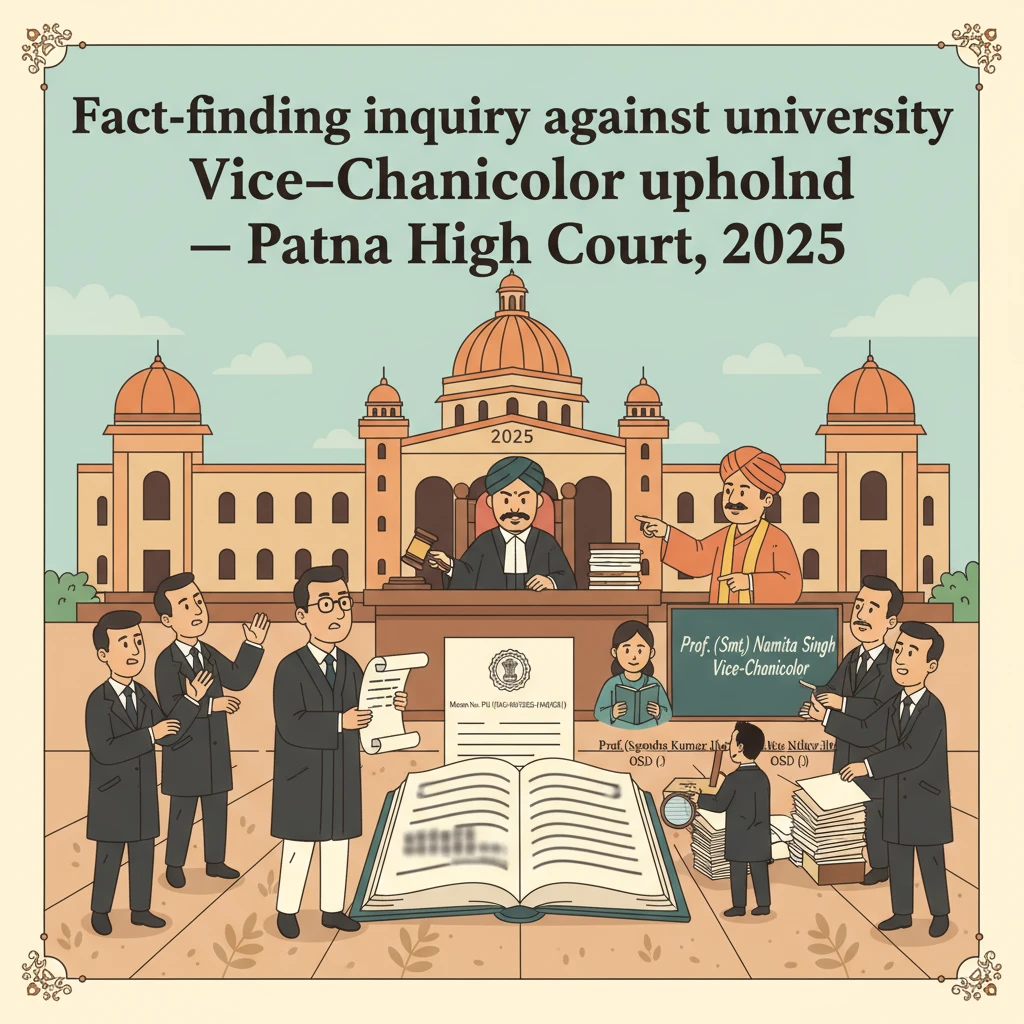
Case Background
The petitioner was serving as the Vice-Chancellor of Patna University.
On 16.10.2025, an order was issued from the office of the Governor of Bihar, acting as the Chancellor of the universities. This order, bearing Memo No. PU (HG)-08/2025-1948/GS (I), constituted a one-member Enquiry Committee under Sections 10 and 12 of the Patna Universities Act, 1976 and other enabling provisions.
By the same order, Prof. Nagendra Kumar Jha and the OSD (J), Governor’s Secretariat, were directed to assist the enquiry. The petitioner was directed to proceed on “compulsory leave” till completion of the enquiry, and Prof. (Smt.) Namita Singh, Department of English, A. N. College, Patliputra University, Patna, was asked to function as Officiating Vice-Chancellor of Patna University until the enquiry was over or further orders were passed.
The petitioner approached the Patna High Court in Civil Writ Jurisdiction Case No. 17831 of 2025, seeking quashing of this order of the Chancellor. The matter was heard by Hon’ble Mr. Justice Harish Kumar and decided on 11.11.2025.
What the Court Examined and Decided
The core question before the Patna High Court was whether the Chancellor’s order constituting a one-member enquiry committee, directing the petitioner to go on compulsory leave, and appointing an officiating Vice-Chancellor could be interfered with at this preliminary stage.
The petitioner, through learned Senior Advocate Mr. Amit Shrivastava, argued that Sections 10 and 12 of the Patna Universities Act, 1976 had been wrongly used against him. According to him, there were no materials on record to justify any enquiry at all.
He stressed that before placing him under enquiry, at least a notice or an opportunity of hearing should have been given to him, as required by Section 12(2) of the Act, 1976. In his view, this legal requirement was mandatory and had been breached, making the order illegal.
The petitioner also relied on Statute 10 of the University Statutes, particularly Statute 3. He pointed out that this provision says that where there are reasons to believe that a university servant, if allowed to continue in active service, might try to tamper with evidence, that person should be asked to proceed on leave that is due to him.
In contrast, he argued, the impugned order forced him to go on “compulsory leave,” which, according to him, was not supported by the Statute. He treated this as an unlawful departure from the statutory scheme.
Another major plank of the petitioner’s case was his apprehension of unfair treatment and bias by the one-member committee. He said he had already placed a detailed representation before the Hon’ble Chancellor, through the Principal Secretary, Raj Bhawan, Patna. This representation, a copy of which was on record as Annexure-P/13, outlined the reasons why he believed he would not receive a fair hearing.
He also questioned the motivation behind the initiation of the enquiry itself. The petitioner submitted that he had repeatedly sought guidelines from the Chancellor’s office for renewal of the terms of 22 remaining Guest Lecturers. According to him, this led to resentment in the Chancellor’s office, which, in turn, triggered the impugned order. Thus, he suggested that the enquiry was malafide.
Further, he challenged the deputation of Prof. (Smt.) Namita Singh as Officiating Vice-Chancellor. His argument was that, if he was to be made to leave office, then the proper course under the statutory rules was to appoint the Pro Vice-Chancellor in his place. Since that had not been done, he contended the arrangement was not in accordance with the rules.
On the other side, learned Senior Advocate Mr. P. K. Shahi, appearing for the Chancellor, strongly refuted these submissions.
He submitted that the petitioner’s reliance on Sections 10 and 12 of the Patna Universities Act, 1976 was misconceived. He asserted that no final decision had yet been taken which could affect the petitioner’s substantive rights and entitlements.
According to the Chancellor’s side, what had been ordered was only a “Fact Finding Enquiry Committee” to enquire into the matters mentioned in the impugned order. It was not a full-fledged departmental proceeding or punitive action.
On the plea of bias and unfair treatment, the Chancellor’s counsel argued that such objections remained open to the petitioner even after the enquiry was concluded. He clarified that the expression “compulsory leave” used in the order appeared to be superfluous and did not change the basic nature of the exercise.
He also pointed out that the petitioner would be at liberty to raise his apprehensions about bias before the committee itself, along with his substantive defence to the issues under enquiry.
On the appointment of an officiating Vice-Chancellor, it was informed to the Court that the post of Pro Vice-Chancellor of Patna University was vacant. Because of this vacancy, a decision had been taken to depute a Senior Professor as Vice-Chancellor.
After hearing both sides and examining Sections 10 and 12 of the Patna Universities Act, 1976, the Patna High Court framed its view of the impugned order.
The Court observed that, prima facie, the order only directed that an enquiry be conducted to enable the Chancellor’s office to decide what further action, if any, should be taken. The Court noted that, after completion of the enquiry, the report would be submitted to the Hon’ble Chancellor.
The Court underlined that, at that later stage, if any action was proposed against the petitioner, the Chancellor would obviously proceed only after proper service of notice to the petitioner or after giving him a chance to show cause, as mandated by law. Thus, the requirement of Section 12(2) was not being bypassed at this initial stage.
The Court also made an important clarification about the nature of this exercise. It observed that a preliminary enquiry serves the limited purpose of collecting facts regarding the conduct and work of a government servant in order to decide whether departmental proceedings or any other action should be initiated.
The Court found no sufficient reason or occasion to interfere with such an enquiry being conducted by a one-member committee. It treated the fact-finding step as a legitimate administrative process.
At the same time, the Court protected the petitioner’s rights for the future. It held that the petitioner would be free to raise all his objections before the one-member committee. If the eventual report caused any prejudice to him, he would have the liberty to challenge it on all grounds raised in the writ petition, including allegations of malafides and bias.
The Court also noticed that the impugned order itself fixed a time frame of two months for completion of the enquiry. The Court expressed its expectation that the one-member committee would complete the exercise within this period and submit its report to the Chancellor.
In view of these findings, the Patna High Court disposed of the writ petition without granting the relief of quashing the Chancellor’s order.
Why This Judgment Matters
This judgment is significant for university officers and public servants who face preliminary enquiries.
The Patna High Court has clarified that a fact-finding or preliminary enquiry, ordered to collect information, does not by itself amount to punishment or final action.
Because it is only a first step, the Court will normally not stop such an enquiry at the very beginning. Instead, the concerned officer must participate, state his defence, and then, if an adverse decision is taken later, challenge that decision.
For university governance in Bihar, the judgment also underlines the power of the Chancellor to order such fact-finding enquiries and make temporary administrative arrangements, like deputing an officiating Vice-Chancellor, when necessary.
At the same time, the Court has kept open the right of the Vice-Chancellor to question any future adverse action, including on grounds of bias or malafides. This balance protects both administrative functioning and individual rights.
Legal Issues and Answers
-
Issue: Can the Patna High Court quash a Chancellor’s order that merely sets up a one-member fact-finding enquiry, sends a Vice-Chancellor on leave, and appoints an officiating Vice-Chancellor?
Answer: No. The Court held that the order is only for a preliminary enquiry to collect facts. No final decision affecting the petitioner’s rights has yet been taken, and he retains the right to be heard and to challenge any later action. -
Issue: Does the use of the expression “compulsory leave” and allegations of bias justify stopping the enquiry at the outset?
Answer: No. The Court treated “compulsory leave” as a superfluous expression and held that apprehension of bias can be raised before the committee and, if needed, against any subsequent adverse decision.
Cases Cited by the Court
- No prior judicial decisions are cited or relied upon in the text of this judgment.
Case Details
Case Number: Civil Writ Jurisdiction Case No. 17831 of 2025
Case Title: Ajay Kumar Singh v. The State of Bihar & Ors.
Coram: Hon’ble Mr. Justice Harish Kumar
Citation: 2026(1) PLJR 169
Advocates:
- For the petitioner: Mr. Amit Shrivastava, Senior Advocate; Mr. Prashant Kumar, Advocate; Mr. Girish Pandey, Advocate; Mr. Akash Ambuj, Advocate
- For the State of Bihar: Mr. Sarvesh Kumar, GP-24
- For the Chancellor, Universities of Bihar: Mr. P. K. Shahi, Senior Advocate; Mr. Siddharth Prasad, Advocate
- For Patna University: Mr. Nadim Seraj, Advocate
Nature of the Case: Writ petition (civil) challenging an order of the Chancellor constituting a fact-finding enquiry committee, directing the Vice-Chancellor to proceed on leave, and appointing an officiating Vice-Chancellor.
Link to Judgment: Click here to read the full judgment of the Patna High Court
If you found this explanation helpful and wish to stay informed about how legal developments may affect your rights in Bihar, you may consider following Samvida Law Associates for more updates.







