
Case Background
The dispute arose from work entrusted by a telecom company (buyer) to a local company (supplier) for establishing mobile towers and related works and materials. Payment disputes followed, and the supplier claimed that amounts remained unpaid by the buyer.
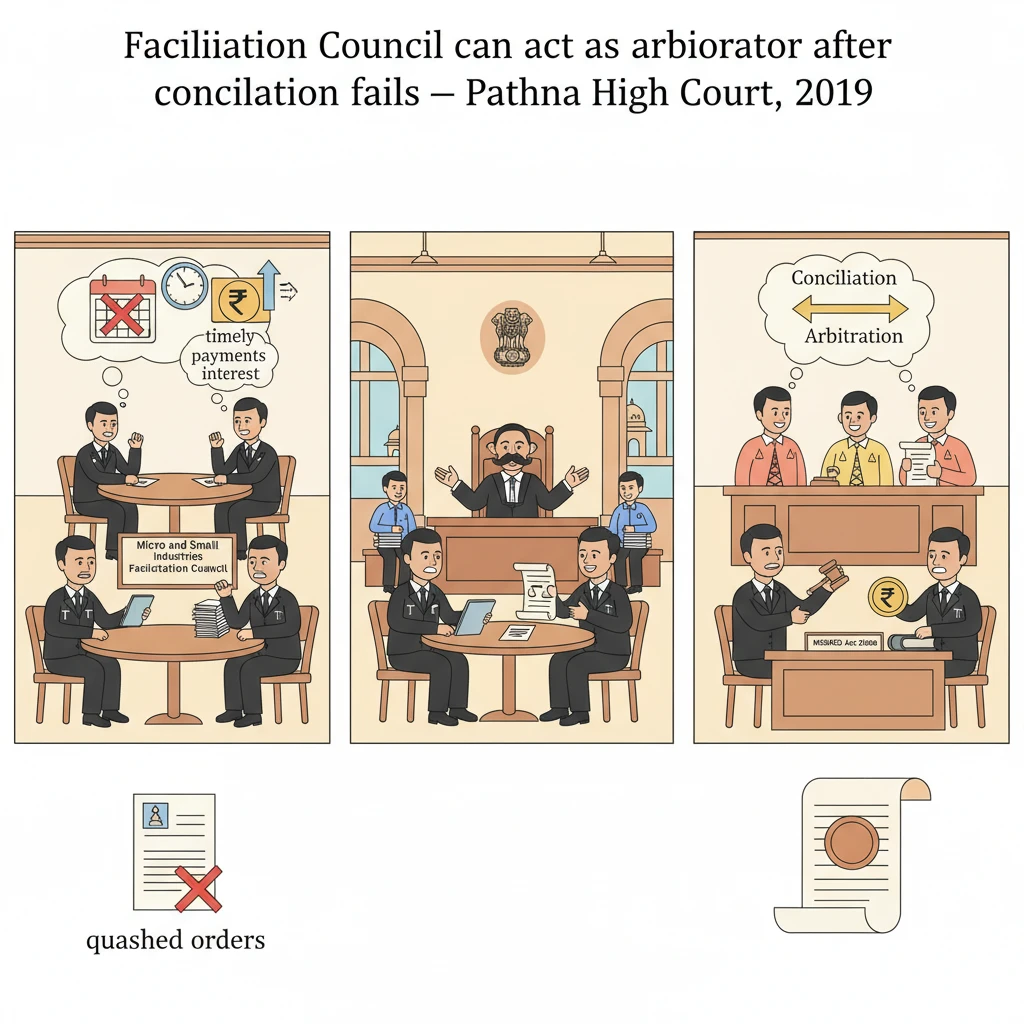
The supplier approached the Micro and Small Industries Facilitation Council, Patna, under the Micro, Small and Medium Enterprises Development Act, 2006 (MSMED Act, 2006). On 30 June 2016, the Council passed an order directing payment to the supplier.
The buyer challenged those orders (memos dated 27.10.2016 and 28.10.2016) in C.W.J.C. No. 14884 of 2016 and C.W.J.C. No. 15044 of 2016. On 11 April 2017, a learned Single Judge of the Patna High Court held that Section 18 of the MSMED Act, 2006 had not been properly followed, because the Council was required first to attempt conciliation, and only on failure could arbitration follow under the Arbitration and Conciliation Act, 1996.
The Single Judge quashed the earlier orders, but directed both parties to appear before the Council within 15 days. The Court clearly said that the Council should try to resolve the dispute and, in future, “either the Facilitation Council itself will take responsibility of arbitrator or refer the matter to third party, according to the provisions of the Act, for arbitration.”
The supplier carried this judgment in appeal as L.P.A. No. 827 of 2017. On 17 July 2017, a Division Bench dismissed the appeal, affirming that there had been a statutory violation of Section 18 but also confirming that the Council could act as arbitrator or make a reference under the Act. The Bench directed the Council to decide the issue within 60 days.
After this, the Council again took up the case. A notice dated 13 September 2017 was issued to both parties. The notice recorded that conciliation was attempted but failed mainly due to the buyer’s non-cooperation. The Council also remarked that the buyer appeared to be trying to delay the matter. Conciliation was formally closed on 18 October 2017.
The Council then initiated arbitration proceedings. The buyer appeared through a representative and sought time, so the matter was adjourned to 28 November 2017 and then again. Eventually, when the buyer continued not to respond to the Council’s directions, the Council, relying on Section 25(b)(c) of the Arbitration and Conciliation (Amendment) Act, 2014 read with Section 18 of the MSMED Act, made an award on 6 February 2018 in favour of the supplier.
During the arbitration, the buyer had filed an application under Section 12 of the 1996 Act challenging the Council’s jurisdiction to act as arbitrator, arguing that Section 80 of the 1996 Act barred a conciliator from acting as arbitrator. The Council rejected this objection and proceeded to award.
On 25 April 2018, the buyer filed two writ petitions before the Patna High Court, C.W.J.C. No. 8086 of 2018 and C.W.J.C. No. 8077 of 2018, challenging the arbitration proceedings and the award dated 06.02.2018 on the ground that the Council lacked inherent jurisdiction to act as arbitrator after having acted as conciliator.
A counter affidavit was filed on behalf of the supplier (respondent no. 4 in the writ petitions) placing on record the entire sequence of conciliation failure and arbitral proceedings. The learned Single Judge reserved judgment on 18 May 2018 and, by judgment dated 19 June 2018, allowed the writ petitions. The Single Judge held that Section 80 of the Arbitration and Conciliation Act, 1996 barred a conciliator from acting as arbitrator unless otherwise agreed by the parties, and that there was no inconsistency between Section 18 of the MSMED Act, 2006 and Section 80 of the 1996 Act. Therefore, the Council was held to have acted without jurisdiction and its award was quashed; the matter was remitted to the Council to make an “appropriate reference” under Section 18(3) of the MSMED Act.
The supplier then filed the present intra-court appeals, L.P.A. No. 1035 of 2018 and L.P.A. No. 1036 of 2018, challenging the Single Judge’s order.
Meanwhile, an important procedural development took place. On 25 May 2018, after the Single Judge had reserved judgment but before it was delivered, the buyer filed an application under Section 34 of the Arbitration and Conciliation Act, 1996 before the District Judge, Patna, registered as Arbitration Case No. 81 of 2018, seeking to set aside the Council’s award dated 06.02.2018.
The case was taken up on 28 May 2018 and listed for admission on 14 June 2018. On that date, though appearance had been put in on behalf of the buyer, no one appeared and the matter was adjourned to 5 July 2018. The Section 34 petition challenged the award on several grounds, including the alleged prohibition under Section 80 of the 1996 Act, the Council’s supposed lack of independence, and the claim that the Council should have appointed an independent arbitrator once conciliation failed.
However, that Section 34 petition did not disclose that the buyer had already filed writ petitions in the High Court challenging the award and that judgment had been reserved. Similarly, while the writ petitions were pending and judgment reserved, the buyer did not inform the Single Judge that it had instituted a Section 34 proceeding in the District Court. The buyer later withdrew the Section 34 proceeding after the Single Judge’s judgment went in its favour.
What the Court Examined and Decided
The Division Bench, comprising Hon’ble the Chief Justice and Hon’ble Justice Smt. Anjana Mishra, first condoned a minor delay of 3 and 5 days in filing the Letters Patent Appeals. It then turned to the core questions: whether the Facilitation Council had statutory power to act as arbitrator after conciliation failed, and whether the writ petitions were maintainable in the face of this statutory scheme and the buyer’s conduct.
The supplier’s counsel argued that Section 18(3) of the MSMED Act expressly authorises the Council, once conciliation fails, either to itself take up the dispute for arbitration or to refer it to any recognised institution or centre. Once arbitration is so commenced, the provisions of the Arbitration and Conciliation Act, 1996 apply “as if the arbitration was in pursuance of an arbitration agreement” under Section 7(1) of that Act. Read with Section 24 of the MSMED Act, which gives Sections 15 to 23 an overriding effect over any inconsistent law, the Council had full authority to function as arbitrator.
According to the supplier, there was a clear inconsistency between Section 18(3) of the MSMED Act and Section 80 of the 1996 Act (which prevents a conciliator from acting as arbitrator unless the parties agree otherwise). Because of Section 24, the special scheme of the MSMED Act must prevail, and the bar in Section 80 could not restrict the Council’s statutory role. The supplier also relied on decisions including GE T&D India Limited v. Reliable Engineering Projects and Marketing (Delhi High Court) and Snehadeep Structures Private Limited v. Maharashtra Small-Scale Industries Development Corporation Limited (2010) 3 SCC 34, which treated MSME legislation as a special, beneficial law intended to curb buyer delay.
The buyer’s counsel, on the other hand, argued that Section 18(2) of the MSMED Act itself imported Sections 65 to 81 of the 1996 Act into conciliation under the Council, and therefore Section 80 applied in full. On this reading, once the Council had acted as conciliator, it could not become arbitrator in respect of the same dispute. It was contended that there was no inconsistency between Section 18 and Section 80, and thus Section 24 of the MSMED Act was not triggered. The buyer further argued, citing Harshad Chiman Lal Modi v. DLF Universal Ltd. (2005) 7 SCC 791, that questions of jurisdiction go to the root and can be raised in writ proceedings despite alternative remedies. The buyer also denied any intention to conceal proceedings or to delay the matter.
The Division Bench first undertook a detailed comparison of the MSMED Act, 2006 and the Arbitration and Conciliation Act, 1996. It noted that the MSMED Act was enacted to promote and protect micro, small and medium enterprises, especially in respect of delayed payments. Under Chapter V, buyers are under a statutory liability to pay within specified timeframes (Sections 16 and 17) and a special forum, the Facilitation Council, is created under Section 18 to handle disputes.
Under Section 18(2), once a dispute is referred, the Council “shall” either itself conduct conciliation or seek assistance of any institution or centre and, for such conciliation, Sections 65 to 81 of the 1996 Act apply as if conciliation was initiated under Part III of that Act. The Bench emphasised that this import of Sections 65–81 is limited to the conciliation stage.
Immediately thereafter, Section 18(3) introduces a distinct mechanism: if conciliation is not successful and stands terminated, the Council “shall either itself take up the dispute for arbitration or refer it” to an institution or centre, and then the Arbitration and Conciliation Act, 1996 applies to the disputes as though there were an arbitration agreement. This, read with Section 24 of the MSMED Act, gives Sections 15 to 23 an overriding effect over any inconsistent law.
The Court held that the power given in Section 18(3) for the Council to itself arbitrate, with an overriding clause in Section 24, clearly prevails over the general bar in Section 80 of the 1996 Act. Once conciliation fails, the statute mandates that the Council may become arbitrator; at that later stage, the 1996 Act “shall then apply.” Thus, any inconsistency with Section 80 is overridden by the special MSMED scheme.
The Bench therefore disagreed with the Single Judge’s view that the Council was prohibited from acting in a dual capacity. It noted that Section 18(4) further empowers the Council to act as arbitrator or conciliator in respect of disputes anywhere in India, reinforcing that the legislature intended the Council to both conciliate and arbitrate where required.
The Court also examined the earlier 2017 Single Judge judgment (affirmed in L.P.A. No. 827 of 2017). That judgment had itself stated that, after conciliation, “either the Facilitation Council will itself take responsibility of arbitrator or refer the matter to third party, according to the provisions of the Act, for arbitration.” The Division Bench pointed out that its earlier order had not contradicted this view. Therefore, those observations was binding on the parties and consistent with the correct interpretation of Section 18(3).
Turning to the buyer’s conduct, the Court highlighted that the Section 34 petition before the District Judge was filed on 25 May 2018, one week after the Single Judge had reserved judgment in the writ petitions. The buyer did not disclose this fresh proceeding to the High Court, nor did it disclose the already filed writ petitions to the District Judge. After the Single Judge allowed the writ petitions, the buyer quietly withdrew the Section 34 proceeding.
The Division Bench found this behaviour highly improper. It observed that if the Single Judge had been informed about the Section 34 proceeding, he may have taken a different approach, especially because Section 18(3) itself directs that once arbitration is commenced under the MSMED Act, the challenge to any award must follow the 1996 Act, including Section 34. The Bench concluded that the buyer had been “playing ducks and drakes” with the law, apparently trying to delay payment and secure multiple bites at the cherry. This conduct disentitled the buyer to discretionary relief under Article 226 of the Constitution.
In sum, the Court held that:
- the Facilitation Council did not lack inherent jurisdiction to act as arbitrator after conciliation failed;
- any challenge to its award should proceed under the Arbitration and Conciliation Act, 1996 (for example, through Section 34), not by way of a writ claiming lack of jurisdiction; and
- the buyer’s suppression of parallel proceedings and its delaying tactics justified imposition of costs.
Consequently, the Division Bench allowed the Letters Patent Appeals, set aside the Single Judge’s judgment dated 19 June 2018, and imposed costs of Rs. 50,000 on the buyer (respondent no. 1–writ petitioner), payable to the Patna High Court Legal Services Committee within one month.
Why This Judgment Matters
This judgment is important for micro and small enterprises across Bihar and India that supply goods or services to big buyers but face delayed payments.
First, the Patna High Court has clearly stated that the MSME Facilitation Council can act both as conciliator and later as arbitrator in the same dispute once conciliation fails. This removes doubts about the Council’s power and avoids additional delays in appointing a separate arbitrator.
Second, the Court has reinforced that the MSMED Act is a special, protective law. When there is any conflict between it and the general arbitration law, the MSMED Act will prevail. For small suppliers, this means their statutory forum is strong and cannot be easily side-tracked by technical objections.
Third, the Court has sent a clear message against “forum shopping” and suppression of material facts. A party cannot simultaneously run a writ petition and a Section 34 challenge, hide one from the other court, and then withdraw whichever case becomes inconvenient. Such conduct can lead to costs and loss of discretionary relief.
For suppliers dealing with large corporate buyers, this decision shows that, once the Facilitation Council passes an award, the proper route is a challenge under the Arbitration and Conciliation Act—not repeated writ petitions alleging lack of jurisdiction. For buyers, it is a warning that delaying tactics can be punished.
Legal Issues and Answers
- Issue: Can the MSME Facilitation Council, after attempting conciliation under Section 18(2) of the MSMED Act, 2006, itself act as arbitrator in the same dispute despite Section 80 of the Arbitration and Conciliation Act, 1996?
Answer: Yes. The Patna High Court held that Section 18(3) read with Section 24 of the MSMED Act overrides any bar in Section 80 of the 1996 Act. The Council is legally empowered to act as arbitrator after conciliation fails. - Issue: Were the writ petitions challenging the Council’s award on the ground of lack of jurisdiction maintainable, especially when a remedy under Section 34 of the Arbitration and Conciliation Act, 1996 was available and actually invoked?
Answer: No. The Court found that the Council did not lack inherent jurisdiction, that Section 34 was the appropriate remedy for challenging the award, and that the buyer’s conduct in running parallel proceedings and suppressing facts disentitled it to writ relief. - Issue: Did the earlier 2017 judgments of the Single Judge and Division Bench restrict the Council’s power to act as arbitrator?
Answer: No. Those judgments had only insisted on proper conciliation under Section 18, and expressly recognised that after conciliation the Council could either itself act as arbitrator or refer the matter under Section 18(3). They supported, rather than limited, the Council’s jurisdiction.
Cases Cited by the Court
- GE T&D India Limited v. Reliable Engineering Projects and Marketing, O.M.P. (COMM) 76/2016, Delhi High Court, decided on 15.02.2017.
- Snehadeep Structures Private Limited v. Maharashtra Small-Scale Industries Development Corporation Limited, (2010) 3 SCC 34.
- Edukanti Kistamma (Dead) through LRs v. S. Venkatareddy (Dead) through LRs (citation as referred in judgment).
- Waman Shriniwas Kini v. Ratilal Bhagwandas & Co. (citation as referred in judgment).
- Harshad Chiman Lal Modi v. DLF Universal Ltd. and another, (2005) 7 SCC 791.
Case Details
Case Numbers: Letters Patent Appeal No. 1035 of 2018 and Letters Patent Appeal No. 1036 of 2018, arising out of C.W.J.C. No. 8086 of 2018 and C.W.J.C. No. 8077 of 2018.
Case Title: The Best Towers Private Limited v. Reliance Communications Limited & Ors.
Citation: 2019 (3) PLJR 486.
Court: High Court of Judicature at Patna.
Coram: Hon’ble the Chief Justice Amreshwar Pratap Sahi and Hon’ble Justice Smt. Anjana Mishra.
Date of Judgment: 14-02-2019.
Advocates:
- For the appellant (supplier): Mr. Jai Kishore Sharma, Advocate; Mrs. Ranjeeta Singh, Advocate.
- For the respondent(s) (including buyer and State authorities): Mr. Anuj Prakash, Advocate; Mr. Rakesh Kumar Sinha, Advocate.
Nature of the Case: Intra-court (Letters Patent) appeals against a Single Judge’s order in writ proceedings under Article 226 of the Constitution, relating to an MSME Facilitation Council award and its jurisdiction.
Link to Judgment: Patna High Court Judgment PDF
If you found this explanation helpful and wish to stay informed about
how legal developments may affect your rights in Bihar,
you may consider following Samvida Law Associates for more updates.







