
Case Background
The State authorities issued Advertisement No. 1 of 2015 inviting applications for appointment to the post of Excise Constable under the State of Bihar. The recruitment was governed by the Bihar Excise Constable Cadre (Appointment & Service Conditions) Rules, 2014.
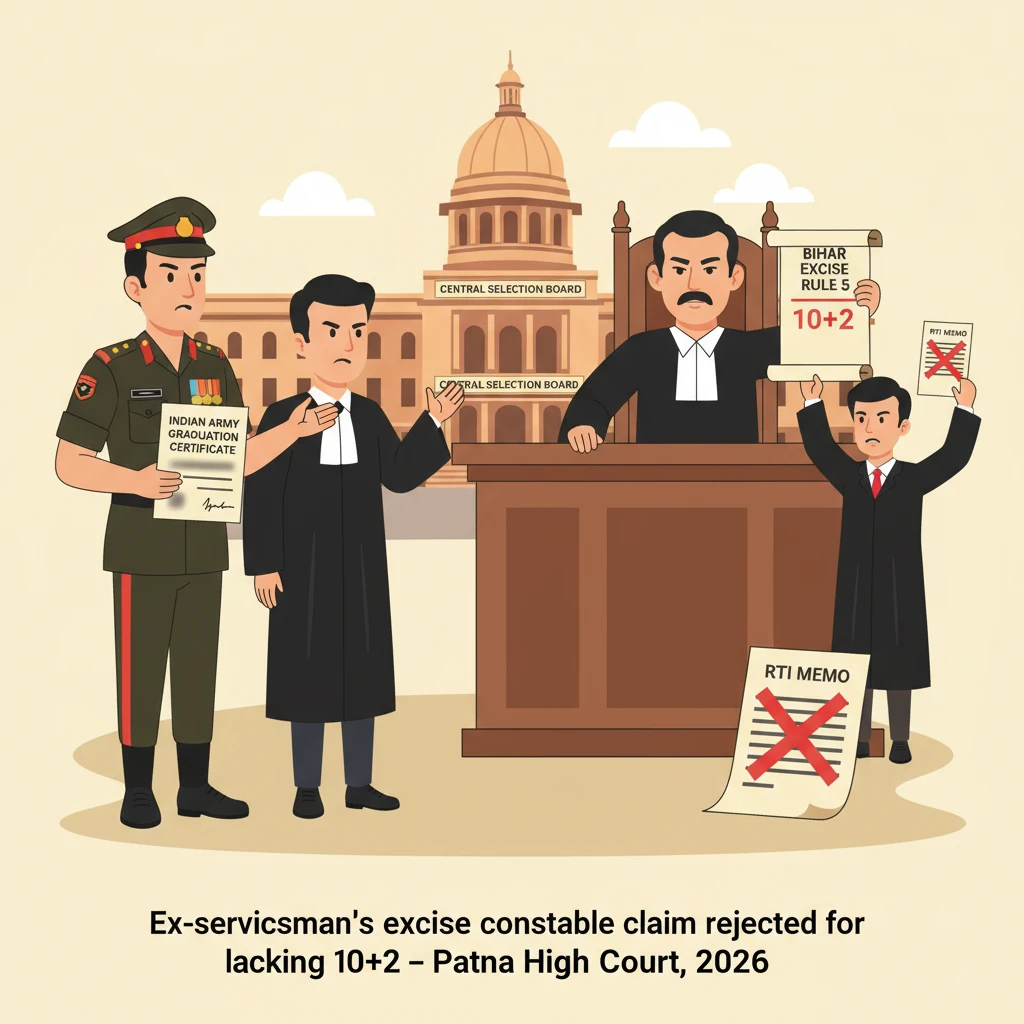
The petitioner, an ex-serviceman from the defence services, applied under the 25% reserved category for Ex-Service (Defence) personnel. He relied on his long service in the Indian Army and on an Army “Graduation Certificate” dated 31.08.2011, which recorded that he had served as a driver in the Army from 25.08.1994 to 31.08.2011.
After the selection process, a final merit list was published on 15.12.2016. The petitioner’s name did not appear in that list. He therefore sought information under the Right to Information Act. By Memo No. 177/C.S.C (R.T.I) dated 30.12.2016, the Public Information Officer, Central Selection Board (Constable Appointment), Bihar, Patna informed him that his candidature had been rejected as he had submitted only the Army Graduation Certificate and not a certificate of intermediate (10+2) or equivalent from a recognised Board/Council.
Feeling aggrieved, the petitioner filed Civil Writ Jurisdiction Case No. 1465 of 2017 before the Patna High Court. He challenged the rejection of his claim for appointment, the relevant clause of the 2014 Rules, and sought a direction for his appointment as Excise Constable.
What the Court Examined and Decided
The writ petition was heard by Hon’ble Mr. Justice Partha Sarthy. The Court heard counsel for the petitioner, for the State, for the Union of India, and for the Central Selection Board of Constable.
The petitioner’s primary challenge was to Memo No. 177/C.S.C (R.T.I) dated 30.12.2016, through which he came to know that his candidature stood rejected. He argued that this rejection was illegal and arbitrary, especially in light of the reservation for ex-servicemen and a central government notification.
He also sought quashing of the notification dated 25.02.2014 containing the Bihar Excise Constable Cadre (Selection and Service Condition) Rules, particularly paragraph/Rule 5 prescribing educational qualifications. Further, he asked for a writ of mandamus directing the authorities to appoint him as an Excise Constable and for appropriate action against officials allegedly responsible for the “illegal” selection process.
On facts, the Court noted that the recruitment in question was for Excise Constables under Advertisement No. 1 of 2015, and that the petitioner had applied under the ex-servicemen quota. The dispute was confined to whether he met the prescribed educational qualification.
Rule 5 of the Bihar Excise Constable Cadre (Appointment & Service Conditions) Rules, 2014, referred to as “the Rules”, clearly laid down the educational qualification. It required that a candidate should have passed intermediate (10+2) or an equivalent examination from a Board or Council recognised by the State Government or Central Government.
The Court recorded that the advertisement itself reproduced this requirement. A copy of Advertisement No. 1 of 2015 was produced as Annexure-B to the counter affidavit of respondent nos. 2 and 3. The advertisement not only repeated Rule 5 but added that the candidate must have passed the required examination on or before 01.01.2015.
The petitioner, however, had not passed the intermediate examination from any recognised Board/Council, nor had he produced any certificate of an equivalent examination from such a Board/Council. He had only produced the Indian Army Graduation Certificate dated 31.08.2011 as his educational qualification.
On behalf of the petitioner, strong reliance was placed on a Government of India notification dated 12.02.1986 (Annexure-6). This notification was issued by the Ministry of Personnel, Public Grievances and Pensions (Department of Personnel & Training). It stated that for appointment to any reserved vacancy in Group-C posts, a matriculate ex-serviceman who had put in 15 years or more of service in the Armed Services of the Union could be considered eligible for posts where the essential qualification prescribed was graduation.
The petitioner argued that since he had served for 17 years as a driver in the Indian Army, as shown in his Army Graduation Certificate, he should be treated as having the requisite educational qualification. He further relied on judgments of the Rajasthan High Court, filed as annexures to his supplementary affidavit, to support his claim that such certificates and long military service should be treated as equivalent to the civilian educational requirement.
The respondents contested this position. They argued that the eligibility condition in Advertisement No. 1 of 2015 was strictly based on Rule 5 of the 2014 Rules. Under that Rule, only intermediate (10+2) or an equivalent examination from a recognised Board/Council would suffice. The Army Graduation Certificate did not meet this standard.
The respondents also addressed the 12.02.1986 central notification. They pointed out that this notification merely allowed departments some discretion to consider long-serving matriculate ex-servicemen as eligible for certain Group-C posts where graduation was prescribed. It did not automatically change or override recruitment rules framed by a State or the specific conditions in a particular advertisement. In this case, the Bihar Rules and the advertisement clearly set out the qualification, and the employer had not chosen to relax or modify it.
Regarding the Rajasthan High Court decisions cited by the petitioner, the respondents submitted that those cases did not consider Rule 5 of the Bihar Excise Constable Cadre (Appointment & Service Conditions) Rules, 2014. Therefore, they had no bearing on the present recruitment.
The Court examined the material and accepted the respondents’ stand. It emphasised that the educational qualification in Rule 5 and in the advertisement was clear and specific: the candidate must have passed intermediate (10+2) or equivalent from a Board/Council recognised by the State or Central Government, and must have done so on or before 01.01.2015.
The Army Graduation Certificate produced by the petitioner was not such a certificate. It did not show that he had passed intermediate or an equivalent examination from a recognised Board/Council. There was no dispute on this fact. Therefore, he did not fulfil the basic educational requirement for the post of Excise Constable.
The Court also considered the Rajasthan High Court judgments cited by the petitioner but held that they were “of no assistance” to him. The key reason was that Rule 5 of the Bihar Excise Constable Cadre (Appointment & Service Conditions) Rules, 2014, which formed the basis of eligibility in Advertisement No. 1 of 2015, had not been examined in those cases. Hence, they could not control the interpretation of the Bihar Rules in this recruitment.
Once the Court found that the petitioner did not meet the prescribed eligibility, the other prayers—such as quashing paragraph 5 of the Rules, directing appointment, or taking action against officials—did not survive. The Court also noted that the final result had been published on 15.12.2016, appointments had already been made, and further advertisements for later vacancies had been issued.
In paragraph 17 of the judgment, the Court clearly concluded that there was no illegality in the non-selection of the petitioner as an Excise Constable pursuant to Advertisement No. 1 of 2015. Consequently, in paragraph 18, the Court held that the writ application had no merit and dismissed it.
Why This Judgment Matters
This decision of the Patna High Court is important for ex-servicemen and other candidates applying for government posts in Bihar. It shows that while reservation and concessions exist, basic eligibility conditions stated in recruitment rules and advertisements remain mandatory.
The Court made it clear that a certificate issued by the Army, showing long service and internal training, is not automatically treated as equivalent to a 10+2 or recognised board examination, unless the recruitment rules specifically allow it. Similarly, a general central government circular giving discretion to treat some ex-servicemen as graduates cannot override clear State rules prescribing a particular level of schooling.
For future candidates, the judgment underlines that one must check the exact educational qualification in the advertisement and ensure that the certificate is from a recognised Board or Council, or is an officially declared equivalent. Otherwise, even long and honourable service in the armed forces will not by itself secure a civilian government job.
Legal Issues and Answers
Issue: Whether an ex-serviceman who has not passed intermediate (10+2) from a recognised Board/Council, but holds an Army Graduation Certificate and has long military service, satisfies the educational qualification for appointment as Excise Constable under Advertisement No. 1 of 2015 and Rule 5 of the 2014 Rules.
Answer: No. The Patna High Court held that Rule 5 and the advertisement require passing intermediate (10+2) or an equivalent examination from a recognised Board/Council. An Army Graduation Certificate is not such a qualification, and the petitioner was therefore rightly not selected.
Issue: Whether central government notification dated 12.02.1986 and Rajasthan High Court judgments compelled the Bihar authorities to treat the petitioner as educationally eligible.
Answer: No. The Court held that the 1986 notification only gives discretion to employers and does not alter the clear eligibility condition in the Bihar Rules and advertisement. The Rajasthan High Court decisions did not consider Rule 5 of the 2014 Rules and were not applicable.
Cases Cited by the Court
The judgment records that the petitioner relied on certain Rajasthan High Court decisions annexed to his supplementary affidavit. However, no specific case names or citations are given in the text, and the Patna High Court held that those decisions were not helpful as Rule 5 of the Bihar Excise Constable Cadre (Appointment & Service Conditions) Rules, 2014 was not in issue there.
Case Details
Case Number: Civil Writ Jurisdiction Case No. 1465 of 2017
Case Title: Manoj Kumar v. The State of Bihar & Others
Citation: 2026 (1) PLJR 586
Court: High Court of Judicature at Patna
Coram: Hon’ble Mr. Justice Partha Sarthy
Date of Judgment: 06.01.2026
Advocates:
For the petitioner: Mr. Ravi Kant Kumar, Advocate
For the State of Bihar: Mr. Pankaj Kumar Singh, AC to GA-9
For the Union of India: Mrs. Kanak Verma, CGC
For the Central Selection Board of Constable: Mr. Sanjay Pandey, Advocate; Mr. Binod Kumar Mishra, Advocate; Mr. Vivek Anand Amritesh, Advocate
Nature of the Case: Writ petition under civil writ jurisdiction challenging rejection of candidature for recruitment to the post of Excise Constable and seeking consequential directions.
Link to Judgment: Click here to read the full Patna High Court judgment
If you found this explanation helpful and wish to stay informed about
how legal developments may affect your rights in Bihar,
you may consider following Samvida Law Associates for more updates.







