

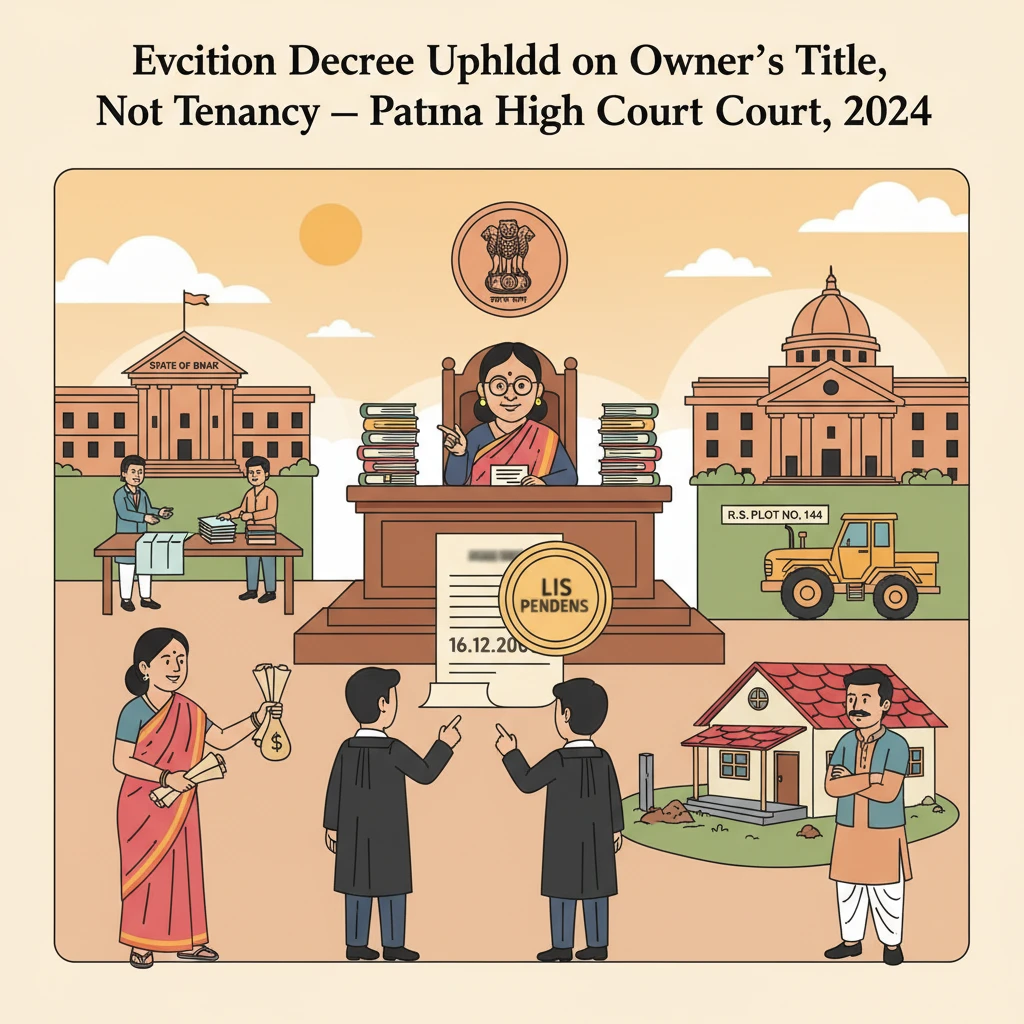
Case Background
The dispute concerns a house with adjoining land measuring 46 decimals in village Brahampura, P.S. Sadar, district Muzaffarpur. The plots involved are R.S. Plot Nos. 143 (20 decimals), 142 (3 decimals), 147 (17 decimals) and 144 (6 decimals).
According to the plaintiff, one Sharda Devi (defendant no.3) purchased 46 decimals over time through five registered sale deeds: two dated 10.03.1980, two dated 01.10.1980, and one dated 24.02.1982. These deeds were executed by recorded tenants or their legal heirs. After purchase, Sharda Devi’s name was mutated and she paid rent to the State.
The plaintiff said that defendants nos.1 and 2, who were contractors, took the house from Sharda Devi as monthly tenants and used the open land for their work. Later, Sharda Devi sold the property (other than land standing in the name of the State) to the plaintiff by registered sale deed dated 07.10.2003 for Rs.3,00,000 and asked defendants nos.1 and 2 to pay rent to the plaintiff.
The plaintiff claimed she needed the house for her residence and children’s education. She asked the defendants to vacate and sent a legal notice when they refused. The defendants then allegedly denied her title and the landlord–tenant relationship. So she filed Title Suit No.424 of 2004.
In the suit, she sought: (i) declaration of her right and title over the Schedule I land; (ii) declaration that sale deed no.26560 dated 16.12.2005 in favour of defendant no.1 was void, hit by lis pendens and not binding on her; (iii) a declaration that defendants nos.1 and 2 were tenants; (iv) their eviction on the ground of personal necessity; (v) damages from 07.10.2003 till delivery of possession; and (vi) other suitable reliefs.
Defendants nos.1 and 2 contested. They denied being tenants and instead claimed ownership. They asserted that in 1985 they paid Rs.15,000 to Hardeo Singh, said to be in possession, under an agreement for the land. They claimed to have built a pucca house on eight decimals at their own cost, used the remaining land for contract materials, and later paid Rs.4,95,000 in 1991. According to them, due to cordial relations they did not insist on a sale deed until Hardeo Singh executed a registered deed on 16.12.2005 in favour of defendant no.1, making him the absolute owner.
They attacked Sharda Devi’s and the plaintiff’s title, saying the property originally belonged to a common ancestor, and that a family arrangement gave the entire disputed land exclusively to Hardeo Singh. The State of Bihar, as defendant no.5, supported the plaintiff’s stand that R.S. Plot No.144 is recorded in the State’s name and argued that the 16.12.2005 sale in favour of defendant no.1 was hit by lis pendens.
The Trial Court partly decreed the suit. It rejected the case of tenancy and personal necessity but declared the plaintiff’s title over R.S. Plot Nos.143, 147 and 142 and held that the defendants were unauthorised occupants liable to eviction. It held that the plaintiff had no title over plot 144 (6 decimals), which belongs to the State. The first appellate court (Title Appeal No.67 of 2015) confirmed this decision. Defendants nos.1 and 2 then filed Second Appeal No.140 of 2021 before the Patna High Court.
What the Court Examined and Decided
The second appeal was heard by Hon’ble Mr. Justice Sunil Dutta Mishra under Section 100 of the Code of Civil Procedure, 1908. On 03.03.2022, the Court framed four substantial questions of law focusing on:
- whether a court hearing what was described as a Bihar Buildings (Lease, Rent and Eviction) Control Act, 1982 (BBC Act) suit could decree eviction on the basis of title under Order VII Rule 7 CPC,
- whether the courts below wrongly treated the defendants as trespassers without pleadings,
- whether the plaintiff’s title was declared merely on the basis of survey and revenue entries, and
- whether the suit itself was maintainable when eviction and declaration of title were combined.
On arguments, both sides accepted that questions (i) and (iv) were connected to the scope of jurisdiction under the BBC Act and Order VII Rule 7 CPC.
Counsel for the appellants argued that:
- the suit was a BBC Act eviction suit, where title cannot be decided;
- once both courts found no landlord–tenant relationship, they could not proceed to declare title or grant eviction as an “alternative relief” under Order VII Rule 7 CPC; and
- the plaintiff could not get a decree for eviction by branding the defendants as trespassers when her pleaded tenancy case failed.
The plaintiff’s senior counsel countered that:
- the suit was a regular title suit, not a pure BBC Act eviction case;
- she had sought a declaration of title and paid ad valorem court fee, so the civil court’s jurisdiction was not limited by the BBC Act; and
- when defendants themselves denied tenancy and set up ownership, they stepped out of BBC Act protection, and the court could grant eviction based on title under Order VII Rule 7 CPC.
The High Court reviewed Supreme Court precedents, including Tribhuwanshankar v. Amrutlal, LIC v. India Automobiles & Co., Dr. Ranbir Singh v. Asharfi Lal, and Rajendra Tiwary v. Basudeo Prasad. These authorities distinguish between eviction suits under general law and special rent-control statutes, but accept that if the law permits, a court may grant alternative relief, and can examine title incidentally when the tenant disputes it.
The Patna High Court also referred to its own earlier decision in Sukhdeoji v. Purushottam Sharma & Ors., which recognised that under Order VII Rule 7 CPC, in an eviction suit, a decree can be granted on the basis of general title even if tenancy is not proved, provided parties have gone to trial on that issue and there is no prejudice.
In this case, the Court noted:
- The plaint clearly sought declaration of title along with eviction and other reliefs.
- Specific issues regarding right and title were framed and decided by both courts below.
- The plaintiff paid proper court fees for declaration of title.
Order VII Rule 7 CPC, quoted in the judgment, allows courts to grant general or other reliefs that are just, even if not specifically prayed, so long as they fall within the scope of the case. The Court explained that when a larger relief is claimed but not fully proved, a smaller included relief can be granted, though a larger relief than claimed cannot be granted.
On these principles, the High Court held that the suit was a regular title suit, not confined to BBC Act jurisdiction. Therefore, the courts below were competent to decide title and, on that basis, order eviction of unauthorised occupants. Substantial questions (i) and (iv) were decided against the appellants.
On the second question—whether the courts wrongly made out a “third case” of trespass—the appellants argued that the plaintiff had only pleaded tenancy and so, once that failed, the suit should have been dismissed. The High Court rejected this.
Relying on Bhagwati Prasad v. Sri Chandramaul (AIR 1966 SC 735), the Court held that if an issue, though not very clearly pleaded, is covered by the issues framed and both sides lead evidence knowing what is in dispute, the court may decide it. Technical objections about pleading cannot defeat substantial justice where no prejudice is caused.
Here, the defendants’ own written statement asserted that:
- they were not tenants at all,
- they had built their own pucca house and possessed the land as owners, and
- they purchased the property by registered sale deed dated 16.12.2005 from Hardeo Singh.
Given these assertions, the Court observed that the possible legal status of the defendants could only be: owner/landlord, licensee, or trespasser. After trial, the courts below held that:
- the landlord–tenant relationship was not proved;
- the 16.12.2005 sale deed executed by Hardeo Singh in favour of defendant no.1 was void and hit by lis pendens, as it was executed during the pendency of the suit when Sharda Devi’s title stood on record; and
- defendants nos.1 and 2 had no right, title or interest and were in unauthorised possession.
Once these findings were reached, calling the defendants trespassers and ordering their eviction followed as a matter of law. As the plaintiff had expressly prayed for their eviction from the premises, the Court held that no new case had been manufactured and no prejudice was caused. Substantial question (ii) was also decided against the appellants.
On the third question, the appellants contended that the plaintiff’s title had been declared only on the basis of revisional survey khatiyan and revenue entries, which are not documents of title. The High Court accepted the legal principle but found that the factual premise of the appellants was wrong.
The Court reiterated Supreme Court law that revenue records and mutation entries:
- do not by themselves create or extinguish title,
- raise only a presumption about possession, and
- are prepared mainly for fiscal purposes.
However, reviewing the judgments below, the High Court held that the plaintiff’s title had not been based merely on survey or revenue entries. Instead, both courts had relied on:
- the chain of registered sale deeds in favour of Sharda Devi (10.03.1980, 01.10.1980 and 24.02.1982) by the recorded tenants or their heirs; and
- the registered sale deed dated 07.10.2003 in favour of the plaintiff from Sharda Devi.
These deeds had never been challenged in appropriate proceedings by the defendants. The appellate court had examined these documents (Exhibits 1/A to 1/E, etc.) in detail and affirmed that the plaintiff had valid right, title and interest over R.S. Khata No.32, Plot 143 (20 decimals), R.S. Khata No.29, Plot 147 (17 decimals) and R.S. Khata No.90, Plot 142 (3 decimals). Only R.S. Khata No.102, Plot 144 (6 decimals) was held to belong to the State of Bihar.
The High Court also took note of case law on purchasers pendente lite, particularly K.N. Aswathnarayan Setty v. State of Karnataka and Md. Noorul Hoda v. Bibi Raifunnisa, which emphasise that a purchaser during the pendency of litigation cannot defeat the successful plaintiff’s decree and that any person wishing to avoid a deed binding on him must seek its cancellation. The defendants had not sought cancellation of the plaintiff’s or Sharda Devi’s sale deeds.
In these circumstances, the Court held that the plaintiff’s title was founded on registered sale deeds, not survey entries, and substantial question (iii) also went against the appellants.
Finally, the Court dismissed the second appeal, confirmed the first appellate court’s judgment and decree, and vacated its earlier interim order dated 29.03.2022 staying further proceedings in Execution Case No.01 of 2015. Each party was left to bear its own costs, and the lower court records were directed to be returned.
Why This Judgment Matters
This decision is important for property disputes where people in occupation of land try to rely on later purchasers or unregistered family arrangements to defeat earlier registered deeds.
First, the Patna High Court has clarified that when a civil suit is filed for declaration of title and eviction, and proper court fee is paid, it is not confined to the limited jurisdiction of the Bihar Building (Lease, Rent and Eviction) Control Act, 1982. The civil court can go into title fully and grant eviction even if the original tenancy claim fails.
Second, the judgment shows that if an occupant denies the landlady’s title and sets up his own ownership, he risks losing the protection of the rent-control law. If he cannot prove his title, he may be treated as a trespasser and ordered to vacate.
Third, the Court has reinforced that survey khatiyan and mutation entries alone do not give title. Registered sale deeds and consistent possession carry far more weight. Purchasers during pending litigation cannot defeat the rights of a person who already holds a registered sale deed and has gone to court.
For ordinary people in Bihar buying or occupying property, the message is clear: rely on proper registered documents, understand that later “deals” done during court cases are risky, and know that a civil court can still grant eviction based on ownership even when tenancy is disputed.
Legal Issues and Answers
- Issue: Can a civil court, in a suit described as under the Bihar Buildings (Lease, Rent and Eviction) Control Act, 1982, grant eviction on the basis of title under Order VII Rule 7 CPC when tenancy is not proved?
Answer: Yes. Where the suit is a regular title suit seeking declaration of title and eviction with proper court fee, the court can decide title and order eviction as an equitable relief under Order VII Rule 7 CPC, even if landlord–tenant relationship is not established. - Issue: Did the courts below illegally make out a new case by treating the defendants as trespassers despite absence of specific pleadings?
Answer: No. Defendants themselves denied tenancy and claimed ownership. Issues on title were framed, evidence was led, and once the plaintiff’s title was upheld and the defendants’ sale deed declared void, their status as trespassers followed as a matter of law. No prejudice was caused. - Issue: Was the plaintiff’s title wrongly declared only on the basis of revisional survey entries and revenue records?
Answer: No. Both courts based their findings on a chain of registered sale deeds in favour of the plaintiff and her vendor. Survey and mutation records were not treated as documents of title, only as supporting material.
Cases Cited by the Court
- Tribhuwanshankar v. Amrutlal, (2014) 2 SCC 788
- LIC v. India Automobiles & Co., (1990) 4 SCC 286
- Dr. Ranbir Singh v. Asharfi Lal, (1995) 6 SCC 580
- Rajendra Tiwary v. Basudeo Prasad, (2002) 1 SCC 90
- Sukhdeoji v. Purushottam Sharma & Ors., (2014) 1 PLJR 332
- Bhagwati Prasad v. Sri Chandramaul, AIR 1966 SC 735
- K.N. Aswathnarayan Setty (Dead) through LRs & Ors. v. State of Karnataka & Ors., AIR 2014 SC 279
- Md. Noorul Hoda v. Bibi Raifunnisa & Ors., (1996) 7 SCC 767
- Union of India v. Vasavi Coop. Housing Society Ltd. & Ors., AIR 2014 SC 937 : (2014) 2 SCC 269
- Guru Amarjit Singh v. Rattan Chand & Ors., (1993) 4 SCC 349
- State of Himachal Pradesh v. Keshav Ram & Ors., (1996) 11 SCC 257
- Sawarni v. Inder Kaur & Ors., (1996) 6 SCC 223
- Balwant Singh & Ors. v. Daulat Singh (Dead) by LRs & Ors., (1997) 7 SCC 137
- Jitendra Singh v. State of Madhya Pradesh & Ors., 2021 SCC OnLine SC 802
Case Details
Case Number: Second Appeal No.140 of 2021
Case Title: Shri Madhurendra Kumar Singh & Anr. v. Smt. Asha Devi & Ors.
Citation: 2024 (2) PLJR 506
Court: High Court of Judicature at Patna
Bench / Coram: Hon’ble Mr. Justice Sunil Dutta Mishra
Date of Judgment: 15.04.2024
Advocates:
- For the appellants (defendant first party): Mr. Sunil Kumar Verma, Advocate; Mr. Suman Kumar Verma, Advocate; Mr. Anish Kumar, Advocate; Mr. Amresh Kumar Mishra, Advocate
- For the respondents (including plaintiff): Mr. Rajendra Narayan, Senior Advocate; Mr. Sunil Kumar Pandey, Advocate
Nature of the Case: Second appeal under Section 100 CPC arising from a title suit for declaration of right, title and interest over immovable property, challenge to a subsequent sale deed as void and hit by lis pendens, and prayer for eviction and ancillary reliefs.
Final Outcome: Second Appeal dismissed; first appellate court’s decree confirming plaintiff’s title over R.S. Plot Nos.143, 147 and 142 and directing eviction of defendants nos.1 and 2 as trespassers (excluding R.S. Plot No.144 belonging to State of Bihar) upheld; stay on Execution Case No.01 of 2015 vacated.
Link to judgement; https://patnahighcourt.gov.in/viewjudgment/OSMxNDAjMjAyMSMxI04=-pfsAu3tXCH0=
If you found this explanation helpful and wish to stay informed about
how legal developments may affect your rights in Bihar,
you may consider following Samvida Law Associates for more updates.







